
What furigana is and what it is not
Furigana is a pronunciation gloss. Small hiragana sit above the kanji in horizontal text, or to the right of it in vertical text, telling you the sound of a character you may not know. It adds nothing to the meaning of the sentence, which is why the same sentence can be printed with full furigana, with a few glosses, or with none at all and still say exactly the same thing.
That is the point learners often miss. Furigana is not simplified Japanese and it is not a beginner dialect. The grammar, the vocabulary, and the register are identical. A page with furigana is not easier Japanese; it is the same Japanese with the reading problem removed. Everything else you find difficult on that page, you will still find difficult when the glosses disappear.
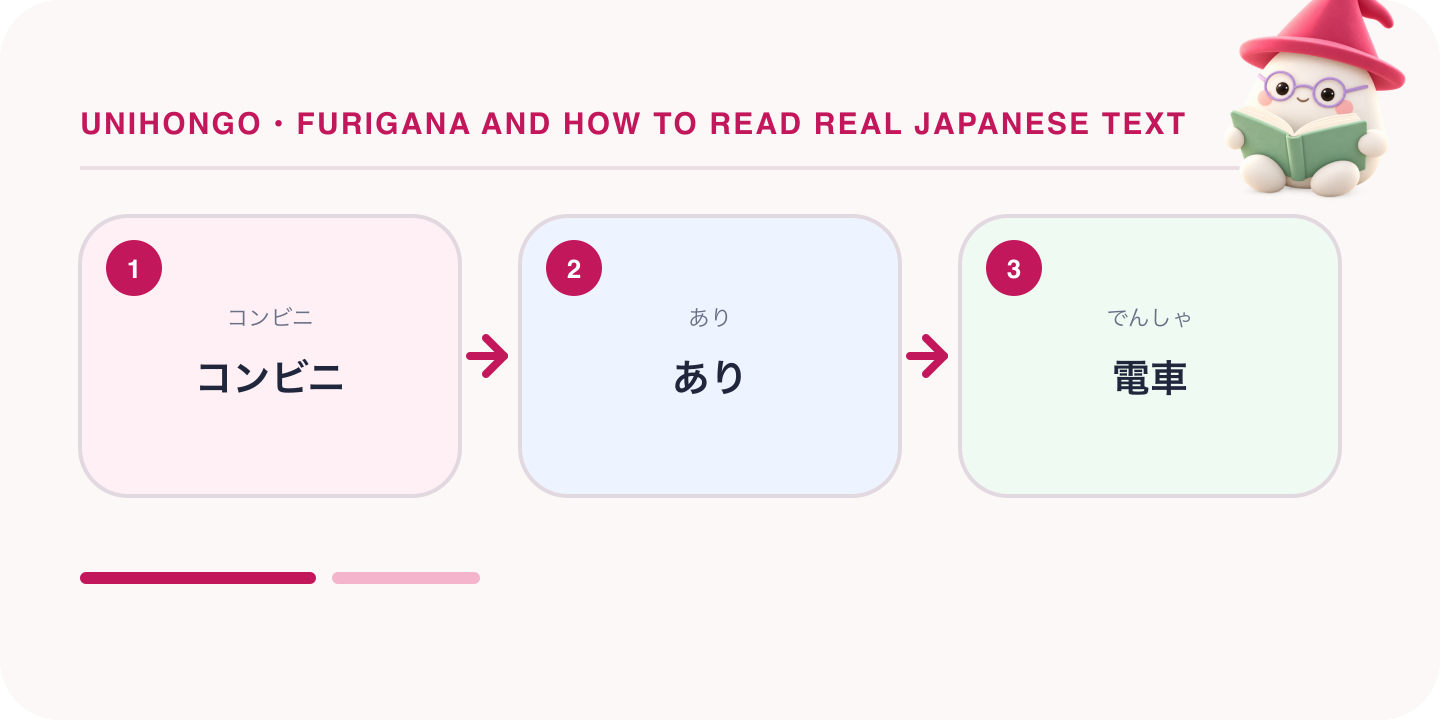
Where furigana appears and where it stops
- Books and textbooks for children, where readings are given for every kanji above the reader's school year.
- Manga aimed at younger readers, which is why manga is often the first long text learners finish.
- News and graded readers written for learners, and NHK's easy-language articles for a general audience.
- Names on forms, business cards, and programmes, where a reading is genuinely unpredictable.
- Station signs and public notices, which usually carry romaji or kana for place names rather than for ordinary words.
Almost everywhere else, there is nothing. Restaurant menus, contracts, city hall forms, product packaging, workplace email, and adult novels print kanji plain. A learner who reads only glossed material can spend a year feeling fluent on the page and then stall completely at a supermarket shelf, because the reading was always being done for them.
One sentence at three levels of support
| Support level | How the sentence appears | What it trains |
|---|---|---|
| Full furigana | 今日(きょう)は駅前(えきまえ)の郵便局(ゆうびんきょく)で荷物(にもつ)を送(おく)ります。 | Meaning and sound together, with no recall demanded |
| Partial furigana | 今日は駅前の郵便局(ゆうびんきょく)で荷物を送ります。 | Recall for the kanji you know, support only where the word is new |
| No furigana | 今日は駅前の郵便局で荷物を送ります。 | Full recognition, including the reading you must produce aloud |
The sentence means the same thing at every level: today I am sending a parcel at the post office in front of the station. Kyō wa ekimae no yūbinkyoku de nimotsu o okurimasu. What changes is how much work your memory does. Read the third row first, out loud. Where you hesitate, look up to the second row, and only if that fails, to the first. Working downward instead of upward is the habit that turns reading practice into kanji practice.
Why leaning on furigana stalls recognition
Your eye is fast and lazy. If a kana reading sits directly above a kanji, you will read the kana, because it is instantly decodable and the kanji is not. The kanji becomes decoration you skim past. After twenty pages you have read a great deal of Japanese and recognised almost no characters, which is why some learners can enjoy a whole glossed novel and still not read 荷物 on a delivery slip.
The fix is small and slightly uncomfortable. Cover the gloss with a finger, a card, or a strip of paper, and commit to a reading out loud before you uncover it. A wrong guess is worth more than a smooth read: the moment of being corrected is what fixes the reading in memory. Use furigana as a marking scheme for a test you have already sat, not as a subtitle track.
Reading a real page in chunks
Unglossed Japanese looks like an unbroken wall because there are no spaces between words. Particles are your spaces. Hiragana such as は, が, を, に, で, and の almost always close a chunk, so scanning for them breaks the wall into pieces before you understand any of them. Mark the particles first, then read each chunk as a unit, then join them. The particles guide has the full map; here you are using them purely as visual punctuation.
This also tells you where the kanji clusters are. A run of two or three kanji between two hiragana is almost certainly one word, and treating it as one word stops you looking up characters individually. In 駅前のコンビニ, the eye should take 駅前 as a single item meaning the area in front of the station rather than as two separate lookups.
| Japanese | Romaji | Meaning |
|---|---|---|
| 駅の前にコンビニがあります。 | Eki no mae ni konbini ga arimasu. | There is a convenience store in front of the station. |
| この電車は東京駅に止まりません。 | Kono densha wa Tōkyō-eki ni tomarimasen. | This train does not stop at Tokyo Station. |
| 受付で名前を書いてください。 | Uketsuke de namae o kaite kudasai. | Please write your name at reception. |
| 二階のトイレは使えません。 | Ni-kai no toire wa tsukaemasen. | The toilet on the second floor cannot be used. |
| 雨の日は営業時間が短くなります。 | Ame no hi wa eigyō jikan ga mijikaku narimasu. | On rainy days the opening hours are shorter. |
| この道をまっすぐ行くと右側にあります。 | Kono michi o massugu iku to migigawa ni arimasu. | Go straight along this road and it is on the right. |
| 入口は建物の裏側です。 | Iriguchi wa tatemono no uragawa desu. | The entrance is at the back of the building. |
Let the grammar tail tell you the shape
Japanese puts the decisive information at the end. Whether something happened, did not happen, must happen, or is merely permitted is settled by the kana tail after the final kanji. Reading that tail before you work through the middle of the sentence gives you a frame to hang the details on, and it stops the common error of understanding every word and still getting the sentence backwards.
Train this by reading the last few kana of a long sentence first. If it ends in ませんでした, you already know it is a negative past statement before you know what did not happen. If it ends in なければなりません, you know an obligation is coming. Then read from the start and fit the pieces into a shape you have already identified.
| Japanese | Romaji | Meaning |
|---|---|---|
| 先に切符を買わなければなりません。 | Saki ni kippu o kawanakereba narimasen. | You have to buy a ticket first. |
| ここで写真を撮ってもいいですか? | Koko de shashin o totte mo ii desu ka? | May I take photos here? |
| 富士山に登ったことがあります。 | Fujisan ni nobotta koto ga arimasu. | I have climbed Mount Fuji. |
| 昨日は郵便局に行きませんでした。 | Kinō wa yūbinkyoku ni ikimasen deshita. | I did not go to the post office yesterday. |
| 今、荷物を送っています。 | Ima, nimotsu o okutte imasu. | I am sending a parcel now. |
Guess the compound before you look it up
Most unfamiliar words on a real page are compounds built from characters you already know, and the meaning is usually the sum of the parts with a small twist. Before reaching for a dictionary, say what each character means and propose a meaning. You will be right often enough to keep reading, and even a wrong guess makes the correct answer stick, because you now have a hypothesis to correct rather than a blank to fill.
| Japanese | Romaji | Meaning |
|---|---|---|
| 郵便局 | Yūbinkyoku | Post office, from mail plus bureau |
| 非常口 | Hijōguchi | Emergency exit, literally the not-ordinary exit |
| 入場券 | Nyūjōken | Admission ticket, from enter plus place plus ticket |
| 自動販売機 | Jidōhanbaiki | Vending machine, a self-moving selling machine |
| 案内所 | Annaijo | Information desk, a guidance place |
| 両替 | Ryōgae | Money changing, from both plus exchange |
| 改札口 | Kaisatsuguchi | Ticket gate, from ticket inspection plus opening |
| 持ち帰り | Mochikaeri | Takeaway, literally carrying and returning home |
Notice that the reading often follows the on-yomi pattern in compounds of two or more kanji, while a kanji standing alone with a kana ending usually takes the kun-yomi. That is not a law, but it is a strong enough tendency to guide a first guess: 送る is okuru on its own, while 送信 is sōshin. Guessing along that line will not always give you the right sound, and it will very often give you the right meaning.
Names are the honest exception
There is no reliable way to read an unfamiliar Japanese name. Family names and given names use readings fixed by family history and region rather than by rule, so the same two characters can be a city and a surname with different sounds. This is not a gap in your study, and native speakers face it too, which is why application forms have a separate line for the reading in kana and why furigana survives on business cards and nameplates.
The practical response is to ask, politely and immediately, rather than to guess and mispronounce someone's name for a year. Asking on first meeting is completely normal and is not treated as ignorance. The same applies to unusual place names on a timetable: ask the station attendant, or check the romaji that most signs carry underneath the kanji.
| Japanese | Romaji | Meaning |
|---|---|---|
| すみません、この漢字は何と読みますか? | Sumimasen, kono kanji wa nan to yomimasu ka? | Excuse me, how do you read this kanji? |
| お名前は何とお読みすればいいですか? | Onamae wa nan to oyomi sureba ii desu ka? | How should I read your name? |
| 名前の読み方を教えていただけますか? | Namae no yomikata o oshiete itadakemasu ka? | Could you tell me how your name is read? |
| 東海林 | Shōji | A surname read Shōji, which the characters do not suggest |
| 日暮里 | Nippori | A Tokyo station name with a fixed, unguessable reading |
| 御茶ノ水 | Ochanomizu | Another Tokyo station name you simply learn |
| 神戸 | Kōbe | The city; the same characters are the surname Kanbe |
| 一 | Hajime | A given name written with the character for one |
Okurigana changes the reading
| Kanji | One kana ending | Another kana ending |
|---|---|---|
| 生 | 生きる ikiru (to live) | 生まれる umareru (to be born) |
| 上 | 上がる agaru (to go up) | 上げる ageru (to raise something) |
| 下 | 下がる sagaru (to go down) | 下りる oriru (to get off, to descend) |
| 細 | 細い hosoi (thin, narrow) | 細かい komakai (fine, detailed) |
| 変 | 変わる kawaru (it changes) | 変える kaeru (to change it) |
| 話 | 話す hanasu (to speak) | 話し合う hanashiau (to talk something over) |
Okurigana is the kana tail written after a kanji, and it does two jobs at once. It carries the conjugation, and it tells you which of the character's readings is intended. This is why you cannot learn a kanji as a single sound: 生 alone is not a word you can pronounce until the kana beside it decides between ikiru, umareru, nama, and the sōshin-style on-yomi found in compounds such as 学生.
It also explains a pair of errors that look like carelessness. Reading 変わる as kaeru and 変える as kawaru swaps something that happens for something you do, and the listener hears a different claim. Learn the verb with its ending attached, exactly as you would learn a verb with its particle, and the reading and the grammar arrive together.
A progression from supported text to plain text
| Japanese | Romaji | Meaning |
|---|---|---|
| この漢字の読み方が分かりません。 | Kono kanji no yomikata ga wakarimasen. | I do not know how to read this kanji. |
| 意味は分かりますが、読めません。 | Imi wa wakarimasu ga, yomemasen. | I understand the meaning, but I cannot read it aloud. |
| もう一度、ゆっくり読んでみます。 | Mō ichido, yukkuri yonde mimasu. | I will try reading it slowly one more time. |
- Start with fully glossed material and read every line aloud, covering the kana and guessing first.
- Move to the same text a day later with a card over the whole furigana column, marking the words that failed.
- Switch to partially glossed material such as learner news, where only uncommon words are supported.
- Take one plain-text item a day that you would meet anyway: a receipt, a poster, a product label, a short notice.
- Reread one plain page you struggled with a week earlier, and note how many stops have disappeared on their own.
- Keep glossed material for enjoyment and volume; keep unglossed material for training. Both have a place.