
The kanji for patience at a glance
Japanese does not have one patience word; it has a small family. The four cards below show the words you will meet most: the formal noun 忍耐, everyday 我慢, long-haul 辛抱 and the verb 耐える. Learn the feeling of each and you will rarely pick the wrong one.
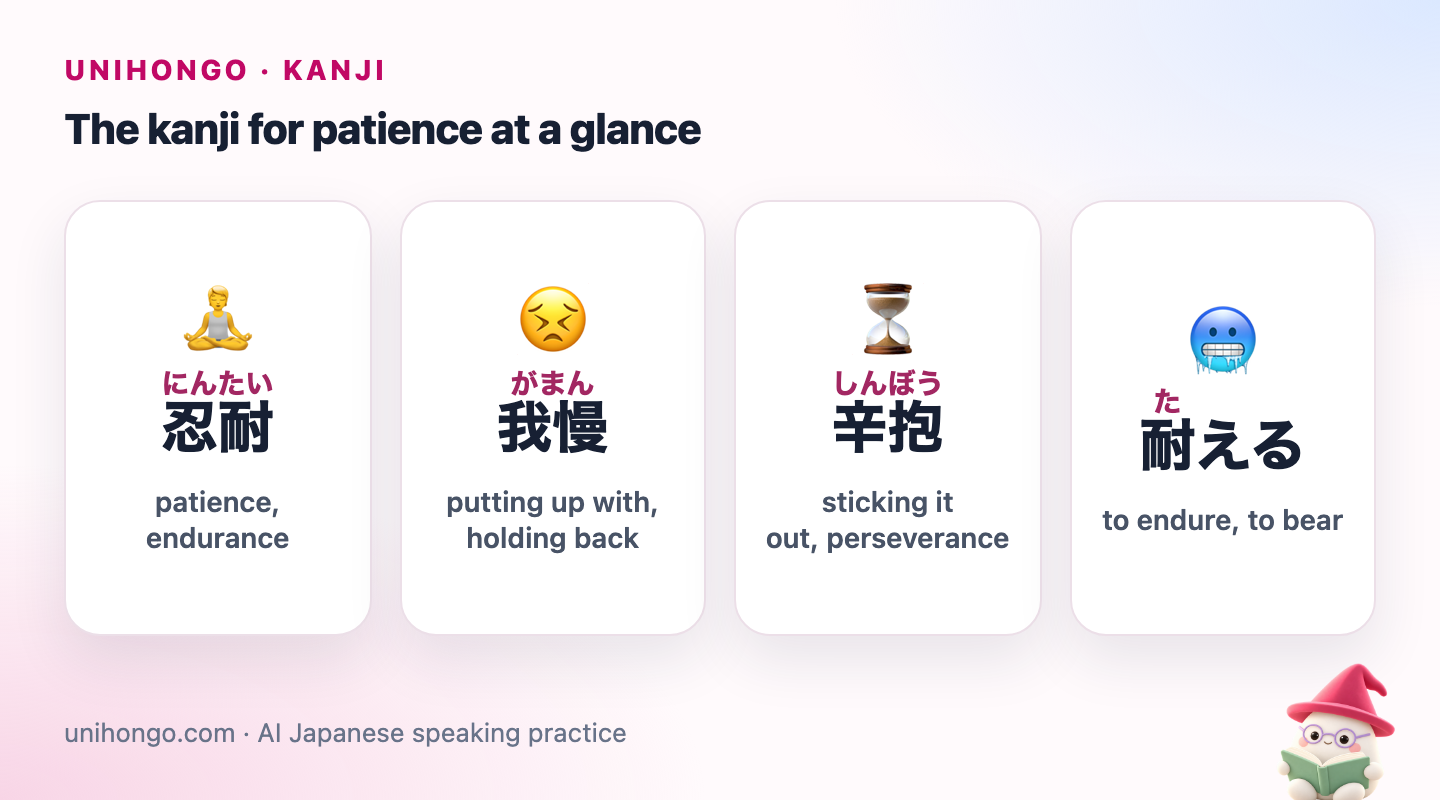
| Japanese | Romaji | Meaning |
|---|---|---|
| 忍耐 | nintai | patience, endurance |
| 我慢 | gaman | putting up with, holding back |
| 辛抱 | shinbō | sticking it out, perseverance |
| 耐える | taeru | to endure, to bear |
Readings, strokes and parts
| Kanji | Strokes | On'yomi | Kun'yomi | Core meaning |
|---|---|---|---|---|
| 忍 | 7 | nin | shinobu, shinobaseru | endure, conceal, stealth |
| 耐 | 9 | tai | taeru | endure, resist, -proof |
| 辛 | 7 | shin | karai, tsurai | spicy, painful, hard |
| 抱 | 8 | hō | daku, idaku, kakaeru | hold, embrace, carry |
忍 has seven strokes: 刃 (yaiba, blade) on top and 心 (heart) below. It is often explained as keeping a blade over your heart without flinching, which makes a memorable image; treat it as a memory aid rather than a settled origin.
耐 has nine strokes: 而 on the left and 寸 on the right. As a suffix it means -proof or -resistant, as in 耐震 (earthquake-resistant) and 耐熱 (heat-resistant), words you see on buildings and kitchenware.
辛抱 combines 辛 (painful, also spicy, as in 辛い karai) and 抱 (to hold). Holding something painful is a fair picture of perseverance.
Everyday words, a proverb and a name
| Japanese | Romaji | Meaning |
|---|---|---|
| 忍者 | ninja | ninja |
| 忍耐力 | nintairyoku | endurance, staying power |
| 忍ぶ | shinobu | to endure; to do secretly |
| 忍び足 | shinobiashi | stealthy steps, tiptoeing |
| 耐久 | taikyū | durability |
| 耐震 | taishin | earthquake-resistant |
| 我慢強い | gamanzuyoi | patient, able to endure |
| 辛抱強い | shinbōzuyoi | patient, persevering |
| 根気 | konki | patience, persistence |
| 気長に | kinaga ni | patiently, without hurrying |
| 堪忍 | kannin | forbearance, forgiveness |
| 残忍 | zannin | cruel, brutal |
| 石の上にも三年 | ishi no ue ni mo sannen | perseverance pays off (proverb) |
| 忍 | Shinobu | endurance · unisex |
The last word is a surprise: in 残忍 (cruel), 忍 has its old sense of hard-hearted. It is a good reminder that one kanji can lean in different directions inside different words. 堪忍 is mostly heard in the Kansai phrase 堪忍して, forgive me, which sounds soft and a little old-fashioned.
The best-known proverb about patience is 石の上にも三年: sit on a cold stone for three years and even it grows warm. It means perseverance pays off, and teachers and bosses often say it to newcomers. Shinobu (忍) is a given name used for both girls and boys, and like most names it can also be written with other kanji.
Which patience word fits
| Japanese | Romaji | Meaning |
|---|---|---|
| 痛いけど我慢します。 | Itai kedo gaman shimasu. | It hurts, but I'll put up with it. |
| もう少しの辛抱だよ。 | Mō sukoshi no shinbō da yo. | Hang in there a little longer. (casual) |
| 寒さに耐えて頑張った。 | Samusa ni taete ganbatta. | I endured the cold and kept going. |
| 気長に待ちましょう。 | Kinaga ni machimashō. | Let's wait patiently. |
| 我慢しすぎないでね。 | Gaman shisuginaide ne. | Don't hold it all in. (caring, casual) |
| Word | Feeling | Typical situation | Register |
|---|---|---|---|
| 忍耐 | Endurance as a virtue | Speeches, essays, sports interviews | Formal, written |
| 我慢 | Holding back, putting up with | Pain, hunger, a noisy room, wanting a sweet | Everyday |
| 辛抱 | Sticking it out over time | A hard job, training, an apprenticeship | Everyday, slightly old-fashioned |
| 耐える | Bearing hardship | Pain, cold, sadness, pressure | Neutral |
| 気長に待つ | Waiting calmly | A delivery, a reply, a long process | Everyday |
我慢 is often discussed as a cultural value in Japan, and you will hear parents tell children to 我慢して. But people also worry about too much of it: 我慢しすぎないで and 無理しないで are kind things to say to a tired friend or coworker. How much 我慢 is admired varies a lot by family, workplace and generation.
Telling someone to be patient
English be patient does not translate directly. 忍耐してください sounds like a stiff order from a textbook. Japanese asks for patience by asking for time, or by saying don't rush.
| Japanese | Romaji | Meaning |
|---|---|---|
| もう少し待ってください。 | Mō sukoshi matte kudasai. | Please wait a little longer. (polite) |
| 焦らなくていいよ。 | Aseranakute ii yo. | No need to rush. (casual) |
| お待たせしてすみません。 | Omatase shite sumimasen. | Sorry to keep you waiting. |
| ご理解のほどよろしくお願いいたします。 | Go-rikai no hodo yoroshiku onegai itashimasu. | Thank you for your understanding. (very formal) |
The last line is the polite formula on notices and in emails when a company asks customers to be patient with a delay. It is useful to recognise, even if you rarely say it yourself.
Mini dialogue: learning the potter's wheel
Patience words often come up when you learn a craft. Here a learner at a pottery class talks with the teacher after another lopsided bowl.
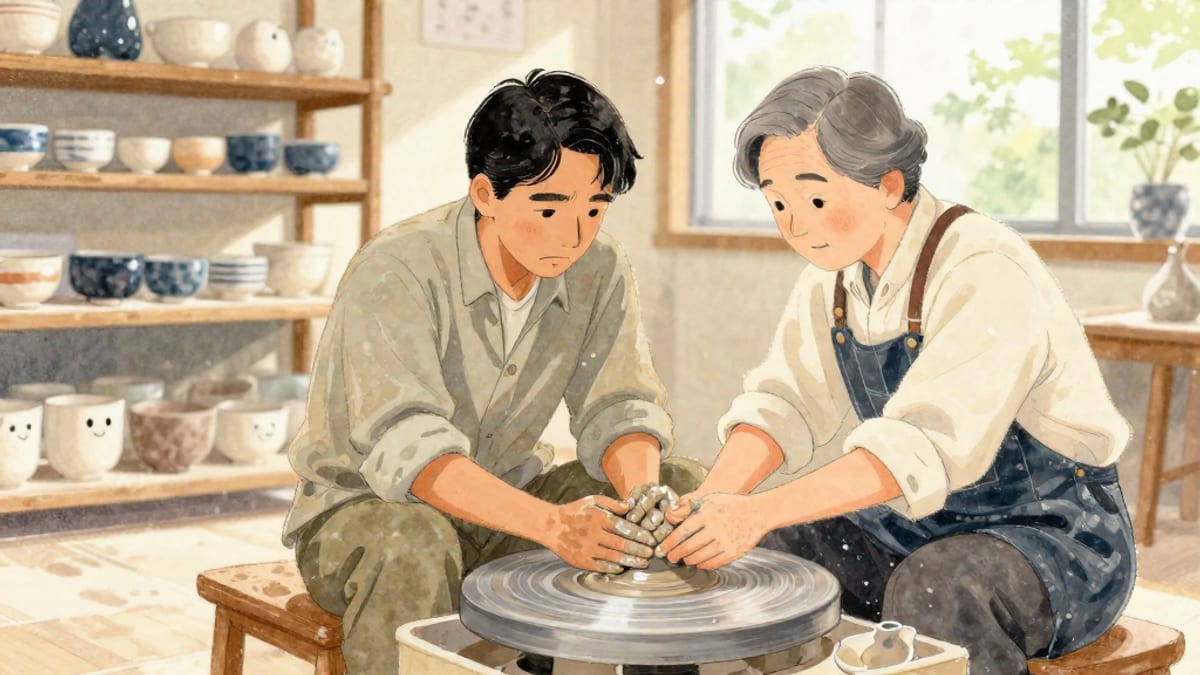
| Japanese | Romaji | Meaning |
|---|---|---|
| また失敗しちゃいました。 | Mata shippai shichaimashita. | You: I messed it up again. |
| 大丈夫。最初はみんなそうですよ。 | Daijōbu. Saisho wa minna sō desu yo. | Teacher: It's fine. Everyone is like that at first. |
| 上手になるまで時間がかかりますね。 | Jōzu ni naru made jikan ga kakarimasu ne. | You: It takes a long time to get good. |
| 石の上にも三年ですよ。気長にいきましょう。 | Ishi no ue ni mo sannen desu yo. Kinaga ni ikimashō. | Teacher: Perseverance pays off. Let's take it slowly. |
| はい、辛抱します。 | Hai, shinbō shimasu. | You: Okay, I'll stick with it. |
The teacher's reply follows a common pattern: reassure first (大丈夫), say the struggle is normal (最初はみんなそう), then offer the proverb and a gentle push. If a Japanese friend is struggling, you can borrow the same steps and end with 気長にいこう or 焦らなくていいよ.
忍 as a tattoo or design
忍 is popular in tattoo catalogues as patience or endurance. To many Japanese readers, though, 忍 on its own points first to ninja, so the message can read as a love of ninja rather than a personal virtue. That is not wrong, just worth knowing.
If you want patience, 忍耐 is clear and serious. 辛抱 is warm and down to earth, and 石の上にも三年 works as a phrase if you like proverbs. In Chinese, 忍 and 忍耐 carry a similar meaning, so the main difference is the ninja association in Japan. Ask a native speaker to check the characters and the design before inking.
Practise patience words with Mocchi, a little at a time
Fittingly, these words stick best with short, repeated practice. Ask Mocchi: Give me four everyday situations and let me choose gaman, shinbō, nintai or taeru for each. Mocchi explains each answer, notes the ones you get wrong, and works them into your next /review without you having to ask.
When the words feel familiar, put them on flashcards with /create-flashcards and play them in Mocchi Flight, guiding Mocchi through the gate with the right word.
Common mistakes and how to write 忍
- Saying 忍耐してください to ask someone to wait. Say もう少し待ってください.
- Using 我慢 for a long career. For years of effort, 辛抱 or 続ける fits better.
- Reading 残忍 as patient. It means cruel.
- Writing 刀 instead of 刃 at the top of 忍; the small extra stroke matters.
- Confusing 忍 with 認 (as in 認める, to admit). 認 is 言 plus 忍, so check for 言 on the left.