
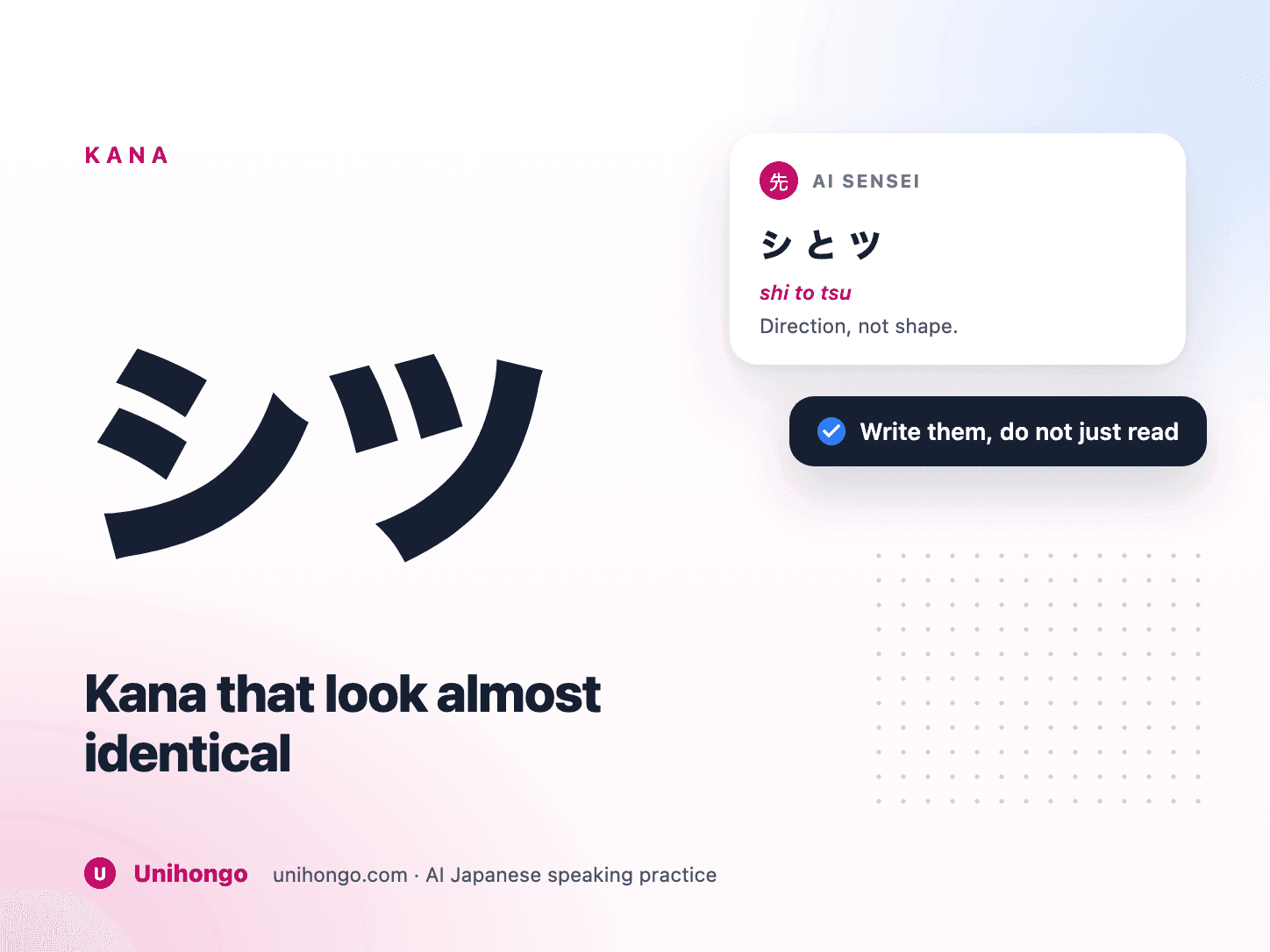
The katakana four
These four characters cause more confusion than the rest of the script combined. All are built from short strokes meeting a longer sweeping one, and in print the shapes are genuinely close.
What separates them is direction. Two are written with the short strokes entering from the side and the long stroke sweeping upward from the bottom; two have the short strokes entering from above and the long stroke sweeping downward. Once you write them, the difference becomes structural rather than visual.
| Japanese | Romaji | Meaning |
|---|---|---|
| シ | shi | Short strokes from the side, long stroke sweeps up |
| ツ | tsu | Short strokes from above, long stroke sweeps down |
| ソ | so | One short stroke from above, long stroke sweeps down |
| ン | n | One short stroke from the side, long stroke sweeps up |
| シャツ | shatsu | Shirt: both of the confusable pair |
| ソング | songu | Song: so and n in one word |
Hiragana pairs
The hiragana confusions are milder because the characters are rounder and more distinct, but a handful still catch everyone. Each differs by a single loop, stroke or its direction.
The best defence is to learn each pair together from the start. Learning one and meeting its partner three weeks later is what produces the lasting confusion.
| Pair | What differs |
|---|---|
| ぬ / め | One has a loop at the end |
| さ / ち | Mirrored, and the stroke count differs |
| は / ほ | One has an extra horizontal stroke |
| ね / れ / わ | The final stroke curls differently |
| る / ろ | One ends in a loop |
| き / さ | Stroke count and the top strokes |
Three of these six differ only in whether a stroke closes into a loop. Writing them is what makes that permanent.
Why writing fixes what reading cannot
Recognition and production are different, and for look-alike characters the production side is what disambiguates them. When you write, you have to commit to a stroke direction, and that commitment encodes the difference far more strongly than looking at the shape.
This is why learners who only ever tap kana on a screen keep confusing these pairs long after they can read most text, and why a week of handwriting resolves it.
- Write each pair alternately, ten times, saying the sound aloud.
- Follow the correct stroke order; it is what makes the pairs differ.
- Write on paper rather than tracing on a screen.
- Do the four katakana separately from the hiragana pairs.
- Repeat for a week, then stop; this does not need months.
Using context to disambiguate
In real text you rarely have to identify a character in isolation, because the surrounding word makes only one reading possible. Learning to use that is faster than perfecting the visual discrimination.
Loanwords help most, since many are from English and the intended word becomes obvious once one or two characters are read.
| Japanese | Romaji | Meaning |
|---|---|---|
| シャツ | shatsu | Shirt |
| ツアー | tsuā | Tour |
| ソース | sōsu | Sauce |
| レストラン | resutoran | Restaurant |
| コンビニ | konbini | Convenience store |
| ワイシャツ | waishatsu | Dress shirt |
If a word is nearly recognisable, the ambiguous character is almost always the one that completes it. Guessing from context is a legitimate reading skill, not cheating.
The pairs across the two scripts
A separate confusion is between hiragana and katakana characters that resemble each other, which catches learners who studied the two scripts weeks apart.
These are worth a short pass once both scripts are known, since they are few.
| Hiragana | Katakana | Note |
|---|---|---|
| か | カ | Katakana drops a stroke |
| せ | セ | Katakana is simpler |
| り | リ | Katakana strokes stay separate |
| や | ヤ | Similar overall shape |
| へ | ヘ | Nearly identical |
| も | モ | Similar, different stroke count |
The last two are effectively identical in some fonts. Context and the surrounding script decide which one it is.
Making it permanent
This is a short problem, not a long one. A week of paired writing practice plus regular reading resolves it for almost everyone, and there is no need to keep drilling once real text has become readable.
Rapid discrimination is what the kana games on Unihongo's alphabet page are built for: seeing a character and identifying it under time pressure, which is a different exercise from recognising it at leisure.
After that, read. Menus, signs, packaging and subtitles all supply the context that makes these pairs resolve themselves, and reading is what turns recognition into speed.
If you still confuse a pair after a month of reading, write that specific pair for a week. It will be one or two, not the whole set.