
Darkness, dark, shadow: 闇, 暗い and 影 at a glance
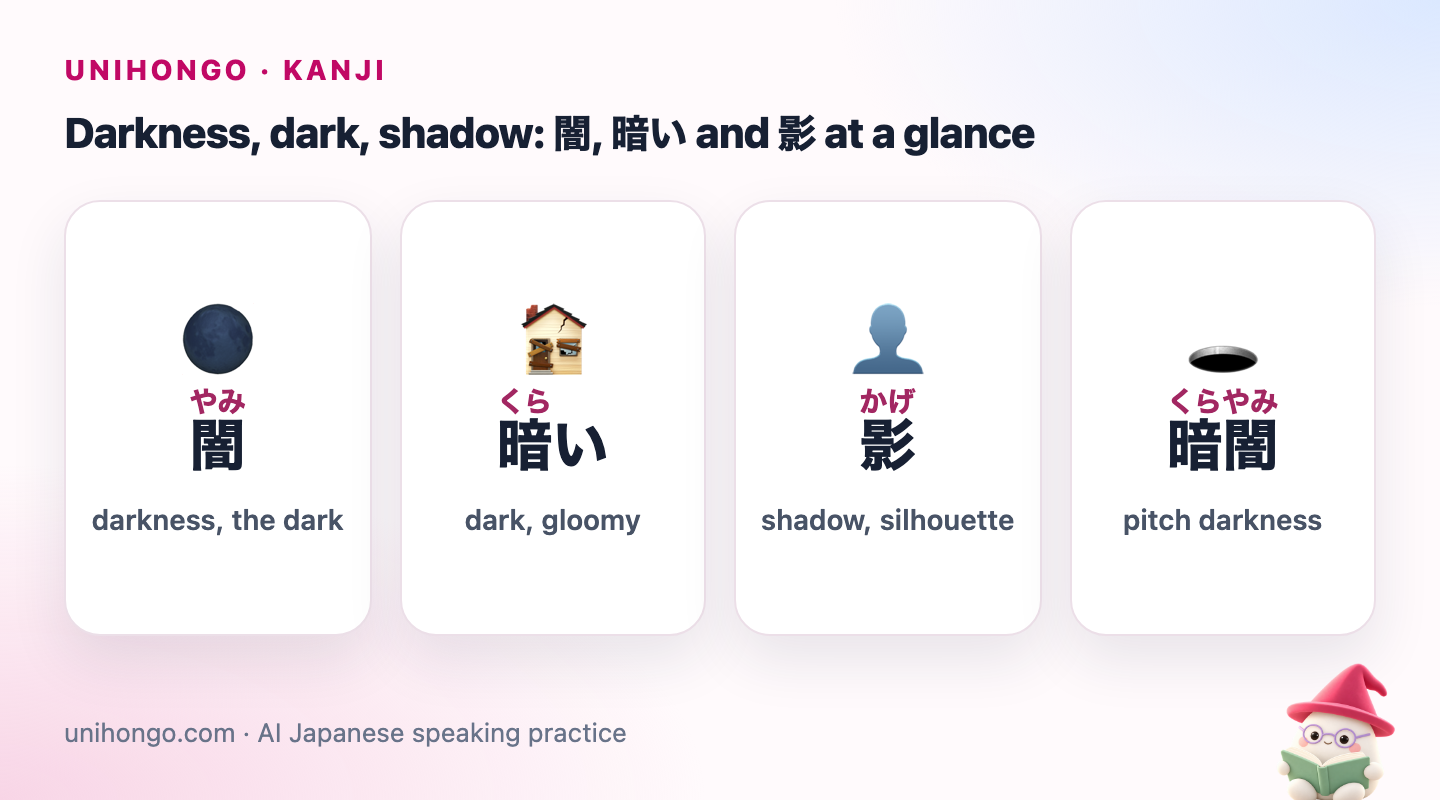
The quickest way to keep these apart is by grammar. 闇 is a noun: the darkness. 暗い is an adjective: something is dark. 影 is a noun for a shadow that has a shape. 暗闇 joins the first two into the strongest everyday word for pitch darkness.
If you are describing a room, a street or the sky, reach for 暗い. If you are writing a story or a song, or talking about a hidden side of something, 闇 gives you the depth. If you can see an outline, it is 影.
| Japanese | Romaji | Meaning |
|---|---|---|
| 闇 | yami | darkness, the dark |
| 暗い | kurai | dark, gloomy |
| 影 | kage | shadow, silhouette |
| 暗闇 | kurayami | pitch darkness |
Readings, stroke counts and parts
| Kanji | Strokes | On'yomi | Kun'yomi | Core meaning |
|---|---|---|---|---|
| 闇 | 17 | an (rare) | yami | darkness, the hidden side |
| 暗 | 13 | an | kurai | dark, gloomy, hidden, by heart |
| 影 | 15 | ei | kage | shadow, silhouette, image |
| 陰 | 11 | in | kage, kageru | shade, the hidden or back side |
闇 is a gate, 門, with 音 (sound) inside. 暗 is the sun, 日, beside the same 音. In both kanji, 音 is usually explained as the part that gives the sound an. A handy memory picture: a closed gate with only sound inside is 闇, and a sun with only sound beside it, no light, is 暗.
影 combines 景 (scenery, view) with 彡, three slanting strokes often described as rays or patterns. 陰 has the hill radical 阝 on the left, the shady side of a hill. You do not need full origin stories to use them; the parts are enough to tell them apart.
闇 is almost always read yami. 暗 is read kurai in the adjective and an in compounds. 影 is kage alone and ei in compounds such as 影響 (eikyō, influence).
Everyday words with 闇 and 暗
Words with 闇 tend to be atmospheric or about something hidden. Words with 暗 are more everyday, and several of them have nothing to do with light: 暗 also means hidden or by heart.
| Japanese | Romaji | Meaning |
|---|---|---|
| 夕闇 | yūyami | dusk, evening gloom |
| 闇夜 | yamiyo | a moonless night |
| 心の闇 | kokoro no yami | the dark side of a heart |
| 闇バイト | yami baito | illegal job offers posted online |
| 真っ暗 | makkura | completely dark |
| 暗記 | anki | memorising, learning by heart |
| 暗証番号 | anshō bangō | PIN number |
| 暗号 | angō | code, cipher |
| 明暗 | meian | light and dark; success or failure |
闇バイト is a word every resident of Japan should recognise. It describes job offers on social media that promise easy money and turn out to be criminal work, and the police warn about it often. If an offer looks like this, walk away.
暗記 is the word you will use most as a learner: 単語を暗記する, to memorise vocabulary. The kanji idea is holding something in the dark, inside your head, without looking.
Shadow words with 影 and shade words with 陰
Here the difference really matters. 影 is a shadow with a shape, something cast by an object or a person; by extension it also means a figure, an image or influence. 陰 is the shaded place itself, the back or hidden side.
| Japanese | Romaji | Meaning |
|---|---|---|
| 人影 | hitokage | a figure, the shape of a person |
| 影響 | eikyō | influence, effect |
| 撮影 | satsuei | filming, photo shoot |
| 面影 | omokage | a trace of how someone looked |
| 影が薄い | kage ga usui | easy to overlook, low profile |
| 木陰で休もう。 | Kokage de yasumō. | Let's rest in the shade of the trees. (casual) |
| 陰口を言わないで。 | Kageguchi o iwanaide. | Don't talk behind people's backs. |
| お陰様で元気です。 | Okagesama de genki desu. | I'm well, thank you. (modest, polite) |
| Kanji | Picture it as | Typical words | Example situation |
|---|---|---|---|
| 影 | A shape cast by light | 人影, 影絵, 影響 | Your shadow on the pavement |
| 陰 | A place light cannot reach | 木陰, 日陰, 陰口 | Resting in the shade of a tree |
A surprise: 影 can also mean light in older and poetic Japanese. 月影 (tsukikage) is moonlight, and 面影 is the lingering image of a face. Think of 影 as anything shaped by light, the bright part or the dark part.
Mini dialogue: a firefly walk after dark
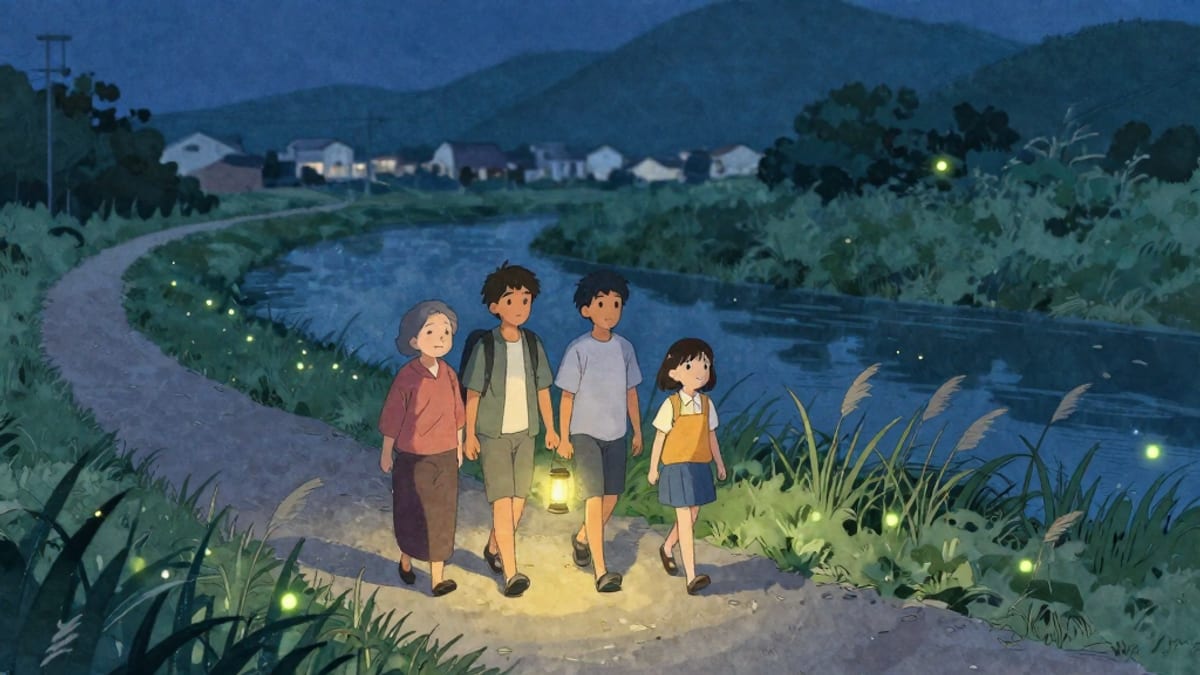
In early summer, many rural areas in Japan have spots where people walk at night to watch fireflies, 蛍 (hotaru). Lights are kept low so the fireflies can be seen, which makes it a perfect moment for darkness words. The speech here is casual, between friends.
| Japanese | Romaji | Meaning |
|---|---|---|
| 思ったより暗いね。 | Omotta yori kurai ne. | You: It's darker than I thought. |
| 蛍を見るから、ライトは下に向けてね。 | Hotaru o miru kara, raito wa shita ni mukete ne. | Friend: Point your light down, we're here for the fireflies. |
| あそこに人影が見える。 | Asoko ni hitokage ga mieru. | You: I can see someone over there. |
| 大丈夫、地元の人だよ。あ、光った! | Daijōbu, jimoto no hito da yo. A, hikatta! | Friend: It's fine, just a local. Oh, a glow! |
| 闇の中で光ってて、きれい。 | Yami no naka de hikattete, kirei. | You: Glowing in the dark, so pretty. |
Idioms, slang and names
Several sayings use darkness to talk about the unknown. The most famous one is a reminder that nobody can see the future, used both seriously and as a joke.
| Japanese | Romaji | Meaning |
|---|---|---|
| 一寸先は闇 | issun saki wa yami | nobody knows what lies ahead |
| 闇が深い | yami ga fukai | has a deep dark side (slang) |
| 闇に葬る | yami ni hōmuru | to hush something up |
| 光と影 | hikari to kage | light and shadow |
闇が深い is internet and casual slang for something that hides a troubling side, such as a company's working culture. Do not mix 闇 up with 病み (yami), from the verb 病む, to fall ill, which young people use in slang for feeling mentally low. Same sound, different kanji and meaning.
In names, darkness kanji are rare, because parents choose characters with bright meanings. 影 and 陰 appear in a few family names, and 闇 mostly appears in fiction, games and song lyrics, where it sets a mood.
闇 as a tattoo or design
Think about how 闇 reads before choosing it. To a Japanese reader, 闇 alone suggests deep darkness, the hidden side of things and, through words like 闇バイト and 闇市 (yamiichi, black market), shady or illegal business. In fiction it can look cool, but on skin it may read as gloomy or slightly edgy, a little like the English word darkness on a T-shirt.
Chinese usage differs here. In modern Chinese, darkness is normally written with 暗, and 闇 is rare, while 影 often brings to mind film, as in the Chinese word for movie. So the same design can give a Chinese reader a different impression from a Japanese one.
A pair often works better than a single kanji. 光と影, light and shadow, or 明暗, light and dark, express balance rather than gloom. Whatever you pick, have a native speaker check the exact characters, the stroke shapes and the font before you ink or print it.
Sort the darkness words with Mocchi
Ask Mocchi something you would really wonder about: Why is it 木陰 and not 木影, and is 夕闇 the same as 夕方? Then type /quiz darkness kanji. Mocchi gives you short fill-in-the-blank sentences for 闇, 暗い, 影 and 陰 one at a time, explains each answer and remembers which pair you got wrong, so the next /review starts there.
For word order, open Sentence Builder and put chunks such as 闇の中で, 蛍が and 光っていた in the right order. Building the sentence yourself fixes the particles in place better than reading it.
Common mistakes and how to write 闇
- Writing お影様で. The phrase is お陰様で, with 陰 for shade, the unseen support of others.
- Confusing 闇 with 間 (aida, between) or 聞 (kiku, to hear). All three sit inside the gate 門; 闇 has 音 inside, 間 has 日 and 聞 has 耳.
- Calling someone 暗い人 lightly. It means a gloomy person and can sound unkind; say 静かな人 (a quiet person) if that is what you mean.
- Using 闇 for an ordinary dark room. 部屋が暗い sounds natural; 部屋の闇 sounds like a horror story.
- Reading 暗記 as kuraki. Inside compounds, 暗 is an.