
One dot apart: 犬, 大 and 太
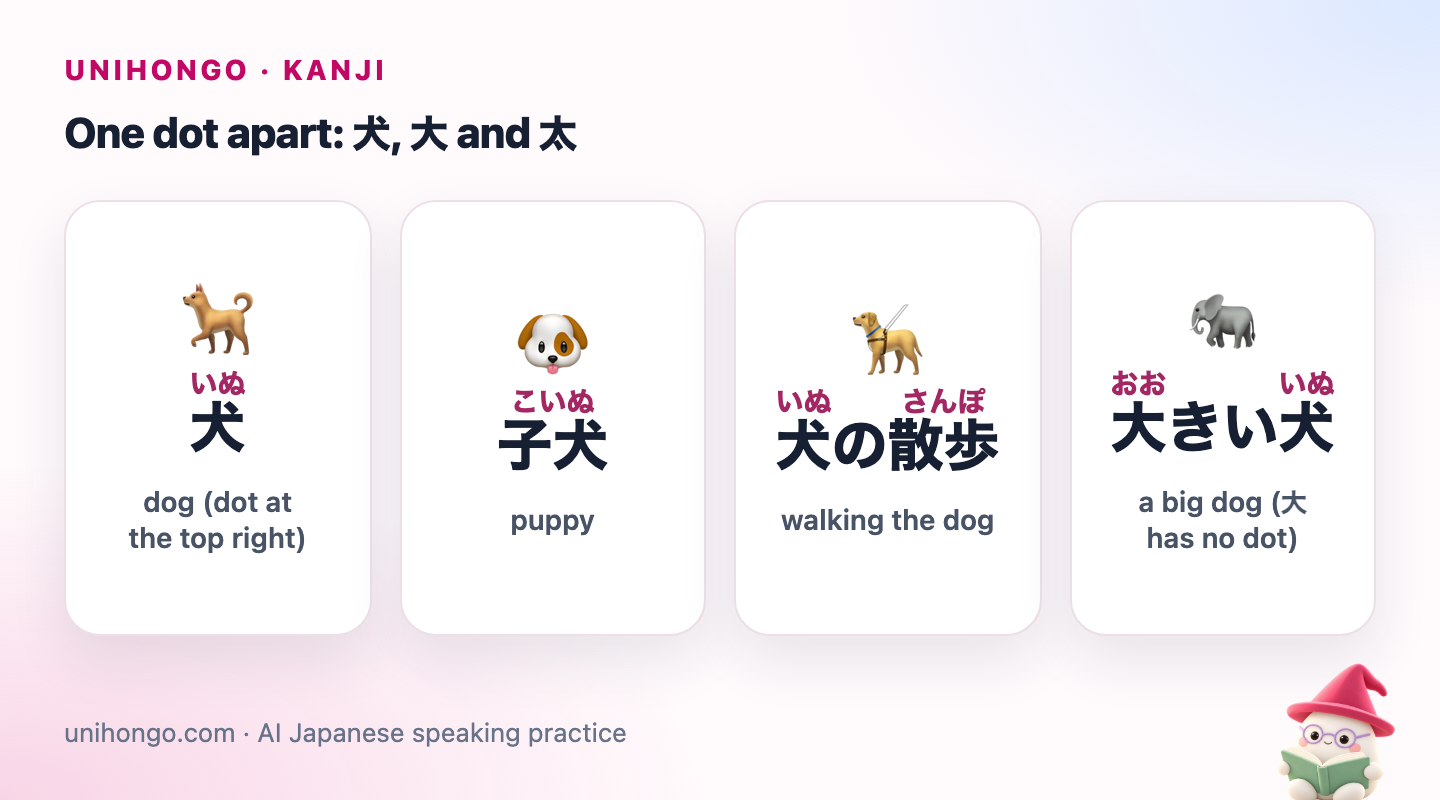
Before any dog vocabulary, get the shape right. 犬, 大 and 太 share the same three strokes and differ only in a dot. 大 is the base: a horizontal and two legs. Add a dot at the top right, outside the figure, and it becomes 犬. Put the dot inside, low between the legs, and it becomes 太. Many teachers tell children the dot on 犬 is the dog's ear. The two adjectives below use the look-alikes, so you can see all three kanji at work in phrases about dogs. If you only remember one thing from this guide, make it the position of that dot.
| Japanese | Romaji | Meaning |
|---|---|---|
| 犬 | inu | dog (dot at the top right) |
| 子犬 | koinu | puppy |
| 犬の散歩 | inu no sanpo | walking the dog |
| 大きい犬 | ōkii inu | a big dog (大 has no dot) |
| 太った犬 | futotta inu | a chubby dog (太 has a dot inside) |
Readings, strokes and the radical 犭
犬 has four strokes and is usually explained as a picture of a dog that became simpler over time. The kun'yomi is inu, the native word. The on'yomi is ken, used in Sino-Japanese compounds. The zodiac character 戌 has six strokes and is read inu as a zodiac sign; its on'yomi, jutsu, is rarely needed.
| Kanji | On'yomi | Kun'yomi | Strokes | Typical use |
|---|---|---|---|---|
| 犬 | ken | inu | 4 | The animal and most dog words |
| 戌 | jutsu | inu | 6 | Zodiac sign, the day of the dog |
| 犭 | - | kemonohen | 3 | Animal radical in 猫, 狐, 狼 |
When 犬 sits on the left side of another kanji, it squeezes into the three-stroke form 犭, called kemonohen, the beast radical. That is why the cat 猫, the fox 狐, the wolf 狼 and the monkey 猿 all carry a small dog on their left. The radical marks a whole family of animal kanji, not only dogs.
Dog vocabulary for owners and dog lovers
Japan has many dog owners, and small dogs are especially common in cities, where apartments are compact. Dog breeds are mostly katakana loanwords, such as トイプードル for a toy poodle, but Japanese breeds keep their kanji. Notice how ken and inu alternate: 柴犬 is usually shiba inu, while 番犬 and 盲導犬 take ken.
| Japanese | Romaji | Meaning |
|---|---|---|
| 愛犬 | aiken | one's beloved dog |
| 柴犬 | shiba inu | Shiba dog |
| 秋田犬 | akita inu | Akita dog |
| 番犬 | banken | guard dog |
| 盲導犬 | mōdōken | guide dog for blind people |
| 野良犬 | norainu | stray dog |
| 犬小屋 | inugoya | doghouse, kennel |
| 犬派 | inuha | a dog person |
| ドッグラン | doggu ran | dog run, an enclosed dog park |
| うちの愛犬は柴犬です。 | Uchi no aiken wa shiba inu desu. | Our dog is a Shiba. |
忠犬, the zodiac 戌 and the day of the dog
忠犬 means a loyal dog. The word is famous because of Hachikō, the Akita who waited at Shibuya Station for his owner for years after the owner died. His statue is a well-known meeting place, and people still call him 忠犬ハチ公. The word also appears about people, half-jokingly, for someone who follows a boss or partner everywhere.
The zodiac dog is 戌, the eleventh sign. 戌の日, the day of the dog in the old twelve-day cycle, has a special meaning: many expectant mothers visit a shrine on a 戌の日 around the fifth month of pregnancy to pray for a safe delivery, because dogs are said to give birth easily. Practices vary by family and region. Some families also give the mother-to-be a special maternity sash on that day, and shrines known for safe-birth prayers can be busy on a 戌の日.
| Japanese | Romaji | Meaning |
|---|---|---|
| 忠犬 | chūken | a loyal dog |
| 忠犬ハチ公 | Chūken Hachikō | Hachikō, the loyal dog of Shibuya |
| 戌年 | inudoshi | the Year of the Dog |
| 戌の日 | inu no hi | the day of the dog, for safe-birth prayers |
| ハチ公の前で待ち合わせしよう。 | Hachikō no mae de machiawase shiyō. | Let's meet in front of Hachikō. (casual) |
Small talk on a dog walk
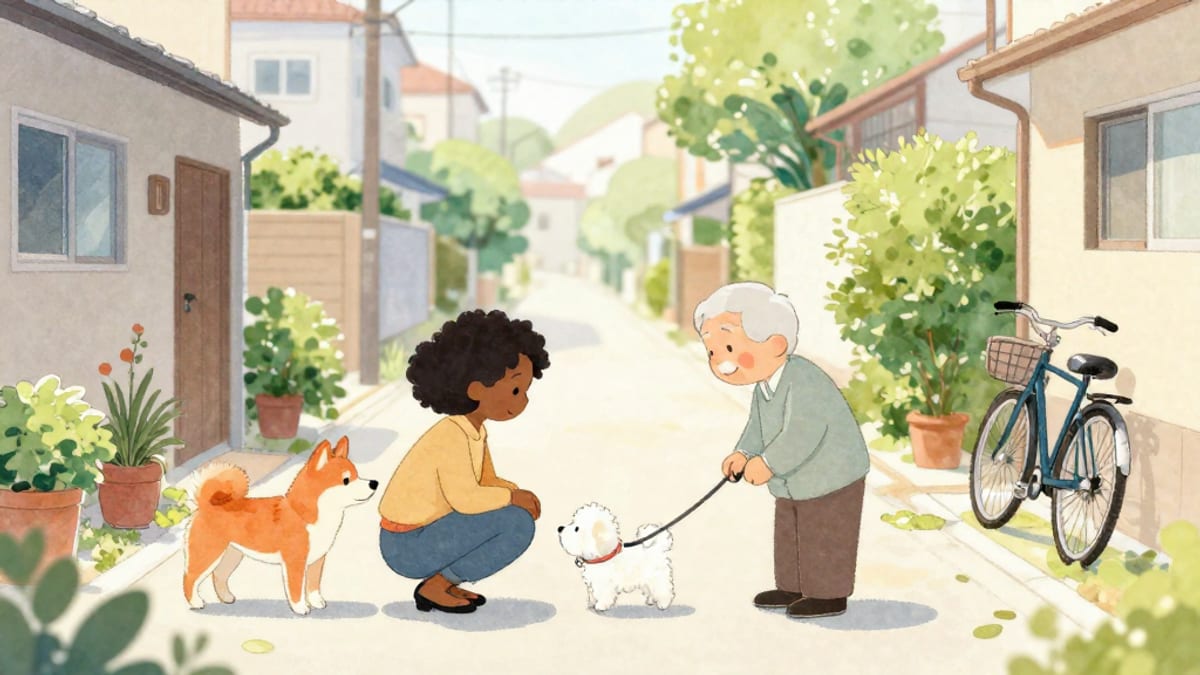
Dog walks are one of the easiest ways to talk with neighbours in Japan. Owners often stop when dogs sniff each other, and the conversation follows a pattern: the name, the age, the breed and a compliment. Ask before touching someone's dog; some dogs are nervous, and owners appreciate the question.
| Japanese | Romaji | Meaning |
|---|---|---|
| かわいいですね。お名前は? | Kawaii desu ne. Onamae wa? | You: How cute. What's his name? |
| コタロウです。三歳です。 | Kotarō desu. Sansai desu. | Neighbour: He's Kotaro. He's three. |
| 触ってもいいですか。 | Sawatte mo ii desu ka. | You: May I pet him? |
| どうぞ。人懐っこいんですよ。 | Dōzo. Hitonatsukkoi n desu yo. | Neighbour: Go ahead. He loves people. |
| うちの子は少し怖がりで。 | Uchi no ko wa sukoshi kowagari de. | You: Mine is a little timid. |
Dog idioms and common mistakes
Real dogs are loved in Japan, but dog idioms are often harsh. 負け犬 is a loser, 犬猿の仲, the relationship of a dog and a monkey, describes two people who cannot stand each other, and calling a person someone's 犬 means a lackey. One cheerful exception is 犬も歩けば棒に当たる, which is used both for running into trouble and for stumbling on luck when you get out and about.
| Japanese | Romaji | Meaning |
|---|---|---|
| 負け犬 | makeinu | a loser, an underdog |
| 犬猿の仲 | ken'en no naka | on terrible terms, like cat and dog |
| 犬も歩けば棒に当たる | Inu mo arukeba bō ni ataru. | Go out and things happen, good or bad. |
| あの二人は犬猿の仲だ。 | Ano futari wa ken'en no naka da. | Those two can't stand each other. |
- Forgetting the dot, or putting it inside. Without it you wrote big; inside, you wrote thick.
- Writing 戌 for a pet dog. 戌 is only the zodiac sign.
- Translating fighting like cat and dog with 猫. Japanese uses a dog and a monkey.
- Calling a person 犬 as a joke. It sounds like an insult: a lackey or a spy.
To write 犬, draw the long horizontal first, then the left-falling stroke that starts above it and sweeps down to the left, then the right-falling stroke from the crossing point. Add the dot last, at the top right, slanting down towards the centre. Writing the dot last, after the body, is what children practise in school.
犬 on a tattoo or design: better words for dog lovers
As a single character, 犬 is simple and readable, and it means dog in both Japanese and Chinese. In Chinese, however, everyday speech uses 狗 for dog, so 犬 can look literary to Chinese readers. In Japanese it looks like an ordinary first-grade kanji, rather like printing DOG in capital letters: honest, but not very poetic.
Words often work better. 愛犬, beloved dog, expresses affection clearly. 忠犬, loyal dog, carries the Hachikō story, though some readers may find it odd on a person. Your own dog's name in katakana is personal and natural, because that is how most pet names are written. Avoid 負け犬 and 犬 alone on clothing meant as a compliment. Show the design to a native speaker before inking.
Practise the dog-walk chat with Mocchi and Haru-sensei
Ask Mocchi: /quiz 犬 大 太, ten quick questions. It shows sentences with a blank and asks which kanji fits, then explains the dot position whenever you slip. Mocchi notes the mix-up so your plan revisits it until it is solid.
Then open AI Sensei on the pets topic, choose Haru-sensei and ask him to be a neighbour walking a shiba. Ask the dog's name and age, compliment it and talk about your own pet. Ask him to speak more slowly if you need it, and read the corrections in the session report.