
夢 at a glance
夢 means dream. It is a common kanji, taught in Japanese schools in the upper years of elementary school, and you will see it everywhere: in song titles, shop names, children's names, school mottos and advertising. Its meaning lines up closely with English. You can have a 夢 while you sleep, and you can have a 夢 for your future.
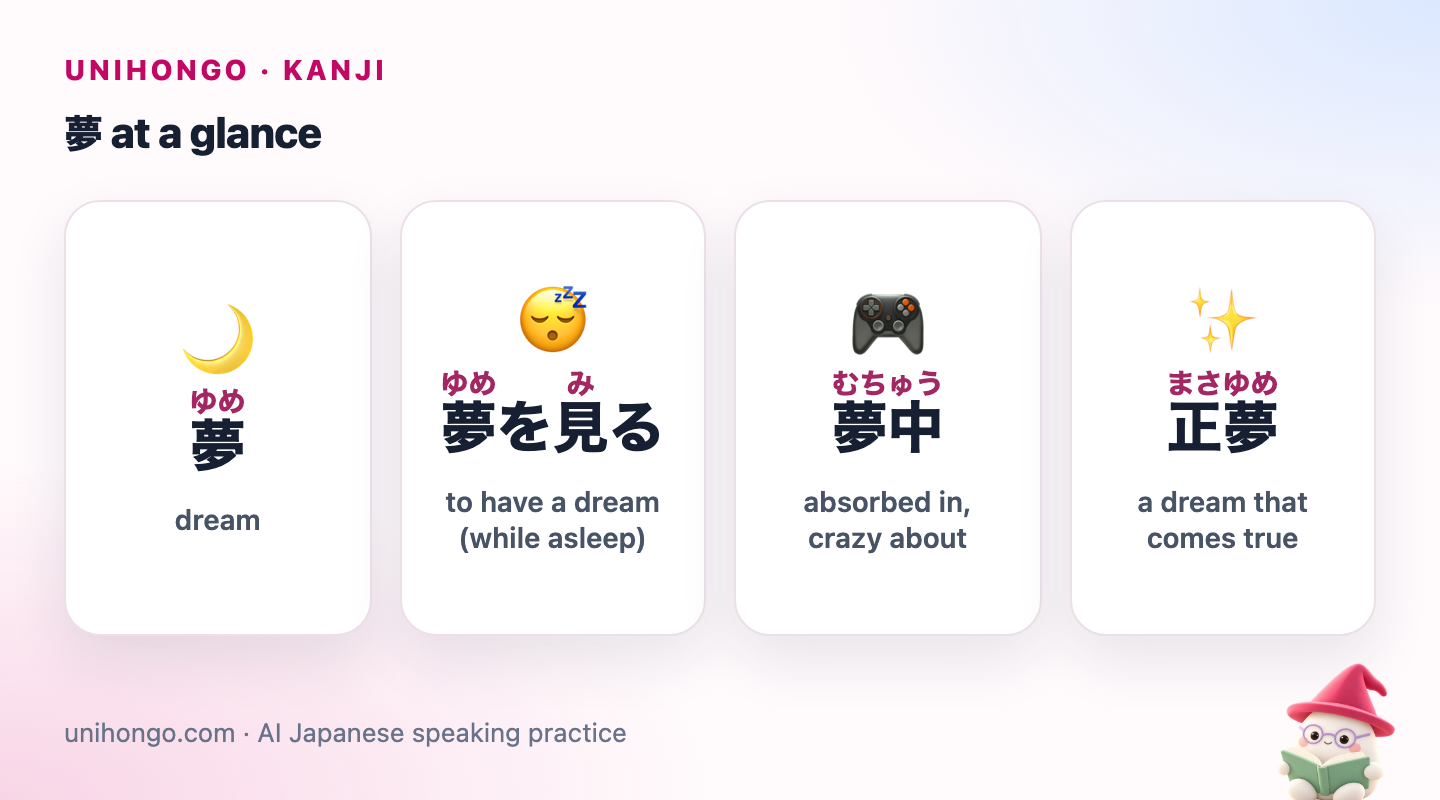
The four cards below show the kanji itself and the three ideas learners need first: dreaming in your sleep, being lost in something, and the lucky dream that comes true.
| Japanese | Romaji | Meaning |
|---|---|---|
| 夢 | yume | dream |
| 夢を見る | yume o miru | to have a dream (while asleep) |
| 夢中 | muchū | absorbed in, crazy about |
| 正夢 | masayume | a dream that comes true |
Notice that the reading changes from card to card. In 夢, 夢を見る and 正夢 you hear the native reading yume, while 夢中 uses the Chinese-derived reading mu. The next section explains the pattern.
Readings, strokes and the parts of 夢
Like most kanji, 夢 has a native Japanese reading (kun'yomi) and a reading borrowed from Chinese (on'yomi). The native reading yume is used when the kanji stands alone or joins native words. The Chinese reading mu appears in compounds built from two or more kanji, which are often more formal or literary.
| Item | Detail | Example |
|---|---|---|
| Kun'yomi (native reading) | yume | 夢 (yume), 初夢 (hatsuyume) |
| On'yomi (Chinese reading) | mu | 夢中 (muchū), 悪夢 (akumu) |
| Stroke count | 13 | Crown 3, eye 5, cover 2, evening 3 |
| Simplified Chinese form | 梦 | Used in mainland China, not in Japan |
The character can be seen as a stack of parts. At the top is a crown that looks like the grass radical 艹. Below it is 罒, a sideways eye. Then comes a short cover, 冖, and at the bottom sits 夕, evening. Scholars discuss the ancient origin in more detail, but the bottom 夕 is a helpful memory hook: an eye under a cover, at night, sees a dream.
Because 夢 is built from parts that appear in other kanji, it is easier to remember if you can name them. When you look at it, read it from top to bottom: crown, eye, cover, evening.
Everyday words with 夢
These are the 夢 words you are most likely to meet in conversation, manga, songs and the news. Each row gives the reading used in that particular word.
| Japanese | Romaji | Meaning |
|---|---|---|
| 子どもがゲームに夢中です。 | Kodomo ga gēmu ni muchū desu. | My kid is absorbed in a video game. |
| ゆうべ、悪夢を見た。 | Yūbe, akumu o mita. | I had a nightmare last night. (casual) |
夢中 is the word learners underuse most. It does not have to do with sleep at all: ゲームに夢中 means completely absorbed in a game, and 彼に夢中 means crazy about him. It is a warm, natural way to say you are hooked on something.
For a daydream in everyday speech, people more often say something like ぼーっとする, to zone out, than 白昼夢, which sounds bookish.
Set phrases: chasing, holding and losing a dream
When 夢 means a life goal, Japanese uses a group of verbs that you can learn as fixed pairs. They work in speeches, interviews, graduation messages and ordinary conversation.
| Japanese | Romaji | Meaning |
|---|---|---|
| 夢を叶える | yume o kanaeru | to make a dream come true |
| 夢が叶う | yume ga kanau | a dream comes true |
| 夢を追う | yume o ou | to chase a dream |
| 夢を諦める | yume o akirameru | to give up on a dream |
| 夢がある | yume ga aru | to have a dream; to be inspiring |
| 夢にも思わなかった | yume ni mo omowanakatta | I never even dreamed of it |
夢がある has two uses. 私には夢がある means I have a dream. But 夢がある話 means a story that fills people with hope, the kind that makes you smile. Hearing 夢がありますね after you share a plan is a compliment: what a hopeful idea.
Hatsuyume, the first dream of the New Year, has its own folk saying: 一富士二鷹三茄子 (ichi Fuji, ni taka, san nasubi), first Mount Fuji, second a hawk, third an aubergine, the three luckiest things to see. People disagree about whether the first dream is the night of 1 January or 2 January, and few take it seriously, but it is a fun New Year topic.
Mini dialogue: talking about your dream
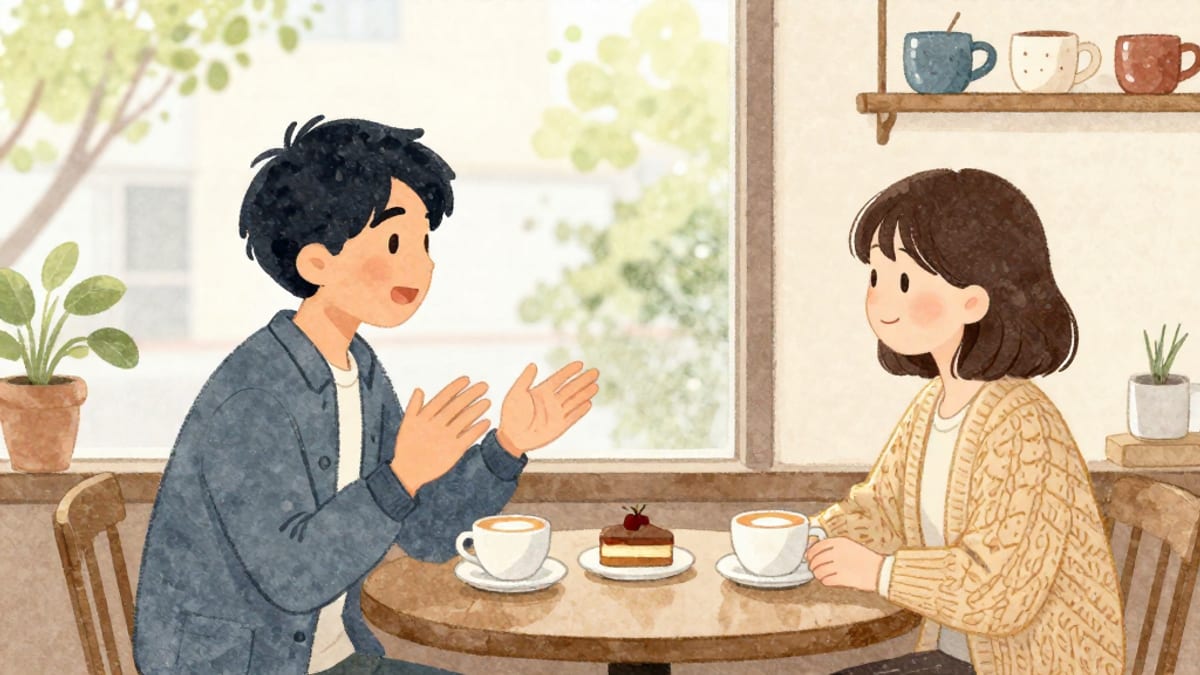
A classic small-talk question in Japan, especially with students and young people, is 将来の夢は何ですか, what is your dream for the future? Here is how a natural exchange can go between two new acquaintances at a language exchange.
| Japanese | Romaji | Meaning |
|---|---|---|
| 将来の夢は何ですか。 | Shōrai no yume wa nan desu ka. | Aiko: What's your dream for the future? |
| 日本で自分のカフェを開くことです。 | Nihon de jibun no kafe o hiraku koto desu. | Lucas: To open my own café in Japan. |
| すてきな夢ですね。 | Suteki na yume desu ne. | Aiko: What a lovely dream. |
| まだ夢みたいな話ですけど。 | Mada yume mitai na hanashi desu kedo. | Lucas: It's still just a dream, though. |
| 夢があっていいですね。応援してます。 | Yume ga atte ii desu ne. Ōen shitemasu. | Aiko: It's inspiring. I'm rooting for you. |
Look-alike kanji, writing tips and common mistakes
The kanji most often confused with 夢 is 蔑 (betsu, contempt, as in 軽蔑, keibetsu). Its top half is almost the same crown-and-eye shape, but the bottom is completely different. For a sign or a tattoo, the difference matters: 夢 is dream, 蔑 is scorn. Also watch 夕 at the bottom; if it is drawn too large, the character looks unbalanced.
How to write it: work from top to bottom. The crown first (3 short strokes), then the sideways eye 罒 (5 strokes), then the cover 冖 (2 strokes), and finally 夕 (3 strokes). Keep the eye wide and flat and the bottom 夕 compact, slightly to the right.
| Japanese | Romaji | Meaning |
|---|---|---|
| 夢 | yume | dream (correct) |
| 蔑 | betsu | contempt (look-alike to avoid) |
- Saying 夢をする or 夢をした. You see a dream in Japanese: 夢を見る.
- Reading 夢中 as yumenaka. The word is muchū, with a long ū.
- Using 夢 for every wish. For a small hope, such as wanting to visit Kyoto next spring, 夢 sounds too grand; say 〜たいです or 楽しみです instead.
- Answering 夢がありますね with a long denial. It is a compliment; a simple ありがとうございます is enough.
夢 as a tattoo, logo or design
夢 is a positive, real kanji that Japanese speakers read instantly, so as a design it is one of the safer single-kanji choices. It does carry a note of youthful hope, and in Japan it often appears on school banners and in pop songs, so some people find it a little sentimental. That is a matter of taste, not a mistake.
A single kanji says one thing; a word or short phrase says something about you. Many people prefer 夢を追う (chase a dream) or 夢中 (lost in what you love) because they feel more personal. If you choose a phrase, keep it short and grammatical.
Chinese and Japanese write this character differently: Japanese and traditional Chinese use 夢, while simplified Chinese uses 梦. If your design is meant to be Japanese, use 夢. Before you ink anything, ask a native speaker to check the exact characters, the stroke shapes and the font, and bring that checked image to the artist.
| Japanese | Romaji | Meaning |
|---|---|---|
| 夢を追う | yume o ou | chase a dream |
| 夢中 | muchū | lost in what you love |
Make 夢 stick with Mocchi
Sign in to your free account and type /kanji 夢 to Mocchi, Unihongo's study assistant. Mocchi shows the meaning, both readings and the common words, and you can ask follow-up questions such as why 夢中 has nothing to do with sleep. Then write one sentence about your own future dream and send it with /correct. Mocchi remembers the readings you mix up, so a later quiz brings back yume and mu until they are automatic.
Finally, type /create-flashcards with the words from this page, pick a photo for each card, and play Kotoba Tank with your own flashcards: you hear 悪夢 or 正夢 and hit the right word before it reaches you.