
血 in four words: from a cut finger to your blood type
血 means blood. It is a common kanji in everyday life even if you never set foot in a hospital, because it appears on health forms, in first-aid situations and in small talk. Start with these four words: the kanji itself, the word for blood type, the formal word for bleeding, and the word for a nosebleed.
Notice the readings. Chi is the native Japanese word, and it changes to ji in hanaji. Ketsu is the reading used in longer, more technical words.
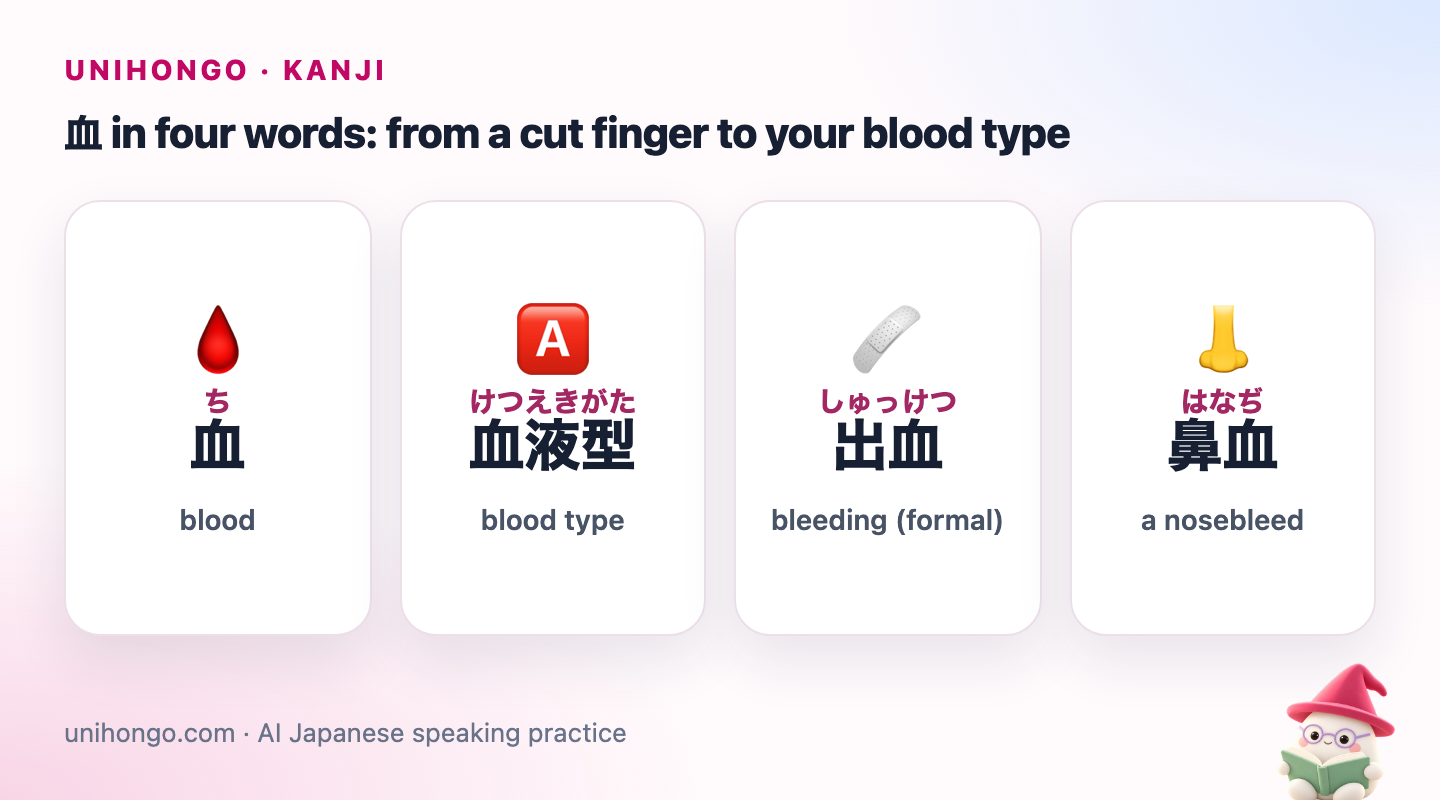
| Japanese | Romaji | Meaning |
|---|---|---|
| 血 | chi | blood |
| 血液型 | ketsuekigata | blood type |
| 出血 | shukketsu | bleeding (formal) |
| 鼻血 | hanaji | a nosebleed |
How 血 is read and built
血 has six strokes. It is usually explained as 皿 (sara, a dish or bowl) with a short stroke on top, often described as a drop of blood in a vessel used for offerings in ancient rituals. Whatever its exact origin, the picture of a drop above a dish is an easy way to remember it.
The readings follow the usual pattern. Alone, or in native Japanese words, say chi. In compounds borrowed from Chinese, say ketsu, which often shortens to ket- or kek- before a k, s or t sound.
| Reading type | Reading | When it is used | Example |
|---|---|---|---|
| kun'yomi | chi | alone and in native words | 血が出た, chi ga deta, it's bleeding |
| kun'yomi (after another word) | ji | with a sound change | 鼻血, hanaji, a nosebleed |
| on'yomi | ketsu | in most compounds | 血液, ketsueki; 献血, kenketsu |
| on'yomi (shortened) | kek- | before a k sound | 血管, kekkan, a blood vessel |
Clinic, first aid and everyday words with 血
These are the 血 words you are most likely to hear at a clinic, during a health check or in the news. Most use the reading ketsu. If you live in Japan, the annual health check, 健康診断 (kenkō shindan), usually includes a blood test, so the clinic words in this list are worth learning before you go.
| Japanese | Romaji | Meaning |
|---|---|---|
| 血液 | ketsueki | blood (formal, medical) |
| 血液検査 | ketsueki kensa | a blood test |
| 採血 | saiketsu | taking a blood sample |
| 献血 | kenketsu | blood donation |
| 血圧 | ketsuatsu | blood pressure |
| 血管 | kekkan | a blood vessel |
| 貧血 | hinketsu | anaemia; feeling faint |
| 止血 | shiketsu | stopping the bleeding |
| 血だらけ | chidarake | covered in blood |
| 血が出た! | Chi ga deta! | I'm bleeding! (casual) |
Hinketsu is medically anaemia, but in everyday conversation people also use it for a sudden dizzy, faint spell, for example during a long morning assembly: hinketsu de taoreta, she fainted. Ketsuatsu comes up at every check-up, along with takai (high) and hikui (low). And chidarake, covered in blood, is the kind of word you hear in dramatic stories, or from a child with a scraped knee who is enjoying the attention.
Chi or ketsueki: which word for blood?
Japanese has two everyday words for blood, and they are not used in the same places. 血 (chi) is short, spoken and personal: your own blood when you cut yourself, a nosebleed, a scratch. 血液 (ketsueki) is formal and scientific: blood as a substance to test, store or measure.
Choosing the wrong one does not cause misunderstandings, but it changes the tone. Telling a friend ketsueki ga deta when you cut your finger sounds like a medical report. A doctor writing chi on a test result would sound too casual.
| Japanese | Romaji | Meaning |
|---|---|---|
| 指から血が出てる。 | Yubi kara chi ga deteru. | Your finger is bleeding. (casual) |
| 血液検査の結果が出ました。 | Ketsueki kensa no kekka ga demashita. | Your blood test results are back. (polite) |
| Point | 血 (chi) | 血液 (ketsueki) |
|---|---|---|
| Register | everyday, spoken | formal, medical, written |
| Typical use | cuts, nosebleeds, idioms | tests, donation, research |
| Example | chi ga tomaranai, it won't stop bleeding | ketsueki kensa, a blood test |
| In idioms | very common | almost never |
Blood-type small talk: what to say when someone asks
Sooner or later, someone in Japan may ask you nani-gata, what type are you? The question refers to blood type. A popular belief links each type with a personality, for example that type A people are careful and type O people are easygoing. There is no scientific support for this, and many people treat it as a light game, like star signs. Others find it tiresome, and judging people by it is widely seen as unfair, so keep it playful.
You can answer, joke, or simply say you do not know. Many people outside Japan never learn their blood type, and Japanese friends are often surprised by this.
| Japanese | Romaji | Meaning |
|---|---|---|
| 何型? | Nani-gata? | Friend: What's your blood type? |
| A型だよ。 | Ēgata da yo. | You: Type A. (casual) |
| やっぱり!真面目だもんね。 | Yappari! Majime da mon ne. | Friend: I knew it! You're so careful. |
| 実は知らないんだ。 | Jitsu wa shiranai n da. | You: Actually, I don't know mine. |
| えっ、知らないの? | E, shiranai no? | Friend: What, you don't know? |
| 国ではあまり調べないんだよ。 | Kuni de wa amari shirabenai n da yo. | You: People don't often check back home. |
Types are said with English letters: ēgata, bīgata, ōgata and ēbīgata for A, B, O and AB. In a job interview or a formal setting, this topic would be out of place, and it is best to avoid asking colleagues about it at work.
Dialogue: a blood test at the clinic
Here is a polite exchange during a blood test, the kind you might have at an annual health check. The nurse speaks politely and kindly; you answer politely too. Saying that you are a little nervous is perfectly normal, and nurses will often let you lie down if you tend to feel faint.

| Japanese | Romaji | Meaning |
|---|---|---|
| 今日は採血をしますね。 | Kyō wa saiketsu o shimasu ne. | Nurse: We'll take a blood sample today. |
| はい。ちょっと苦手なんですが… | Hai. Chotto nigate nan desu ga... | You: OK. I'm a bit nervous about it... |
| 気分が悪くなったら言ってくださいね。 | Kibun ga waruku nattara itte kudasai ne. | Nurse: Tell me if you feel unwell. |
| 左腕でいいですか? | Hidari ude de ii desu ka? | Nurse: Is your left arm all right? |
| はい、お願いします。 | Hai, onegai shimasu. | You: Yes, please. |
| 少しチクッとしますよ。 | Sukoshi chikutto shimasu yo. | Nurse: You'll feel a small prick. |
| 終わりました。ここを押さえてください。 | Owarimashita. Koko o osaete kudasai. | Nurse: All done. Please press here. |
| 血、止まりました。 | Chi, tomarimashita. | You: The bleeding has stopped. |
Idioms: when your blood stirs, boils or drains away
Japanese uses 血 in several vivid idioms about excitement, family and character. They are common in conversation, TV and manga, and the first one is a lovely phrase to use yourself.
| Japanese | Romaji | Meaning |
|---|---|---|
| 血が騒ぐ | chi ga sawagu | to feel excitement stir inside |
| 血の気が引く | chi no ke ga hiku | to go pale with shock |
| 血の気が多い | chi no ke ga ōi | hot-tempered |
| 血も涙もない | chi mo namida mo nai | heartless, cold-blooded |
| 血がつながっている | chi ga tsunagatte iru | to be related by blood |
| 熱血 | nekketsu | hot-blooded, passionate |
Chi ga sawagu, my blood stirs, describes the urge to join in when you hear something you love: festival drums, a crowd chanting at a stadium, or the opening notes of a favourite song. Matsuri no taiko o kiku to chi ga sawagu, when I hear festival drums my blood starts racing, is a natural thing to say. Nekketsu describes an intensely passionate person, often a coach or teacher in a sports drama, and is mostly positive.
Chi mo namida mo nai, with neither blood nor tears, is a strong criticism of someone who shows no mercy, so be careful with it. Chi ga tsunagatte inai, not related by blood, often appears in stories about step-families and adoption, usually to say that love matters more than blood.
血 in tattoos and designs, and the 皿 trap
Blood is a strong image. As a single kanji, 血 can look like a horror film title or a warning, so think about what you want to say before using it in a tattoo, logo or game title.
| Japanese | Romaji | Meaning |
|---|---|---|
| 皿 | sara | a plate, a dish |
| 灰皿 | haizara | an ashtray |
- A lone 血 reads simply as blood. Many Japanese readers will find it gory or aggressive rather than deep.
- For family and ancestry, 絆 (kizuna, bond) or 家族 (kazoku, family) usually express the idea better than a word with blood in it.
- For passion and fighting spirit, 熱血 (nekketsu) is positive and familiar from sports stories.
- Chinese and Japanese both use 血, but some compounds differ: blood type is 血液型 in Japanese and 血型 in Chinese. Check which language you are writing in.
- Have a native speaker check the characters and the style before you get inked, and watch the look-alike below.
The look-alike to watch is 皿, a dish. It is 血 without the short stroke on top, and leaving that stroke off is the most common mistake with this kanji. The other common mistakes are reading 出血 as shutsuketsu (it is shukketsu) and saying ketsueki in casual situations where chi sounds natural.
Rehearse the clinic words with Mocchi before your check-up
A health check is easier when the words are already familiar. Sign in and ask Mocchi: Teach me the Japanese I need for a blood test, then quiz me on it. Mocchi explains words like saiketsu, ketsuatsu and hinketsu, quizzes you, and remembers which ones you miss so it can bring them back in a /review before the day.
Then say it aloud. In AI Sensei, choose Yamada-sensei and ask for a clinic nurse roleplay, spoken slowly at first. Say that you get nervous, answer questions about your arm, and ask when the results will be ready. The session report afterwards shows which phrases came out naturally and which need another try.