
The honest case for writing by hand
Handwriting is easy to skip because nothing punishes you for skipping it. You read Japanese on a screen, you type with predictive input that shows you the right characters, and you feel like you know a character when you can pick it out of a list. That feeling is recognition, and it is much weaker than it looks. Ask yourself to produce the same character on blank paper and the gaps appear immediately.
There is also a practical argument that has nothing to do with memory. Japan still runs a great deal of daily life on paper: bank forms, city hall registrations, clinic intake sheets, delivery slips, hotel check-in cards, school paperwork. Each of them asks for your name, your address, and a date in small boxes. Being able to write those legibly and without panic is a small skill with a disproportionate effect on how ordinary errands feel.
What handwriting fixes that typing does not
- It converts passive recognition into active production, which is the skill exams and forms both test.
- It forces you to notice components, so characters stop being pictures and start being built objects.
- It slows you down enough to see the difference between similar shapes you had been reading interchangeably.
- It gives your hand a physical memory that survives long after you forget the mnemonic you used.
- It prepares you for the counter, where a form is pushed across the desk and typing is not offered.
- It gives you something to check: your own past attempts show precisely what keeps going wrong.
Proportion and balance in the square
Every Japanese character, from the simplest kana to a dense kanji, occupies the same imaginary square. This is the single idea that makes handwriting look native rather than foreign. Roman handwriting varies width by letter, so a learner naturally writes a narrow character narrow and a wide one wide, and the line ends up ragged even when each character is drawn correctly.
Practise inside a grid at first. The character should nearly fill the square without touching the edges, sitting centred rather than drifting to one corner, and the internal spaces should stay roughly even. When a character has a left and a right part, keep the left slightly narrower. When it stacks, keep the upper part slightly flatter. Those two habits alone remove most of the awkwardness from beginner handwriting.
The pen strokes that make kana look written
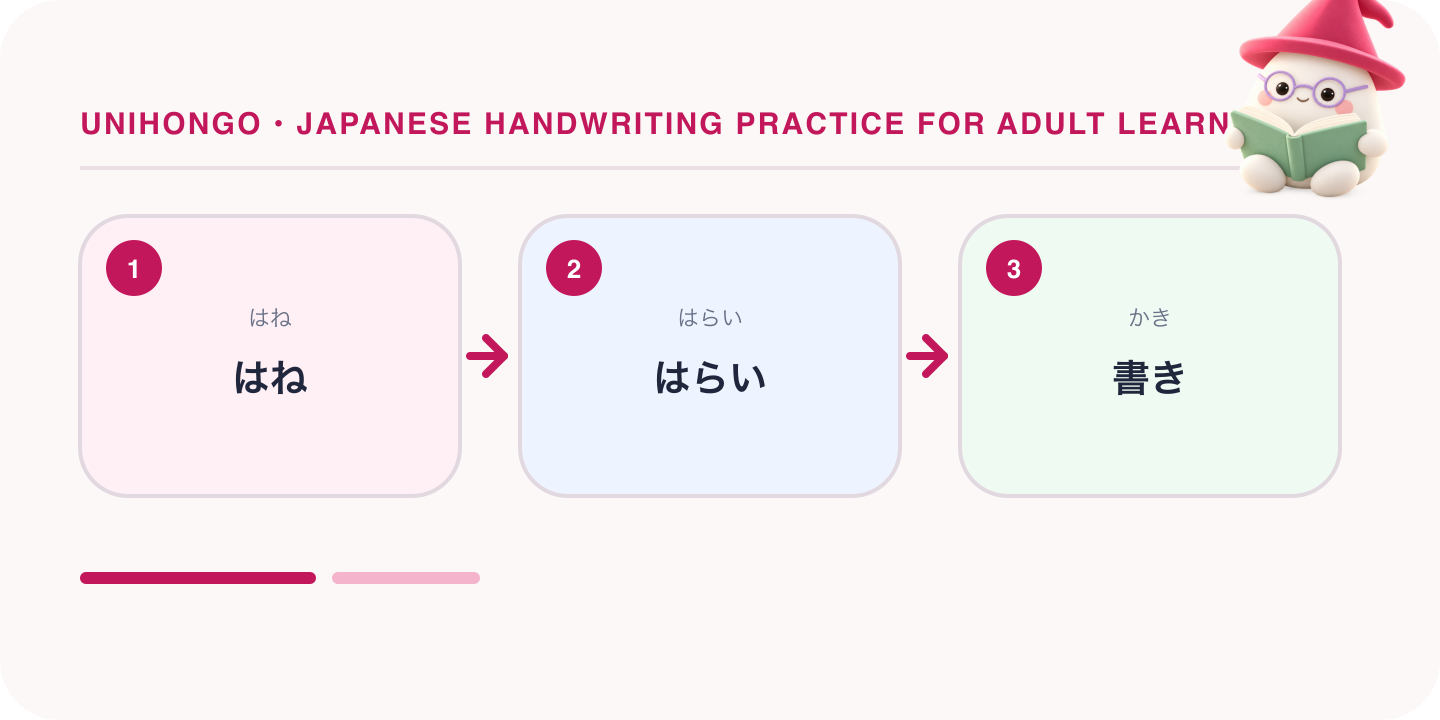
Japanese strokes end in one of a few defined ways, and reproducing those endings is what separates writing from tracing. A stop finishes with the pen pressed and lifted cleanly in place. A hook finishes with a small turn back on itself. A sweep tapers away as the pen lifts while still moving. A bend turns a corner without lifting at all, which is also why it counts as a single stroke.
You do not need a brush to show these. With an ordinary pen the difference is mostly speed and lift: stop by pausing before lifting, hook by flicking briefly against the direction of travel, sweep by accelerating as you lift. Practising the four endings on their own for a minute at the start of a session improves every character you write afterwards more than repeating whole characters does.
| Japanese | Romaji | Meaning |
|---|---|---|
| とめ | Tome | A stop, ending with the pen held then lifted |
| はね | Hane | A hook, flicking back at the end of a stroke |
| はらい | Harai | A sweep, tapering away as the pen lifts |
| おれ | Ore | A bend, turning a corner within one stroke |
| 書き順 | Kakijun | Stroke order |
| 画数 | Kakusū | Stroke count |
| 楷書 | Kaisho | Block script, the clear everyday style |
Stroke order is worth respecting for the same reason: it produces those endings naturally and keeps proportions stable, and it is what handwriting recognition on your phone expects. It is not a moral rule, and nobody inspects your order on a finished form, but characters written in the standard order simply come out better balanced.
Kana pairs that go wrong on paper
| Pair | The real difference | What to watch as you write |
|---|---|---|
| さ and き | さ has one crossbar, き has two | Write the crossbars before the curve and count them |
| ぬ and め | ぬ closes with a loop, め does not | Only ぬ finishes with that small loop on the right |
| は and ほ | ほ has two crossbars on the right, は has one | Keep the gaps between crossbars even |
| れ, わ and ね | The last stroke flicks out, curves in, or curls into a loop | Finish the final stroke deliberately, not vaguely |
| る and ろ | る ends in a closed loop, ろ ends open | Do not let ろ curl shut at the bottom |
| シ and ツ | シ's marks stack on the left, ツ's sit along the top | シ sweeps upward, ツ sweeps downward |
| ソ and ン | The same upward and downward contrast | ン sweeps up from low left, ソ sweeps down from high right |
| ク and タ | タ has an extra stroke crossing inside | Check for that third stroke before moving on |
Reading these pairs is a different problem from writing them, and the kana-learning guide covers the recognition side. On paper the failure is directional: your hand knows roughly what the shape looks like but not which way the final stroke travels, so the character comes out as something between the two. Writing the pair side by side, deliberately exaggerating the difference, fixes it faster than writing either one twenty times.
A fifteen-minute weekly routine
Long copying sessions feel productive and teach very little, because after the third repetition your hand is tracing its own last attempt rather than retrieving anything. A short, targeted session once or twice a week works better. The structure below fits in fifteen minutes and ends with something you can actually check, which is what makes it repeatable.
- One minute: practise the four stroke endings on a blank line to warm up the hand.
- Two minutes: write the alphabet you are weaker on straight through, at speed, and mark every hesitation.
- Five minutes: take the five characters you hesitated on and write each six times inside a grid.
- Four minutes: write six real words using those characters, not the characters in isolation.
- Two minutes: write your name, today's date, and your postcode as if filling in a form.
- One minute: compare this week's sheet with last week's and circle what improved.
Writing your name the way forms expect
Japanese forms assume a name shape that foreign names do not naturally fit, so decide once how you will write yours and then keep it identical everywhere. Family name comes first, given name second, usually with a space or a separating dot between them. Most forms want katakana, and many also have a furigana line above or below the name field asking for the reading, which for a katakana name means writing it again in katakana.
Practise this until it is automatic, because it is the single piece of handwriting you will produce most often. Then practise your address, which runs from the largest unit to the smallest, the opposite of the order you are used to. Writing the whole thing out from memory a few times is worth more than reading an explanation of the format.
| Field | Reading | What to write |
|---|---|---|
| 氏名 | Shimei | Family name first, then given name |
| フリガナ | Furigana | The same name in katakana, same order |
| 住所 | Jūsho | Largest unit first: prefecture, city, ward, block numbers |
| 郵便番号 | Yūbin bangō | Seven digits, split three then four |
| 生年月日 | Seinengappi | Year, month, day, sometimes in a Japanese era year |
| 電話番号 | Denwa bangō | Digits with hyphens, no country code |
The pieces of a Japanese address
| Japanese | Romaji | Meaning |
|---|---|---|
| 東京都渋谷区神南一丁目二番三号 | Tōkyō-to Shibuya-ku Jinnan itchōme ni-ban san-gō | 1-2-3 Jinnan, Shibuya Ward, Tokyo |
| 都 | To | Metropolis, used only for Tokyo |
| 県 | Ken | Prefecture |
| 市 | Shi | City |
| 区 | Ku | Ward |
| 町 | Chō | Town or district |
| 丁目 | Chōme | District block |
| 番 | Ban | Block number |
| 号 | Gō | Building or house number |
Note that the numbers at the end are not a street address in the Western sense; they identify a block, a lot within it, and a building. Copy your own address exactly as it appears on an official document rather than translating it yourself, and write it the same way every time. Consistency matters more than elegance, because mismatched addresses across forms cause genuine administrative trouble.
What handwriting on forms really needs
The standard at a counter is lower than learners fear and different from what they imagine. Nobody is judging your brushwork. What staff need is characters that are unmistakable at a glance, one character per box where boxes are printed, consistent size, and a dark pen rather than pencil. Katakana in particular should be written slightly more angular and separated than feels natural, because cramped katakana is the most common cause of a form being handed back.
If you make a mistake, do not scribble it out. Japanese practice is usually to draw two neat horizontal lines through the error and write the correction beside it, though on official documents staff may simply give you a fresh sheet. Ask before you correct, and if the form matters, ask for a new one rather than producing something messy.
Phrases for the counter
Filling in a form in front of someone is a conversation as much as a writing task, and these are the lines that come up. Say them rather than pointing, because a single clear question saves several minutes of guessing and the staff member will usually show you exactly where to write.
| Japanese | Romaji | Meaning |
|---|---|---|
| すみません、ここは何を書けばいいですか? | Sumimasen, koko wa nani o kakeba ii desu ka? | Excuse me, what should I write here? |
| フリガナはカタカナで書きますか? | Furigana wa katakana de kakimasu ka? | Should I write the furigana in katakana? |
| 名前は漢字で書かなくても大丈夫ですか? | Namae wa kanji de kakanakute mo daijōbu desu ka? | Is it all right if I do not write my name in kanji? |
| ローマ字で書いてもいいですか? | Rōmaji de kaite mo ii desu ka? | May I write it in Roman letters? |
| 書き間違えました。書き直してもいいですか? | Kakimachigaemashita. Kakinaoshite mo ii desu ka? | I made a mistake. May I correct it? |
| 新しい用紙をもらえますか? | Atarashii yōshi o moraemasu ka? | Could I have a new form? |
| この字で合っていますか? | Kono ji de atte imasu ka? | Is this character right? |
| 住所はどこまで書きますか? | Jūsho wa doko made kakimasu ka? | How much of the address should I write? |
| 印鑑は必要ですか? | Inkan wa hitsuyō desu ka? | Do I need a personal seal? |
| サインでも大丈夫ですか? | Sain demo daijōbu desu ka? | Is a signature acceptable? |
The replies are short and predictable. You will hear こちらにお願いします, meaning please write here, ここは空欄で大丈夫です, meaning you can leave this blank, and もう一枚お渡しします if they are giving you a fresh form. Learn to catch those three and the rest of the exchange takes care of itself.
Talking about your own handwriting
Handwriting comes up in conversation more often than you would expect, usually because someone watches you write and comments on it. These lines let you answer without stalling, and the compliment in the first one is one you will genuinely receive, since writing kana at all is treated as an achievement worth mentioning.
| Japanese | Romaji | Meaning |
|---|---|---|
| 字が上手ですね。 | Ji ga jōzu desu ne. | Your handwriting is good. |
| まだ書くのが遅いです。 | Mada kaku no ga osoi desu. | I am still slow at writing. |
| 週に一回、十五分練習しています。 | Shū ni ikkai, jūgo-fun renshū shite imasu. | I practise for fifteen minutes once a week. |
| 書き順が違うかもしれません。 | Kakijun ga chigau kamo shiremasen. | My stroke order may be wrong. |
| もう一度書いてみます。 | Mō ichido kaite mimasu. | I will try writing it once more. |
| ゆっくり丁寧に書きます。 | Yukkuri teinei ni kakimasu. | I write slowly and carefully. |
A compliment on your writing is usually genuine encouragement rather than politeness, and the graceful reply is まだまだです, meaning I still have a long way to go, or a simple ありがとうございます. Either keeps the conversation moving, which matters more than the modesty formula you choose.