
鶴 in four words: the bird, the fold and the wish
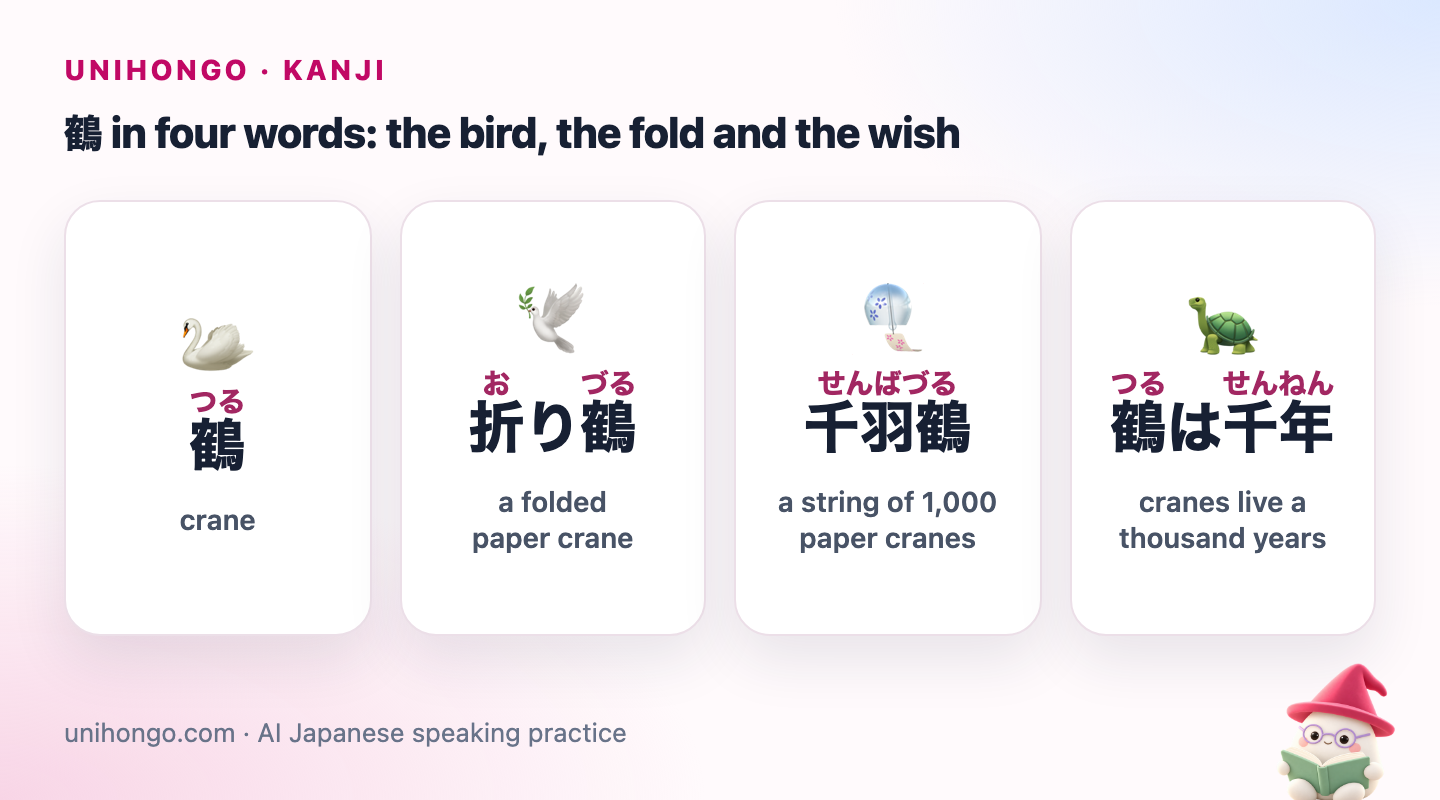
Most people meet 鶴 through paper before they see a real crane. These four rows cover the bird, the folded crane, the thousand-crane string and the saying that explains why cranes mean long life.
| Japanese | Romaji | Meaning |
|---|---|---|
| 鶴 | tsuru | crane |
| 折り鶴 | orizuru | a folded paper crane |
| 千羽鶴 | senbazuru | a string of 1,000 paper cranes |
| 鶴は千年 | tsuru wa sennen | cranes live a thousand years |
Readings, strokes and the bird inside 鶴
鶴 is on the official list of kanji for general use, but with 21 strokes it is one of the heavier characters most people meet. The kun'yomi is tsuru, which becomes zuru in compounds such as 折り鶴 and 千羽鶴, a regular sound change in Japanese. The on'yomi is kaku, used in a few formal words.
| Part | Strokes | Role |
|---|---|---|
| 隺 (left side) | 10 | Usually explained as the sound part, kaku |
| 鳥 (right side) | 11 | The bird radical: marks the meaning |
| 鶴 (whole) | 21 | tsuru / kaku |
Many bird kanji follow the same pattern, a sound part plus 鳥: 鳩, hato, dove; 鴨, kamo, duck; 鷺, sagi, heron. Once you can write 鳥 confidently, half of 鶴 is done. The left part, 隺, looks complicated but breaks down into a small roof shape on top and 隹 below, another bird element you also see in 進 and 集.
When you read tsuru, the sound change to zuru matters. Say orizuru, not oritsuru, and senbazuru, not senbatsuru. The same thing happens in many compound words, such as 紙, kami, which becomes gami in 折り紙, origami, and 話, hanashi, which becomes banashi in 昔話, mukashibanashi, an old tale.
Crane words, sayings and names
Cranes appear in sayings about long life and in a few lively idioms. 鶴は千年、亀は万年 is a set phrase, often printed on celebration goods for long life, and the crane-and-turtle pair 鶴亀 appears on wedding and New Year designs. 鶴の恩返し, the crane's return of a favour, is a folk tale every Japanese child knows: a crane rescued from a trap returns in human form and weaves beautiful cloth, on the condition that no one watches her work.
| Japanese | Romaji | Meaning |
|---|---|---|
| 鶴は千年、亀は万年 | Tsuru wa sennen, kame wa mannen. | Cranes live a thousand years, turtles ten thousand. |
| 鶴亀 | tsurukame | crane and turtle: a pair for long life |
| 鶴の恩返し | tsuru no ongaeshi | The Crane's Return of a Favour (folk tale) |
| 鶴の一声 | tsuru no hitokoe | the boss's decisive word |
| 丹頂鶴 | tanchōzuru | the red-crowned crane |
| 千鶴 | Chizuru | girl's name: a thousand cranes |
| 社長の鶴の一声で決まりました。 | Shachō no tsuru no hitokoe de kimarimashita. | It was settled by one word from the company president. |
In names, 鶴 suggests longevity and elegance. It appears in girls' names such as Chizuru and in many family names and place names, such as 鶴田 and 鶴岡, where it is read tsuru. As always, check how a person reads their own name.
鶴の一声 is useful at work, but notice the slightly ironic tone: it can imply that a long discussion was wasted because one person decided everything. Saying it about your own boss in front of them would be awkward.
Folding cranes with a Japanese friend
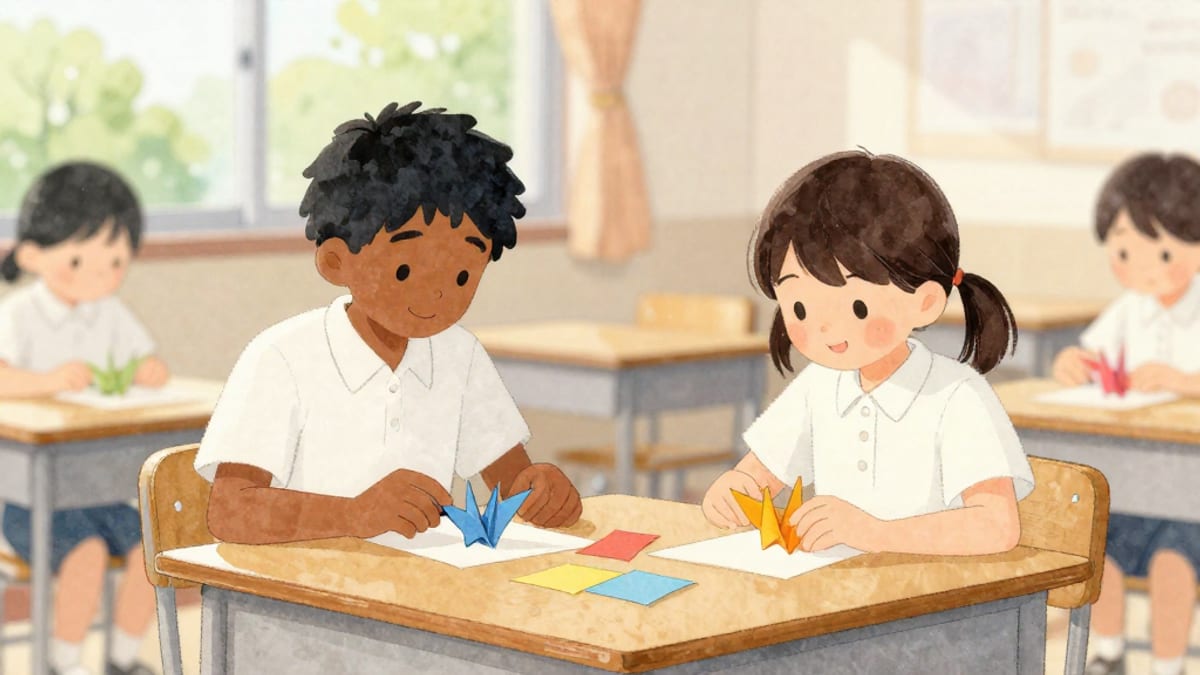
Folding an origami crane is a common shared activity, at schools, hospitals, community centres and family tables. Groups sometimes fold a 千羽鶴 together for a classmate in hospital, a team before a tournament or a ceremony for peace. Asking someone to show you how is a lovely conversation opener, and the vocabulary of folding is short and practical.
| Japanese | Romaji | Meaning |
|---|---|---|
| 鶴の折り方を教えてくれる? | Tsuru no orikata o oshiete kureru? | You: Can you teach me how to fold a crane? (casual) |
| いいよ。まず三角に折って。 | Ii yo. Mazu sankaku ni otte. | Friend: Sure. First fold it into a triangle. |
| ここはどうするの? | Koko wa dō suru no? | You: What do I do here? |
| ここを開いて、つぶすんだよ。 | Koko o hiraite, tsubusu n da yo. | Friend: Open this part and flatten it. |
| できた!ちょっと曲がってるけど。 | Dekita! Chotto magatteru kedo. | You: Done! It's a bit crooked, though. |
| 上手だよ。千羽まであと九百九十九羽だね。 | Jōzu da yo. Senba made ato kyūhyaku kyūjūkyū wa da ne. | Friend: It's good. Only 999 more to a thousand. |
Cranes at weddings, New Year and celebrations
Because the crane means long life and happiness, it decorates many celebrations. Cranes are a classic pattern on wedding kimono and on the decorative cords and envelopes used for gifts of money at weddings. At New Year, cranes often appear on greeting cards, lacquer boxes and decorations next to pine, bamboo and plum. Designs and customs vary between regions and families, but the meaning, a wish for a long and happy life, is widely shared.
Recognising the crane helps you join the conversation. Complimenting a kimono or a gift wrapping by naming the crane shows you understand the wish behind it, and people are often pleased to explain more.
| Japanese | Romaji | Meaning |
|---|---|---|
| 鶴の柄の着物、素敵ですね。 | Tsuru no gara no kimono, suteki desu ne. | Your kimono with the crane pattern is lovely. |
| 鶴は長生きの象徴なんです。 | Tsuru wa nagaiki no shōchō nan desu. | The crane is a symbol of long life. |
| 縁起がいい柄ですね。 | Engi ga ii gara desu ne. | It's a lucky pattern, isn't it? |
| 早く元気になりますように。 | Hayaku genki ni narimasu yō ni. | I hope you get well soon. (a wish, e.g. with cranes) |
Cranes, not cranes: 鶴 vs クレーン, and bird look-alikes
English uses crane for the bird and the machine. Japanese does not: the machine is クレーン, a loanword, and the claw machine at an arcade is クレーンゲーム. Writing 鶴 for a construction crane would be a funny mistake.
Among kanji, the trap is not another crane but other birds. 鳥, bird, and 烏, crow, differ by one stroke: the crow is missing the short horizontal inside the head, because, as children are told, you cannot see a black crow's eye. 鶴 and 鷺, heron, are both long-legged birds with complex left sides; read the left half carefully.
| Japanese | Romaji | Meaning |
|---|---|---|
| クレーン | kurēn | a construction crane (the machine) |
| 鳥 | tori | bird |
| 烏 | karasu | crow (one stroke fewer than 鳥) |
| 鷺 | sagi | heron |
- Saying oritsuru instead of orizuru. In compounds, tsuru becomes zuru.
- Writing the left side as 隹 alone and forgetting the small roof on top.
- Calling every white bird with long legs 鶴. Herons, 鷺, are far more common in rice fields.
- Treating 千羽鶴 as decoration only. For many people it carries a sincere wish, so handle one gently.
To write 鶴, do the left side first, from the top: the small roof, then 隹 with its four horizontals. Then write 鳥 on the right: the short slanting stroke, the box, the horizontals, the long stroke that bends and hooks, and finally the four dots along the bottom, left to right. Keep the left part narrow so the bird has room.
鶴 for a tattoo or design
鶴 is one of the most positive animal kanji you can choose: long life, grace and celebration, with associations that are broadly similar in Japan and China. The challenge is visual. With 21 strokes, a small 鶴 turns into a blur, so choose a size where the four bottom dots and the lines of 隹 stay separate.
Combinations work well. 鶴亀 pairs the crane with the turtle for long life, and an origami crane drawing next to 折り鶴 makes the design read clearly even to people who cannot read kanji. 千羽鶴 is better as an image than as text, because the words alone look like a label. Show the final artwork to a native speaker and, for brush styles, to someone who knows calligraphy before you go ahead.
Fold 鶴 into your study plan with Mocchi
Type /kanji 鶴 and Mocchi gives you the meaning, the readings and words such as 折り鶴 and 鶴の一声. Then write two sentences of your own about cranes and send them with /correct; Mocchi fixes them, explains each change and remembers the points you missed for later reviews.
To make the bird kanji stick, ask Mocchi to make flashcards for 鳥, 烏, 鶴, 鷺, 鳩 and 鴨 and pick a photo for each, then play Vocabulary Dash with that deck on the games page. Running past the right bird at speed is a fun test of whether you really see the differences.