
気 in four everyday words
If you learn only four words with 気, learn these. Together they show how wide the kanji is: your health and energy, the sky above you, your inner feelings and the warning you give someone you care about.
In each word, 気 is about something you cannot touch but can clearly feel: energy, air, mood, attention. That is the core of the kanji, and it is a better guide than any single translation.
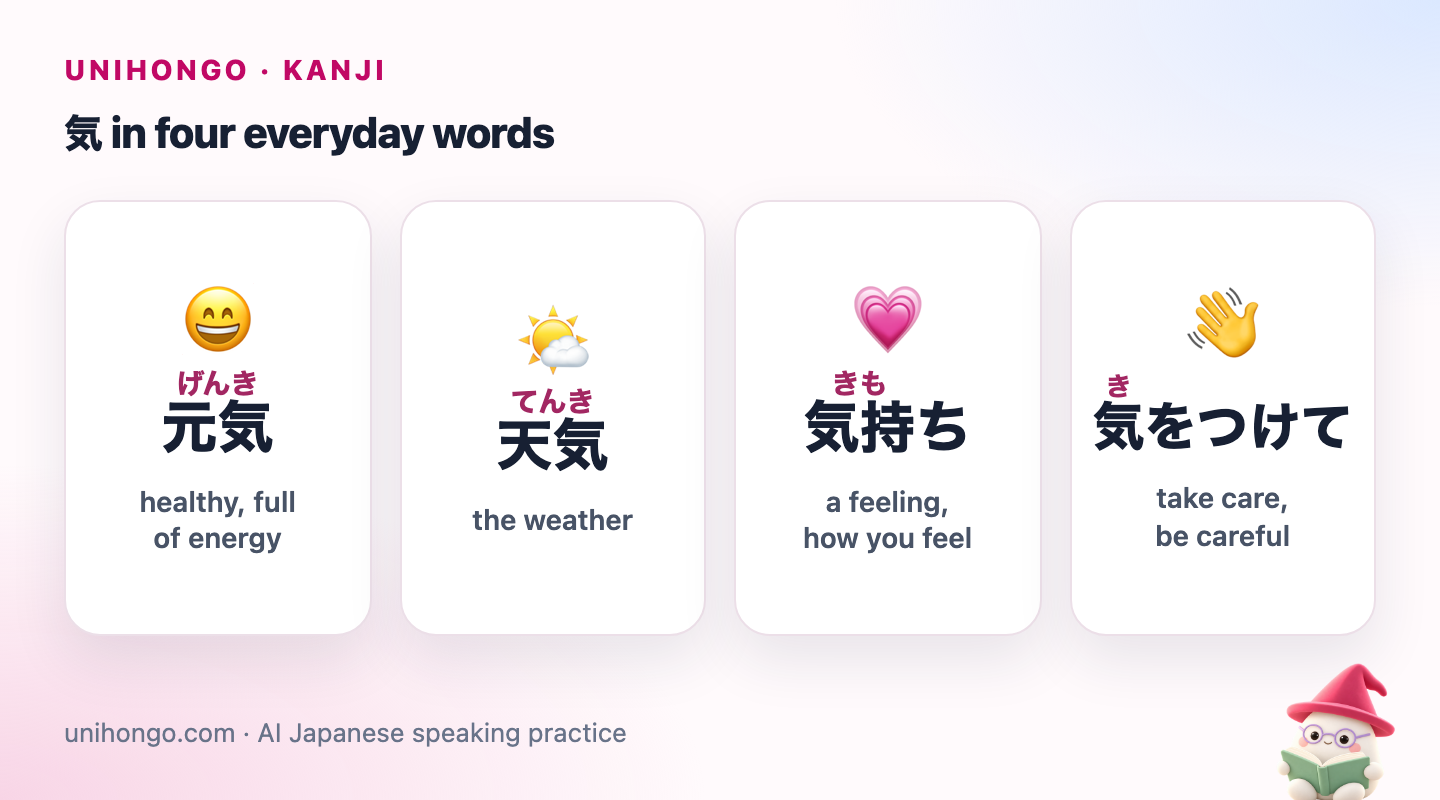
| Japanese | Romaji | Meaning |
|---|---|---|
| 元気 | genki | healthy, full of energy |
| 天気 | tenki | the weather |
| 気持ち | kimochi | a feeling, how you feel |
| 気をつけて | ki o tsukete | take care, be careful |
気, 氣 and 气: forms, readings and strokes
| Form | Strokes | Readings | Where you see it |
|---|---|---|---|
| 気 | 6 | ki, ke | Standard modern Japanese, everywhere |
| 氣 | 10 | ki, ke | Older texts, some martial arts and shop names, designs |
| 气 | 4 | qì (Chinese) | Simplified Chinese, not used in Japanese words |
The outer part, 气, is a picture of rising vapour or breath. In the older form 氣, 米 (rice) sits inside it, and the kanji is often explained as the steam rising from cooking rice: something invisible that gives life. In the post-war reform of Japanese characters, 米 was simplified to メ, giving the 気 used today. Mainland Chinese went further and dropped the inside entirely, leaving 气.
気 is one of the kanji with no common kun'yomi; ki and ke are both on'yomi, readings that came from Chinese. Ki is by far the more frequent. Ke appears in a smaller set of words, many of them about a faint sign or sensation, which you will see in the next section.
Four families of 気 words
Grouping 気 words by meaning makes them far easier to remember than learning a long alphabetical list. Here are the four families, with the words you will meet first.
| Japanese | Romaji | Meaning |
|---|---|---|
| 空気 | kūki | air; the mood in a room |
| 気温 | kion | air temperature |
| 電気 | denki | electricity, the lights |
| 病気 | byōki | illness |
| 本気 | honki | seriousness, for real |
| 気分 | kibun | mood, how you feel right now |
| 雰囲気 | fun'iki | atmosphere, vibe |
| 人気 | ninki | popularity |
| 寒気 | samuke | chills, shivers |
| 気配 | kehai | a sign, a sense of presence |
| Family | Core idea | Example words |
|---|---|---|
| Air and weather | What is around you and above you | 空気, 天気, 気温, 電気 |
| Energy and health | How much life you have in you | 元気, 病気, 勇気, 本気 |
| Mind and feelings | Mood, attention, intention | 気持ち, 気分, 気になる |
| Atmosphere | The air of a place or person | 雰囲気, 人気, 気配 |
Two of these hide a trap. 人気 read ninki means popularity, but the same kanji read hitoke means signs of people, as in 人気のない道, a deserted road. And 空気 is not only air: 空気を読む, to read the air, means to sense what a group expects without being told.
電気 is literally electric energy, and in daily speech it also means the lights: 電気を消して, turn off the lights. 雰囲気 is often mispronounced as funiki; the standard reading is fun'iki, with a clear n.
気になる, 気にする and other phrases that confuse learners
気 forms a large set of verb phrases. Rather than listing dozens, focus on the few that cause the most trouble, because they look alike but mean quite different things.
| Japanese | Romaji | Meaning |
|---|---|---|
| あの音が気になる。 | Ano oto ga ki ni naru. | That noise bothers me; I keep noticing it. |
| 新しいカフェが気になる。 | Atarashii kafe ga ki ni naru. | I'm curious about the new café. |
| 人の目を気にする。 | Hito no me o ki ni suru. | To worry about what others think. |
| 気にしないで。 | Ki ni shinaide. | Don't worry about it. (casual) |
| 雨が降る気がする。 | Ame ga furu ki ga suru. | I have a feeling it will rain. |
| 彼とは気が合う。 | Kare to wa ki ga au. | He and I get along well. |
| 気が利くね。 | Ki ga kiku ne. | That's thoughtful of you. |
The difference between 気になる and 気にする follows a general rule. になる describes something that happens to you: the noise catches your attention, the café makes you curious. にする describes something you actively do: you choose to worry about it. That is why the kind reply to an apology is 気にしないで, don't worry about it, and why あなたが気になる can mean I'm interested in you.
気がする, to have a feeling that, is a gentle way to give an opinion without sounding sure: そんな気がする, I get that feeling. 気が利く praises someone who notices what others need, a compliment Japanese people value highly.
元気 and 気をつけて in greetings and goodbyes
Two of the four card words are fixed parts of daily conversation. 元気 is how you ask after someone; 気をつけて is how you send them off safely. Both change shape with politeness.
| Japanese | Romaji | Meaning |
|---|---|---|
| 元気? | Genki? | How are you? (casual) |
| お元気ですか。 | Ogenki desu ka. | How are you? (polite, after a while) |
| 気をつけてね。 | Ki o tsukete ne. | Take care. (casual) |
| お気をつけてお帰りください。 | Oki o tsukete okaeri kudasai. | Please get home safely. (very polite) |
| お大事に。 | Odaiji ni. | Get well soon. (to someone unwell) |
お元気ですか sounds natural when you have not seen someone for a while, or in a letter; between people who meet every day, it can sound oddly formal. 気をつけて is said when someone leaves, especially at night, in bad weather or before a trip. If they are ill, say お大事に instead, which wishes them a good recovery.
Mini dialogue: saying goodbye after dinner
A Japanese friend's family has invited you for dinner, and it is late when you leave. Goodbyes in the entrance hall, the genkan, are full of 気. The family speaks politely, and you answer in kind.
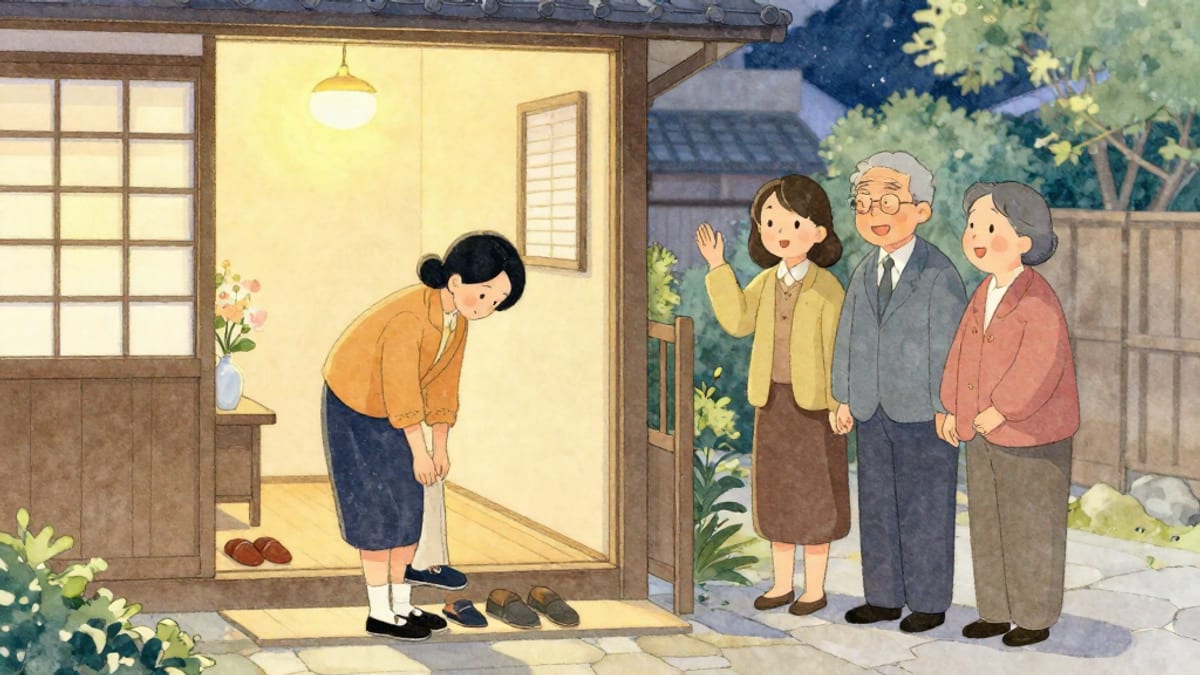
| Japanese | Romaji | Meaning |
|---|---|---|
| 今日は本当にありがとうございました。 | Kyō wa hontō ni arigatō gozaimashita. | You: Thank you so much for today. |
| こちらこそ。また気軽に来てね。 | Kochira koso. Mata kigaru ni kite ne. | Mother: Our pleasure. Drop by any time. |
| 外は寒いから、気をつけてね。 | Soto wa samui kara, ki o tsukete ne. | Friend: It's cold out, so take care. |
| ありがとう。おやすみなさい。 | Arigatō. Oyasumi nasai. | You: Thanks. Good night. |
| お気をつけて。 | Oki o tsukete. | Father: Safe journey home. |
気軽に, lightly and casually, is another useful 気 word: 気軽に来てね means come without any fuss. When you are the guest, the next day a short message such as 昨日はありがとうございました is a kind follow-up.
気 or 氣 as a tattoo or design
Ki is one of the most requested kanji for designs, and you have a real choice of form. 気 is the standard modern character; every Japanese reader knows it, but some feel it looks plain or even unfinished on its own, because it is mostly seen inside words. 氣, with 米 inside, looks older and fuller, and some martial arts groups write their art's name with it, for example in 合氣道. Both are correct; the older one carries a more traditional flavour. In given names, 気 is uncommon on its own, but it appears in names built on words such as 勇気 (Yūki).
Chinese usage differs in an important way. Simplified Chinese writes the character 气, and in everyday Chinese it means air, gas or breath, and it appears in the common word for being angry, 生气. A Chinese reader will not see anger in 気 or 氣 alone, but a design copied from a Chinese site may give you the simplified form instead of either Japanese one.
A word can say more than one character. 元気 (energy, health) is cheerful, 勇気 (courage) is bold, and 気合い (kiai, fighting spirit) is energetic. Before you ink or print anything, ask a native speaker to check the exact form, the stroke shapes and the font.
| Japanese | Romaji | Meaning |
|---|---|---|
| 気合い | kiai | fighting spirit; a focused shout |
| 勇気 | yūki | courage |
Untangle 気 phrases with Mocchi
Paste a sentence that confuses you into Mocchi with /explain, for example 気にしないでって言われたけど、やっぱり気になる. Mocchi breaks it into parts, names the patterns and explains why the first 気 takes にする and the second になる. Ask for three more sentences of your own level, and Mocchi notes which phrase you hesitate on so that it turns up again in your next /review.
Then add the four families of 気 words to your Flash Card list with /create-flashcards, picking a photo for each, and stack them in Kotoba Stack, where you build a tower word by word. Grouping cards by family before you play makes ki and ke readings stick faster.
Common mistakes and how to write 気
- Confusing 気 with 汽 (ki, steam), as in 汽車 (kisha, steam train) and 汽笛 (kiteki, steam whistle). 汽 has the water radical 氵 on the left and no メ inside.
- Reading every 気 as ki. 寒気, 吐き気, 湿気 and 気配 use ke.
- Saying 気にならないで to comfort someone. The natural phrase is 気にしないで.
- Using お元気ですか with people you see every day. It sounds like a letter; with them, a comment such as 今日は寒いですね works better.
- Writing 気 with 米 inside in normal text. 氣 is fine as a design choice, but everyday Japanese uses 気.