
Calm in four words: 静か, 冷静, 静寂 and 穏やか
Each of the four words describes a different kind of calm. 静か is calm you can hear, or rather cannot hear: no noise. 冷静 is calm in the head: a clear mind when something goes wrong. 静寂 is a deep, almost total stillness, the kind you find in a temple garden at dawn. 穏やか is calm in mood and weather: gentle, mild, peaceful.
When you want to describe calm in Japanese, ask yourself which of these you mean. That one question removes most of the mistakes learners make.
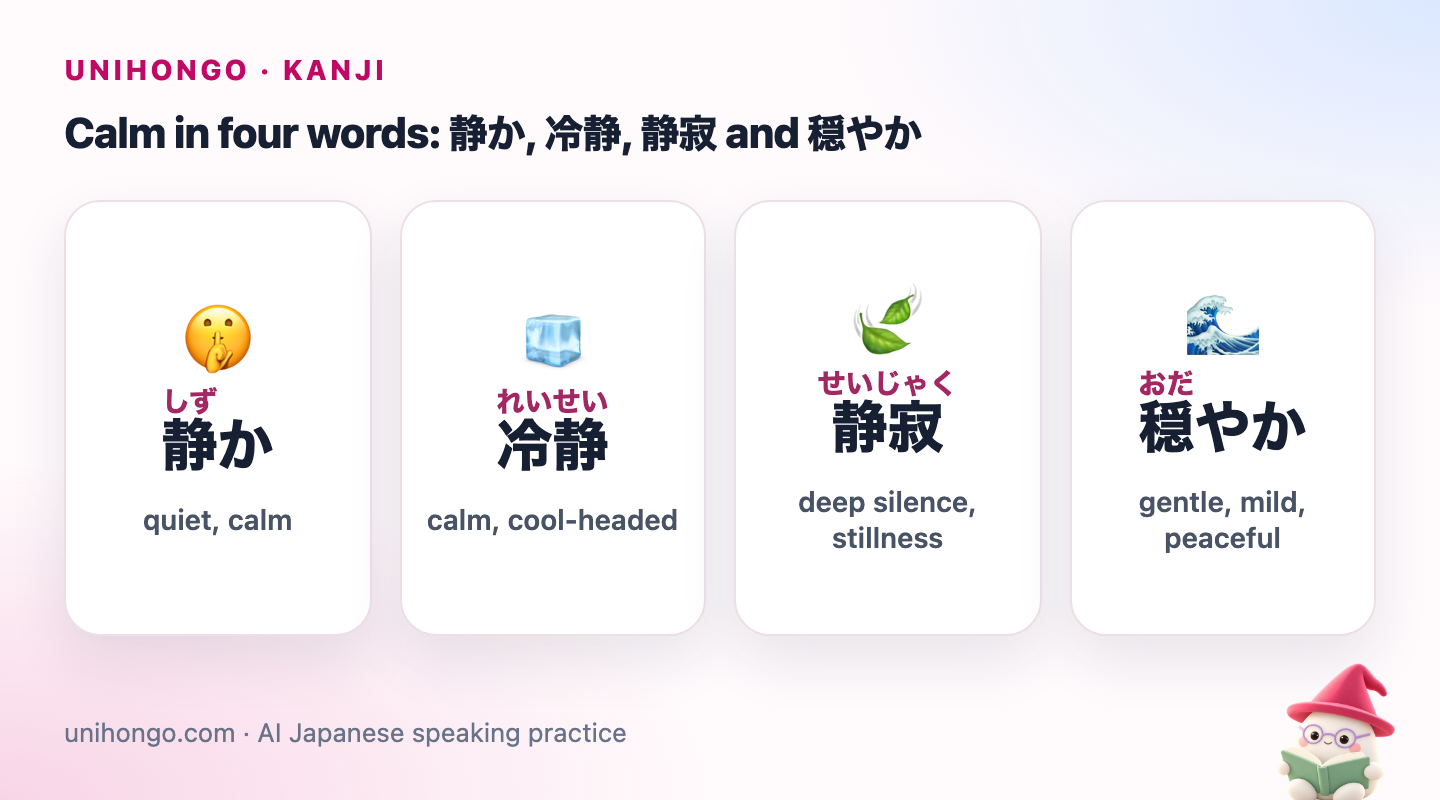
| Japanese | Romaji | Meaning |
|---|---|---|
| 静か | shizuka | quiet, calm |
| 冷静 | reisei | calm, cool-headed |
| 静寂 | seijaku | deep silence, stillness |
| 穏やか | odayaka | gentle, mild, peaceful |
Readings, strokes and parts of 静 and 穏
| Kanji | Strokes | On'yomi | Kun'yomi | Core meaning |
|---|---|---|---|---|
| 静 | 14 | sei, jō | shizuka, shizumaru, shizumeru | quiet, still, calm |
| 穏 | 16 | on | odayaka | gentle, mild, peaceful |
静 has 14 strokes: 青 (blue, green, young) on the left and 争 (to compete, to struggle) on the right. 青 is also read sei and gives 静 its main reading. A memory picture many learners like: the struggle (争) has settled into calm blue (青). It is a mnemonic rather than a history, but it works. The older form 靜 has 16 strokes and appears on some old signs and in traditional Chinese.
穏 has 16 strokes, with the grain radical 禾 on the left and 心 (heart) at the bottom right. Think of a heart at peace beside a field of ripe grain. 穏 is used mainly in 穏やか and in a few formal compounds.
The reading jō for 静 is rare and appears mostly in 静脈 (jōmyaku, vein). Shizuka is the adjective, and shizumaru and shizumeru are the verbs to become calm and to calm something down.
Everyday words with 静
Words with 静 range from daily life to medicine and science. Several of them describe a state of no movement, which is the core of the kanji.
| Japanese | Romaji | Meaning |
|---|---|---|
| 静けさ | shizukesa | quietness, stillness |
| 安静 | ansei | rest, staying still (medical) |
| 平静 | heisei | composure, calmness |
| 静止 | seishi | standing still, at rest |
| 静電気 | seidenki | static electricity |
| 静脈 | jōmyaku | vein |
| 静岡 | Shizuoka | Shizuoka Prefecture |
| お静かにお願いします。 | Oshizuka ni onegai shimasu. | Please be quiet. (polite request) |
| 会場が静まり返った。 | Kaijō ga shizumarikaetta. | The hall fell completely silent. |
If a doctor tells you 安静にしてください, it means rest and avoid moving around, not just relax. 静電気 is a word you will use in a dry Japanese winter, when door handles give you small shocks. お静かにお願いします is the polite request you will see and hear in libraries, temples, trains and theatres.
Words with 穏 and other gentle calm
穏 words describe calm as the absence of trouble. They suit weather, the sea, daily life and personalities, and a couple of them are useful in polite business Japanese.
| Japanese | Romaji | Meaning |
|---|---|---|
| 穏やかな人 | odayaka na hito | a gentle, even-tempered person |
| 今日は海が穏やかですね。 | Kyō wa umi ga odayaka desu ne. | The sea is calm today, isn't it? |
| 平穏 | heion | peace and quiet, tranquillity |
| 穏便に | onbin ni | quietly, without a fuss |
| 不穏 | fuon | uneasy, threatening |
| のどか | nodoka | peaceful, idyllic (a scene) |
| 和やか | nagoyaka | friendly and relaxed (a mood) |
穏便に is useful at work and in disputes: 穏便に済ませたい, I'd like to settle this without a fuss. 不穏, the opposite, describes an uneasy atmosphere, as in 不穏な空気, a tense, threatening mood. のどか and 和やか have no 穏, but they describe the same gentle calm: のどかな村 is a peaceful village, 和やかな雰囲気 a warm, friendly atmosphere.
Which calm word to use: a quick comparison
Here are the main calm words side by side, with what they describe and one place each would fit naturally. The everyday verb 落ち着く, to settle down, is included because you will use it more than any of the others.
| Japanese | Romaji | Meaning |
|---|---|---|
| 落ち着いて。 | Ochitsuite. | Calm down. (casual, kind) |
| 冷静になろう。 | Reisei ni narō. | Let's keep a cool head. |
| 週末はのんびりしました。 | Shūmatsu wa nonbiri shimashita. | I took it easy at the weekend. |
| 落ち着いた雰囲気のお店 | ochitsuita fun'iki no omise | a shop with a calm atmosphere |
| Word | Reading | Calm as | Natural use |
|---|---|---|---|
| 静か | shizuka | Little noise or movement | A quiet street, a quiet child |
| 冷静 | reisei | A clear head under pressure | Staying calm in an emergency |
| 穏やか | odayaka | Gentle, mild, peaceful | Mild weather, a kind person |
| 落ち着いた | ochitsuita | Settled, composed, subdued | A calm voice, a muted colour |
| のんびり | nonbiri | Relaxed, unhurried | A slow weekend, a laid-back person |
When you describe a person, the choice says a lot. 静かな人 is someone who does not talk much; it is neutral and can even hint at shy. 落ち着いた人 is composed and mature, often a compliment for someone young who seems older than their years. 冷静な人 keeps a cool head in a crisis, the colleague you want beside you when a system crashes. 穏やかな人 is gentle and slow to anger, the grandparent who never raises their voice. In a job interview, 冷静に判断できます, I can make calm judgements, sounds confident; in a dating profile, 穏やかな性格です, I have a gentle personality, sounds warm.
Mini dialogue: keeping calm when a phone goes missing
Calm words are most useful when someone is not calm. Here a friend thinks she has lost her phone in a café. The speech is casual, between friends.

| Japanese | Romaji | Meaning |
|---|---|---|
| どうしよう、スマホがない! | Dō shiyō, sumaho ga nai! | Friend: Oh no, my phone's gone! |
| 大丈夫、落ち着いて。 | Daijōbu, ochitsuite. | You: It's okay, calm down. |
| さっきまであったのに… | Sakki made atta noni… | Friend: I had it a minute ago… |
| 冷静に考えよう。最後にどこで使った? | Reisei ni kangaeyō. Saigo ni doko de tsukatta? | You: Let's think calmly. Where did you last use it? |
| レジで払ったとき…あ、ポケットにあった! | Reji de haratta toki… a, poketto ni atta! | Friend: When I paid at the till… oh, it's in my pocket! |
| よかった。ほっとしたね。 | Yokatta. Hotto shita ne. | You: Phew. What a relief. |
ほっとする means to feel relieved, the moment calm returns. If you say 静かにして here instead of 落ち着いて, your friend will hear be quiet!, which is not what you want.
静 and 穏 in names, sayings and design
静 is used in girls' names such as 静香 (Shizuka) and 静 (Shizuka), and in some boys' names such as 静男 (Shizuo). It suggests a calm, graceful person and has a slightly classic feel. 穏 is rare in given names.
As a design, 静 reads as quiet, still or calm. It looks balanced, but alone it can feel like the stem of 静か cut short. The traditional form 靜 is still used in traditional Chinese, while Japanese and simplified Chinese both write 静. 穏 needs more care: in simplified Chinese the related character is 稳, which means steady or stable, a different shade of meaning from the Japanese sense of gentle.
Words often say more. 静寂 (stillness) is serene; 平常心 (heijōshin), an everyday, untroubled mind, is a phrase often used in martial arts and sport about staying calm under pressure; 明鏡止水 (meikyō shisui), a clear mirror and still water, is a classic four-character idiom for a clear, calm mind. Before you ink or print anything, ask a native speaker to check the exact characters, the stroke shapes and the font.
| Japanese | Romaji | Meaning |
|---|---|---|
| 平常心 | heijōshin | a calm, everyday state of mind |
| 明鏡止水 | meikyō shisui | a mind as clear as still water |
| 静香 | Shizuka | quiet, fragrant · girl |
Hear the calm words with Mocchi
Ask Mocchi: Is it more natural to say 静かな人 or 穏やかな人 about my calm, kind grandfather? Mocchi explains the difference with a couple of examples, then gives you a three-question /quiz on the calm words. It remembers which word you reach for by mistake, so the same choice comes up again in a later review.
Calm words also have sounds learners blur. The ei in 冷静 (reisei) and 平静 (heisei) is pronounced like a long e. In the pronunciation coach, pick the long vowels focus, listen to the drill slowed down, record yourself and check the rhythm score until the long vowel feels natural.
Common mistakes and how to write 静
- Saying 静かい. 静か is a na-adjective: 静かな町, 静かです, 静かにして.
- Saying 静かにして to calm someone down. It means be quiet; use 落ち着いて.
- Using 冷静 for weather or a place. 冷静 is about a person's head; a calm day is 穏やかな日.
- Confusing 静 with other kanji in the 青 family read sei: 清 (pure), 晴 (clear weather), 精 (spirit, energy) and 情 (feeling).
- Reading 静脈 as seimyaku. It is jōmyaku.