
月 at a glance: moon, month, Monday
月 means moon. It began as a drawing of a crescent moon, and even in the modern shape you can imagine a narrow moon standing upright. Because ancient calendars counted months by the moon, the kanji also means month, and it gives its name to Monday, moon day, just as in many European languages.
These four words show its range: the moon itself, the custom of moon viewing, Monday, and a month name.
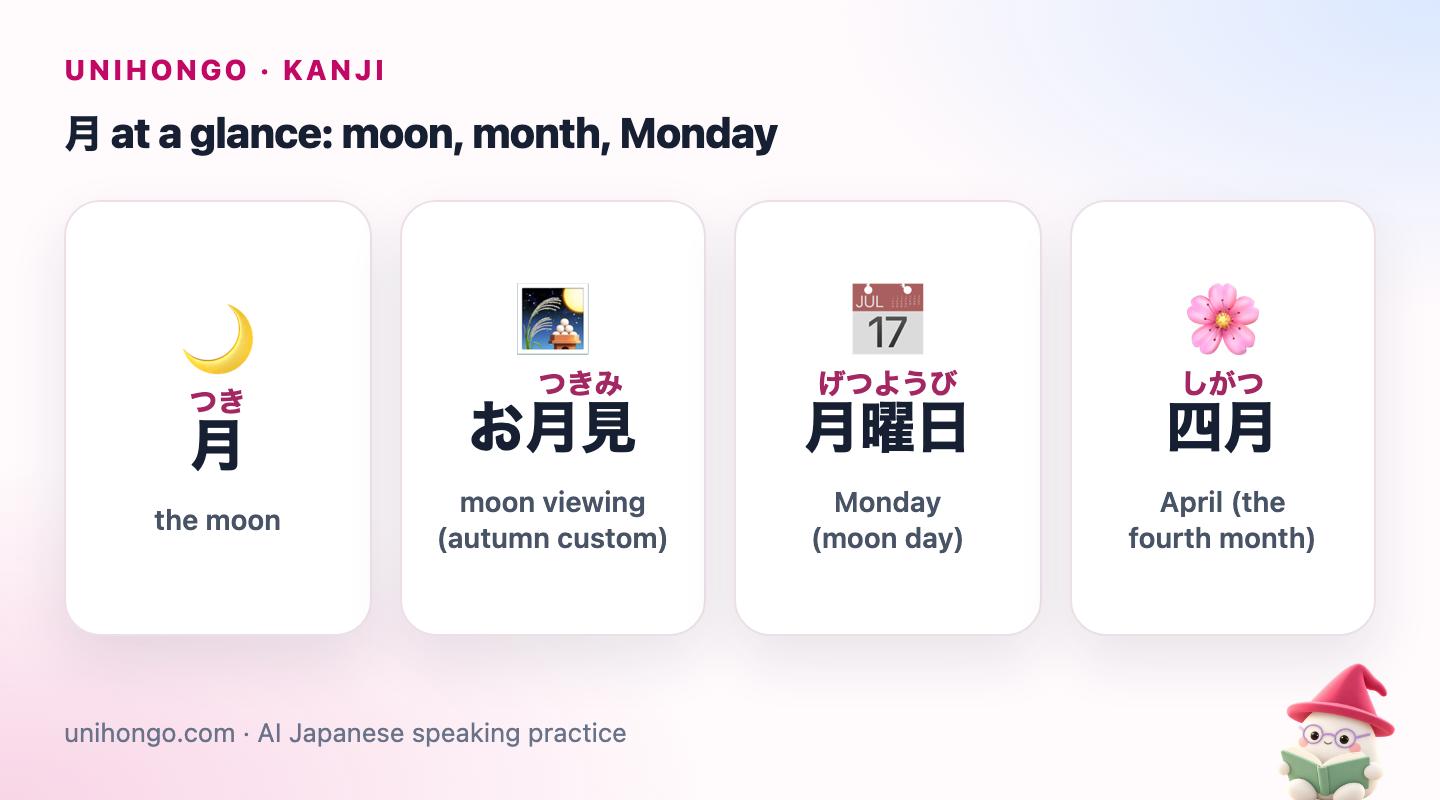
| Japanese | Romaji | Meaning |
|---|---|---|
| 月 | tsuki | the moon |
| お月見 | otsukimi | moon viewing (autumn custom) |
| 月曜日 | getsuyōbi | Monday (moon day) |
| 四月 | shigatsu | April (the fourth month) |
Three readings: tsuki, getsu and gatsu
月 has four strokes and is a pictograph, so it is not built from smaller parts. The tricky part is choosing the reading. Use this rule of thumb: the moon itself and native words use tsuki; the names of the twelve months use gatsu; most other Chinese-style words use getsu. A few words have more than one reading, and you simply learn those as they come.
| Japanese | Romaji | Meaning |
|---|---|---|
| 一か月 | ikkagetsu | (for) one month |
| 三か月 | sankagetsu | (for) three months |
| 二月 | nigatsu | February |
| Reading | Type | Used for | Examples |
|---|---|---|---|
| tsuki (zuki) | kun'yomi | the moon, native words | 月, tsuki; 毎月, maitsuki; 三日月, mikazuki |
| gatsu | on'yomi | the names of the months | 一月, ichigatsu; 十二月, jūnigatsu |
| getsu | on'yomi | most other compounds | 今月, kongetsu; 月曜日, getsuyōbi; 満月, mangetsu |
Counting months uses a different pattern again: ikkagetsu, one month; nikagetsu, two months; sankagetsu, three months. The small ka in between is often written ヶ or か, as in 一ヶ月 or 一か月, and both are common. Do not confuse nikagetsu, a period of two months, with nigatsu, February.
Twelve everyday words with 月
Here are the 月 words you will hear most, from the calendar on the office wall to the night sky. Notice the mix of readings: maitsuki and mikazuki use the native reading, while kongetsu and mangetsu use getsu.
| Japanese | Romaji | Meaning |
|---|---|---|
| 月日が経つのは早いですね。 | Tsukihi ga tatsu no wa hayai desu ne. | Time really flies, doesn't it? |
| 月末は忙しいです。 | Getsumatsu wa isogashii desu. | The end of the month is busy. |
Shōgatsu, often said politely as oshōgatsu, means the New Year period, not January as a whole: January is ichigatsu. Tsukihi is a gentle, slightly literary word for the passing of time, used in a classic line people say when they meet an old friend or see a child who has grown.
Otsukimi: viewing the autumn moon
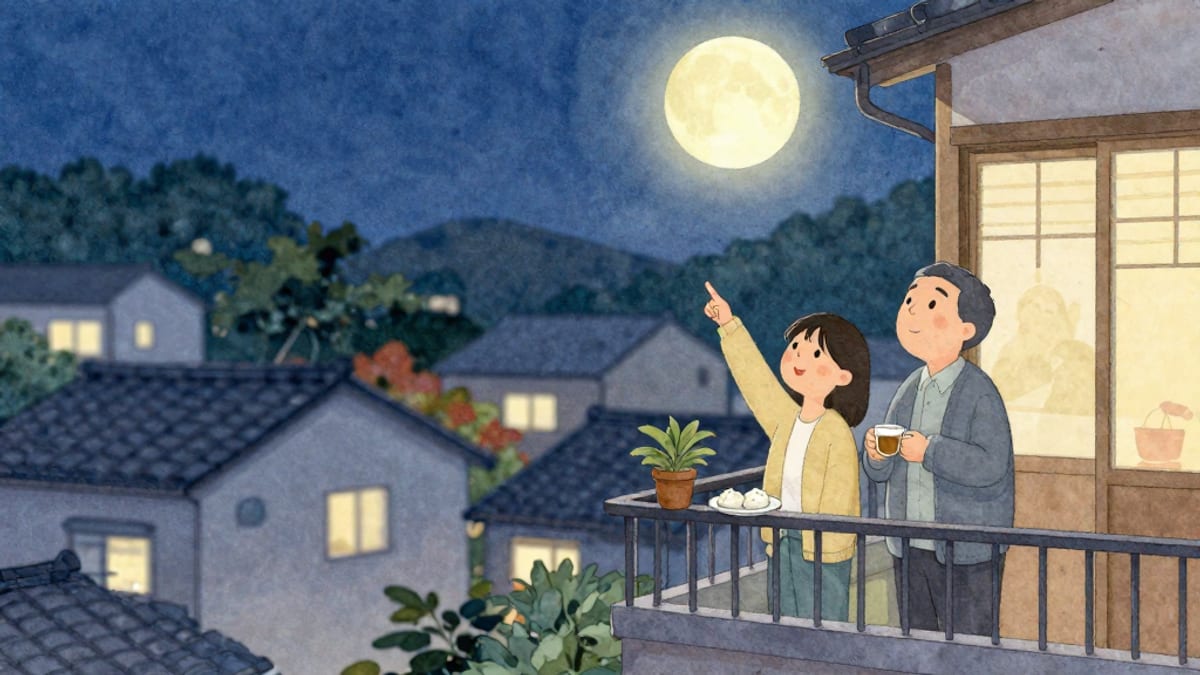
Otsukimi is the custom of admiring the autumn moon. The main night is jūgoya, the fifteenth night of the eighth month of the old lunar calendar, which falls in September or early October in the modern calendar and changes every year. Families who keep the custom place a small stand of white rice dumplings, tsukimi dango, near a window or on a veranda, add a vase of susuki, Japanese pampas grass, and sometimes seasonal produce such as taro or chestnuts. Then they simply look at the moon, perhaps with tea. How it is observed varies a lot by region and family, and many people just enjoy a look at the moon on the way home.
In Japan, the dark patches on the full moon are often said to be a rabbit pounding mochi. Many children grow up with this picture, and you will see moon rabbits on autumn sweets and decorations. Food names borrow the moon too: tsukimi soba or tsukimi udon is a bowl topped with a raw egg, whose yolk looks like the moon.
| Japanese | Romaji | Meaning |
|---|---|---|
| 月見団子 | tsukimi dango | moon-viewing rice dumplings |
| すすき | susuki | Japanese pampas grass |
| 十五夜 | jūgoya | the main moon-viewing night |
| 月見そば | tsukimi soba | soba topped with a raw egg |
| 月にうさぎがいるよ。 | Tsuki ni usagi ga iru yo. | There's a rabbit on the moon. (to a child) |
Mini dialogue: looking at the moon with your host family
| Japanese | Romaji | Meaning |
|---|---|---|
| 見て、今日は満月ですよ。 | Mite, kyō wa mangetsu desu yo. | Host father: Look, it's a full moon today. |
| わあ、本当だ。明るいですね。 | Wā, hontō da. Akarui desu ne. | You: Wow, it really is. It's so bright. |
| 今夜は十五夜なんです。 | Kon'ya wa jūgoya nan desu. | Host father: Tonight is the moon-viewing night. |
| だから団子があるんですね。 | Dakara dango ga aru n desu ne. | You: So that's why there are dumplings. |
| そうそう。一緒に食べましょう。 | Sō sō. Issho ni tabemashō. | Host father: Exactly. Let's eat them together. |
| 月がきれいですね。 | Tsuki ga kirei desu ne. | You: The moon is beautiful, isn't it? |
That last line has a famous story attached. It is often claimed that the novelist Natsume Sōseki once translated I love you as tsuki ga kirei desu ne, because a direct confession sounded too blunt. No reliable source for the story has been found, but it is so well known that some Japanese people will smile or tease you a little if you say it at a romantic moment. With a host family, it is simply a lovely, normal thing to say.
Old month names, sayings and names with 月
Before the modern numbered months, Japan used poetic names for each month. You still see them on traditional calendars, in letters, in shop names and in given names. Not all twelve contain 月 (the twelfth, shiwasu, is written 師走), but many do. Their spelling follows the old lunar calendar, so the season does not always match the modern month: satsuki, the fifth month, is often linked with planting rice seedlings, which happened around the rainy season.
| Japanese | Romaji | Meaning |
|---|---|---|
| 月とすっぽん | tsuki to suppon | as different as chalk and cheese |
| 美月 | Mizuki | beautiful moon · girl |
| 葉月 | Hazuki | the eighth month · girl |
| Month | Old name | Reading |
|---|---|---|
| January | 睦月 | mutsuki |
| February | 如月 | kisaragi |
| May | 皐月 | satsuki |
| June | 水無月 | minazuki |
| August | 葉月 | hazuki |
| October | 神無月 | kannazuki |
| November | 霜月 | shimotsuki |
Some of these are used as given names, especially Satsuki and Hazuki for girls. 月 also appears in names with other kanji, such as 美月, often read Mizuki, beautiful moon. As always with Japanese names, the same kanji can be read in several ways, so ask how a person reads their name.
The best-known moon saying compares the moon with a soft-shell turtle, suppon. Both are round, but one shines in the sky and the other lives in the mud, so tsuki to suppon describes two things that look a little alike but are worlds apart in quality.
Moon tattoos and designs
The moon is a popular design theme, linked in Japanese poetry with autumn, quiet nights and longing. A few points will help your design read well to Japanese eyes.
- 月 alone is clear and attractive, but it also means month and appears on every calendar and payslip. Some Japanese readers may read it as month first.
- A word removes the doubt: 満月 (mangetsu, full moon), 三日月 (mikazuki, crescent moon) or 月光 (gekkō, moonlight) all point clearly to the moon in the sky.
- Chinese and Japanese use 月 in the same way, for both moon and month, so there is no hidden difference between the two languages here.
- Do not combine 月 with 日 to make a sun-and-moon design without checking: 明 (akarui, bright) is already a kanji made of 日 and 月, and a homemade merge may look like a misspelling of it.
- Have a native speaker look at the exact characters and the brush style before you book the tattoo.
Look-alikes and common mistakes
月 is easy to confuse with three other boxy kanji. 日 (sun, day) is shorter and wider with one line inside. 目 (eye) is a tall box with two lines inside, closed at the bottom. 用 (use) adds a vertical line through the middle. And on the left of a kanji, the shape that looks like 月 is usually nikuzuki, flesh, as in the body-part kanji below.
| Japanese | Romaji | Meaning |
|---|---|---|
| 日 | hi | sun, day |
| 目 | me | eye |
| 腕 | ude | arm |
| 胸 | mune | chest |
- Saying yongatsu for April. It is shigatsu. July is shichigatsu and September is kugatsu.
- Saying ichigetsu for one month. A period of one month is ikkagetsu; ichigatsu is January.
- Reading 毎月 as maigetsu in everyday speech. It is usually maitsuki, although maigetsu also exists in formal use.
- Using shōgatsu to mean the whole of January. It is the New Year holiday period.
A month of 月: let Mocchi drill the readings
Sign in and ask Mocchi: Quiz me on the readings of 月 in month names, time words and moon words, mixing them up. Mocchi asks one at a time, explains why kongetsu is getsu but maitsuki is tsuki, and remembers which ones catch you out, so your next /review starts with them. You can also type /kanji 月 for the meaning, readings and common words, or ask Mocchi to fold a short month-names task into your study plan this week.
Then put the readings into sentences with Sentence Builder in the games: arrange chunks like raigetsu, Kyōto ni, ikimasu into the right order until dates and time words feel natural.