
Why sign kanji come before textbook kanji
Most kanji lists are ordered by school year or by exam level, which means a beginner spends early weeks on characters that rarely appear in the physical world. Sign kanji are ordered by the street instead. The same words appear on every platform, every shop shutter, and every packet of food, so each one you learn is repaid several times a day rather than once a chapter.
They are also forgiving to learn. A sign gives you the context for free: a character on a door is about opening, closing, pushing or pulling, and a character on a shelf edge is about price or date. You are guessing from a very short list of possibilities, so partial knowledge is genuinely useful in a way that partial knowledge of a rare literary kanji is not.
The compressed grammar of signs
Written notices strip a sentence down to its core. Particles disappear, the verb desu is understood rather than printed, and a compound noun does the work. Tachiiri kinshi is literally entering-prohibition, and a reader supplies the rest. Once you accept that signs are labels rather than sentences, they stop looking like broken Japanese and start looking like a system.
Three suffixes carry most of the meaning. Kinshi marks something forbidden, chū marks a state that is currently in progress, and chūi marks something you should be careful of rather than something banned. Genkin is a stronger, absolute prohibition, used for fire and similar hazards. Politer public notices soften instead, with go-enryo kudasai meaning please refrain, and o-negai shimasu meaning we ask you to.
- Noun plus kinshi: forbidden, as in satsuei kinshi, photography prohibited.
- Noun plus chū: currently happening, as in kōjichū, work in progress.
- Noun plus chūi: be careful of this, as in ashimoto chūi, watch your step.
- Noun plus genkin: absolutely forbidden, as in kaki genkin, no open flames.
- Verb stem plus kudasai or go-enryo kudasai: a polite request rather than a ban.
Stations, platforms, and transfers
| Sign | Reading | Meaning |
|---|---|---|
| 入口 | Iriguchi | Entrance |
| 出口 | Deguchi | Exit |
| 非常口 | Hijōguchi | Emergency exit |
| 改札口 | Kaisatsuguchi | Ticket gate |
| 東口 | Higashi-guchi | East exit |
| 西口 | Nishi-guchi | West exit |
| 南口 | Minami-guchi | South exit |
| 北口 | Kita-guchi | North exit |
| 乗換 | Norikae | Transfer to another line |
| 精算 | Seisan | Fare adjustment |
| 精算機 | Seisanki | Fare adjustment machine |
| 券売機 | Kenbaiki | Ticket machine |
| 各駅停車 | Kakueki teisha | Local train, stops at every station |
| 快速 | Kaisoku | Rapid service |
| 急行 | Kyūkō | Express |
| 特急 | Tokkyū | Limited express |
| 普通 | Futsū | Local service |
| 番線 | Bansen | Platform number |
| 上り | Nobori | Inbound, toward the main city |
| 下り | Kudari | Outbound, away from the main city |
| 優先席 | Yūsenseki | Priority seat |
| 自由席 | Jiyūseki | Non-reserved seat |
| 指定席 | Shiteiseki | Reserved seat |
| 運賃 | Unchin | Fare |
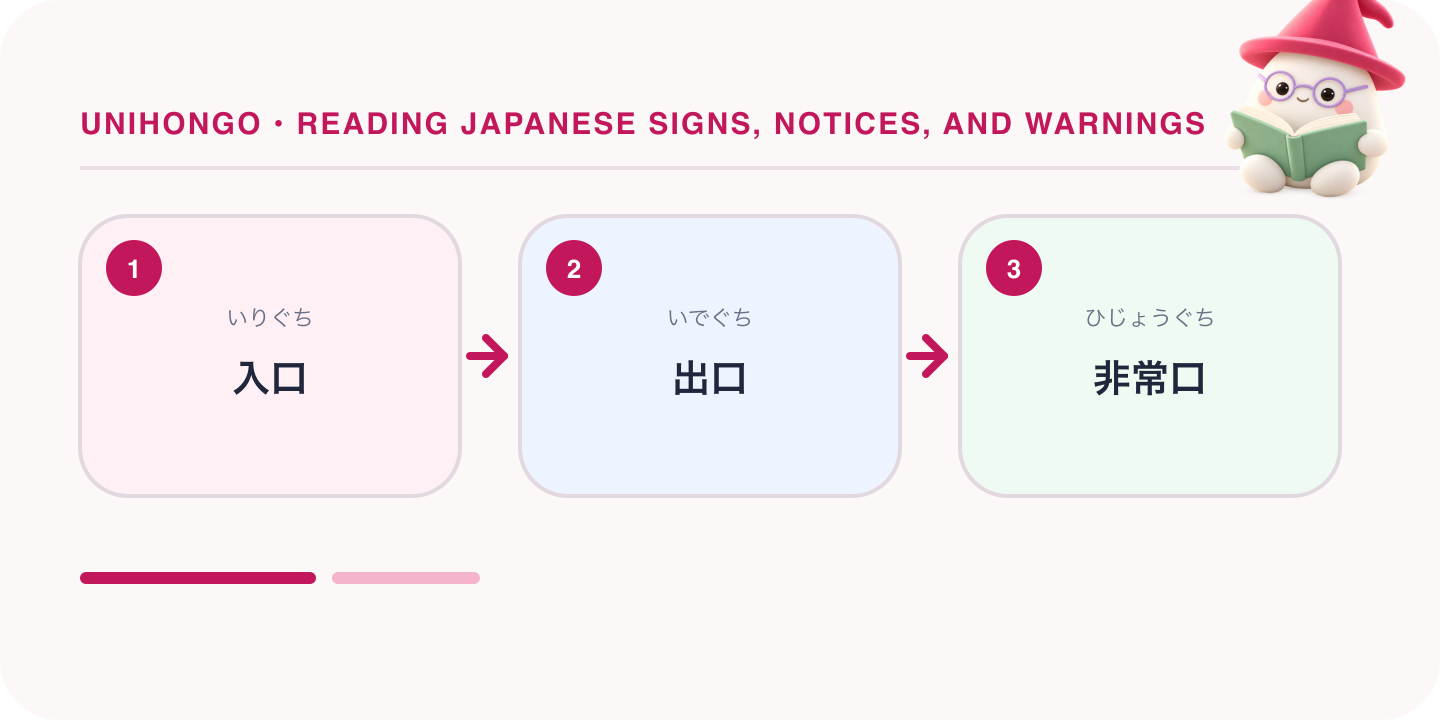
Notice how often the character guchi appears. It means an opening, so it turns any preceding word into a way in or out: iriguchi, deguchi, hijōguchi, kaisatsuguchi. If you are meeting someone at a large station, the compass exits matter more than the station name itself, because a big station may have exits several minutes' walk apart.
Doors, floors, and rooms
| Sign | Reading | Meaning |
|---|---|---|
| 押 | Osu | Push |
| 引 | Hiku | Pull |
| 開 | Hiraku | Open, also the open button in a lift |
| 閉 | Shimaru | Close, also the close button in a lift |
| 男 | Otoko | Men |
| 女 | Onna | Women |
| 男子 | Danshi | Men, on public facilities |
| 女子 | Joshi | Women, on public facilities |
| お手洗い | Otearai | Toilet |
| 化粧室 | Keshōshitsu | Restroom, a politer sign |
| 使用中 | Shiyōchū | In use, occupied |
| 空室 | Kūshitsu | Vacant room |
| 満室 | Manshitsu | No rooms available |
| 受付 | Uketsuke | Reception |
| 案内 | Annai | Information |
| 会計 | Kaikei | Cashier |
| 地下 | Chika | Basement level |
| 屋上 | Okujō | Rooftop |
| 階段 | Kaidan | Stairs |
| 非常階段 | Hijō kaidan | Emergency stairs |
The push and pull pair is the one worth burning in first, because getting it wrong is the most common small embarrassment for a new arrival. On a glass door the character is usually printed at eye height on the side you act on. In a lift, the wider button with 開 holds the doors open and the one with 閉 closes them.
Open, closed, and everything in between
| Sign | Reading | What it tells you |
|---|---|---|
| 営業中 | Eigyōchū | Open for business right now |
| 準備中 | Junbichū | Preparing, not open yet |
| 本日休業 | Honjitsu kyūgyō | Closed today |
| 定休日 | Teikyūbi | The regular weekly closing day |
| 営業時間 | Eigyō jikan | Opening hours |
| 休憩中 | Kyūkeichū | On a break |
| 点検中 | Tenkenchū | Under inspection |
| 故障中 | Koshōchū | Out of order |
| 工事中 | Kōjichū | Under construction |
| 満席 | Manseki | All seats taken |
| 予約席 | Yoyakuseki | Reserved table |
| 貸切 | Kashikiri | Booked for a private event |
Junbichū is the one that catches people out. A restaurant showing it is not closed for the day; it is between services, usually in the afternoon, and will reopen in the evening. Teikyūbi is worth reading carefully too, since it is followed by a day of the week and often the phrase meaning except public holidays.
Warnings and prohibitions
| Sign | Reading | Meaning |
|---|---|---|
| 危険 | Kiken | Danger |
| 注意 | Chūi | Caution |
| 警告 | Keikoku | Warning |
| 禁止 | Kinshi | Prohibited |
| 立入禁止 | Tachiiri kinshi | No entry |
| 関係者以外立入禁止 | Kankeisha igai tachiiri kinshi | Authorised personnel only |
| 火気厳禁 | Kaki genkin | No open flames |
| 土足禁止 | Dosoku kinshi | No outdoor shoes |
| 禁煙 | Kin'en | No smoking |
| 撮影禁止 | Satsuei kinshi | No photography |
| 進入禁止 | Shinnyū kinshi | No entry for vehicles |
| 駐車禁止 | Chūsha kinshi | No parking |
| 使用禁止 | Shiyō kinshi | Do not use |
| 足元注意 | Ashimoto chūi | Watch your step |
| 頭上注意 | Zujō chūi | Mind your head |
| 段差注意 | Dansa chūi | Mind the step |
| 落石注意 | Rakuseki chūi | Beware of falling rocks |
| 水深注意 | Suishin chūi | Beware of deep water |
| 立入禁止区域 | Tachiiri kinshi kuiki | Restricted area |
| ご遠慮ください | Go-enryo kudasai | Please refrain from this |
Guessing a sign from its parts
You do not need to know a compound to make a good guess at it. A small set of single characters carries most of the meaning on public notices, and they combine in predictable ways. If a sign contains the character for fire and the character for forbid, you can act correctly without ever having seen that exact pairing before.
| Element | Reading in compounds | What it signals |
|---|---|---|
| 口 | guchi, kō | An opening, a way in or out |
| 中 | chū | Currently in progress |
| 禁 | kin | Forbidden |
| 止 | shi, tomeru | Stop or halt |
| 注 | chū | Pour attention onto, pairs with i to make caution |
| 危 | ki | Danger |
| 火 | ka, hi | Fire |
| 水 | sui, mizu | Water |
| 電 | den | Electricity |
| 非常 | hijō | Emergency |
| 要 | yō | Requires, must have |
| 無 | mu | Without, none |
| 有 | yū | With, has |
| 料 | ryō | Charge or fee |
| 期限 | kigen | Deadline or expiry |
| 専用 | sen'yō | For the exclusive use of |
Two of these pairs are especially productive. Muryō and yūryō, free and paid, appear on lockers, parking, bags and Wi-Fi. Yōreizō and yōreitō, requires refrigeration and requires freezing, appear on anything you carry home. Sen'yō is the one that quietly excludes you: josei sen'yō means women only, and kankeisha sen'yō means staff only.
Prices, packaging, and dates
| Sign | Reading | Meaning |
|---|---|---|
| 無料 | Muryō | Free of charge |
| 有料 | Yūryō | Chargeable |
| 割引 | Waribiki | Discount |
| 半額 | Hangaku | Half price |
| 特価 | Tokka | Special price |
| 税込 | Zeikomi | Tax included |
| 税抜 | Zeinuki | Before tax |
| 賞味期限 | Shōmi kigen | Best-before date, quality |
| 消費期限 | Shōhi kigen | Use-by date, safety |
| 要冷蔵 | Yōreizō | Keep refrigerated |
| 要冷凍 | Yōreitō | Keep frozen |
| 開封後 | Kaifūgo | After opening |
| 原材料 | Genzairyō | Ingredients |
| 産地 | Sanchi | Place of production |
| 数量限定 | Sūryō gentei | Limited quantity |
| 本日限り | Honjitsu kagiri | Today only |
| お一人様一点 | O-hitorisama itten | One item per person |
| 持ち帰り | Mochikaeri | Takeaway |
| 店内 | Tennai | Eat in, inside the shop |
The two date words are not interchangeable. Shōmi kigen is about quality, so a packet slightly past it is usually still edible even if it is no longer at its best. Shōhi kigen is about safety and appears on fresh items such as bentō and sandwiches, and it should be respected. Both are usually printed as year, month, day in that order.
Asking someone what a sign means
These are the lines that turn a wall of characters into a short conversation. Keep them very short: staff are usually busy, and a pointed finger plus one clear question gets a faster answer than a long apology. Lines marked staff are what you will hear back, so read them aloud too rather than only the ones you say.
| Japanese | Romaji | Meaning |
|---|---|---|
| すみません、この漢字は何と読みますか。 | Sumimasen, kono kanji wa nan to yomimasu ka? | Excuse me, how do you read this kanji? |
| これはどういう意味ですか。 | Kore wa dō iu imi desu ka? | What does this mean? |
| ここに書いてあることが読めません。 | Koko ni kaite aru koto ga yomemasen. | I cannot read what is written here. |
| ひらがなで書いていただけますか。 | Hiragana de kaite itadakemasu ka? | Could you write it in hiragana for me? |
| もう少しゆっくり言ってもらえますか。 | Mō sukoshi yukkuri itte moraemasu ka? | Could you say that a little more slowly? |
| 英語の表示はありますか。 | Eigo no hyōji wa arimasu ka? | Is there an English sign anywhere? |
| ここは入ってもいいですか。 | Koko wa haitte mo ii desu ka? | Is it all right to go in here? |
| ここは立入禁止ですか。 | Koko wa tachiiri kinshi desu ka? | Is entry prohibited here? |
| はい、関係者以外は入れません。 | Hai, kankeisha igai wa hairemasen. | Staff: Yes, only authorised people may enter. |
| そこは今、工事中です。 | Soko wa ima, kōjichū desu. | Staff: That area is under construction at the moment. |
Checking a rule, a platform, and a price
| Japanese | Romaji | Meaning |
|---|---|---|
| 今、営業していますか。 | Ima, eigyō shite imasu ka? | Are you open at the moment? |
| 準備中なので、十一時からです。 | Junbichū na node, jūichi-ji kara desu. | Staff: We are still setting up, so we open at eleven. |
| 定休日はいつですか。 | Teikyūbi wa itsu desu ka? | Which day are you closed? |
| 何時までですか。 | Nan-ji made desu ka? | Until what time are you open? |
| ここで写真を撮ってもいいですか。 | Koko de shashin o totte mo ii desu ka? | May I take photographs here? |
| 申し訳ありません、撮影は禁止です。 | Mōshiwake arimasen, satsuei wa kinshi desu. | Staff: I am sorry, photography is not permitted. |
| 靴は脱いだほうがいいですか。 | Kutsu wa nuida hō ga ii desu ka? | Should I take my shoes off? |
| はい、ここから土足禁止です。 | Hai, koko kara dosoku kinshi desu. | Staff: Yes, no outdoor shoes beyond this point. |
| このドアは押しますか、引きますか。 | Kono doa wa oshimasu ka, hikimasu ka? | Do I push this door or pull it? |
| この席は優先席ですか。 | Kono seki wa yūsenseki desu ka? | Is this a priority seat? |
| 乗り換えはどこですか。 | Norikae wa doko desu ka? | Where do I change trains? |
| 東口はどちらですか。 | Higashi-guchi wa dochira desu ka? | Which way is the east exit? |
| この電車は各駅停車ですか。 | Kono densha wa kakueki teisha desu ka? | Is this train a local service? |
| いいえ、快速です。 | Iie, kaisoku desu. | Staff: No, it is a rapid service. |
| 精算機はどこにありますか。 | Seisanki wa doko ni arimasu ka? | Where is the fare adjustment machine? |
| 切符が足りませんでした。 | Kippu ga tarimasen deshita. | My ticket did not cover the fare. |
| 何番線ですか。 | Nan-bansen desu ka? | Which platform is it? |
| これは税込みですか。 | Kore wa zeikomi desu ka? | Is this price tax included? |
| 税抜きの表示です。 | Zeinuki no hyōji desu. | Staff: The price shown is before tax. |
| 賞味期限はいつまでですか。 | Shōmi kigen wa itsu made desu ka? | How long is the best-before date? |
| これは冷蔵庫に入れますか。 | Kore wa reizōko ni iremasu ka? | Does this need to go in the fridge? |
| はい、要冷蔵です。 | Hai, yōreizō desu. | Staff: Yes, it has to be kept refrigerated. |
| この割引はいつまでですか。 | Kono waribiki wa itsu made desu ka? | How long does this discount run for? |
| 試食は無料ですか。 | Shishoku wa muryō desu ka? | Is the sample free? |
Asking before acting is normal and welcome, and it is far cheaper than apologising afterwards. If the answer comes back too fast to follow, the safest recovery is mō ichido onegai shimasu, which asks for one more repetition without claiming that you understood the first time.
A two-week plan for sign kanji
- Days one to three: the openings. Iriguchi, deguchi, hijōguchi, kaisatsuguchi, and the four compass exits.
- Days four to six: the doors. Osu, hiku, hiraku, shimaru, otoko, onna, shiyōchū, kūshitsu.
- Days seven to nine: the states. Eigyōchū, junbichū, teikyūbi, kōjichū, koshōchū, and the chū suffix as a pattern.
- Days ten to twelve: the warnings. Kiken, chūi, kinshi, tachiiri kinshi, kaki genkin, dosoku kinshi.
- Days thirteen and fourteen: the shelf. Muryō, waribiki, zeikomi, shōmi kigen, shōhi kigen, yōreizō.
- Every day, say one full sentence per sign rather than the reading alone, so the word arrives attached to speech.
Two weeks of five characters a day covers almost everything above, and unlike a general kanji list you will see the results the moment you leave the house. Once the set is solid, add the words you personally keep meeting: a commuter needs the platform vocabulary, while someone cooking at home needs the packaging words far more.