
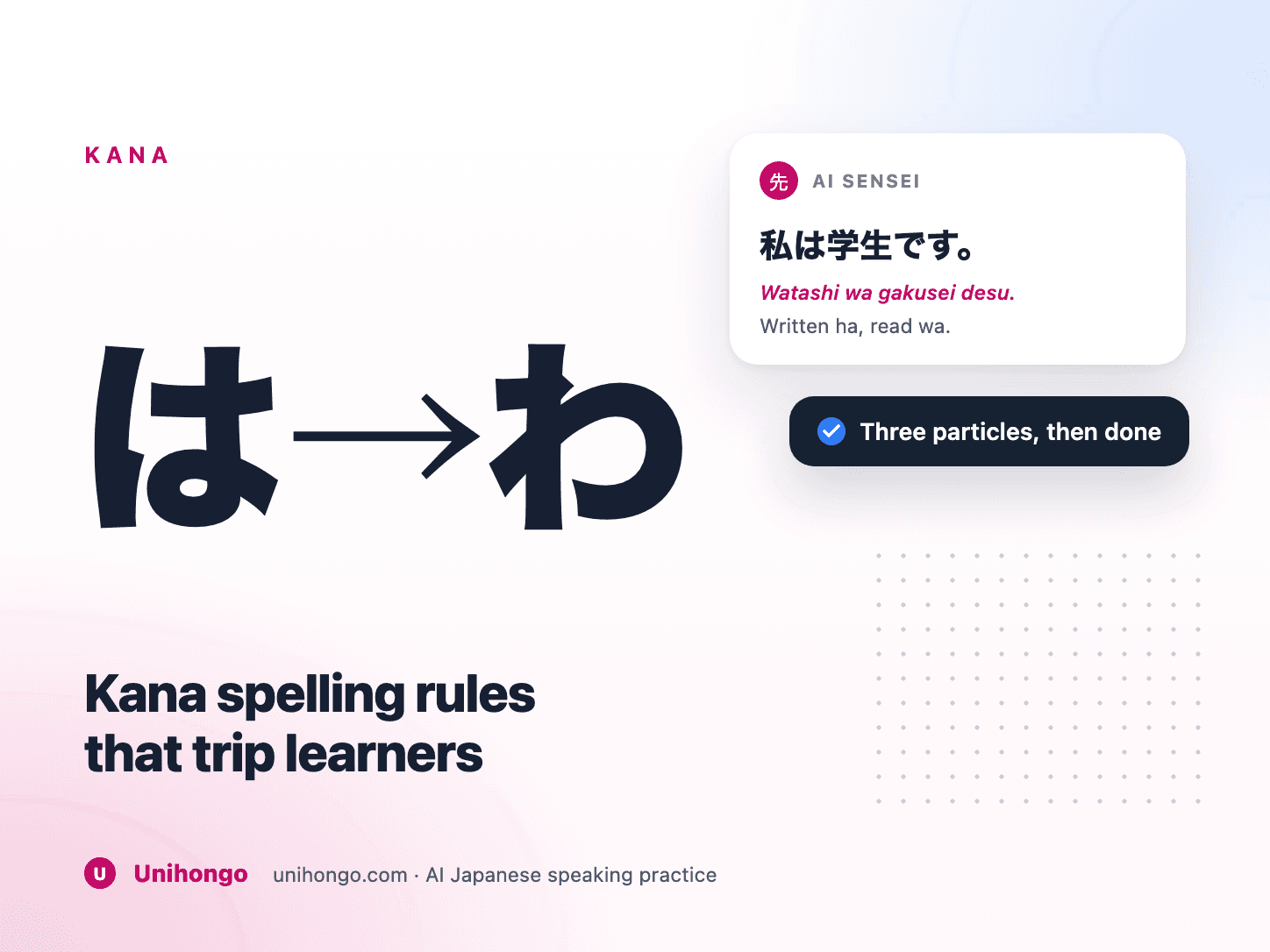
The three particles
These are the first exceptions every learner meets and the most important, because the three particles concerned appear in almost every sentence.
In each case the spelling preserves an older pronunciation. The rule is simple: when the character is being used as a particle, it takes the older reading; everywhere else it is read normally.
| Japanese | Romaji | Meaning |
|---|---|---|
| は | wa | As a particle; otherwise read ha |
| へ | e | As a particle; otherwise read he |
| を | o | Only used as a particle |
| 私は学生です。 | Watashi wa gakusei desu. | The topic particle, read wa |
| 東京へ行きます。 | Tōkyō e ikimasu. | The direction particle, read e |
| 本を読みます。 | Hon o yomimasu. | The object particle, read o |
Long o, spelled two ways
A long o sound is written either by adding the u character or by adding the o character, and which one a word takes is fixed rather than chosen.
The version with u is far more common. The version with o appears in a shorter list of words, several of which are everyday vocabulary, so they are worth learning as a set.
| Japanese | Romaji | Meaning |
|---|---|---|
| とうきょう | Tōkyō | Long o with u, the common pattern |
| おおきい | ōkii | Long o with o: big |
| とおい | tōi | Long o with o: far |
| おおい | ōi | Long o with o: many |
| とおる | tōru | Long o with o: to pass through |
| こおり | kōri | Long o with o: ice |
The five words spelled with o here cover a good part of the list. Learning them as a group saves guessing later.
The kana that sound the same
Two pairs of voiced kana are pronounced identically in modern standard Japanese. This is a spelling matter rather than a pronunciation one, and trying to hear a difference is not productive.
Which spelling a word uses is fixed. The less common member of each pair appears mainly where a word has been voiced inside a compound, or in a handful of set words.
| Pair | Pronunciation | When the rarer one appears |
|---|---|---|
| じ / ぢ | Identical | In compounds, and set words |
| ず / づ | Identical | In compounds, and set words |
A useful rule of thumb: if the word is a compound whose second element began with the unvoiced character, the rarer spelling is likely.
Long e and long i
Long e is usually written by adding the i character rather than the e character, which surprises learners who expect the vowel to be doubled.
Long i is written by adding the i character, which is the straightforward case.
| Japanese | Romaji | Meaning |
|---|---|---|
| せんせい | sensei | Long e written with i |
| えいが | eiga | Long e written with i: film |
| とけい | tokei | Long e written with i: clock |
| おねえさん | onēsan | Long e written with e: older sister |
| おいしい | oishii | Long i, straightforwardly |
| ちいさい | chiisai | Long i: small |
Why the exceptions exist
All of these come from the same source: the spelling was standardised at a point when the pronunciation was different, and the writing did not follow the sound as it changed.
Knowing that is not required to use the language, but it makes the exceptions feel like history rather than arbitrariness, which makes them easier to accept and remember.
- The particle spellings preserve older readings of those characters.
- The duplicate kana pairs were once distinct sounds and merged.
- The two ways of writing long o reflect different historical origins.
- Modern spelling was reformed in the twentieth century, which removed many more exceptions than it left.
What to actually learn
The practical list is short. Three particle exceptions, one list of long-o words, and an awareness that two kana pairs are homophones. That is the whole of it.
The particles come first because they appear in every sentence, and they become automatic within days of reading real text rather than needing drilling.
Everything else is learned word by word as you meet it. Because kana is otherwise regular, these exceptions stand out and stick quickly, which is the advantage of a script that is nearly phonetic rather than one that is not.
Do not let these shake your confidence in kana. Compared with the spelling of most languages, a handful of exceptions is remarkably little.