

Land and water: 山 川 海 湖 島 田 石
These seven characters describe the shape of the country. 山 yama, mountain, is the most common of all, and Japan has so many that 山 appears in hundreds of surnames and place names. 川 kawa, river, is three strokes of flowing water, and it becomes gawa after another word: Ishikawa but Kamogawa. 海 umi, sea, carries the water radical, and 湖 mizuumi, lake, literally water-sea, is read ko in Biwako, Lake Biwa.
島 shima, island, contains a bird over a mountain, a bird resting on a rock in the sea. It is jima after a vowel in many names, as in Hiroshima and Miyajima. 田 ta, rice field, is a picture of divided paddies, and it is da in Yamada and Honda. 石 ishi, stone, is a cliff with a rock beneath it, and it is read seki in 石油 sekiyu, oil, and 石鹸 sekken, soap.
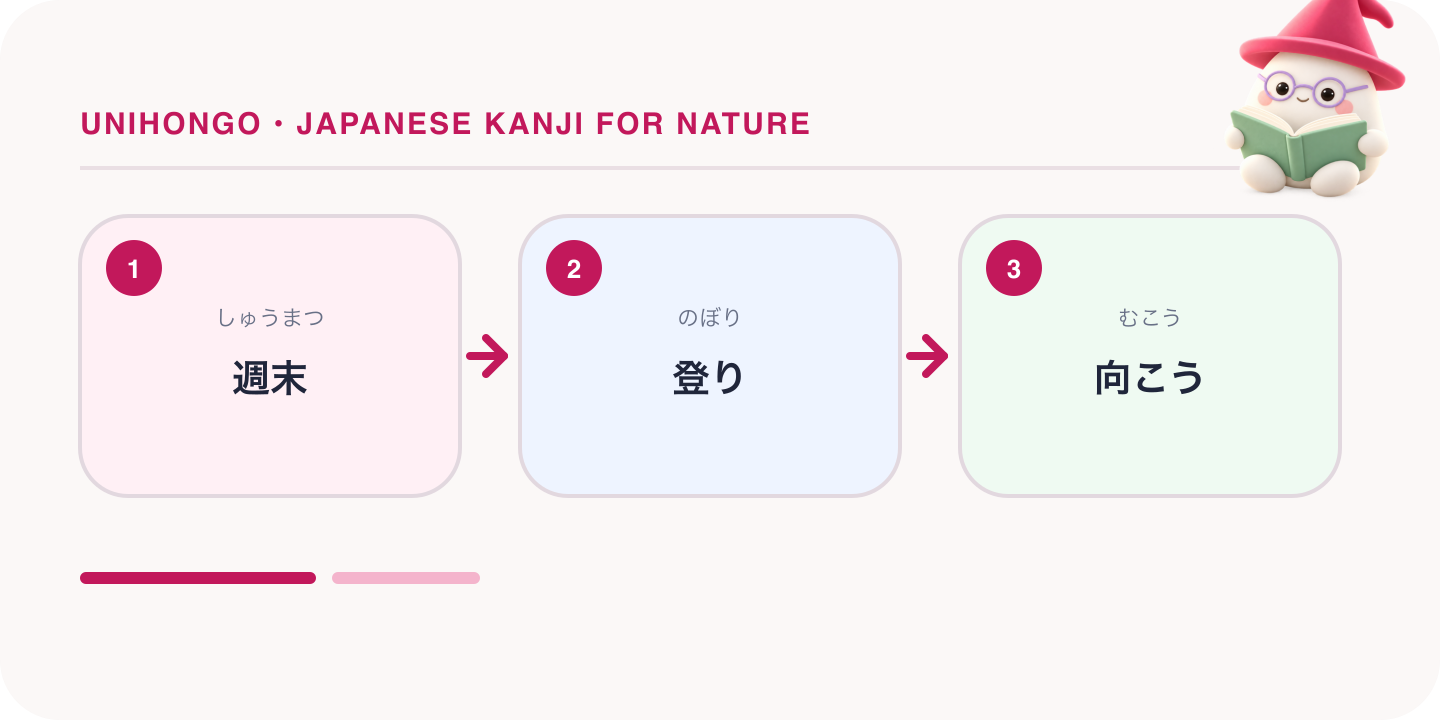
| Japanese | Romaji | Meaning |
|---|---|---|
| 週末は山に登りました。 | Shūmatsu wa yama ni noborimashita. | At the weekend I climbed a mountain. |
| 川の向こうに駅があります。 | Kawa no mukō ni eki ga arimasu. | The station is on the other side of the river. |
| 海が見えるホテルに泊まりたいです。 | Umi ga mieru hoteru ni tomaritai desu. | I want to stay at a hotel with a sea view. |
| 琵琶湖は日本で一番大きい湖です。 | Biwako wa Nihon de ichiban ōkii mizuumi desu. | Lake Biwa is the biggest lake in Japan. |
| この島にはフェリーで行きます。 | Kono shima ni wa ferī de ikimasu. | You go to this island by ferry. |
| Kanji | Reading | Meaning |
|---|---|---|
| 山 | san, yama | mountain; Fujisan, yamanobori (climbing), Yamada |
| 川 | sen, kawa | river; kawa, Ishikawa, Kamogawa |
| 海 | kai, umi | sea; umi, kaigan (coast), Hokkaidō |
| 湖 | ko, mizuumi | lake; Biwako, mizuumi |
| 島 | tō, shima | island; Hiroshima, hantō (peninsula) |
| 田 | den, ta | rice field; Tanaka, Yamada, suiden (paddy) |
| 石 | seki, ishi | stone; ishi, Ishikawa, sekiyu (oil) |
| 空 | kū, sora, kara, a(ku) | sky, empty; sora, kūkō (airport), kūki (air) |
Sky and light: 空 星 光
空 has two lives. As sora it is the sky above you; as kū it is emptiness and air, which gives you 空港 kūkō, airport, 空気 kūki, air, and 空席 kūseki, an empty seat. The link is that the sky is the great empty space. On a hotel sign 空室 means vacancies, and the reading there is kūshitsu.
星 hoshi, star, is the sun above a growing plant, and it is sei in 星座 seiza, constellation, and 火星 Kasei, Mars. 光 hikari, light, is a person carrying fire on their head, and it is kō in 観光 kankō, sightseeing, and 日光 Nikkō, both the town and the word for sunlight. The verb hikaru means to shine, and it is the everyday word for a light that glints or a screen that glows.
| Japanese | Romaji | Meaning |
|---|---|---|
| 今夜は星がきれいですね。 | Kon'ya wa hoshi ga kirei desu ne. | The stars are beautiful tonight, aren't they? |
| 空港まで電車で一時間かかります。 | Kūkō made densha de ichijikan kakarimasu. | It takes an hour by train to the airport. |
| 今日は空が青いです。 | Kyō wa sora ga aoi desu. | The sky is blue today. |
| 観光案内所はどこですか。 | Kankō annaijo wa doko desu ka. | Where is the tourist information office? |
| 遠くに光が見えます。 | Tōku ni hikari ga miemasu. | I can see a light in the distance. |
Plants and trees: 木 林 森 花 草
The tree family is the one every learner remembers. 木 ki is a tree, 林 hayashi is a wood made of two, and 森 mori is a forest made of three. The on readings are moku, rin and shin: 木曜日 mokuyōbi, Thursday, 森林 shinrin, forest. 木 is also read ko in a few words such as 木陰 kokage, tree shade, and boku in 大木 taiboku, a great tree.
花 hana, flower, has the grass radical over 化 change, a plant that changes, and it is ka in 花瓶 kabin, vase, and 花火 hanabi keeps the kun reading. 草 kusa, grass, has the same grass radical over 早, and it is sō in 草原 sōgen, grassland. The grass radical, kusakanmuri, sits on top of dozens of plant names, from 茶 tea to 菜 vegetables, so once you know it you can guess that a character on a menu is a plant.
| Japanese | Romaji | Meaning |
|---|---|---|
| 春になると花が咲きます。 | Haru ni naru to hana ga sakimasu. | When spring comes the flowers bloom. |
| 森の中は涼しいです。 | Mori no naka wa suzushii desu. | It is cool inside the forest. |
| 庭の草を抜きました。 | Niwa no kusa o nukimashita. | I pulled the weeds in the garden. |
| 木曜日に花見に行きませんか。 | Mokuyōbi ni hanami ni ikimasen ka. | Shall we go cherry blossom viewing on Thursday? |
| この木は何の木ですか。 | Kono ki wa nan no ki desu ka. | What kind of tree is this? |
| Kanji | Reading | Meaning |
|---|---|---|
| 木 | moku, boku, ki | tree, wood; ki, mokuyōbi (Thursday), Kimura |
| 林 | rin, hayashi | wood, grove; Hayashi, Kobayashi, ringyō (forestry) |
| 森 | shin, mori | forest; Mori, shinrin (forest), Aomori |
| 花 | ka, hana | flower; hana, hanami, hanabi (fireworks), kabin (vase) |
| 草 | sō, kusa | grass; kusa, sōgen (grassland), zassō (weeds) |
| 星 | sei, shō, hoshi | star; hoshi, seiza (constellation), Kasei (Mars) |
| 光 | kō, hikari, hika(ru) | light; hikari, kankō (sightseeing), Nikkō |
How nature kanji build place names and surnames
Once you know these fifteen characters, a large part of the map opens up. Place names usually keep the kun reading, so 山 is yama, 川 is kawa and 田 is ta, and they combine with a small set of position words: 上 kami or ue, 下 shimo or shita, 中 naka, 本 moto, 小 ko and 大 ō. The result is a description of where the family lived or where the village stood.
The commonest surnames in Japan are almost all built this way. Reading them is a good test: Yamada, mountain rice field; Yamamoto, foot of the mountain; Kobayashi, small wood; Tanaka, in the rice fields; Ishikawa, stone river; Nakajima, middle island; Mori, forest; Hayashi, wood. Station names follow the same logic, and so do prefectures: Yamaguchi, mountain mouth; Ishikawa; Yamagata, mountain shape; Aomori, blue forest.
| Japanese | Romaji | Meaning |
|---|---|---|
| 田中と申します。田んぼの田に、中です。 | Tanaka to mōshimasu. Tanbo no ta ni, naka desu. | My name is Tanaka: the ta of rice field and naka, middle. |
| お名前はどう書きますか。 | O-namae wa dō kakimasu ka. | How do you write your name? |
| 山本の本は、本の本です。 | Yamamoto no moto wa, hon no hon desu. | The moto of Yamamoto is the hon of book. |
- 山田 Yamada, 山本 Yamamoto, 山口 Yamaguchi, 山下 Yamashita, 山崎 Yamazaki: mountain names
- 小林 Kobayashi, 林 Hayashi, 森 Mori, 大森 Ōmori, 森田 Morita: wood and forest names
- 田中 Tanaka, 山田 Yamada, 本田 Honda, 池田 Ikeda, 前田 Maeda: rice field names
- 石川 Ishikawa, 石田 Ishida, 大石 Ōishi: stone names
- 川口 Kawaguchi, 中川 Nakagawa, 小川 Ogawa, 川崎 Kawasaki: river names
- 中島 Nakajima, 大島 Ōshima, 島田 Shimada, 広島 Hiroshima: island names
- 花田 Hanada, 星野 Hoshino, 光田 Mitsuda, 草野 Kusano, 湖東 Kotō: flower, star, light, grass and lake names
Notice 光 read mitsu in names such as Mitsuda and Mitsuo: name readings, nanori, often differ from the dictionary readings, and 光 is one of the commonest cases. When in doubt, ask, or look for furigana on the name badge.
Where you meet these kanji
Nature kanji are on the map, on the weather forecast and on the menu, and the more places you spot them the faster they settle.
- Railway maps and station signs: 山手線 Yamanote line, 中野 Nakano, 品川 Shinagawa, 川崎 Kawasaki
- Weather forecasts: 山沿い along the mountains, 海上 at sea, 晴れ clear, 星空 starry sky
- Hiking and trail signs: 山頂 summit, 登山口 trailhead, 湖畔 lakeside, 川原 riverbank
- Hotels and tourism: 空室 vacancies, 海側 sea side, 山側 mountain side, 観光 sightseeing
- Menus and shops: 山菜 mountain vegetables, 海鮮 seafood, 草餅 mugwort rice cake, 石焼 stone-grilled
- Festivals and the calendar: 花火大会 fireworks display, 花見 blossom viewing, 七夕 with its star-crossed lovers
Look-alike kanji and reading traps
Because these characters are simple, a single stroke separates several of them from unrelated kanji. These are the pairs to check.
| Japanese | Romaji | Meaning |
|---|---|---|
| 木と本は一画違います。 | Ki to hon wa ikkaku chigaimasu. | Tree and book differ by one stroke. |
| 石と右は似ていますね。 | Ishi to migi wa nite imasu ne. | Stone and right look alike, don't they? |
- 木 tree and 本 book: 本 adds a short bar at the base; 本 also means origin, as in Yamamoto
- 石 stone and 右 right: 右 has a hand on top of the mouth; 石 has a cliff over a rock
- 田 rice field and 由 reason: 由 pokes a stroke above the box, as in 自由, freedom
- 川 river and 州 state or sandbank: 州 adds three dots, as in 本州, Honshu
- 空 sky and 究 research: same hole radical on top; 究 has 九 underneath, as in 研究
- 星 star and 昼 daytime: both start with the sun; 星 has 生 below, 昼 has a flat base
- 山 in Fujisan is san, in Yamada it is yama, in Kōyasan it is zan: named mountains use the on reading
A three-week study plan
Fifteen picture-like kanji are quick to recognise, so the plan puts most of the effort into readings and names. Ten to fifteen minutes a day is enough.
- Week 1: land and water. Learn 山 川 海 湖 島 田 石 with kun readings first, then draw a map of an imaginary town and label it in kanji
- Week 2: sky, light and plants. Learn 空 星 光 木 林 森 花 草 with one compound each, and write five sentences about a real walk or view
- Week 3: names. Take the surname list in this article and read it aloud without looking at the romaji, then find ten station names on a railway map and decode them
- Every day: five minutes in Unihongo's free learning games on this set, then describe today's weather and one place you can see from your window
At the end of the third week, open any Japanese railway map and count the stations you can read. It will be more than you expect, and each one is a free review.