
涙 at a glance
涙 means tears. It is not a beginner kanji, but it is everywhere in songs, novels, manga and TV, so you meet it early. The verb to cry is written with a different kanji, 泣 in 泣く, and a third kanji, 鳴, sounds the same but belongs to animals. Sorting these three out is the main job of this post.
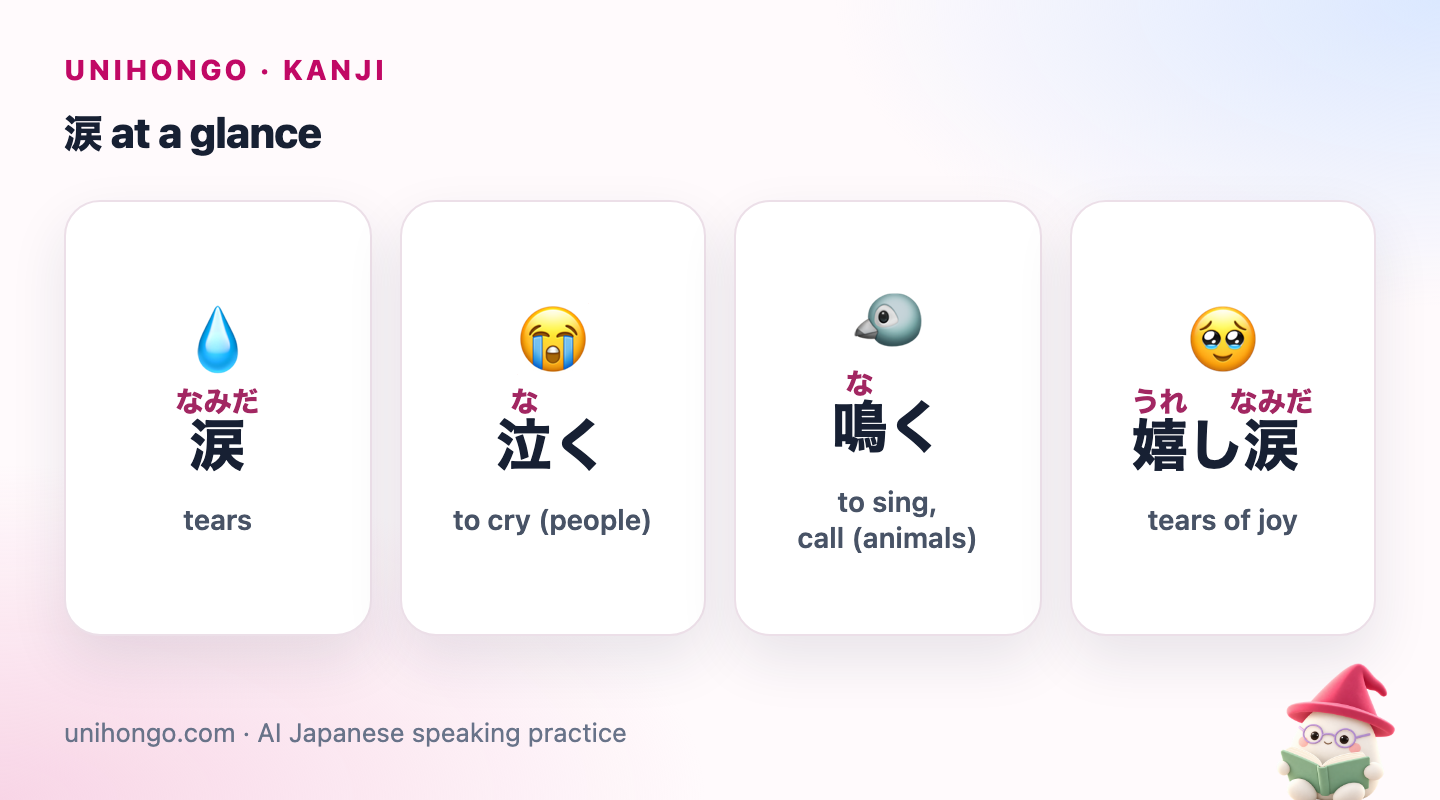
| Japanese | Romaji | Meaning |
|---|---|---|
| 涙 | namida | tears |
| 泣く | naku | to cry (people) |
| 鳴く | naku | to sing, call (animals) |
| 嬉し涙 | ureshinamida | tears of joy |
Notice that 泣く and 鳴く sound the same. In conversation the subject tells you which one is meant; in writing, the kanji does.
Readings, strokes and parts of 涙, 泣 and 鳴
Both 涙 and 泣 have 氵, the three-drop water radical, on the left. It is the same radical you see in 海 (sea), 泳 (swim) and 涼 (cool), and it tells you the character has something to do with liquid. 鳴 has no water at all; it is a bird, 鳥, with a mouth, 口, which is a neat picture of birdsong.
The right side of 涙 is 戻, which on its own means to return (戻る, modoru). In older writing the right side was 戾, and you may still see the older form 淚 in Chinese. In everyday Japanese, only 涙 is used. A memory hook many learners like: water (氵) that returns (戻), again and again, down your cheeks. It is not the historical explanation, but it makes the character easy to recall.
| Japanese | Romaji | Meaning |
|---|---|---|
| 戻る | modoru | to return (the right side of 涙) |
| 鳴る | naru | to ring, to sound (bells, phones) |
| Kanji | Readings | Strokes | Parts |
|---|---|---|---|
| 涙 | rui; namida | 10 | 氵 water + 戻 |
| 泣 | kyū; na(ku) | 8 | 氵 water + 立 stand |
| 鳴 | mei; na(ku), na(ru) | 14 | 口 mouth + 鳥 bird |
Everyday words for tears and crying
These are the words you will actually hear and read. Note which ones use namida, which use naku and which use rui.
| Japanese | Romaji | Meaning |
|---|---|---|
| 涙が出る | namida ga deru | tears come, to tear up |
| 涙ぐむ | namidagumu | to have tears in your eyes |
| 涙もろい | namidamoroi | easily moved to tears |
| 悔し涙 | kuyashinamida | tears of frustration |
| 涙声 | namidagoe | a tearful voice |
| 感涙 | kanrui | tears of deep emotion (written) |
| 涙腺 | ruisen | tear glands |
| 泣き虫 | nakimushi | crybaby |
| 泣き顔 | nakigao | a crying face |
| 号泣 | gōkyū | sobbing, crying your eyes out |
| 嘘泣き | usonaki | fake crying |
| 泣ける | nakeru | moving, tear-jerking (casual) |
泣ける is the potential form of 泣く, can cry, but in everyday speech it means makes you cry, in a good way. この曲、泣ける is high praise for a song. Similarly, 号泣 is common in film reviews: 号泣した means I sobbed my heart out. Strictly, 号泣 once meant crying loudly, but most people now use it for any heavy crying, even silent tears; dictionaries note both uses.
涙腺 appears in a playful expression: 年を取ると涙腺が緩くなる, as you get older your tear glands loosen, meaning you cry more easily. People often say it about themselves with a laugh.
鳴く: when animals cry
In Japanese, animals 鳴く. The verb covers birdsong, meowing, barking, mooing and the buzz of summer cicadas. Using 泣く for an animal suggests it is sad and in tears, which sounds odd or comic unless that is exactly what you mean.
| Japanese | Romaji | Meaning |
|---|---|---|
| 鳥が鳴いている。 | Tori ga naite iru. | The birds are singing. |
| 猫がニャーと鳴いた。 | Neko ga nyā to naita. | The cat meowed. |
| 夏はセミが鳴きます。 | Natsu wa semi ga nakimasu. | Cicadas chirp in summer. |
| 電話が鳴っている。 | Denwa ga natte iru. | The phone is ringing. |
| 赤ちゃんが泣いている。 | Akachan ga naite iru. | The baby is crying. |
Bells, alarms, phones and stomachs use 鳴る, to sound or ring: お腹が鳴った, my stomach rumbled. That is another reason 鳴 is worth knowing: it is about sounds, not sorrow.
There is also a rarer kanji, 啼く, for animals' cries, used mostly in literature. You do not need it, but you may see it in poems and song lyrics.
Mini dialogue: a film that made you cry
Talking about films is easy small talk, and tears are a common topic. This is a casual exchange between two coworkers on a Monday morning.

| Japanese | Romaji | Meaning |
|---|---|---|
| 週末、何してた? | Shūmatsu, nani shiteta? | Rina: What did you do at the weekend? |
| 映画を見たんだけど、号泣しちゃった。 | Eiga o mita n da kedo, gōkyū shichatta. | Jonas: I saw a film and cried my eyes out. |
| え、どんな映画? | E, donna eiga? | Rina: Really? What kind of film? |
| 犬とおじいさんの話。本当に泣けるよ。 | Inu to ojiisan no hanashi. Hontō ni nakeru yo. | Jonas: It's about a dog and an old man. It really makes you cry. |
| 私、涙もろいから無理かも。 | Watashi, namidamoroi kara muri kamo. | Rina: I cry so easily, I might not cope. |
| ハンカチ必須だね。 | Hankachi hissu da ne. | Jonas: You'll need a handkerchief, then. |
Look-alike kanji, writing tips and common mistakes
The right side of 涙 is 戻, and learners sometimes write 戻 when they mean 涙, or forget the water radical. Another trap is 泣 versus 位 (i, rank, position): both have 立 on the right, but 位 has 亻, the person radical, on the left. Water for crying, a person for rank.
How to write 涙: start with the three drops of 氵, top to bottom, the last one flicking upwards. Then write 戸 (the door shape) on the right, and finish with 大 underneath it. Keep 氵 narrow and leave enough height for 大 so the character does not look squashed.
| Japanese | Romaji | Meaning |
|---|---|---|
| 涙 | namida | tears (water radical) |
| 戻 | rei | return (no water) |
| 位 | i | rank (person radical, look-alike of 泣) |
- Writing 犬が泣いた for the dog barked. Use 鳴いた, or 吠えた (hoeta, barked) for dogs specifically.
- Saying 泣けた to mean I could cry. In speech it usually means it moved me to tears.
- Using 涙 as a verb. Tears come with 涙が出る or 涙を流す; to cry is 泣く.
- Assuming crying in public is taboo. Attitudes vary, and tears at weddings, graduations and sports events are common and accepted.
涙 as a tattoo or design
涙 is a real and beautiful kanji, but think carefully about the message. Alone, it means tears, and for many Japanese readers that suggests sadness or grief. In a song title it can be moving; on skin, without context, people may wonder what loss it refers to.
If you mean something positive, a word makes it clear: 嬉し涙 (tears of joy) or 感涙 (tears of deep emotion). Expressions such as 涙を力に (turn tears into strength) are understandable but sound like a slogan, so test them with native speakers first. In Chinese, the same character is common, while the older form 淚 is used in traditional Chinese; make sure your design uses the form you intend.
Before inking, ask a native speaker to check the meaning, the characters and the design, and give the artist a clean, checked image.
| Japanese | Romaji | Meaning |
|---|---|---|
| 感涙 | kanrui | tears of deep emotion |
Practise 泣く and 鳴く with Mocchi
Ask Mocchi, Unihongo's study assistant: Give me ten fill-in-the-blank sentences with 泣く, 鳴く or 鳴る, one at a time. Mocchi checks each answer, explains the reason, and remembers whether animals or phones are the ones that catch you, so your next /review starts there.
Then open AI Sensei, choose Hana-sensei and ask her to chat with you about a film or a moment that made you cry. Ask her to keep it casual. The session report afterwards lists your corrections and new words such as 涙もろい and 号泣.