
道 at a glance: one road, many arts
In everyday Japanese, 道 is first of all a road or path you can walk on. When it comes at the end of a word, it takes the reading dō and becomes a way of life: the gentle way of judo, the way of tea, the way of the brush.
The four cards show the two faces of the kanji: the physical road and three of the traditional arts that carry its name. Learn them together and you will recognise 道 in a street name, on a dojo door and on a tea school's sign.
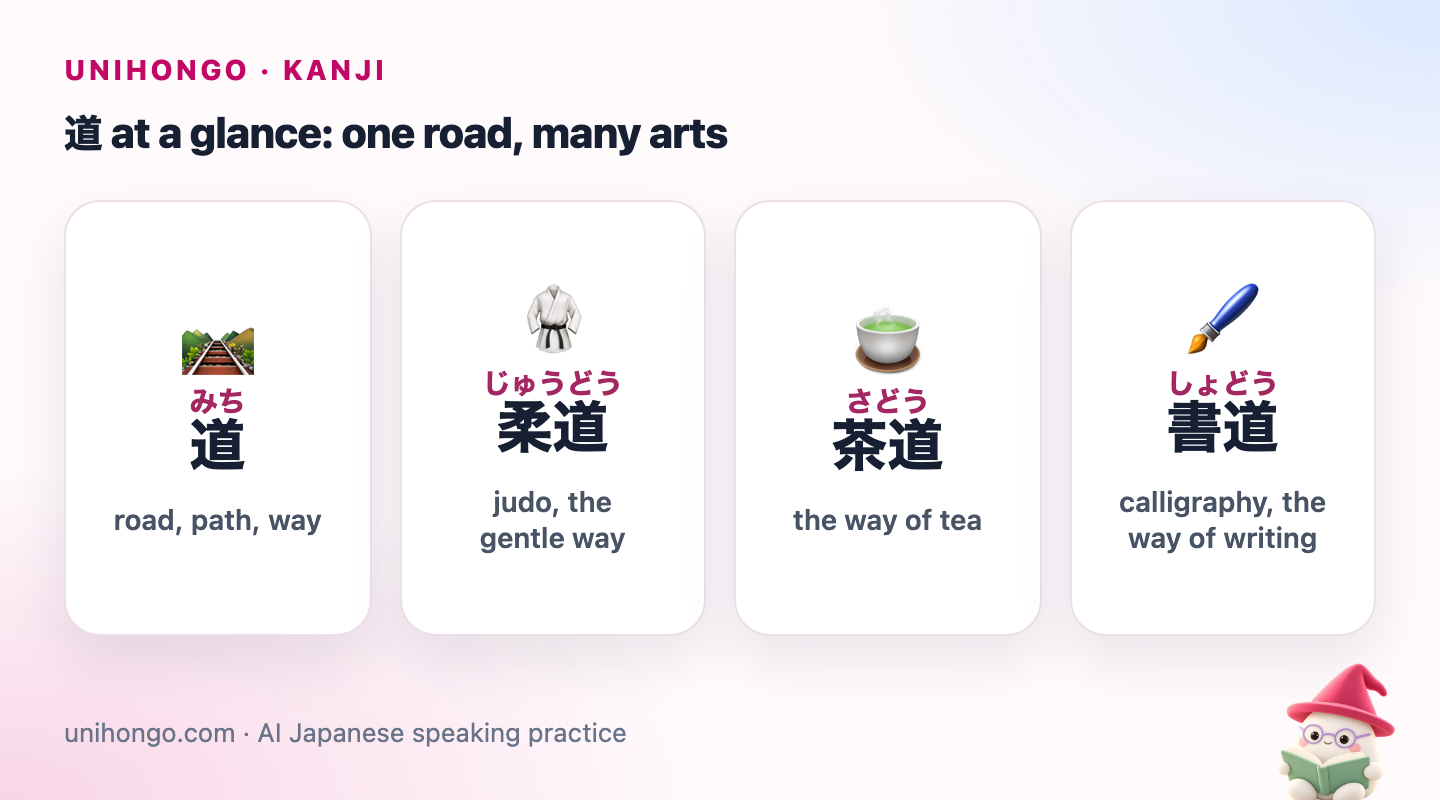
| Japanese | Romaji | Meaning |
|---|---|---|
| 道 | michi | road, path, way |
| 柔道 | jūdō | judo, the gentle way |
| 茶道 | sadō | the way of tea |
| 書道 | shodō | calligraphy, the way of writing |
Readings, strokes and the parts of 道
| Kanji | Strokes | On'yomi | Kun'yomi | Core meaning |
|---|---|---|---|---|
| 道 | 12 | dō, tō | michi | road, path, way, discipline; also says |
道 has 12 strokes: nine for 首 (head, neck) and three for the movement radical 辶, called shinnyō, which wraps around the bottom left. 辶 appears in many kanji about movement and roads, such as 道, 通 (to pass through), 近 (near) and 遠 (far). A common way to remember 道 is a head moving forward along a road, which is a memory aid rather than a full history.
Michi is the reading for the word by itself and in native compounds such as 近道 (chikamichi, shortcut). Dō is the reading in most Sino-Japanese compounds. The rare reading tō survives in 神道 (shintō), the native religion of Japan.
道 also appears in Japanese geography. 北海道 (Hokkaidō) is the only 道 among Japan's 47 prefectures, which is why the full set is called 都道府県 (todōfuken): one 都 (Tokyo), one 道 (Hokkaido), two 府 (Osaka and Kyoto) and 43 県.
Road words with 道 for getting around
These are the words you need on foot, on a bicycle or in a car. Notice how often 道 is read michi in everyday road words and dō in formal or technical ones.
| Japanese | Romaji | Meaning |
|---|---|---|
| 道路 | dōro | road (formal, traffic) |
| 歩道 | hodō | pavement, sidewalk |
| 近道 | chikamichi | shortcut |
| 片道 | katamichi | one way (ticket, trip) |
| 道順 | michijun | route, the way to go |
| 道の駅 | michi no eki | roadside rest station |
| 鉄道 | tetsudō | railway |
| 水道 | suidō | water supply, tap water |
| 道に迷いました。 | Michi ni mayoimashita. | I got lost. (polite) |
| この道をまっすぐ行ってください。 | Kono michi o massugu itte kudasai. | Please go straight along this road. |
道の駅 are roadside stations along highways and country roads, with toilets, local produce, food stalls and often a small museum or hot spring nearby. On a road trip they are a pleasant place to stop, and the staff are usually used to visitors.
片道 and its partner 往復 (ōfuku, round trip) are the words you need when buying a ticket. 水道 is literally a water road, the pipes that bring water to your home.
The -dō arts: martial arts and traditional culture
When 道 ends the name of an art, it means the activity is a path of training that shapes the person, not only a skill. Teachers often stress manners, posture and attitude as much as technique.
| Japanese | Romaji | Meaning |
|---|---|---|
| 武道 | budō | martial arts as a path |
| 武士道 | bushidō | the way of the warrior |
| 道場 | dōjō | training hall, the place of the way |
| 子どものころ柔道をやっていました。 | Kodomo no koro jūdō o yatte imashita. | I did judo as a child. |
| 茶道に興味があります。 | Sadō ni kyōmi ga arimasu. | I'm interested in the tea ceremony. |
| Art | Reading | Literal meaning | What it is |
|---|---|---|---|
| 柔道 | jūdō | the gentle way | Throws, holds and falls |
| 剣道 | kendō | the way of the sword | Fencing with bamboo swords and armour |
| 弓道 | kyūdō | the way of the bow | Japanese archery |
| 合気道 | aikidō | the way of harmonising energy | Joint locks and redirecting force |
| 書道 | shodō | the way of writing | Brush calligraphy |
| 華道 | kadō | the way of flowers | Ikebana, flower arranging |
| 茶道 | sadō or chadō | the way of tea | The tea ceremony |
道場 is literally the place of the way: originally a place of Buddhist practice, and today any hall for martial arts. When you visit one, you bow at the entrance. 武士道 is an idealised code associated with the samurai, and it is discussed today more as an idea than as a living rule.
道 as a way of life: idioms and abstract words
Like the English word way, 道 also means a method, a career or a moral path. These expressions are common in speeches, interviews and conversations about life choices.
| Japanese | Romaji | Meaning |
|---|---|---|
| 道のり | michinori | the distance, the journey ahead |
| この道一筋 | kono michi hitosuji | devoted to one path for life |
| 我が道を行く | waga michi o iku | to go your own way |
| 道草を食う | michikusa o kuu | to dawdle on the way |
| 地道 | jimichi | steady, patient, unglamorous |
| 道具 | dōgu | tool, equipment |
| 報道 | hōdō | news reporting |
この道一筋 is a classic description of a craftsperson who has spent decades on one craft: この道一筋五十年, fifty years on this one path. 地道 is a warm compliment for steady effort: 地道に努力する, to work at something patiently. 道草を食う, to eat grass by the road, is what a child does on the way home from school, stopping at every interesting thing.
In names, 道 appears in boys' names such as 道夫 (Michio) and 道也 (Michiya), and in family names such as 道下. It suggests a straight, principled path and sounds a little classic.
Mini dialogue: a first tea ceremony class
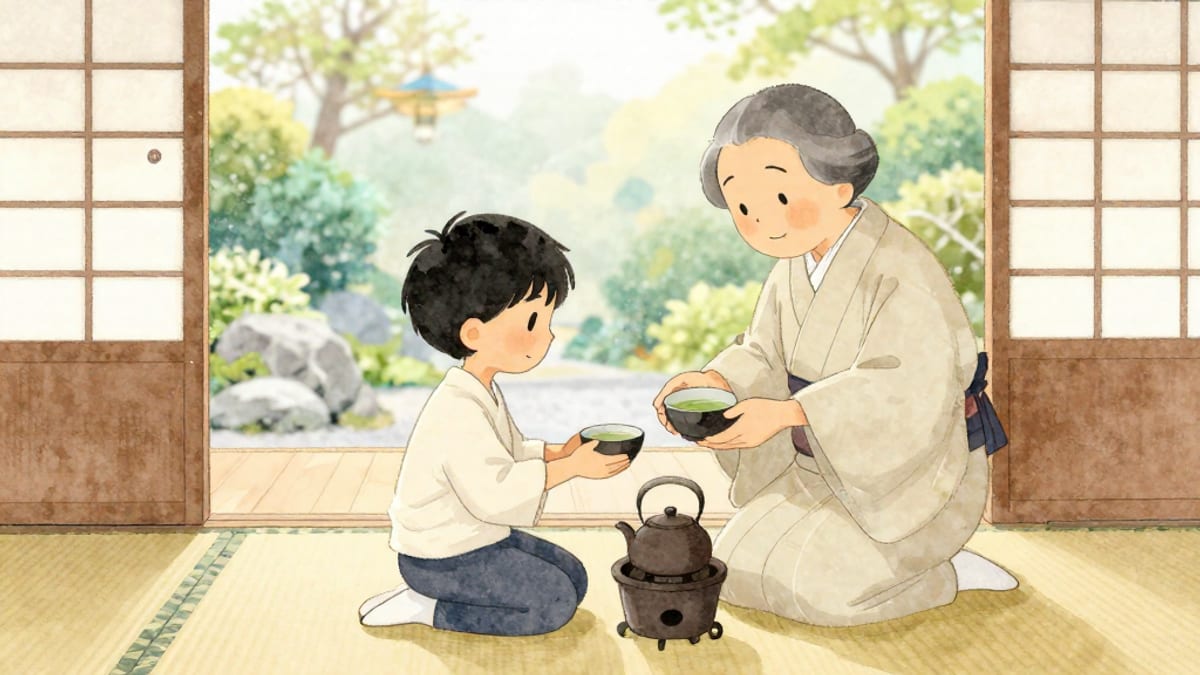
Many cultural centres and some tea schools offer trial lessons for beginners. Here you arrive at a first class. The teacher speaks politely and warmly; you answer politely too.
| Japanese | Romaji | Meaning |
|---|---|---|
| 今日はよろしくお願いします。 | Kyō wa yoroshiku onegai shimasu. | You: Thank you for having me today. |
| 茶道は初めてですか。 | Sadō wa hajimete desu ka. | Teacher: Is this your first time at tea ceremony? |
| はい、初めてです。正座が少し心配です。 | Hai, hajimete desu. Seiza ga sukoshi shinpai desu. | You: Yes, my first. I'm a bit worried about kneeling. |
| 足が痛くなったら、崩してくださいね。 | Ashi ga itaku nattara, kuzushite kudasai ne. | Teacher: If your legs hurt, please sit more comfortably. |
| お茶碗はこう回してからいただきます。 | Ochawan wa kō mawashite kara itadakimasu. | Teacher: Turn the bowl like this, then drink. |
| 結構なお点前でした。 | Kekkō na otemae deshita. | You: That was a wonderful preparation. |
結構なお点前でした is the traditional compliment to the host after drinking the tea. In a trial class the teacher will usually tell you when to say it, so do not worry about timing.
道 as a tattoo or design
道 is one of the most popular kanji for designs, and it is easy to see why: it is balanced, it has movement and it means way. Still, think about how it reads. To a Japanese reader, 道 on its own most often suggests road or path first, and the deeper sense of the Way only from context, such as a dojo wall.
In Chinese, 道 (dào) strongly brings to mind the Dao of Daoism, as in the Daodejing. If that is what you want, it works; if you mean judo or kendo, a Chinese reader may still think of Daoism first. The character is written the same way in Japanese and Chinese, so the difference is in the meaning people see, not the form.
A word is often clearer than a single kanji. Your art itself, such as 柔道 or 合気道, says exactly what you practise. 我が道 (waga michi, my own path) is personal, and この道一筋 suits someone devoted to one craft for life. Before you ink or print anything, ask a native speaker to check the characters, the stroke shapes and the font.
| Japanese | Romaji | Meaning |
|---|---|---|
| 我が道 | waga michi | my own path |
| 道を極める | michi o kiwameru | to master a path completely |
Walk the 道 vocabulary with Mocchi
Type /vocab words with 道, road and arts, and Mocchi gives you a set at your level with readings and short examples, then asks which ones you already know. It keeps track of the readings you miss, such as michi versus dō, and fits a short review of them into your study plan for the next days.
Once the words are in your Flash Card list with photos you pick, such as a tatami room for 茶道 or a country road for 道の駅, play them in Vocabulary Dash, the 3D word runner. Running toward the right word at speed is a good test of whether michi and dō have really sunk in.
Common mistakes and how to write 道
- Confusing 道 with 首 (kubi, neck). 首 is only the inside part; 道 adds the movement radical 辶.
- Confusing 道 with 導 (dō, michibiku, to guide). 導 is 道 with 寸 underneath, as in 指導 (shidō, instruction).
- Reading 道 as dō on its own. Alone it is michi; dō belongs to compounds.
- Saying 道を迷いました. The verb takes に: 道に迷いました.
- Writing the movement radical first. In 道, 辶 is written last, after 首.