
Why an old negative is still worth learning
Japanese did not always negate with nai. The older system used zu, whose forms spread through the sentence in different shapes: zu when it modified a verb, nu when it stood at the end or before a noun, and zaru in some fixed constructions. Modern Japanese replaced all of that with nai, but the older forms were never fully cleared out. They stayed inside proverbs, on public signs, in book and film titles, in legal and administrative language, in song lyrics, and in a handful of ordinary adverbs nobody thinks of as archaic.
The practical consequence is one-sided. You will never be required to produce these forms, and using them in conversation would sound theatrical. But if you cannot read them, a sign says nothing to you and a proverb turns into a puzzle. This guide is therefore a recognition guide: learn the shapes, learn the modern equivalent for each, and keep speaking with nai.
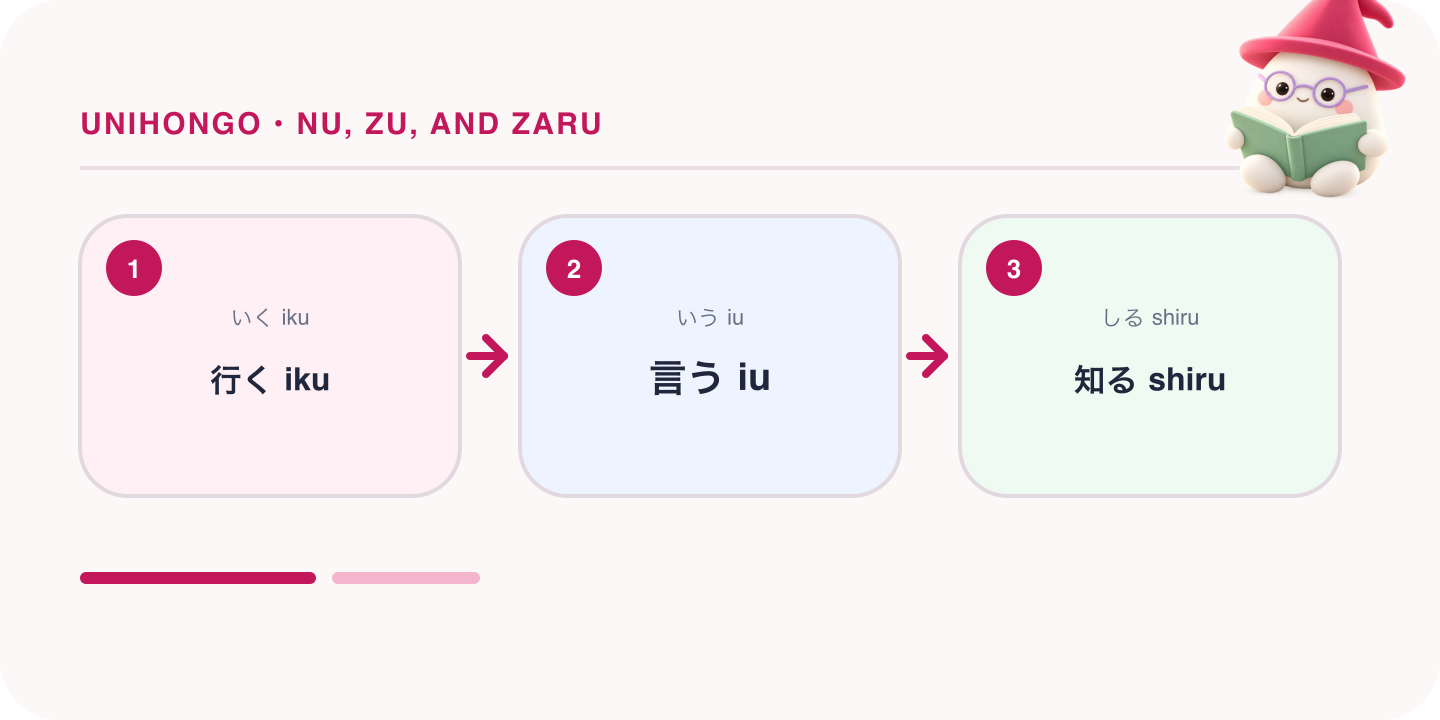
One stem, three endings
The good news is that you already know the stem. Nu, zu and zaru attach to exactly the same base as nai: the a-row stem for godan verbs, the bare stem for ichidan verbs. So if you can say ikanai, you can read ikanu, ikazu and ikazaru without learning anything new. The only work is memorising the two irregulars and one spelling trap.
| Verb | Class | ~nai | ~nu | ~zu | ~zaru |
|---|---|---|---|---|---|
| 行く iku | Godan | 行かない ikanai | 行かぬ ikanu | 行かず ikazu | 行かざる ikazaru |
| 言う iu | Godan | 言わない iwanai | 言わぬ iwanu | 言わず iwazu | 言わざる iwazaru |
| 知る shiru | Godan | 知らない shiranai | 知らぬ shiranu | 知らず shirazu | 知らざる shirazaru |
| 食べる taberu | Ichidan | 食べない tabenai | 食べぬ tabenu | 食べず tabezu | 食べざる tabezaru |
| 見る miru | Ichidan | 見ない minai | 見ぬ minu | 見ず mizu | 見ざる mizaru |
| する suru | Irregular | しない shinai | せぬ senu | せず sezu | せざる sezaru |
| 来る kuru | Irregular | 来ない konai | 来ぬ konu | 来ず kozu | 来ざる kozaru |
The spelling trap is the u-ending godan verbs. Just as iu becomes iwanai and not ianai, it becomes iwazu and not iazu; the same w appears in omowazu, kamawazu and shiawase o negawazu. The irregular to memorise is suru, whose forms all begin with se: senu, sezu, sezaru. Kuru follows its usual pattern and reads ko, giving konu, kozu and kozaru. Aru is the odd one out entirely, since its negative is simply nai, though the classical arazu survives in fixed phrases such as sa ni arazu, meaning that is not so.
Nu at the end of a sentence and before a noun
Nu does two jobs in the text you will meet. It can close a sentence, which reads as formal, old or emphatic, and it can sit directly before a noun, where it replaces the nai of a relative clause. Shiranu hito is simply a person one does not know; yokisenu jitai is an unforeseen situation. In both positions, translating nu as nai gives you the meaning immediately.
| Japanese | Romaji | Meaning |
|---|---|---|
| 知らぬ人に話しかけられた。 | Shiranu hito ni hanashikakerareta. | I was spoken to by a person I did not know. |
| 予期せぬ事態が起きた。 | Yokisenu jitai ga okita. | An unforeseen situation arose. |
| 思いも寄らぬ結果だった。 | Omoi mo yoranu kekka datta. | It was a result nobody imagined. |
| 見知らぬ町を歩く。 | Mishiranu machi o aruku. | To walk through an unfamiliar town. |
| 知らぬ間に日が暮れた。 | Shiranu ma ni hi ga kureta. | Before I knew it, the sun had set. |
| 彼は何も語らぬままだった。 | Kare wa nani mo kataranu mama datta. | He remained without saying anything. |
| 行かねばならぬ。 | Ikaneba naranu. | One must go. (archaic or dramatic) |
| 分からん。 | Wakaran. | I do not get it. (casual, contracted from wakaranu) |
Note the last two rows. Nebanaranu is the older shape of nakereba naranai, and you will meet it in period drama and in written slogans. The contracted n, as in wakaran, shiran and dekin, is alive in casual speech and in western Japanese, so a form that looks archaic on the page can be very ordinary in a conversation. Neither is something to add to your own speech before you can hear which one a room is using.
Zu as the written adverbial negative
Zu is the form that connects. It negates a verb and then hands the sentence on to the next clause, exactly as the negative te-form nakute or naide does in speech. In writing, zu is compact and neutral, which is why report and news style uses it constantly. A sentence such as denwa ni mo dezu, renraku mo torenakatta packs two clauses together with no wasted syllables.
| Japanese | Romaji | Meaning |
|---|---|---|
| 何も言わず、部屋を出た。 | Nani mo iwazu, heya o deta. | Saying nothing, he left the room. |
| 返事を待たず、先に始めた。 | Henji o matazu, saki ni hajimeta. | Without waiting for a reply, we started first. |
| 休まず働き続けた。 | Yasumazu hatarakitsuzuketa. | He kept working without resting. |
| 理由を告げず辞めていった。 | Riyū o tsugezu yamete itta. | She quit without giving a reason. |
| 調査は行われず、報告のみが提出された。 | Chōsa wa okonawarezu, hōkoku nomi ga teishutsu sareta. | No investigation was carried out, and only a report was submitted. |
| 準備をせず、試験に臨んだ。 | Junbi o sezu, shiken ni nozonda. | He faced the exam without preparing. |
In these sentences zu is not the final negative of the sentence; it negates one clause and continues. That is exactly the job of nakute and naide in speech, so when you convert a written line for a conversation, iwazu becomes iwanaide and matazu becomes matanaide. The other direction, tightening a spoken paragraph into written style, is covered in the guide on choosing a Japanese written style.
Zu ni: without doing something
Zu ni is the pattern you will actually see most often, and it is the written equivalent of naide. It means without doing the action, and it attaches to the same stem as everything else in this guide. Asagohan o tabezu ni dekaketa means she went out without eating breakfast, and it says the same thing as tabenaide dekaketa with a more formal surface.
The suru form is where learners stumble. Without doing something is sezu ni, never shizu ni. Renraku sezu ni, kakunin sezu ni and yoyaku sezu ni are all common in written Japanese, and each one has a plain spoken twin ending in shinaide. Keep both halves of each pair in your notes so that reading and speaking stay connected.
| Written with zu ni | Spoken with naide | Meaning |
|---|---|---|
| 食べずに出かけた Tabezu ni dekaketa | 食べないで出かけた Tabenaide dekaketa | Went out without eating |
| 何も言わずに帰った Nani mo iwazu ni kaetta | 何も言わないで帰った Nani mo iwanaide kaetta | Left without saying anything |
| 確認せずに送った Kakunin sezu ni okutta | 確認しないで送った Kakunin shinaide okutta | Sent it without checking |
| 傘を持たずに出た Kasa o motazu ni deta | 傘を持たないで出た Kasa o motanaide deta | Went out without an umbrella |
| 予約せずに行った Yoyaku sezu ni itta | 予約しないで行った Yoyaku shinaide itta | Went without booking |
| 寝ずに勉強した Nezu ni benkyō shita | 寝ないで勉強した Nenaide benkyō shita | Studied without sleeping |
One caution about naide: it also forms a request, as in minaide kudasai, please do not look. Zu ni never does that. If you need to ask someone not to do something, the spoken naide kudasai is the only natural choice, and no amount of formality turns it into sezu ni kudasai.
Zaru in fixed expressions
Zaru is the form you should treat almost entirely as vocabulary. It appears before nouns and inside a small number of set constructions, of which sezaru o enai is by far the most common: it means cannot help doing, or has no choice but to do. The pattern is verb stem plus zaru o enai, so mitomezaru o enai means one has to admit it, and yameru gives yamezaru o enai, one has no choice but to stop.
| Japanese | Romaji | Meaning |
|---|---|---|
| 認めざるを得ない。 | Mitomezaru o enai. | One has no choice but to admit it. |
| 計画を変更せざるを得なかった。 | Keikaku o henkō sezaru o enakatta. | We had no choice but to change the plan. |
| 中止せざるを得ない状況である。 | Chūshi sezaru o enai jōkyō de aru. | It is a situation in which cancellation is unavoidable. |
| やむを得ず欠席いたします。 | Yamu o ezu kesseki itashimasu. | I will unavoidably be absent. |
| 見ざる言わざる聞かざる | Mizaru iwazaru kikazaru | See not, speak not, hear not (the three monkeys) |
| 飲まずにはいられなかった。 | Nomazu ni wa irarenakatta. | I could not stop myself from drinking. |
Zaru o enai has a plain spoken equivalent in shika nai or nakereba naranai, so kyanseru sezaru o enai and kyanseru suru shika nai carry the same practical message with very different weight. Use the heavy written form when you want the reader to understand that the decision was forced, which is exactly why it fills company announcements.
Fixed phrases you will actually meet
| Phrase | Reading | Modern equivalent | Meaning |
|---|---|---|---|
| 思わず | Omowazu | つい | Involuntarily, before you can think |
| 相変わらず | Aikawarazu | いつもと同じで | As ever, unchanged |
| 絶えず | Taezu | いつも切れずに | Constantly, without a break |
| 遠からず | Tōkarazu | もうすぐ | Before long |
| 残らず | Nokorazu | 全部 | Every last one |
| 少なからず | Sukunakarazu | かなり | Not a little, considerably |
| 知らず知らずのうちに | Shirazu shirazu no uchi ni | 気づかないうちに | Without realising it |
| 見ず知らずの人 | Mizushirazu no hito | 全然知らない人 | A complete stranger |
| 世間知らず | Sekenshirazu | 世の中を知らない人 | Naive about the world |
| 人知れず | Hitoshirezu | 誰にも知られずに | Without anyone knowing |
| 負けず嫌い | Makezugirai | 負けるのが嫌いな性格 | Hating to lose |
| 食わず嫌い | Kuwazugirai | 食べたことがないのに嫌い | Disliking something untried |
| 知らぬが仏 | Shiranu ga hotoke | 知らないほうが幸せ | Ignorance is bliss |
| 言わぬが花 | Iwanu ga hana | 言わないほうがいい | Some things are better unsaid |
| 触らぬ神に祟りなし | Sawaranu kami ni tatari nashi | 関わらなければ問題ない | Let sleeping dogs lie |
| ほかならぬ | Hoka naranu | ほかでもない | None other than |
Look at how many of these have quietly become ordinary vocabulary. Omowazu, aikawarazu, taezu and makezugirai are everyday words that nobody experiences as classical, and you should feel free to use them in speech. The proverbs in the lower rows are different: they are quoted as units, usually with a knowing tone, and a learner who deploys one at the wrong moment sounds as if they have swallowed a phrasebook.
Where a modern reader meets these forms
- Public and workplace signs, especially older or deliberately formal ones.
- Proverbs and four-character idioms, where the classical shape is fossilised.
- Book, film and song titles, which favour compact and slightly archaic phrasing.
- Legal, administrative and contract language, which preserves older written norms.
- Newspaper sentences, where zu joins clauses without spending characters.
- Period drama and historical fiction, where nu and zu mark the era of the speech.
- Song lyrics, which use nu and zu for rhythm and for a literary tone.
Signage is worth a separate note. The old prohibition ending bekarazu, as in tachiiru bekarazu meaning entry is forbidden, belongs to the same classical family and is built from beshi rather than from zu. Most modern signs prefer the plain noun tachiiri kinshi or the polite go-enryo kudasai, so bekarazu now reads as stern or old-fashioned, which is sometimes exactly the effect intended.
Reading signs and titles out loud
These are lines you will read aloud rather than compose, plus the questions you ask when a phrase defeats you. Practise the questions especially, because knowing how to ask about an unfamiliar form is worth more than memorising twenty more of them.
| Japanese | Romaji | Meaning |
|---|---|---|
| この「ざる」はどういう意味ですか。 | Kono zaru wa dō iu imi desu ka? | What does this zaru mean? |
| 古い言い方ですか。 | Furui iikata desu ka? | Is it an old way of saying it? |
| 今でも使いますか。 | Ima demo tsukaimasu ka? | Is it still used today? |
| 普通の言い方だと何になりますか。 | Futsū no iikata da to nani ni narimasu ka? | What would it be in ordinary language? |
| 会話で使っても大丈夫ですか。 | Kaiwa de tsukatte mo daijōbu desu ka? | Is it all right to use in conversation? |
| 書き言葉だけですね。 | Kakikotoba dake desu ne. | So it is written language only. |
| 読み方を教えていただけますか。 | Yomikata o oshiete itadakemasu ka? | Could you tell me how to read it? |
| 「せず」は「しないで」と同じですか。 | Sezu wa shinaide to onaji desu ka? | Is sezu the same as shinaide? |
| この看板は何と書いてありますか。 | Kono kanban wa nan to kaite arimasu ka? | What does this sign say? |
| ことわざですか。 | Kotowaza desu ka? | Is it a proverb? |
| 少し硬い表現ですね。 | Sukoshi katai hyōgen desu ne. | It is a slightly stiff expression. |
| 覚えておきます。 | Oboete okimasu. | I will remember it. |
A likely reply to the first question is Mukashi no uchikeshi desu, meaning it is an old negative, or Ima wa amari tsukaimasen ga, kanban ya kotowaza ni nokotte imasu, meaning it is not much used now but it survives on signs and in proverbs. Both answers tell you the same thing this guide does, and hearing them from a native speaker fixes it faster than reading it.
A recognition drill, not a production drill
- Read a phrase, cover it, and say the nai version aloud: iwazu becomes iwanaide.
- Sort every new example into three buckets: sentence-final nu, connecting zu, and fixed zaru.
- Drill the suru row alone until senu, sezu and sezaru come faster than shinai.
- Photograph one formal sign a week and decode its ending before looking anything up.
- Keep a page of proverbs with the modern paraphrase written beside each one.
- Never insert nu or zu into your own conversation until you have heard a native speaker use that exact phrase.
The last rule matters most. These forms give a text authority, but in a learner's spoken sentence they usually give the wrong impression, as if a formal document had started talking. Understand every one of them on sight, keep the fixed adverbs such as omowazu and kanarazu in active use, and let the rest stay where they belong, on the page.