
Three kanji for happiness
English has happiness, luck and joy; Japanese has 幸, 福 and 喜. They overlap, and many words combine two of them, but each kanji leans in its own direction. 幸 is the quiet, lasting kind of happiness. 福 is good fortune that comes to you, often with a sense of blessing from the gods. 喜 is the feeling of joy, often the moment you hear good news or receive something.
The cards below show the four words to start with.
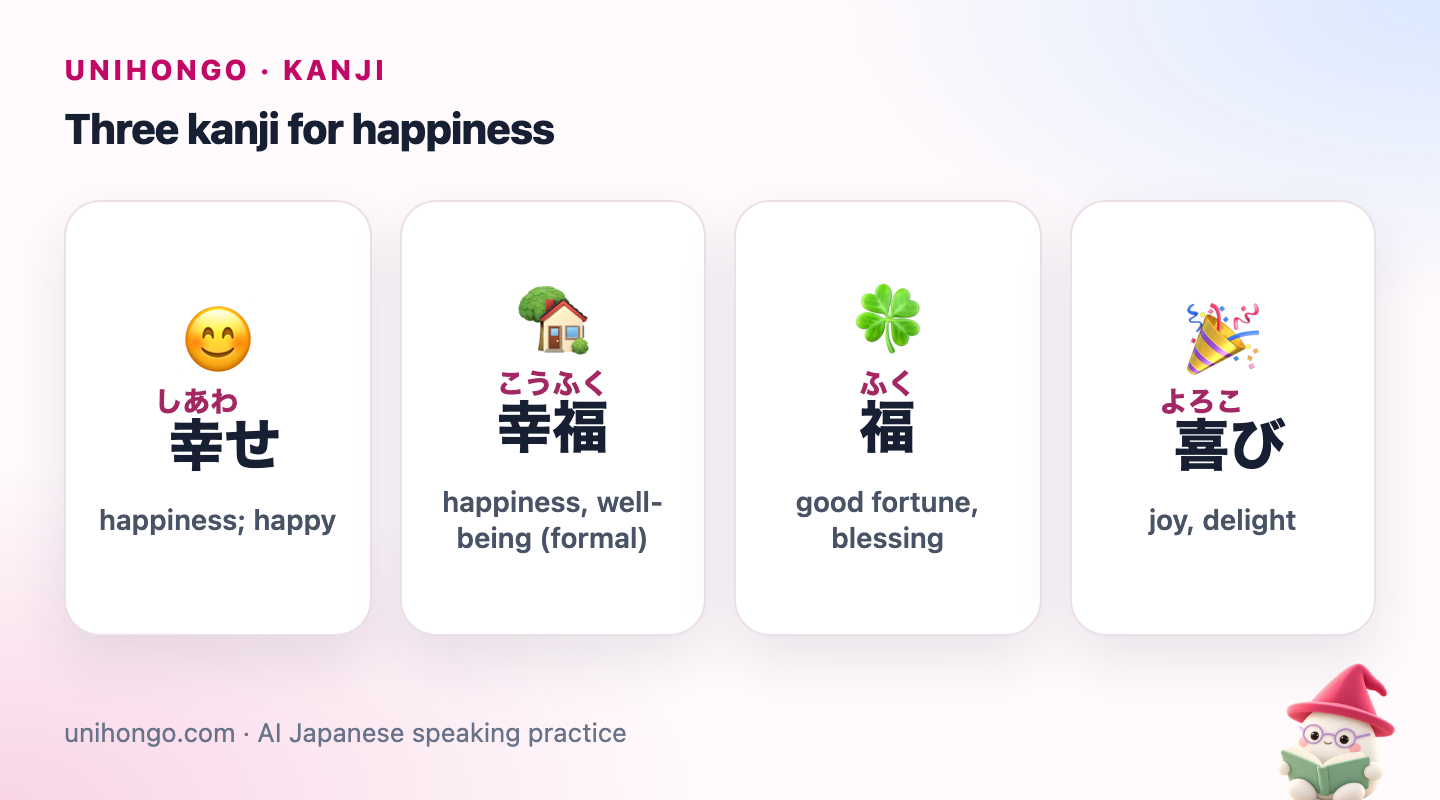
| Japanese | Romaji | Meaning |
|---|---|---|
| 幸せ | shiawase | happiness; happy |
| 幸福 | kōfuku | happiness, well-being (formal) |
| 福 | fuku | good fortune, blessing |
| 喜び | yorokobi | joy, delight |
幸せ is the word for everyday use. It works as a noun (happiness) and as a na-adjective (happy): 幸せな毎日, happy days. 幸福 means almost the same but sounds formal, as in a book title or a speech.
Readings, strokes and how the characters are built
幸 has an unusual history. Many character dictionaries explain the ancient form as a picture of handcuffs, and suggest that escaping them, or being spared punishment, came to mean good luck. Accounts differ in detail, so treat this as an interesting story rather than a memory rule. Its modern shape is easy to describe: 土 on top, a short dotted middle, and 干-like strokes below.
福 is built from 礻, the shape of 示 on the left, a radical connected with gods and rituals, and a right side that is usually linked to plenty or a full vessel. You find 礻 in other kanji to do with worship and blessing, such as 神 (god) and 祝 (celebrate).
喜 contains 口, mouth, at the bottom; dictionaries often connect the upper part with a drum, giving a picture of music and celebration. Whatever the history, the 口 is a useful reminder that joy is often spoken or sung.
| Japanese | Romaji | Meaning |
|---|---|---|
| 幸 | sachi | happiness, blessings (literary, names) |
| 喜寿 | kiju | a 77th birthday celebration |
| Kanji | Readings | Strokes | Core idea |
|---|---|---|---|
| 幸 | kō; shiawase, saiwai, sachi | 8 | Happiness, good luck |
| 福 | fuku | 13 | Fortune, blessing |
| 喜 | ki; yorokobu | 12 | Joy, delight |
Everyday words with 幸, 福 and 喜
Each kanji builds a small family of everyday words. Learn them in groups, and the differences start to feel natural.
| Japanese | Romaji | Meaning |
|---|---|---|
| 幸せな | shiawase na | happy (before a noun) |
| 幸運 | kōun | good luck, fortune |
| 不幸 | fukō | misfortune; a death in the family |
| 幸い | saiwai | fortunately |
| 福袋 | fukubukuro | a New Year lucky bag |
| 福引き | fukubiki | a lucky draw, a raffle |
| 祝福 | shukufuku | blessing, congratulations |
| 福の神 | fuku no kami | god of good fortune |
| 七福神 | shichifukujin | the Seven Lucky Gods |
| 喜ぶ | yorokobu | to be glad, to be delighted |
| 大喜び | ōyorokobi | overjoyed |
| 喜んで | yorokonde | with pleasure, gladly |
Be careful with 不幸. Besides misfortune, it is used as a gentle word for a death in someone's family: ご不幸がありまして means there has been a bereavement. You will hear it in work emails explaining an absence.
福袋 are bags of goods sold at a discount by shops around New Year; you pay a set price without knowing exactly what is inside. The name simply means fortune bag.
Useful expressions: お幸せに, 喜んで and 幸いです
Three expressions from these kanji are worth learning as whole phrases, because you will use them as they are.
| Japanese | Romaji | Meaning |
|---|---|---|
| お幸せに! | Oshiawase ni! | Be happy together! (to a couple) |
| 喜んで! | Yorokonde! | With pleasure! |
| ご確認いただけると幸いです。 | Gokakunin itadakeru to saiwai desu. | I would be grateful if you could check. (email) |
| 幸いなことに、けがはありませんでした。 | Saiwai na koto ni, kega wa arimasen deshita. | Fortunately, nobody was hurt. |
| 今、すごく幸せ。 | Ima, sugoku shiawase. | I'm so happy right now. (casual) |
| 鬼は外、福は内! | Oni wa soto, fuku wa uchi! | Demons out, fortune in! (Setsubun chant) |
〜いただけると幸いです is a staple of Japanese business emails. Literally it means it would be my happiness if you could…, and it is a soft, polite way to make a request. Do not translate it as happy when you read it: it means I would appreciate it.
喜んで is a cheerful way to accept an invitation or a task, and some izakaya staff shout a version of it when you order. Between friends, いいね! or 行く行く! is more casual.
鬼は外、福は内 is the chant of Setsubun in early February, when many families throw roasted beans to drive out bad luck. Customs vary by region and household.
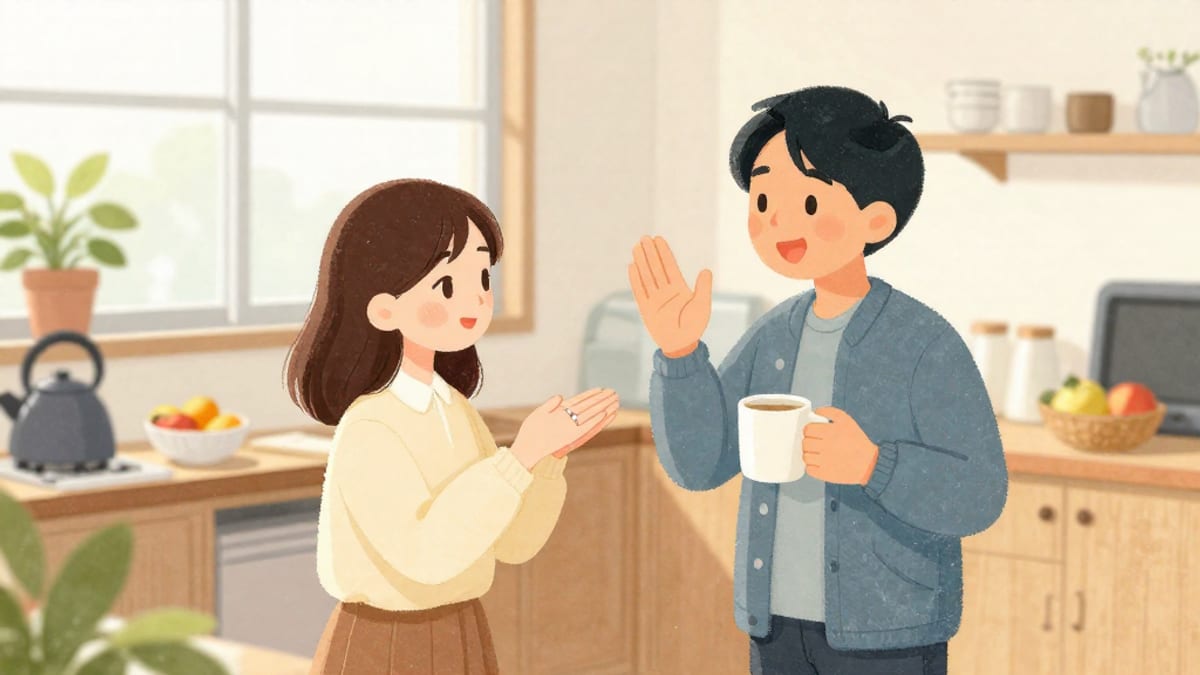
Mini dialogue: congratulating a coworker on her engagement
When someone shares happy news, the reaction matters as much as the words. This is how a short exchange might go in a friendly office.
| Japanese | Romaji | Meaning |
|---|---|---|
| 実は、結婚することになりました。 | Jitsu wa, kekkon suru koto ni narimashita. | Yui: Actually, I'm getting married. |
| えっ、おめでとうございます! | E, omedetō gozaimasu! | Carlos: Oh, congratulations! |
| ありがとうございます。 | Arigatō gozaimasu. | Yui: Thank you. |
| すごく幸せそうですね。 | Sugoku shiawase sō desu ne. | Carlos: You look so happy. |
| はい、おかげさまで。 | Hai, okagesama de. | Yui: Yes, thank you, I'm very lucky. |
| どうぞお幸せに。 | Dōzo oshiawase ni. | Carlos: I wish you every happiness. |
Look-alike kanji, writing tips and common mistakes
The big trap is 辛 (shin, karai, tsurai), which means spicy or painful. The two differ only at the top: 幸 starts with 土, a cross with two horizontals, while 辛 starts with a dot, as in 立. People in Japan often say that adding one line to 辛 turns pain into happiness, a well-known piece of wordplay rather than history.
How to write 幸: start with 土 at the top (three strokes), then the two small dots, then two horizontal lines, and finish with the long vertical down the centre, eight strokes in all. Keep the spacing even and the final vertical straight.
| Japanese | Romaji | Meaning |
|---|---|---|
| 幸 | kō | happiness (starts with 土) |
| 辛 | shin | pain, spicy (starts with a dot) |
- Translating 〜いただけると幸いです as I will be happy. It means I would appreciate it.
- Asking 幸せですか in casual chat. It sounds like a survey or a counselling session.
- Using 福 for personal happiness. 福 is fortune; I am happy is 幸せです or うれしいです.
- Mixing up 喜ぶ and うれしい. うれしい is how you feel; 喜ぶ usually describes how someone else reacts: 母が喜んだ, my mother was delighted.
Happiness kanji as a tattoo or design
幸 and 福 both appear on everyday Japanese objects: 福 on New Year decorations and lucky charms, 幸 in shop names and girls' names such as 幸 (Sachi) or 幸子 (Sachiko, a classic name). A single happiness kanji is real and positive, but it can look like a souvenir if it stands alone.
A word usually says more. 幸せ (happiness) is clear and warm, and 幸福 (well-being) feels calm and serious. In Chinese, 福 is extremely common on New Year decorations, often hung upside down, so a lone 福 may read as Chinese rather than Japanese to some viewers; that is fine if it is what you want.
Because 幸 and 辛 differ by one stroke, a copying mistake can turn your happiness into pain. Have a native speaker check the characters and the design, and give the artist a clean, checked image.
| Japanese | Romaji | Meaning |
|---|---|---|
| 幸子 | Sachiko | happiness child · girl |
| 幸太 | Kōta | happiness, big · boy |
Use Mocchi to tell 幸, 福 and 喜 apart
Ask Mocchi, Unihongo's study assistant: Give me eight short situations and ask whether 幸, 福 or 喜 fits. Mocchi explains each answer and remembers the ones you hesitate over, so they come back in a later quiz. Then write a short work email asking a colleague to check a document, end it with 〜いただけると幸いです, and send it with /correct to see whether the politeness level is right.
To make the words stick, type /create-flashcards for the words in this post, choose a photo for each, such as a lucky bag for 福袋, and review them with /review-flashcards. Cards you find hard come back sooner.