
The tiger kanji in four words
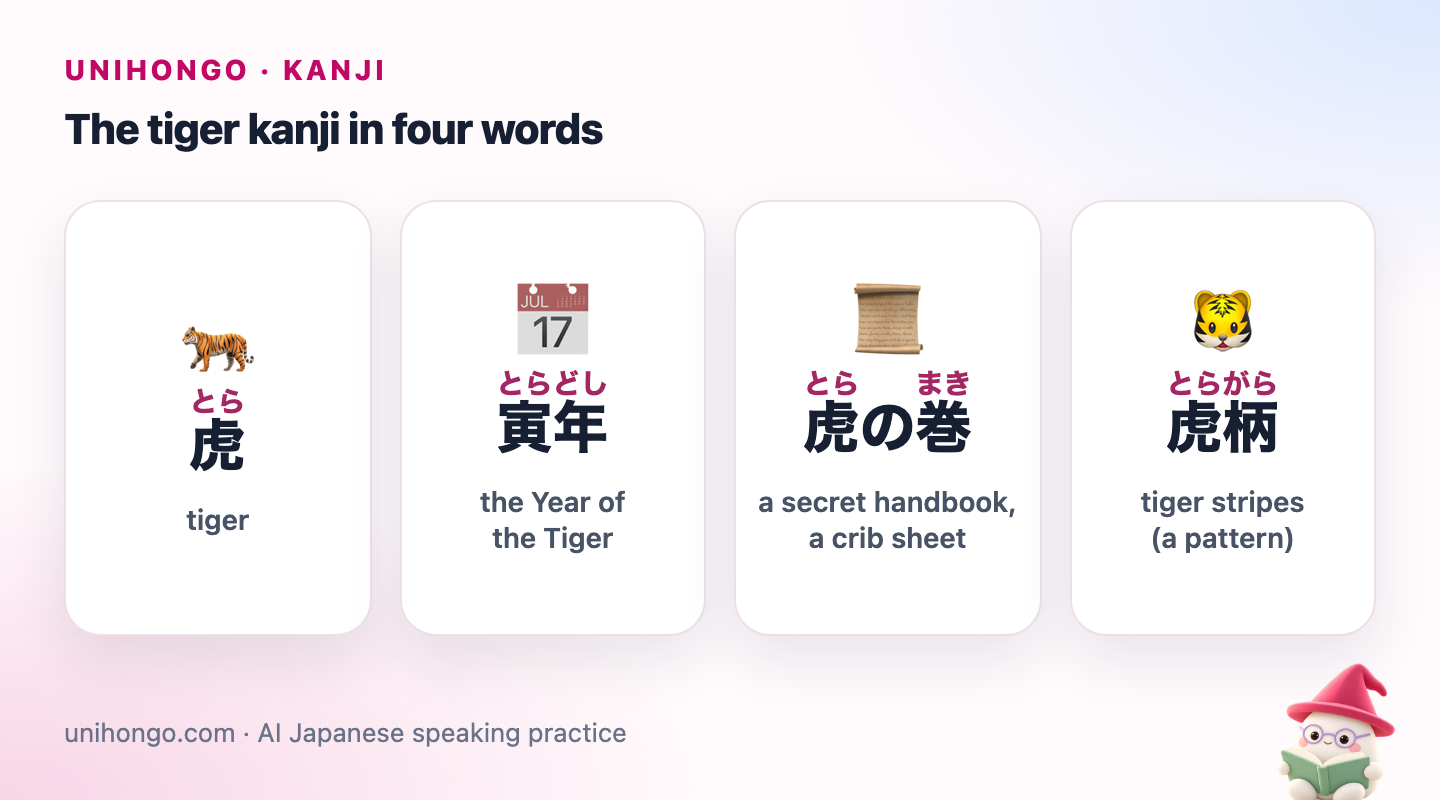
虎 is the kanji you need for the animal, the idioms and most names. The zodiac uses 寅, and the tiger's stripes, its strength and its famous handbook all come up in everyday words. These four rows cover what most learners meet first. Note that the kanji is pronounced tora in all four, so you can learn the reading once and recognise it everywhere. Only in more formal compounds and idioms, which come later, does the reading ko appear.
| Japanese | Romaji | Meaning |
|---|---|---|
| 虎 | tora | tiger |
| 寅年 | toradoshi | the Year of the Tiger |
| 虎の巻 | tora no maki | a secret handbook, a crib sheet |
| 虎柄 | toragara | tiger stripes (a pattern) |
Readings, strokes and the tiger head 虍
虎 has eight strokes. Its top part, 虍, is known as the tiger head, torakanmuri, or tora gashira. Below it sits 几, which is usually explained as the legs of the animal. The character began as a drawing of a tiger, and the tiger head part survives in several other kanji.
| Kanji | On'yomi | Kun'yomi | Strokes | Typical use |
|---|---|---|---|---|
| 虎 | ko | tora | 8 | The animal, idioms, names |
| 寅 | in | tora | 11 | Zodiac sign, some names |
| 虍 | - | torakanmuri | 6 | The tiger-head radical in other kanji |
虎 was added to the official list of kanji for general use in 2010, so it now appears in school materials and newspapers. Before that, the animal was often written in kana. 寅 has nothing to do with the shape of a tiger: it is one of the twelve earthly branches, an old counting system, and only its zodiac animal links it to the tiger.
The tiger head appears in kanji such as 虚, empty; 劇, drama; and 慮, consideration. In those characters it is part of the shape and does not mean tiger. Learning the tiger head as a unit, six strokes in a fixed order, makes all of these kanji faster to write and easier to recognise.
Everyday words and tiger idioms
Japanese idioms use the tiger for power, danger and preciousness. Several come from classical Chinese, so they sound formal; others are casual and modern. The table of registers below helps you choose.
| Japanese | Romaji | Meaning |
|---|---|---|
| 虎の子 | tora no ko | something treasured, such as savings |
| 虎視眈々 | koshi tantan | watching closely for a chance |
| 張り子の虎 | hariko no tora | a paper tiger: all show, no strength |
| 虎の威を借る狐 | tora no i o karu kitsune | a fox borrowing the tiger's power |
| 虎穴に入らずんば虎子を得ず | Koketsu ni irazunba koji o ezu. | Nothing ventured, nothing gained. |
| 竜虎 | ryūko | dragon and tiger: two great rivals |
| 白虎 | byakko | the White Tiger, guardian of the west |
| 虎刈り | toragari | a patchy, uneven haircut |
| 虎の子の貯金を使ってしまった。 | Tora no ko no chokin o tsukatte shimatta. | I ended up spending my precious savings. |
| Expression | Register | Who uses it |
|---|---|---|
| 虎の巻 | Casual, playful | Students, hobbyists, magazine headlines |
| 虎の子 | Neutral | Anyone, often about money |
| 虎視眈々 | Formal, written | News, sports commentary, essays |
| 虎穴に入らずんば虎子を得ず | Literary | Speeches, motivational talk |
虎の威を借る狐 describes someone who acts powerful only because of the person behind them, like a junior who keeps saying the boss wants it. It is critical, so use it about situations rather than to someone's face. Notice that 虎子 in the proverb is read koji, the tiger's cub, while 虎の子 is tora no ko.
寅 and the Year of the Tiger
The tiger is the third animal of the Japanese zodiac, after the rat and the ox. People often mention their sign when talking about age, and New Year cards in a tiger year are covered with tigers. Use 寅 for the sign and 虎 for pictures of the animal.
| Japanese | Romaji | Meaning |
|---|---|---|
| 私は寅年生まれです。 | Watashi wa toradoshi umare desu. | I was born in the Year of the Tiger. |
| 寅年の人は勇ましいと言われますね。 | Toradoshi no hito wa isamashii to iwaremasu ne. | They say Tiger people are brave. |
| 来年の年賀状は虎の絵にしよう。 | Rainen no nengajō wa tora no e ni shiyō. | Let's put a tiger on next year's New Year cards. (casual) |
Tigers in temples, screens and stripes
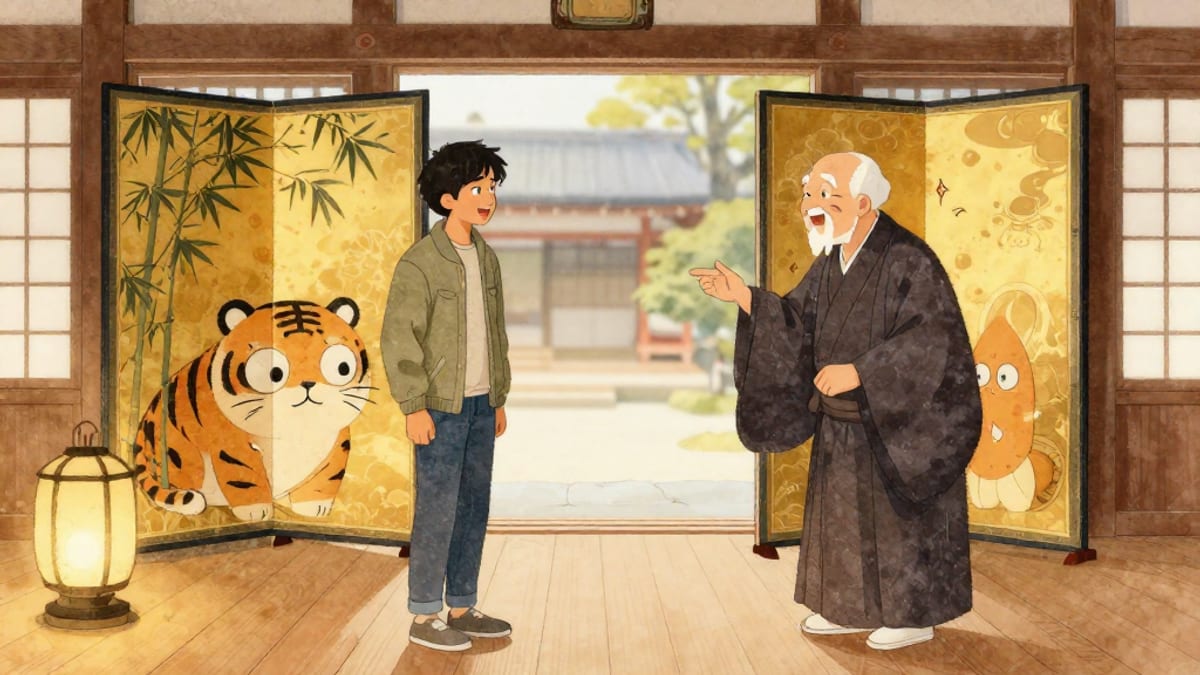
Because real tigers were never seen in old Japan, painters worked from imported pictures, skins and imagination, and some temple tigers look charmingly like big cats. Tigers paired with bamboo are a classic subject on sliding screens. Today you are more likely to meet the tiger in stripes: on sports fans' shirts and on the yellow-and-black barriers and ropes at construction sites, whose pattern people compare to a tiger's coat.
| Japanese | Romaji | Meaning |
|---|---|---|
| この虎、猫みたいでかわいいですね。 | Kono tora, neko mitai de kawaii desu ne. | You: This tiger looks like a cat, it's cute. |
| 昔の絵師は本物の虎を見たことがなかったんですよ。 | Mukashi no eshi wa honmono no tora o mita koto ga nakatta n desu yo. | Guide: Painters back then had never seen a real tiger. |
| じゃあ、想像で描いたんですか。 | Jā, sōzō de kaita n desu ka. | You: So they painted from imagination? |
| そうなんです。毛皮や絵を参考にしたそうです。 | Sō nan desu. Kegawa ya e o sankō ni shita sō desu. | Guide: That's right. Apparently they used skins and pictures. |
虎 vs 虚, and how to write the tiger
The most common confusion is with 虚, empty or false, as in 虚しい, munashii, and 謙虚, kenkyo, modest. Both start with the tiger head 虍. 虎 has 几 below, like two legs; 虚 has a shape like 业 below. If the bottom has many short vertical lines, it is not a tiger.
| Japanese | Romaji | Meaning |
|---|---|---|
| 虚しい | munashii | empty, futile |
| 謙虚 | kenkyo | modest, humble |
| 劇場 | gekijō | theatre (tiger head inside 劇) |
- Writing 寅 for a tiger in a story. 寅 is the zodiac sign only.
- Reading 虎の子 as koshi. The idiom is tora no ko.
- Using 虎視眈々 in casual chat. It sounds like a news report among friends.
- Forgetting the hooked final stroke of 几, which makes the tiger look unfinished.
To write 虎, start with the short vertical and the short horizontal at the top, then the long horizontal across the top and the left-falling stroke that frames the character. Write the small inner strokes of the tiger head next, then 几 at the bottom: a left-falling stroke and a final stroke that bends right and hooks upwards. That last stroke gives the tiger its stance, so make it generous.
Tiger names and the tiger who drinks too much
Because the tiger stands for courage and strength, 虎 appears in boys' names, often combined with other kanji that add brightness or a classic feel. Readings vary, so a name with 虎 might start with Ko or Tora. As with every Japanese name, the family chooses the kanji for meaning, sound and look, and the only way to know the reading is to ask.
There is also a comic side. In casual speech, a person who gets loud and wild when drunk is said to turn into a tiger, トラになる, tora ni naru, and a very drunk person is sometimes called 大虎, ōtora, a big tiger. It is teasing, not cruel, but keep it for friends and for situations, not for your boss.
Kanji often carry several layers like this. The dictionary meaning of 虎 is simply tiger, yet a Japanese reader may also think of bravery, a temple painting, a baseball crowd or a friend who sang too loudly after the third round. That is part of why choosing a kanji for a name or a design takes more thought than looking up one English word.
| Japanese | Romaji | Meaning |
|---|---|---|
| 虎太郎 | Kotarō | boy's name: tiger + great + son |
| 虎之介 | Toranosuke | boy's name with a classic samurai feel |
| 昨日の部長は完全にトラだったね。 | Kinō no buchō wa kanzen ni tora datta ne. | The manager got really wild after drinking yesterday. (casual, teasing) |
| 飲みすぎてトラになっちゃった。 | Nomisugite tora ni natchatta. | I drank too much and went wild. (casual) |
Choosing 虎 for a tattoo or design
虎 is a strong single-character design: compact, symmetrical in weight and readable in Japanese and Chinese, where it means the same thing. If you want to say more than tiger, think about the word. 竜虎, dragon and tiger, suggests a balance of two powers. 猛虎, mōko, a fierce tiger, sounds intense and a little old-fashioned. 寅 makes sense only if you mean your zodiac sign.
Avoid long proverbs unless you love the exact words; 虎穴に入らずんば虎子を得ず is a sentence in classical style and reads oddly as body art. Calligraphy styles change the shape of the tiger head considerably, so have a native speaker check the exact design you will ink.
Make tiger idioms your own with Mocchi
- Ask Mocchi: /quiz tiger idioms. It asks you to match 虎の巻, 虎の子 and 虎視眈々 to their meanings and explains each one you miss.
- Tell Mocchi you want these idioms in your plan. It remembers, and they reappear in later reviews.
- Open Sentence Builder on the games page and put the chunks of 虎穴に入らずんば虎子を得ず in order until the classical word order feels natural.