
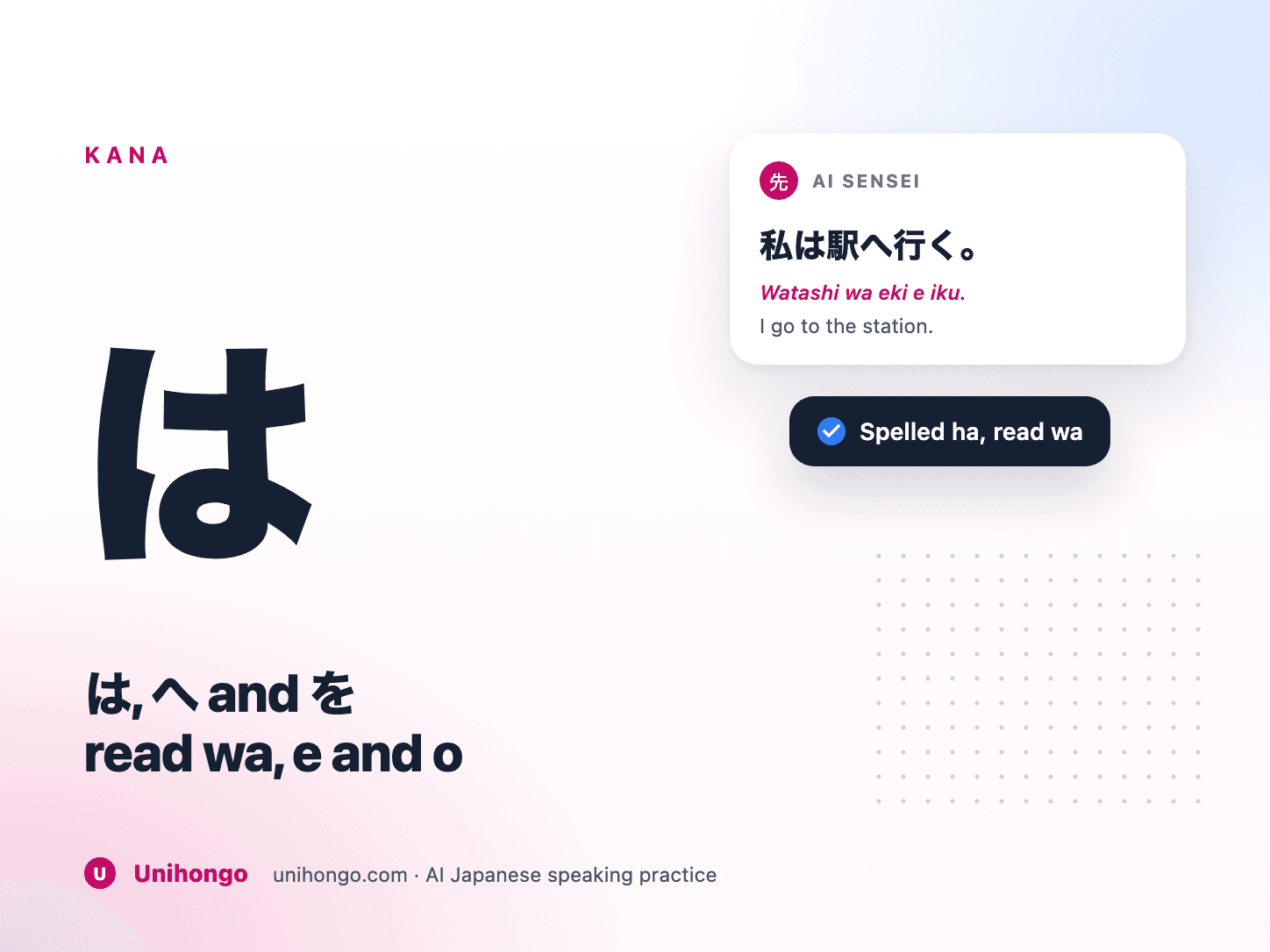
Particles spelled the old way
When Japanese spelling was modernised, words were respelled to match their pronunciation, but three particles kept their traditional kana. That is the whole history you need: the spelling is old, the reading is modern.
In practice the rule is narrow. It applies only when these kana function as particles. The same kana inside ordinary words are read normally, which is why fluent reading depends on recognising which is which.
| Japanese | Romaji | Meaning |
|---|---|---|
| 私は学生です。 | Watashi wa gakusei desu. | I am a student: は is the topic particle, read wa |
| 駅へ行きます。 | Eki e ikimasu. | I am going to the station: へ is the direction particle, read e |
| 水を飲みます。 | Mizu o nomimasu. | I drink water: を is the object particle, read o |
Particle or part of a word
は appears constantly inside words, and there it keeps its normal reading ha. The clue is position: the particle follows a noun or phrase and marks what the sentence is about, while the kana inside a word is simply one of its syllables.
Reading slowly at first, and checking whether a は finishes a word or sits inside one, builds the habit quickly. Within a few weeks it becomes automatic.
| Japanese | Romaji | Meaning |
|---|---|---|
| 花 | hana | Flower: は inside the word, read ha |
| はい | hai | Yes: read ha |
| 母は元気です。 | Haha wa genki desu. | My mother is well: the first は is ha, the second is wa |
| 橋はあそこです。 | Hashi wa asoko desu. | The bridge is over there |
| 部屋 | heya | Room: へ inside a word, read he |
| へえ | hē | Oh, really: an interjection, read he |
Set phrases that hide a particle
Some very common expressions end in or contain a particle は that has fused into the phrase. They are read with wa and spelled with は, and they are where learners most often misspell.
Konnichiwa and konbanwa began as longer greetings, roughly as for today and as for this evening, which is why their final sound is the particle.
| Japanese | Romaji | Meaning |
|---|---|---|
| こんにちは | konnichiwa | Hello |
| こんばんは | konbanwa | Good evening |
| では | de wa | Well then; also part of de wa arimasen |
| または | mata wa | Or |
| あるいは | arui wa | Or, alternatively |
| には | ni wa | At or for, with emphasis |
| とは | to wa | As for what is called; used in definitions |
へ and を in real sentences
へ as a particle marks direction and is read e. It overlaps with ni in many sentences, but its spelling never changes: it is always へ, never え.
を is simpler, because it is used almost only as the object particle. If you see を, you can read it o without checking anything else.
| Japanese | Romaji | Meaning |
|---|---|---|
| 日本へようこそ。 | Nihon e yōkoso. | Welcome to Japan |
| 家へ帰ります。 | Ie e kaerimasu. | I am going home |
| 友達への手紙 | tomodachi e no tegami | A letter to a friend |
| ドアを開けてください。 | Doa o akete kudasai. | Please open the door |
| 日本語を勉強しています。 | Nihongo o benkyō shite imasu. | I am studying Japanese |
Typing the particles
Keyboards follow the spelling, not the pronunciation. To get the particle は you type ha; for へ you type he; for を you type wo. Typing wa, e or o produces わ, え or お, which are the wrong kana for particles.
On a phone flick keyboard, は is in the ha group and へ in the same group, while を sits on the wa key. It feels odd for a few days and then becomes a reflex.
- Particle wa: type ha.
- Particle e: type he.
- Particle o: type wo.
- Konnichiwa: type konnnichiha with three n's, or kon'nichiha, so the ん does not swallow the next i.
- If the conversion suggests the wrong kanji, the particle kana is usually the cause.
Spelling mistakes that give a learner away
These mistakes are understandable because they follow the sound. In handwritten work, emails or forms, they are also immediately noticeable.
- Writing わ for the topic particle, as in 私わ.
- Writing こんにちわ in anything formal.
- Writing お for the object particle, as in 水お.
- Writing え for the direction particle.
- Reading the particle は aloud as ha when reading a text.
- Confusing the particle は with the sentence-ending わ, which is a different particle actually written わ.
The last one catches intermediate learners: in いいわ or 行くわ, the final わ is a real わ, used as a sentence ending, not the topic particle.
Making it automatic
Two habits fix this for good. Reading aloud trains the pronunciation of each particle in context, and typing trains the spelling, because the keyboard will not accept the sound-based version.
Fast kana recognition helps too, because hesitation over は often comes from reading kana one by one. Unihongo's Kana Dash builds that speed, and reading a few sentences aloud to your AI Sensei in the 3D classroom gives you the spoken side, so the reading wa becomes as natural as the spelling は.