
勝 at a glance: win, victory, match and title
Four words cover almost every way Japanese talks about winning. 勝つ is the verb you use in conversation. 勝利 is the formal noun from the news. 勝負 is the contest itself, the moment where someone must win and someone must lose. 優勝 is the final prize, first place in the whole competition.
Notice that 勝負 combines win (勝) with lose (負). A 勝負 is not a victory, it is a showdown: 勝負しよう means let's settle this, and 真剣勝負 is a serious, all-out contest.
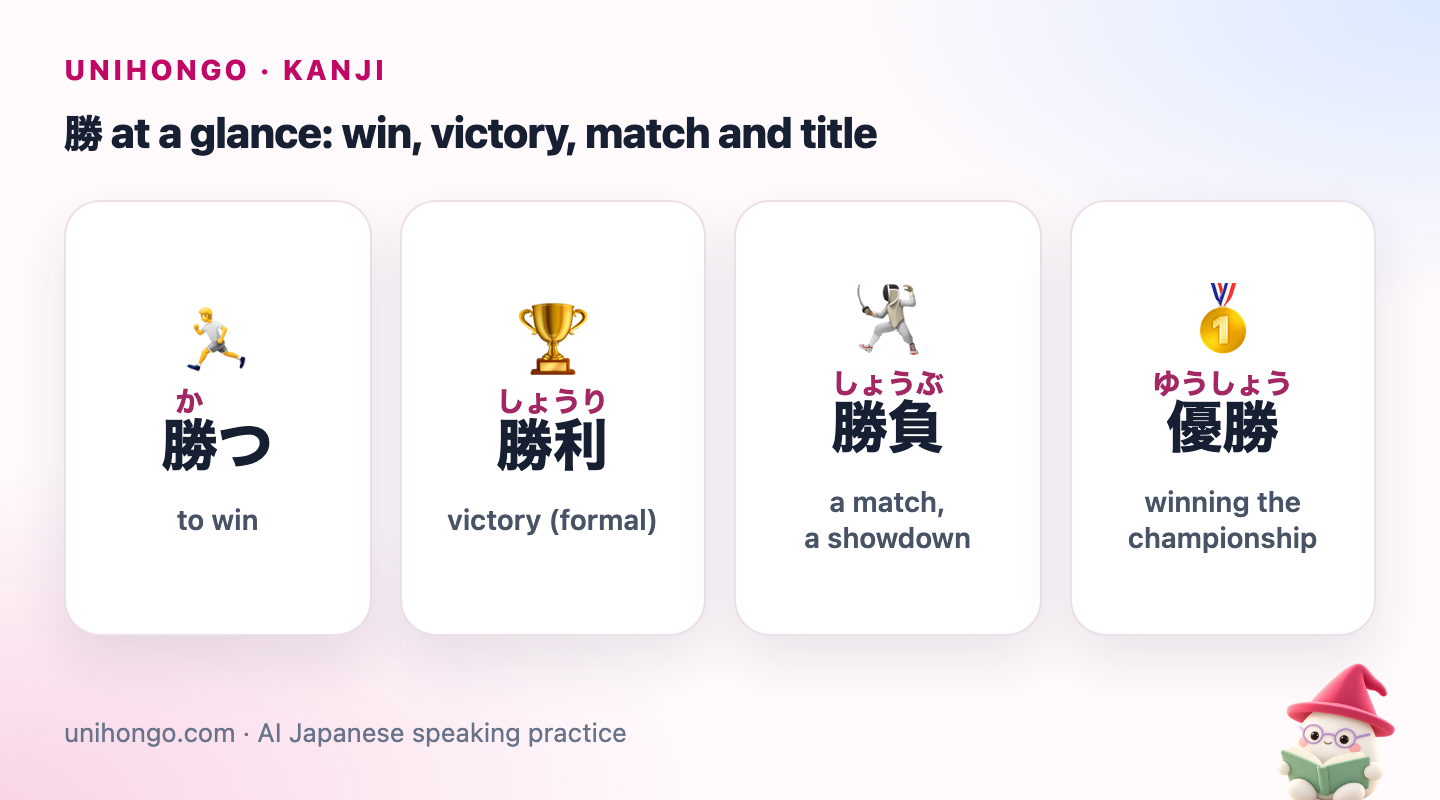
| Japanese | Romaji | Meaning |
|---|---|---|
| 勝つ | katsu | to win |
| 勝利 | shōri | victory (formal) |
| 勝負 | shōbu | a match, a showdown |
| 優勝 | yūshō | winning the championship |
Readings, strokes and parts of 勝
| Kanji | Strokes | On'yomi | Kun'yomi | Core meaning |
|---|---|---|---|---|
| 勝 | 12 | shō | katsu, masaru | to win, to surpass; scenic, excellent |
勝 has 12 strokes. The left side looks like 月, and the bottom right is 力, power, which is the radical under which dictionaries list the kanji. A simple memory picture: power at the bottom right, pushing upward to come out on top.
Katsu is the everyday verb, and its stem kachi (勝ち) works as a noun. Masaru, to surpass, is an older verb usually written 勝る today, as in 健康に勝るものはない, nothing beats good health. Shō is the reading in compound words, and it also carries a second meaning, excellent or scenic, which you will meet in travel Japanese.
The sound katsu also explains a light-hearted custom. Because the pork cutlet in カツ丼 (katsudon) sounds like 勝つ, many students eat it the night before an entrance exam, and some athletes and their families do the same before a big match. It is a play on words rather than a serious belief, and plenty of people skip it, but if a host family serves you katsudon before an exam, now you know why, and a simple ありがとう、頑張ります is the perfect reply.
Everyday words built on 勝
These words come up in sports, school, work and travel. Several are compounds with numbers or prefixes that sports commentators use constantly.
| Japanese | Romaji | Meaning |
|---|---|---|
| 勝ち負け | kachimake | winning and losing |
| 決勝 | kesshō | the final |
| 準決勝 | junkesshō | the semi-final |
| 連勝 | renshō | a winning streak |
| 必勝 | hisshō | certain victory, must win |
| 勝者 | shōsha | winner |
| 逆転勝ち | gyakuten gachi | a come-from-behind win |
| 勝負服 | shōbufuku | your lucky or best outfit |
| 景勝地 | keishōchi | scenic spot |
| 勝ち組 | kachigumi | winners in life (slang) |
勝負服 started as the outfit a jockey or athlete wears in competition, and today it is the outfit you wear when it really counts: a first date, an interview, a big presentation. 勝ち組 and its opposite 負け組 (makegumi) label people as winners and losers in life; they are common in media but can sound judgmental, so use them carefully.
When 勝ち follows another word it often changes to gachi, as in 逆転勝ち. This sound change is common in Japanese compounds, so expect it in sports news.
勝つ, 勝利, 優勝 or 勝ち: which word to use
All four can translate as win, but they live in different places. Using the formal word in a casual chat sounds like a news anchor; using the casual word in a speech sounds too light.
| Japanese | Romaji | Meaning |
|---|---|---|
| 昨日の試合に勝ったよ! | Kinō no shiai ni katta yo! | We won yesterday's match! (casual) |
| じゃんけんは私の勝ち。 | Janken wa watashi no kachi. | I win at rock-paper-scissors. |
| チームは見事な勝利を収めました。 | Chīmu wa migoto na shōri o osamemashita. | The team won a splendid victory. (formal) |
| 大会で優勝しました。 | Taikai de yūshō shimashita. | I won the tournament. (polite) |
| 自分に勝つのが一番難しい。 | Jibun ni katsu no ga ichiban muzukashii. | Beating yourself is the hardest thing. |
| Word | Register | Use it for | Typical sentence idea |
|---|---|---|---|
| 勝つ | Everyday verb | Winning a game, an argument, against someone | We won yesterday |
| 勝ち | Casual noun | A single win, a result | That's a win, I win |
| 勝利 | Formal noun | News, speeches, elections, battles | The team's victory |
| 優勝 | Neutral noun | Coming first in a whole tournament | She won the championship |
Look at the particle in each example. 勝つ always takes に for the opponent or the event: 試合に勝つ, 相手に勝つ, 自分に勝つ. Its opposite, 負ける (makeru, to lose), works the same way: 試合に負けた, we lost the match.
Mini dialogue: after the game with a teammate
Here two members of a weekend futsal team talk on the bench after a narrow win. The speech is casual, as it would be between teammates of a similar age.
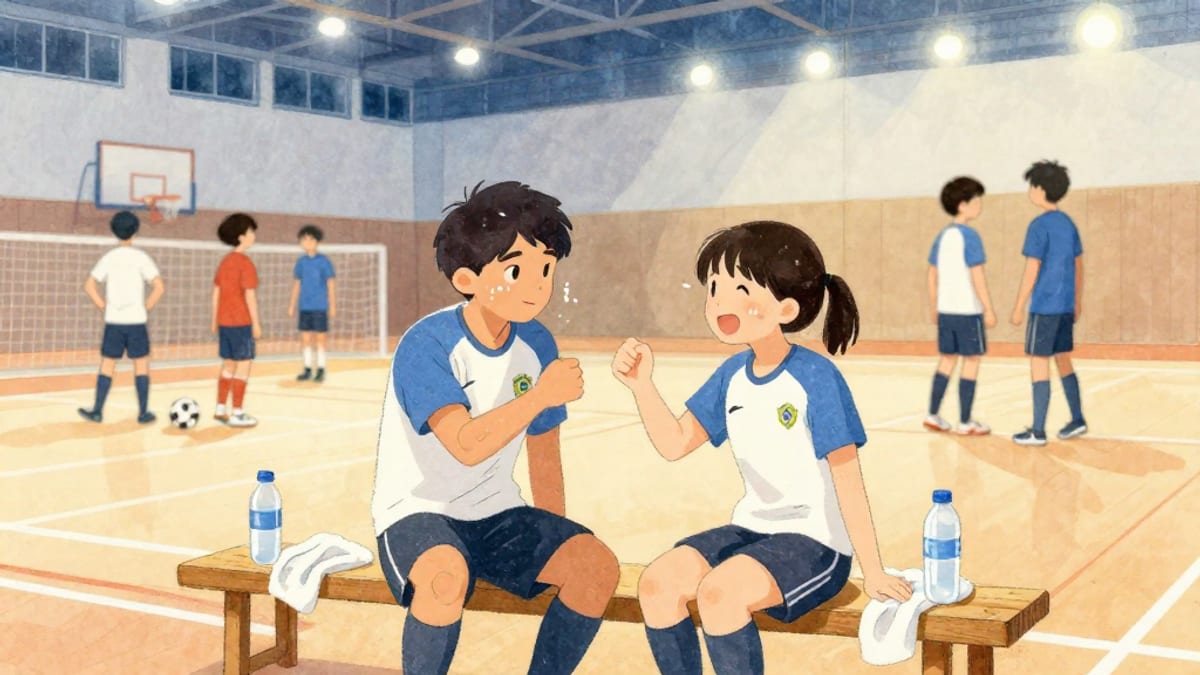
| Japanese | Romaji | Meaning |
|---|---|---|
| やった、勝った! | Yatta, katta! | Teammate: Yes, we won! |
| 最後のゴール、すごかったね。 | Saigo no gōru, sugokatta ne. | You: That last goal was amazing. |
| いや、運がよかっただけだよ。 | Iya, un ga yokatta dake da yo. | Teammate: Nah, I just got lucky. |
| これで三連勝だね。 | Kore de sanrenshō da ne. | You: That's three wins in a row. |
| 来月の大会、優勝したいな。 | Raigetsu no taikai, yūshō shitai na. | Teammate: I'd love to win next month's tournament. |
| 勝って兜の緒を締めよ、だね。 | Katte kabuto no o o shimeyo, da ne. | You: Stay sharp even after a win, right? |
The modest reply 運がよかっただけ is very Japanese: after a win, people often play down their own part and praise the team or luck. When someone compliments you, a similar line sounds natural and kind.
Proverbs, cheers and names with 勝
Japanese has a few sayings about winning that people actually quote, often half-jokingly. They are worth knowing because you will hear them from coaches, teachers and older colleagues.
| Japanese | Romaji | Meaning |
|---|---|---|
| 負けるが勝ち | makeru ga kachi | losing is winning; give way to win |
| 勝負あり | shōbu ari | the match is decided |
| 必勝祈願 | hisshō kigan | a prayer for victory |
| 絶対勝てるよ! | Zettai kateru yo! | You'll definitely win! (casual) |
勝って兜の緒を締めよ, from the dialogue, means after a victory, tighten the cords of your helmet: do not relax just because you won. 負けるが勝ち means that giving way, for example in an argument, can be the wiser win in the long run.
Before exams and tournaments, students and fans often wear a headband, a hachimaki, printed with 必勝, and some visit a shrine for a 必勝祈願. In names, 勝 appears as the boy's name Masaru and in names such as Katsuya and family names such as 勝田 (Katsuta); it sounds solid and a little classic.
勝 as a tattoo or design
勝 on its own reads clearly as win or victory. To Japanese eyes it can look like a slogan from a sports headband or a sales poster, energetic but a little plain. That is not a problem for a team shirt, but for something permanent, many people prefer a word with more depth.
Good options include 必勝 (certain victory, very sporty), 勝利 (victory, formal) and 己に勝つ (onore ni katsu, overcome yourself), which shifts the meaning from beating others to beating your own weakness. Note that Chinese writes victory with a simplified character, 胜, in mainland China, so a design copied from a Chinese source may not match the Japanese 勝.
Whatever you choose, ask a native speaker to check the exact characters, the stroke shapes and the font. 勝 has many small strokes on the right, and they are easy to get subtly wrong in a hand-drawn design.
| Japanese | Romaji | Meaning |
|---|---|---|
| 己に勝つ | onore ni katsu | to overcome yourself |
| 真剣勝負 | shinken shōbu | an all-out, serious contest |
Win the particle battle with Mocchi
Write three sentences about a match you care about and send them to Mocchi with /correct. Mocchi fixes them, explains each change and, if you wrote 試合を勝った, notes the mistake so a later /review gives you a quick に or を question before you can repeat it.
Then take the sentences out loud. In AI Sensei, ask Hana-sensei to play a teammate after a game and to keep the talk casual. You report the score, play down your own goal and plan for the next tournament, and the session report afterwards lists any 勝 words you stumbled on.
Common mistakes and how to write 勝
- Saying 試合を勝つ. Use に: 試合に勝つ. The same goes for 負ける: 試合に負ける.
- Thinking 勝手 means victory hand. 勝手 (katte) means as you like, on your own, or selfishly: 勝手に使わないで, don't use it without asking.
- Using 勝利 in casual chat. 勝ったね sounds natural with friends; 勝利したね sounds like a commentator.
- Confusing 勝 with 騰 (tō, to rise sharply, as in 高騰, a price surge). 騰 has 馬 (horse) at the bottom right where 勝 has 力.
- Using 優勝 for a single win. One match won is 勝ち; the whole tournament is 優勝.