
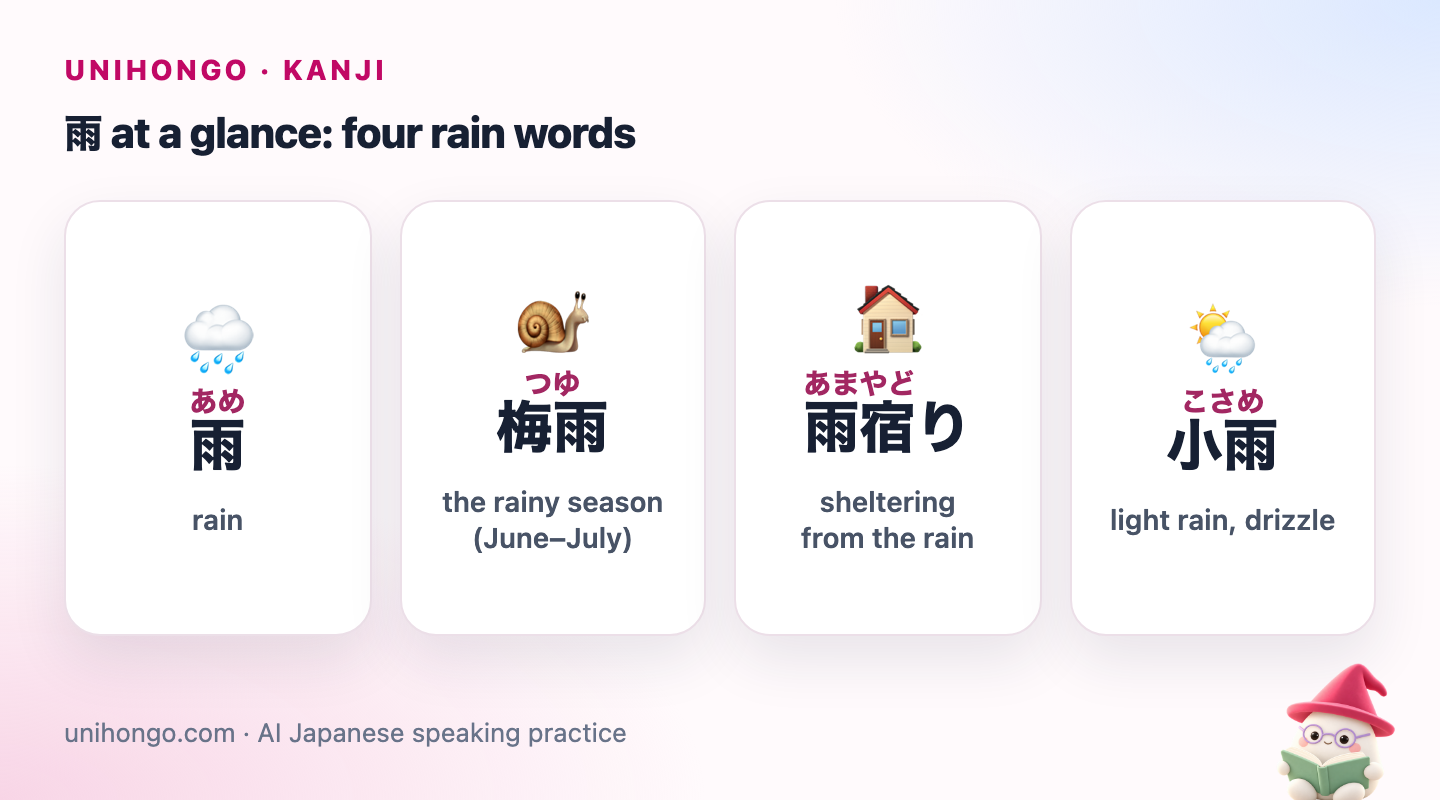
雨 at a glance: four rain words
雨 means rain. It began as a picture of rain falling from the sky: the top line is the sky, the frame is the clouds, and the four short dots are the raindrops. Once you see the drops, you will never forget it.
These four words are the ones you will hear first: rain itself, the rainy season, sheltering from the rain under a roof, and a light drizzle.
| Japanese | Romaji | Meaning |
|---|---|---|
| 雨 | ame | rain |
| 梅雨 | tsuyu | the rainy season (June–July) |
| 雨宿り | amayadori | sheltering from the rain |
| 小雨 | kosame | light rain, drizzle |
Readings, the rain radical and stroke order
雨 has eight strokes. It is a pictograph, so it is not made from smaller parts. It has several readings, and the pattern behind them is easier than it looks: ame is the basic native word; ama appears at the start of some older native words; after another word, ame often becomes same; and in Chinese-style compounds it is u.
| Japanese | Romaji | Meaning |
|---|---|---|
| 雲 | kumo | a cloud |
| 雷 | kaminari | thunder, lightning |
| 霧 | kiri | fog, mist |
| Reading | Type | When you use it | Examples |
|---|---|---|---|
| ame | kun'yomi | alone and in most native words | 雨, ame; 大雨, ōame; 雨上がり, ameagari |
| ama | kun'yomi | at the start of some older words | 雨傘, amagasa; 雨宿り, amayadori; 雨戸, amado |
| same | kun'yomi (sound change) | after another word | 小雨, kosame; 春雨, harusame; 霧雨, kirisame |
| u | on'yomi | Chinese-style compounds | 雨天, uten; 豪雨, gōu; 雷雨, raiu |
On top of another kanji, 雨 becomes a flatter shape called amekanmuri, the rain crown. It marks kanji about weather and the sky: 雪 (snow), 雲 (cloud), 雷 (thunder), 霧 (fog) and 霜 (frost). 電 (electricity) also uses it, because its lower part originally showed lightning. If you see the rain crown on an unknown kanji, guess weather first.
How to write it: start with the short top horizontal line. Then write the short vertical on the left, followed by the top and right side of the frame as one stroke ending in a hook. Next comes the vertical line down the centre. Finally add the four drops: the two on the left from top to bottom, then the two on the right.
Fifteen everyday rain words
Japanese weather forecasts, schools and event organisers all have their own rain words. These are the ones worth knowing for daily life. Two of the most practical are uten chūshi and uten kekkō, which you will see on notices for sports days, festivals and outdoor events: cancelled if it rains, and going ahead even in rain.
| Japanese | Romaji | Meaning |
|---|---|---|
| 私、雨女なんです。 | Watashi, ameonna nan desu. | I'm a rain woman. (a joke) |
| 明日の運動会は雨天中止です。 | Ashita no undōkai wa uten chūshi desu. | Tomorrow's sports day is off if it rains. |
Ameotoko and ameonna, rain man and rain woman, are friendly jokes about a person who always seems to bring bad weather to trips and events. If it pours on your company picnic, someone may laugh and ask who the ameotoko is. The opposite is hareotoko or hareonna, a person who brings sunshine. A sun shower, tenkiame, also has a folk name, kitsune no yomeiri, a fox's wedding.
Note that harusame means both a soft spring rain and the thin, clear glass noodles sold in every supermarket. On a menu, it is always the noodles.
How Japanese hears rain: shito shito to zā zā
Japanese uses sound-and-feeling words, onomatopoeia, to describe rain far more than English does, and they are completely normal in conversation and in weather reports. Choosing the right one is a quick way to sound natural.
| Japanese | Romaji | Meaning |
|---|---|---|
| ぽつぽつ降ってきた。 | Potsu potsu futte kita. | It's starting to spit with rain. |
| しとしと降っている。 | Shito shito futte iru. | It's raining softly and steadily. |
| ざあざあ降りだ。 | Zā zā buri da. | It's pouring down. |
| 雨がやんだ。 | Ame ga yanda. | The rain has stopped. |
| 降ったりやんだりですね。 | Futtari yandari desu ne. | It keeps starting and stopping. |
Potsu potsu is the first scattered drops; shito shito is a gentle, quiet, steady rain, often used for tsuyu; zā zā is a heavy downpour you can hear on the roof. Note the verbs: rain falls, furu, and stops, yamu. Learners often say ame ga tomatta, but for rain and snow the natural verb is yamu.
Tsuyu: living with the rainy season
Tsuyu is the long early-summer rainy season that covers much of Japan, usually from around early June to mid or late July, with regional differences. It is not constant rain, but grey, humid days with frequent showers, when laundry will not dry and mould is a household worry. People talk about it constantly: when the rainy season has started, tsuyu iri, and when it is finally over, tsuyu ake, which marks the real start of summer.
The season has its pleasures too. Hydrangeas, ajisai, bloom in blue, purple and pink in temple gardens and along railway lines, and many people visit them in the rain. Children hang a small cloth doll called a teru teru bōzu by the window to wish for a sunny day before an outing.
| Japanese | Romaji | Meaning |
|---|---|---|
| 梅雨入りしましたね。 | Tsuyu iri shimashita ne. | The rainy season has started, hasn't it? |
| 早く梅雨が明けてほしい。 | Hayaku tsuyu ga akete hoshii. | I want the rainy season to end soon. |
| 洗濯物が乾かない。 | Sentakumono ga kawakanai. | The laundry won't dry. |
| あじさいがきれいですね。 | Ajisai ga kirei desu ne. | The hydrangeas are lovely. |
Mini dialogue: caught in the rain without an umbrella
Sudden showers are common in summer, and convenience stores sell clear plastic umbrellas for exactly this moment. At work, a coworker may offer to share or lend you an umbrella, and returning it promptly with a word of thanks is the polite thing to do. Many offices and shops also keep a stand of spare umbrellas for staff and customers to borrow.

| Japanese | Romaji | Meaning |
|---|---|---|
| うわ、すごい雨ですね。 | Uwa, sugoi ame desu ne. | You: Wow, it's really pouring. |
| 傘、持ってますか。 | Kasa, mottemasu ka. | Coworker: Do you have an umbrella? |
| いえ、忘れてしまいました。 | Ie, wasurete shimaimashita. | You: No, I forgot it. |
| 駅まで入っていきませんか。 | Eki made haitte ikimasen ka. | Coworker: Want to share mine to the station? |
| 助かります。ありがとうございます。 | Tasukarimasu. Arigatō gozaimasu. | You: That's a big help. Thank you. |
| しばらく雨宿りしてもいいですね。 | Shibaraku amayadori shite mo ii desu ne. | Coworker: Or we could wait it out here. |
Tasukarimasu, literally I am saved, is the natural way to thank someone for practical help. It sounds warmer and more grateful than a plain arigatō in this situation.
A saying, names and rain designs
The best-known rain saying is ame futte ji katamaru: after rain, the ground becomes firm. It means that a quarrel or trouble can leave a relationship stronger than before, and it is a popular line in wedding speeches and after a team has sorted out a conflict. Megumi no ame, a blessed rain, is a welcome rain after a dry spell, also used for any timely help.
雨 is not common in given names, but related words are: 雫 (Shizuku, a water drop) is sometimes used as a girl's name, and 時雨 (shigure), a cold, passing shower of late autumn, appears in poetry and some names. As always, one kanji can be read many ways in names.
| Japanese | Romaji | Meaning |
|---|---|---|
| 雨降って地固まる | ame futte ji katamaru | trouble makes bonds stronger |
| 恵みの雨 | megumi no ame | a blessed, welcome rain |
| 時雨 | shigure | a passing late-autumn shower |
- For a tattoo or design, 雨 alone is beautiful but may feel sad or puzzling. 雨上がり (ameagari, after the rain) or 恵みの雨 carry a hopeful meaning.
- Chinese and Japanese both use 雨 for rain with the same form, and 梅雨 exists in Chinese too, so there is no hidden trap here.
- Ask a native speaker to check the characters and the four drops: they are easy to draw wrongly in a stylised design.
Look-alikes and common mistakes
雨 is easy to recognise, but two kanji look similar at a glance. 両 (ryō, both) has a similar frame but no drops and a different inside. And under the rain crown, 雪 (snow), 雲 (cloud) and 電 (electricity) can blur together; look at the bottom part to tell them apart.
| Japanese | Romaji | Meaning |
|---|---|---|
| 両方 | ryōhō | both |
| 雪 | yuki | snow |
| 電気 | denki | electricity, the lights |
- Saying ame ga tomatta. The natural verb is yamu: ame ga yanda.
- Reading 小雨 as koame. It is kosame.
- Reading 梅雨 kanji by kanji as umeame. It is tsuyu, or baiu in weather reports.
- Using 雨 in a weather forecast heading for a typhoon. Look for 暴風雨, bōfūu, a rainstorm, or 大雨警報, a heavy-rain warning.
A rainy-day routine with Mocchi and Hana-sensei
Ask Mocchi: Teach me the Japanese rain words and sounds from this list, then quiz me, mixing kanji and onomatopoeia. Mocchi explains each one, notices which ones you confuse, such as kosame and kirisame, and brings them back the next time you study. You can also ask Mocchi to add a rain-word review to your plan for the rainy season.
Then open AI Sensei, choose Hana-sensei and ask her to play a coworker at the office door on a stormy evening. Talk about the rain, accept her umbrella and thank her naturally. Afterwards, the session report shows which phrases sounded natural and what to fix.