
友 in four words: friend, best friend and friendship
These four words cover almost everything you will say with 友 in daily life. The first is the one you need constantly; the others add closeness, formality and the idea of friendship itself.
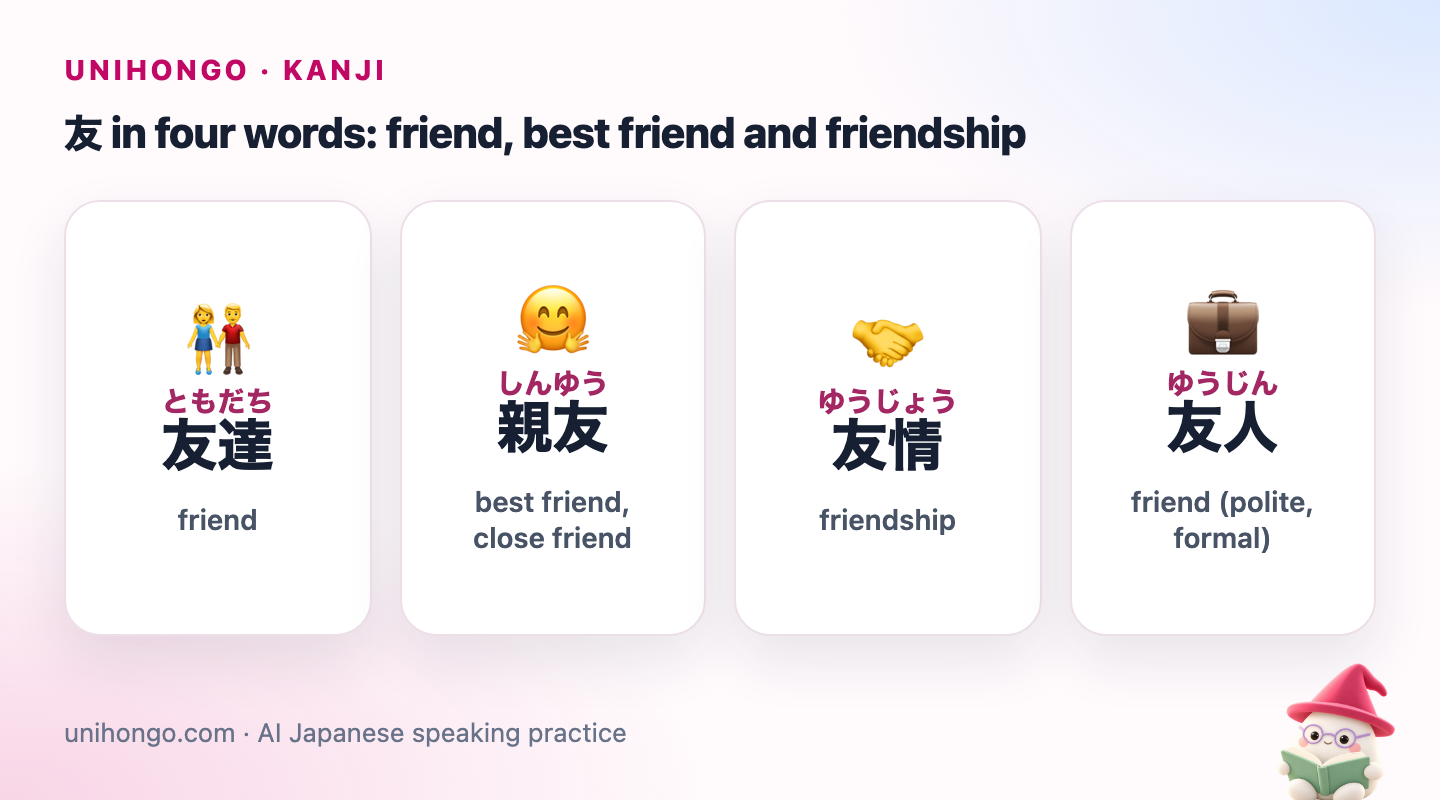
| Japanese | Romaji | Meaning |
|---|---|---|
| 友達 | tomodachi | friend |
| 親友 | shin'yū | best friend, close friend |
| 友情 | yūjō | friendship |
| 友人 | yūjin | friend (polite, formal) |
Readings, strokes and two joined hands
友 has four strokes. The common explanation is that it shows two right hands: the top part, which looks like ナ, is one hand, and 又 below is another, an old form meaning hand. Two hands joined, people helping each other, became friend. This explanation is widely taught and a lovely way to remember the shape. The reading yū is the one you will hear most in formal compounds, while tomo dominates names and everyday words.
| Reading | Type | Examples |
|---|---|---|
| tomo | Kun'yomi | 友, 友達, 友だち, 竹馬の友 |
| yū | On'yomi | 友情, 親友, 友人, 友好, 学友 |
| tomo | In names | 友美 (Tomomi), 友也 (Tomoya) |
友達 contains 達, a suffix that once made plurals, as in 私達, watashitachi, we. Today 友達 means one friend or several, and to stress the plural people say 友達たち or 友人たち. You will also see 友だち written half in kana, which looks softer and is common in schools and on children's materials.
The 友 family: classmates, old friends and allies
The on'yomi yū builds a large family of compounds, many of them formal. Notice how a single kanji in front changes the kind of friend: school, war, old times or pen.
| Japanese | Romaji | Meaning |
|---|---|---|
| 学友 | gakuyū | schoolmate (formal) |
| 旧友 | kyūyū | an old friend |
| 戦友 | sen'yū | a comrade in arms; a close teammate |
| 友好 | yūkō | friendly relations, e.g. between cities |
| 友好的 | yūkōteki | friendly, amicable |
| 交友関係 | kōyū kankei | one's circle of friends |
| 友人の結婚式に出席します。 | Yūjin no kekkonshiki ni shusseki shimasu. | I'm attending a friend's wedding. (formal) |
| 彼とは大学からの友達です。 | Kare to wa daigaku kara no tomodachi desu. | He and I have been friends since university. |
| 二つの町は友好都市です。 | Futatsu no machi wa yūkō toshi desu. | The two towns are sister cities. |
Becoming friends: verbs that go with 友達
Knowing the noun is only half the job; you also need the verbs that go with it. Japanese says you become friends, 友達になる, and you make friends, 友達を作る or 友達ができる. The last one is especially natural: it describes friends appearing in your life, rather than you building them, and it is how most people talk about a new school, job or city.
Asking someone directly to be your friend, 友達になってください, exists, but between adults it can sound childlike or very earnest. Adults usually let friendship grow from a shared activity and say something lighter, such as suggesting another meeting or exchanging contacts. Children and teenagers use the direct version more freely.
| Japanese | Romaji | Meaning |
|---|---|---|
| 日本で友達ができました。 | Nihon de tomodachi ga dekimashita. | I've made friends in Japan. |
| すぐ友達になりました。 | Sugu tomodachi ni narimashita. | We became friends right away. |
| 友達を作るのが苦手です。 | Tomodachi o tsukuru no ga nigate desu. | I'm not good at making friends. |
| また一緒に行きましょう。 | Mata issho ni ikimashō. | Let's go together again. (a light way to grow a friendship) |
Set phrases, proverbs and the calendar day 友引
Several set phrases use 友 alone, in its literary reading tomo. 竹馬の友, a bamboo-horse friend, is a childhood friend you played with as kids; it sounds warm and slightly old-fashioned. 類は友を呼ぶ, like calls to like, is the Japanese version of birds of a feather flock together, and it can be teasing.
友引, tomobiki, is one of the six days of the traditional Japanese calendar cycle still printed on many calendars. Its name is read as pulling a friend along, and for that reason many people avoid holding funerals on a 友引 day, and many crematoriums are closed. It is a custom, not a rule, and attitudes vary, but you may hear it when a funeral date is being chosen.
| Japanese | Romaji | Meaning |
|---|---|---|
| 竹馬の友 | chikuba no tomo | a childhood friend |
| 類は友を呼ぶ | Rui wa tomo o yobu. | Birds of a feather flock together. |
| 友引 | tomobiki | a calendar day avoided for funerals |
| 一生の友 | isshō no tomo | a friend for life |
| 友と呼べる人 | tomo to yoberu hito | someone I can truly call a friend |
In names, 友 suggests friendliness and is common in both boys' and girls' names, such as Tomoya and Tomomi. The same sound tomo can also be written with other kanji, such as 智 or 知, so do not assume. Ask how a name is written before you write it on a card or a gift.
Meeting an old friend again
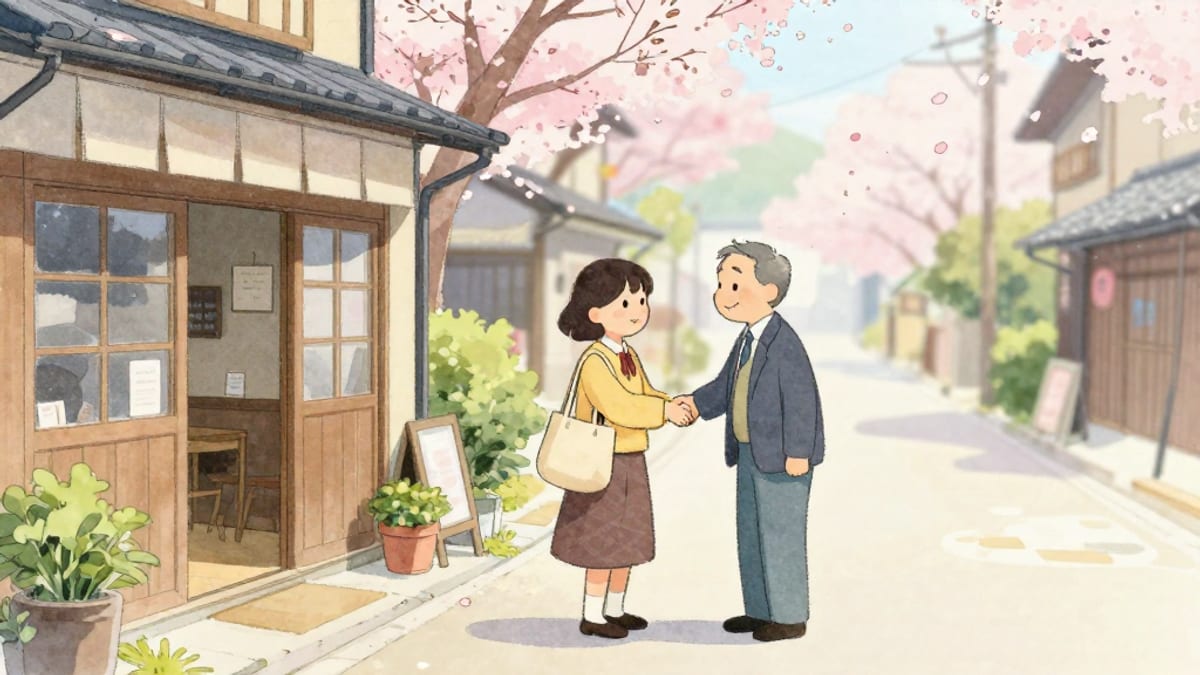
One of the nicest moments to use 友 words is a reunion: running into a school friend, meeting a host family after years, or a class gathering. Japanese has a ready-made greeting for this, 久しぶり, long time no see, and friends usually follow with how they have been and a suggestion to eat or drink together.
| Japanese | Romaji | Meaning |
|---|---|---|
| 久しぶり!元気だった? | Hisashiburi! Genki datta? | Friend: Long time no see! How have you been? |
| 元気だよ。もう十年ぶりだね。 | Genki da yo. Mō jūnen buri da ne. | You: I'm good. It's been ten years, hasn't it? |
| 全然変わってないね。 | Zenzen kawattenai ne. | Friend: You haven't changed at all. |
| 今度ゆっくりご飯でも行こうよ。 | Kondo yukkuri gohan demo ikō yo. | You: Let's go for a proper meal sometime. |
| いいね。連絡するね。 | Ii ne. Renraku suru ne. | Friend: Sounds good. I'll be in touch. |
友 vs 反 vs 左, and the stroke-order rule
Three shapes cause trouble. 反, against, as in 反対, hantai, opposition, has a slanted roof instead of the crossing strokes. 左, left, shares the top of 友 but has 工 below. And 右, right, looks like 左 but is written in a different order, which is the famous rule worth knowing.
| Japanese | Romaji | Meaning |
|---|---|---|
| 反対 | hantai | opposition, the opposite |
| 左 | hidari | left |
| 右 | migi | right |
- Writing the left-falling stroke of 友 first. In 友 and 左, the horizontal comes first.
- Using 友 alone in a casual message. Write 友達 or 友だち.
- Calling a classmate 戦友 seriously. It means comrade in arms and sounds dramatic, unless you are joking about exam season.
- Writing 親友 as 新友. 新 means new; 親 means close, as in parent.
To write 友, draw the horizontal first, then the long left-falling stroke that crosses it, then 又: the stroke that goes right and turns down to the left, and finally the long sweep to the bottom right. In 右, by contrast, the left-falling stroke comes first and the horizontal second. Teachers explain it by stroke length: the shorter of the two crossing strokes is written first.
友, 友情 or 親友 for a tattoo or gift
友 alone is clear but plain, and in both Japanese and Chinese it simply means friend. For matching tattoos, bracelets or a framed gift, a word usually expresses more. 友情, friendship, is warm and complete. 親友, best friend, suits two people. 一生の友, a friend for life, is a phrase and reads like a message, which many people like on a card or a gift.
Avoid the informal 心友 for anything permanent: it is playful and modern, and some readers will think it is a spelling mistake. Matching designs double the risk of a mistake, so ask a native speaker to check both before anyone goes to the studio.
Introduce your best friend, then rehearse the reunion
- Write three sentences introducing a friend and send them to Mocchi with /correct. Mocchi corrects them, explains the choice between 友達 and 友人, and remembers what you got wrong.
- Ask Mocchi to add 親友, 友情, 旧友 and 竹馬の友 to your plan; they come back in later quizzes.
- Open AI Sensei, choose Hana-sensei and ask her to play an old school friend you meet after ten years. Greet her, catch up and make a plan, then read the session report.