
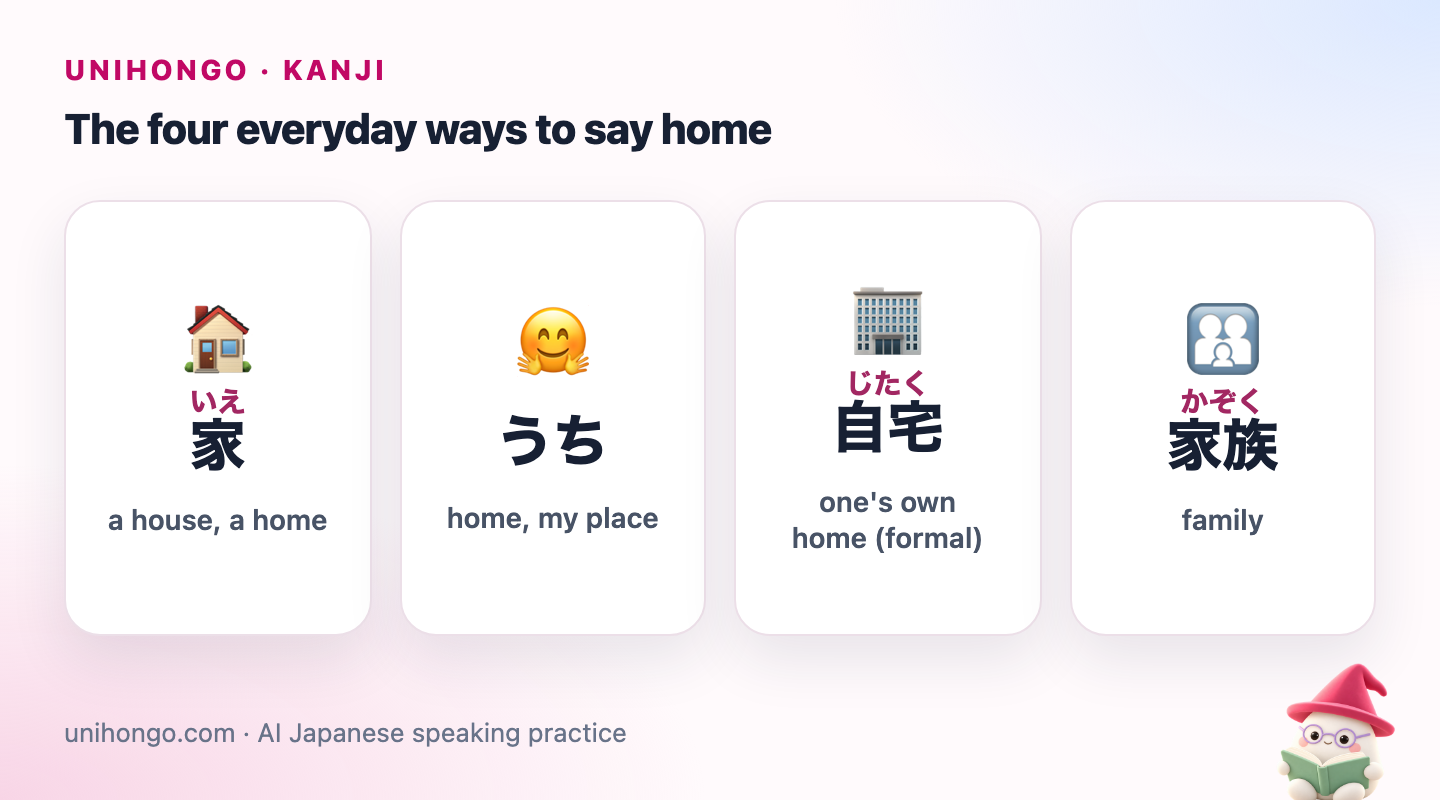
The four everyday ways to say home
Most learners meet 家 first and assume it is the only home kanji. In practice, Japanese speakers move between several words, and choosing the right one makes you sound much more natural. These four cover almost every situation: the house, the warm personal home, the formal home on paperwork, and the family who lives there.
| Japanese | Romaji | Meaning |
|---|---|---|
| 家 | ie | a house, a home |
| うち | uchi | home, my place |
| 自宅 | jitaku | one's own home (formal) |
| 家族 | kazoku | family |
Readings and parts of 家 and 宅
家 has ten strokes. It is made of 宀, a roof, over 豕, an old character for a pig. The pig under a roof is the standard explanation, often linked to households keeping animals in or beside the house. It is an odd image for home, which makes it easy to remember.
宅 has six strokes and shares the same roof on top. It has only one common reading, taku, so it is a simple kanji to learn once you know the words it appears in.
| Kanji | Reading type | Reading | Example |
|---|---|---|---|
| 家 | kun'yomi | ie | 家, ie, a house; 家出, iede, running away from home |
| 家 | kun'yomi | ya | 家賃, yachin, rent; 大家, ōya, landlord |
| 家 | on'yomi | ka | 家族, kazoku; 作家, sakka, a writer |
| 家 | on'yomi | ke | 田中家, Tanaka-ke, the Tanaka family |
| 宅 | on'yomi | taku | 自宅, jitaku; 帰宅, kitaku, going home |
Fifteen home words for renting, family and daily life
These are the words you will need if you rent a flat, talk about your family or fill in a form in Japan. The first group uses 家, the second 宅. Notice how the rental words use the reading ya.
| Japanese | Romaji | Meaning |
|---|---|---|
| 家賃 | yachin | rent |
| 大家さん | ōya-san | the landlord |
| 実家 | jikka | one's parents' home |
| 一軒家 | ikkenya | a detached house |
| 家具 | kagu | furniture |
| 家電 | kaden | home appliances |
| 家事 | kaji | housework |
| 家庭 | katei | a household, home life |
| 空き家 | akiya | an empty house |
| 住宅 | jūtaku | housing, a residence |
| 帰宅 | kitaku | going home (formal) |
| 在宅勤務 | zaitaku kinmu | working from home |
| 宅配便 | takuhaibin | home delivery service |
| 家賃はいくらですか? | Yachin wa ikura desu ka? | How much is the rent? (polite) |
| 週末は実家に帰ります。 | Shūmatsu wa jikka ni kaerimasu. | I'm going to my parents' this weekend. |
Jikka deserves a special mention. It is the house you grew up in, where your parents live, and adults use it all the time: jikka ni kaeru, to go back to your parents' place. Kaji, housework, sounds exactly like 火事 (kaji, a fire), so context does the work. And akiya, empty houses, have become a common news topic in Japan as some rural areas lose population.
Ie, uchi, jitaku or otaku? Picking the right home
All four words can be translated as home, but they live in different situations. Ie is the neutral word for the house. Uchi is the warm, personal place you belong, and it stretches to mean our family or our side, as in uchi no ko, our kid, or uchi no kaisha, our company. Jitaku is your own home in formal or official language. Otaku is someone else's home, said politely.
| Japanese | Romaji | Meaning |
|---|---|---|
| うちに遊びに来ない? | Uchi ni asobi ni konai? | Want to come over? (casual) |
| うちの猫、かわいいでしょう。 | Uchi no neko, kawaii deshō. | Isn't our cat cute? |
| 今日は自宅で仕事をします。 | Kyō wa jitaku de shigoto o shimasu. | I'm working from home today. (polite) |
| お宅はどちらですか? | Otaku wa dochira desu ka? | Where do you live? (polite) |
| Word | Feeling | Typical sentence | Who says it |
|---|---|---|---|
| 家 (ie) | neutral, the building | ookii ie desu ne, what a big house | anyone |
| うち (uchi) | warm, personal, our side | uchi ni kuru? want to come over? | friends, family |
| 自宅 (jitaku) | formal, official | jitaku de shigoto o shimasu | at work, on forms |
| お宅 (otaku) | polite, your home | otaku wa dochira desu ka | polite adults, sales staff |
Otaku as a polite you or your home can sound a little old-fashioned or distant, and many people prefer to use a name instead. The slang otaku, a devoted fan, is usually traced back to this polite word, which some fans once used to address each other. Context always tells you which one is meant.
家 as a job title: from 作家 to 専門家
Added to the end of a word, 家 (ka) often means a person who is devoted to something or works in a field, a bit like -ist or -er in English. These words are common in the news, on book covers and in conversation about careers.
| Japanese | Romaji | Meaning |
|---|---|---|
| 作家 | sakka | a writer, a novelist |
| 画家 | gaka | a painter (artist) |
| 音楽家 | ongakuka | a musician |
| 専門家 | senmonka | an expert, a specialist |
| 努力家 | doryokuka | a hard worker |
Doryokuka is a lovely compliment: someone who keeps putting in effort. Kanojo wa doryokuka da ne, she really works hard, is something you can say about a classmate or colleague. The same suffix appears in family names: Tanaka-ke no hito means a member of the Tanaka family, and you may see -ke on wedding signs or family graves.
Dialogue: an invitation to a friend's family home
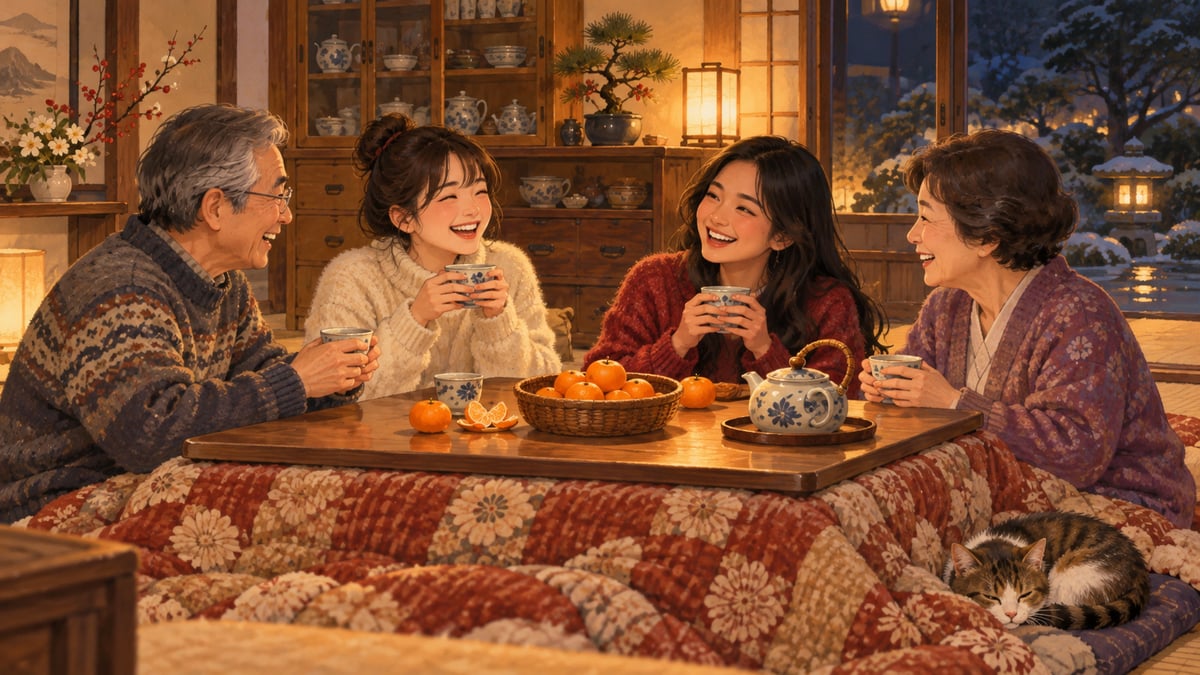
In Japan, many people go back to their jikka over New Year. If you are staying in the country, a friend may invite you along. Here is a casual conversation between two friends, with the words for home used naturally.
| Japanese | Romaji | Meaning |
|---|---|---|
| 年末は実家に帰るの? | Nenmatsu wa jikka ni kaeru no? | Friend: Going home to your parents over New Year? |
| ううん、国は遠いから日本にいるよ。 | Uun, kuni wa tōi kara Nihon ni iru yo. | You: No, home's too far, so I'm staying in Japan. |
| じゃあ、うちの実家に来ない? | Jā, uchi no jikka ni konai? | Friend: Then why not come to my parents' place? |
| えっ、いいの? | E, ii no? | You: Really? Is that OK? |
| もちろん。母も喜ぶよ。 | Mochiron. Haha mo yorokobu yo. | Friend: Of course. My mum will be happy. |
| ありがとう!どんな家? | Arigatō! Donna ie? | You: Thank you! What's the house like? |
| 古い一軒家で、庭に柿の木があるよ。 | Furui ikkenya de, niwa ni kaki no ki ga aru yo. | Friend: An old house with a persimmon tree. |
| 楽しみ! | Tanoshimi! | You: I can't wait! |
Home tattoos and designs: 家, 家族 or something warmer?
Home and family are meaningful themes for tattoos and designs, but a single kanji can read quite differently from what you intend.
- A lone 家 reads mostly as house. Japanese readers may also see the -ka of a job title, so it can feel incomplete.
- 家族 (kazoku, family) is clearer when the idea is the people you love. It is common in designs and is easy to read.
- Chinese and Japanese differ in feeling here. In Chinese, 家 is the warm everyday word for home and family, so a Chinese reader may see more emotion in it than a Japanese reader.
- For a sense of belonging or bond, 絆 (kizuna) is a popular choice that many people find more moving than 家.
- Ask a native speaker to check the characters and the brush style before getting inked. The pig part of 家 is easy to draw wrongly.
Look-alikes and mistakes with the roof kanji
家 and 宅 both sit under the roof radical 宀, and so do many other kanji, which makes them easy to confuse. 宅 is close to 字 (ji, a character) and 宇 (u, space). 家 can be mixed up with 豪 (gō, grand), which has a similar pig shape under a different top.
| Japanese | Romaji | Meaning |
|---|---|---|
| 漢字 | kanji | kanji, Chinese characters |
| 宇宙 | uchū | space, the universe |
| 教室 | kyōshitsu | a classroom |
| 豪華 | gōka | luxurious |
- Reading 家賃 as iechin. Rent uses the reading ya: yachin.
- Saying jitaku to friends. It sounds like a form; uchi is natural.
- Using ie for your family. For our family, say uchi or kazoku.
- Writing 宅 as 字. Taku ends with a hooked bend, not the child shape of 子.
Ask Mocchi which home fits your sentence
The quickest way to get these words right is to try them in your own sentences. Sign in and paste a sentence such as 今日は家で仕事をします into Mocchi with /explain. Mocchi breaks it down, names each particle and tells you whether ie, uchi or jitaku sounds most natural for the situation. Ask it to quiz you with five more, and it remembers which word you tend to choose wrongly so a later /review starts there.
For listening, try Listen & Pick in the games. Load it with your own home words, such as jikka, yachin and zaitaku kinmu, and train your ear to catch them at natural speed.