
雪 at a glance: four kinds of snow
雪 means snow. On its own it is yuki, a word many learners know already. In compounds it is usually still yuki, or setsu in formal, Chinese-style words.
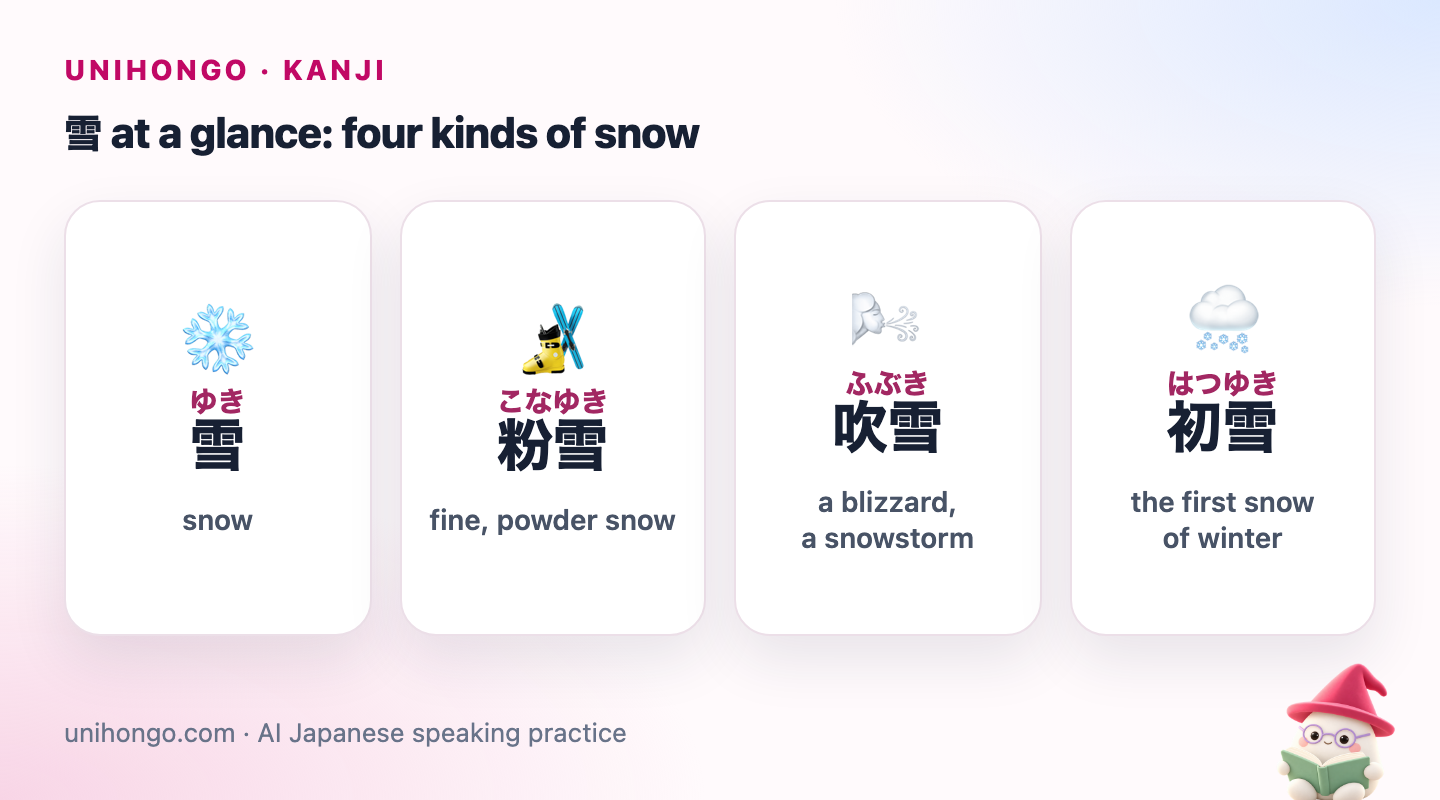
These four words cover the snow you will meet first: snow itself, the fine powder snow skiers love, a blizzard, and the first snow of the season.
| Japanese | Romaji | Meaning |
|---|---|---|
| 雪 | yuki | snow |
| 粉雪 | konayuki | fine, powder snow |
| 吹雪 | fubuki | a blizzard, a snowstorm |
| 初雪 | hatsuyuki | the first snow of winter |
Readings, parts and stroke order of 雪
雪 has eleven strokes: eight for the rain crown on top and three for the shape below, which looks like the katakana ヨ. The rain crown tells you it is weather. The lower part is often explained as coming from a broom, as if snow were the rain you can sweep away, which fits nicely with the second meaning of 雪, to wipe clean.
| Reading | Type | When you use it | Examples |
|---|---|---|---|
| yuki | kun'yomi | alone and in most native words | 雪, yuki; 大雪, ōyuki; 雪国, yukiguni |
| setsu | on'yomi | Chinese-style compounds | 積雪, sekisetsu; 除雪, josetsu; 新雪, shinsetsu |
| special | whole-word reading | a few words read as a unit | 吹雪, fubuki; 雪崩, nadare, avalanche |
How to write it: write the rain crown first, flatter than 雨 on its own: the short top line, the short left stroke, the frame with a small hook, the centre line, then the four short drops, left pair first. Then write the ヨ shape below in three strokes: the top line and right side as one stroke, then the middle line, then the bottom line. In the standard form, the middle line of ヨ does not stick out past the right side.
Everyday snow words
These words come up in weather reports, at ski resorts and in snowy towns. Several are compounds with yuki at the end; others put yuki at the front. Yukidaruma, a snowman, is the one children shout first.
| Japanese | Romaji | Meaning |
|---|---|---|
| 雪が積もってきた。 | Yuki ga tsumotte kita. | The snow is starting to settle. |
| 朝から雪かきをしました。 | Asa kara yukikaki o shimashita. | I've been shovelling snow since morning. |
| 雪道は滑りやすいです。 | Yukimichi wa suberiyasui desu. | Snowy roads are slippery. |
Botan'yuki, peony snow, is named after the large, soft flakes that fall when the temperature is close to zero, like peony petals. Konayuki, powder snow, falls in colder, drier air. Neyuki, root snow, is snow that stays on the ground until spring in snowy regions. Yukidoke, the thaw, is also used for a thaw in relations between people or countries.
雪 as wiping clean: the word 雪辱
Snow has a second, older meaning in kanji: to wash away or wipe clean, perhaps because snow covers everything white. You see it in 雪辱 (setsujoku), literally wiping away a disgrace. In sports news it means a revenge win, beating a team that beat you before. The usual phrase is setsujoku o hatasu, to achieve a revenge win, and it is a common headline after a rematch. The related verb 雪ぐ (susugu), to clear one's name, is mostly found in writing.
| Japanese | Romaji | Meaning |
|---|---|---|
| 雪辱 | setsujoku | a revenge win |
| 雪辱を果たした。 | Setsujoku o hatashita. | They got their revenge win. |
| 去年の雪辱を果たしたい。 | Kyonen no setsujoku o hatashitai. | I want to make up for last year's loss. |
This is a good example of why kanji meanings are worth learning beyond the first one. If you only know 雪 as snow, a sports headline with 雪辱 makes no sense; with the second meaning, it reads clearly.
Mini dialogue: the first snow of the winter
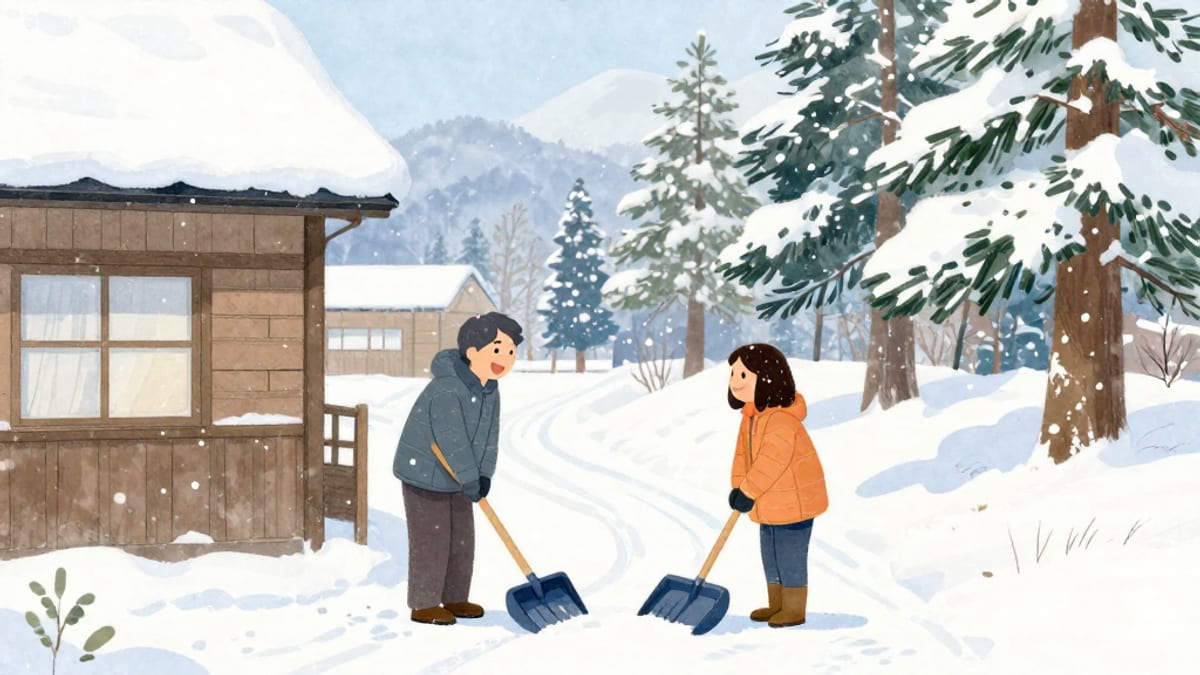
In many parts of Japan, the first snow is a small event. People mention it to each other, the news reports hatsuyuki in each city, and everyone wonders whether it will settle. In snowy regions, the talk turns quickly to practical things: snow tyres, shovelling and train delays.
| Japanese | Romaji | Meaning |
|---|---|---|
| あ、雪だ! | A, yuki da! | You: Oh, it's snowing! |
| 初雪ですね。 | Hatsuyuki desu ne. | Neighbour: The first snow, isn't it? |
| 積もるでしょうか。 | Tsumoru deshō ka. | You: Do you think it'll settle? |
| 夜までに少し積もるらしいですよ。 | Yoru made ni sukoshi tsumoru rashii desu yo. | Neighbour: They say a little will settle by tonight. |
| じゃあ、明日は雪かきですね。 | Jā, ashita wa yukikaki desu ne. | You: Then it's snow shovelling tomorrow. |
| 一緒にやりましょう。 | Issho ni yarimashō. | Neighbour: Let's do it together. |
Snow in poetry, sayings and names
Snow is one of the great images of Japanese poetry and art. The phrase 雪月花 (setsugekka), snow, moon and flowers, sums up the beauty of the seasons and appears in poems, shop names and design. 雪化粧 (yukigeshō), snow make-up, describes a town or mountain lightly dusted white, a phrase you will hear on TV in winter.
雪 is also a popular kanji in girls' names, chosen for its sense of purity and beauty. Families pick kanji for meaning, sound and look, and the same name can be written in many ways, so these are only examples.
| Japanese | Romaji | Meaning |
|---|---|---|
| 雪月花 | setsugekka | snow, moon and flowers |
| 雪化粧 | yukigeshō | a light dusting of snow |
| 美雪 | Miyuki | beautiful snow · girl |
| 小雪 | Koyuki | light snow · girl |
| 雪菜 | Yukina | snow and greens · girl |
Snow tattoos and designs
Snow suggests calm, purity and quiet beauty, and 雪 is an elegant character with a pleasing balance between the crown and the base. A few things are worth thinking about before you use it.
- 雪 alone is clear and lovely, but it reads simply as snow. If you want a feeling, a word helps: 雪月花 for seasonal beauty, 雪解け for a new beginning, 新雪 for a fresh start.
- Chinese and Japanese both use 雪 for snow, with the same form. Some phrases differ, so check that a longer phrase is natural in the language you intend.
- 雪 is also a name, so some readers may take a single 雪 as a person's name.
- Have a native speaker check the final characters and style, especially the four small drops and the ヨ shape, which are easy to distort.
Look-alikes and common mistakes
Under the rain crown, three weather kanji are easy to mix up. Look at the bottom part: 雪 has the ヨ shape, 雷 (thunder) has 田, a rice field, and 雲 (cloud) has 云. 電 (electricity) also has the rain crown, with a long tail at the bottom.
| Japanese | Romaji | Meaning |
|---|---|---|
| 雷 | kaminari | thunder, lightning |
| 雲 | kumo | a cloud |
| 電車 | densha | a train |
- Reading 吹雪 as fukiyuki. It is fubuki, a whole-word reading.
- Saying yuki ga tomatta. Like rain, snow stops with yamu: yuki ga yanda.
- Writing the middle line of the ヨ shape too long, so it sticks out to the right.
- Using setsu on its own for snow. It only appears inside compounds.
Make a snow deck with photos and Mocchi
- Ask Mocchi to make flashcards for konayuki, botan'yuki, mizore, fubuki and neyuki with /create-flashcards. You choose a photo for each card, so every kind of snow has its own picture.
- Review them with /review-flashcards. Mocchi brings back the cards you find hard sooner and remembers which snow words keep slipping away.
- Then build a tower with them in Kotoba Stack, word by word, before the first real snow arrives.