
星 at a glance: four star words
星 means star. On its own it is hoshi, and you can use it for any star in the sky, the star shape ★ on a page, and a rating, as in hoshi mittsu, three stars. In compounds it often appears as boshi or sei.
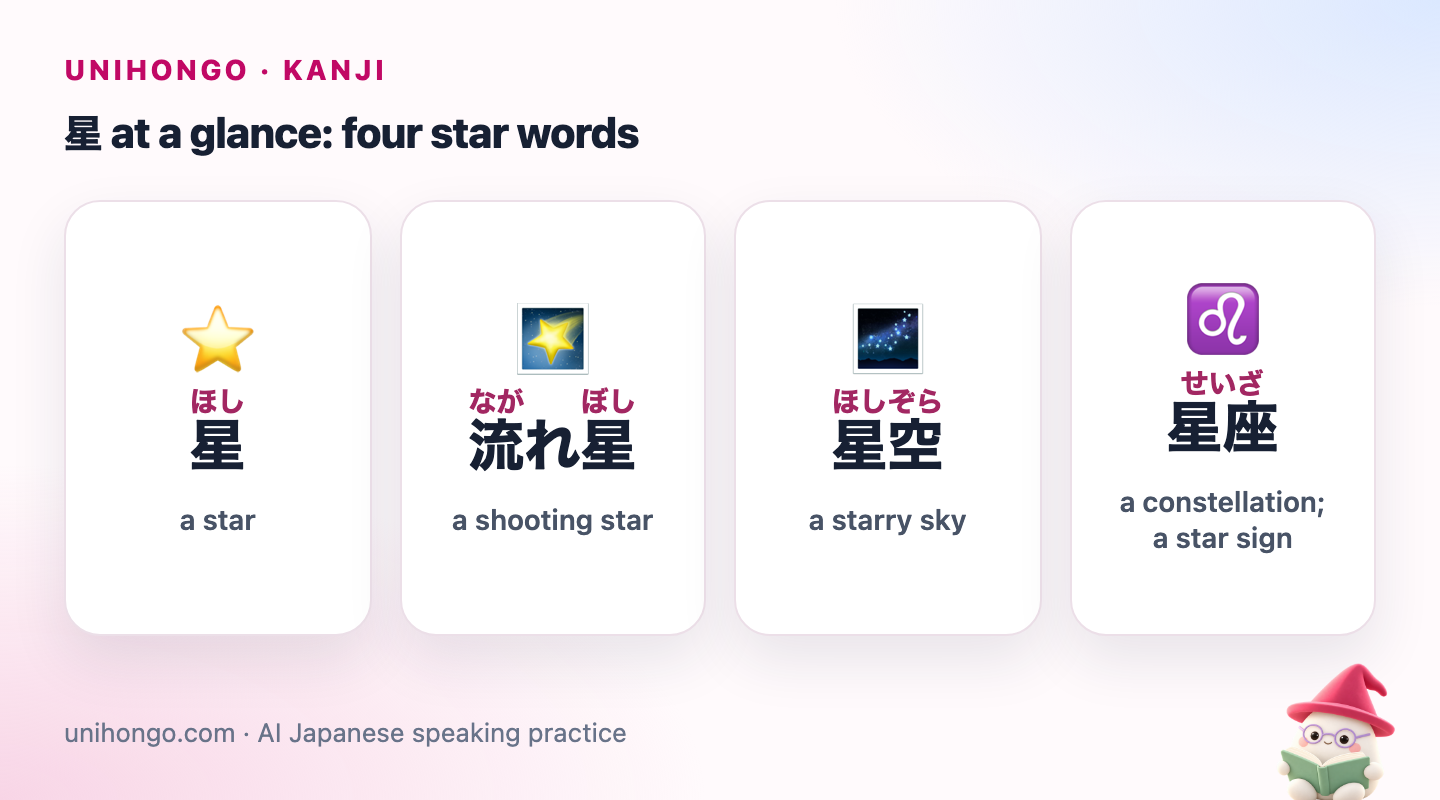
These four words cover most of what you will want to say about stars: the star itself, a shooting star, a starry sky and a constellation or star sign.
| Japanese | Romaji | Meaning |
|---|---|---|
| 星 | hoshi | a star |
| 流れ星 | nagareboshi | a shooting star |
| 星空 | hoshizora | a starry sky |
| 星座 | seiza | a constellation; a star sign |
Readings, parts and stroke order of 星
星 has nine strokes and two parts you probably know already: 日 (sun, day) on top and 生 (life, birth) below. The top was originally a picture of shining stars, and 生 gives the sound sei, which is why 星 is read sei in compounds. So when you see 星, think of a little sun of light over something being born.
| Reading | Type | When you use it | Examples |
|---|---|---|---|
| hoshi | kun'yomi | on its own and at the start of native words | 星, hoshi; 星空, hoshizora |
| boshi | kun'yomi (sound change) | after another word | 流れ星, nagareboshi; 一番星, ichibanboshi |
| sei | on'yomi | most compounds | 星座, seiza; 火星, kasei; 衛星, eisei |
| shō, jō | on'yomi (rare) | a few set words | 明星, myōjō, a bright star; a rising star |
How to write it: write 日 first, a little flatter than usual. Then write 生 underneath: a short stroke falling to the left, a horizontal line, the vertical line through the centre, then a shorter horizontal and finally the long bottom line. Make the bottom line the longest stroke in the kanji so 星 sits firmly.
Everyday words with 星
These are the 星 words that come up in conversation, the news, reviews and sport. The ratings and sumo words are worth knowing because they surprise learners who only think of stars in the sky.
| Japanese | Romaji | Meaning |
|---|---|---|
| 図星だ! | Zuboshi da! | You got me! (casual) |
| このお店は星三つです。 | Kono omise wa hoshi mittsu desu. | This restaurant has three stars. |
| 星の数ほど | hoshi no kazu hodo | as many as the stars; countless |
| 希望の星 | kibō no hoshi | a bright hope (a promising person) |
| ホシを挙げる | hoshi o ageru | to catch the culprit (police slang) |
Zuboshi is fun to use. When someone guesses exactly what you were thinking, you can laugh and say zuboshi da, you got me. In sumo results, a wrestler's wins are shown as white circles and losses as black ones, so a newscaster might say kyō wa shiroboshi, today he won.
Planets and the weekday kanji
The Japanese names of the five planets visible to the naked eye reuse the kanji of the days of the week, which come from the traditional five elements: fire, water, wood, metal and earth. If you know your weekdays, you already know most of the solar system. Earth itself is chikyū, the earth ball, and does not use 星.
| Japanese | Romaji | Meaning |
|---|---|---|
| あの明るい星は金星かな。 | Ano akarui hoshi wa kinsei kana. | I wonder if that bright one is Venus. |
| 土星の輪が見えた! | Dosei no wa ga mieta! | I could see Saturn's rings! |
| Weekday | Planet | Reading | English |
|---|---|---|---|
| 火曜日 Tuesday | 火星 | kasei | Mars |
| 水曜日 Wednesday | 水星 | suisei | Mercury |
| 木曜日 Thursday | 木星 | mokusei | Jupiter |
| 金曜日 Friday | 金星 | kinsei | Venus |
| 土曜日 Saturday | 土星 | dosei | Saturn |
Kana at the end of a sentence means I wonder, and it is the most natural way to guess about something in casual speech. With a teacher you might say kinsei deshō ka instead.
Star signs and small talk
Horoscopes are a regular part of Japanese morning TV, often as a quick ranking of the twelve signs, and many people know their sign. Asking is a light, friendly question among friends and coworkers, though not everyone takes it seriously. Each sign name ends in za, constellation.
| Japanese | Romaji | Meaning |
|---|---|---|
| 何座ですか。 | Naniza desu ka. | What's your star sign? |
| 私はしし座です。 | Watashi wa shishiza desu. | I'm a Leo. |
| おひつじ座 | ohitsujiza | Aries |
| ふたご座 | futagoza | Gemini |
| さそり座 | sasoriza | Scorpio |
| うお座 | uoza | Pisces |
| 今日の星占い、一位だった。 | Kyō no hoshiuranai, ichii datta. | My sign came first in today's horoscope. |
The sign names are usually written in hiragana with 座, as above. If you do not know your sign in Japanese, give your birthday and someone will happily work it out for you.
Mini dialogue: stargazing on a clear night
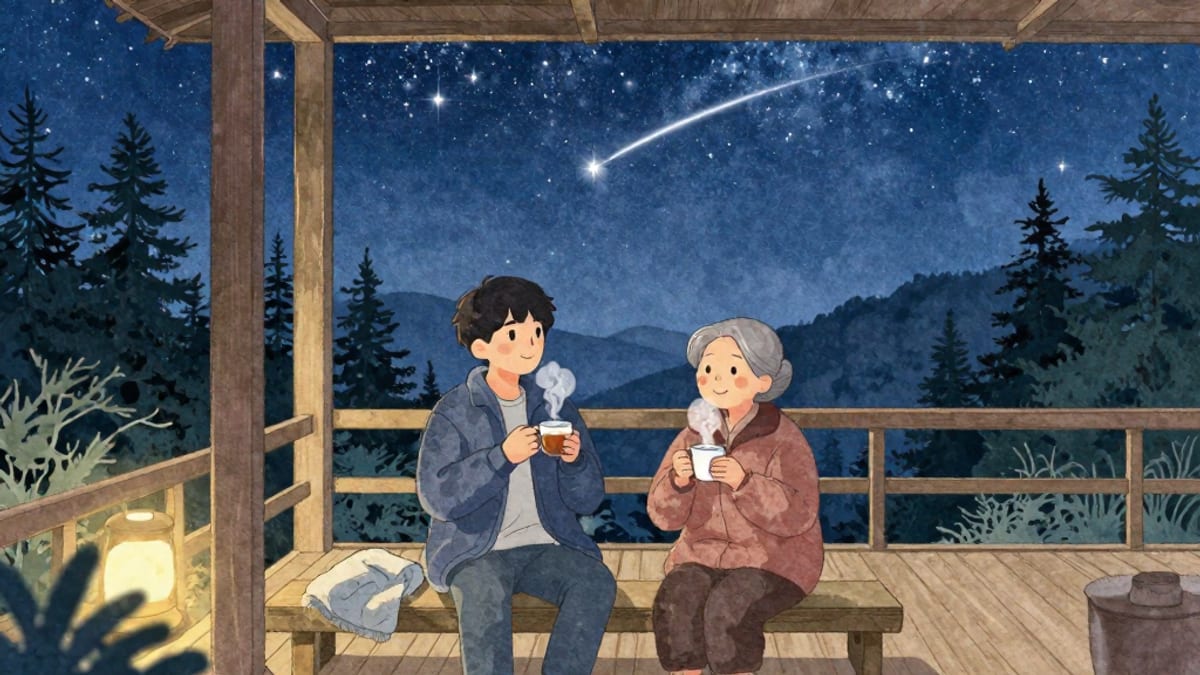
Away from city lights, in the mountains or on a quiet beach, the night sky in Japan can be full of stars. Tanabata, the star festival on 7 July (celebrated in August in some regions), is built on a legend about two stars, Orihime and Hikoboshi, who can meet only once a year across the River of Heaven, amanogawa, the Milky Way. People write wishes on paper strips and hang them on bamboo.
| Japanese | Romaji | Meaning |
|---|---|---|
| わあ、星がすごい! | Wā, hoshi ga sugoi! | You: Wow, look at all the stars! |
| 天の川も見えるね。 | Amanogawa mo mieru ne. | Friend: You can see the Milky Way too. |
| あ、流れ星! | A, nagareboshi! | You: Oh, a shooting star! |
| お願い事した? | Onegaigoto shita? | Friend: Did you make a wish? |
| 速すぎて無理だった。 | Hayasugite muri datta. | You: It was too fast, I couldn't. |
| じゃあ、もう少し待とう。 | Jā, mō sukoshi matō. | Friend: Then let's wait a little longer. |
Star tattoos and designs
Stars suggest hope, guidance and dreams, and 星 looks balanced on the page. Here is how Japanese readers may see the usual choices.
- 星 alone is clear and positive, but it can read like a single label. A word adds a picture: 星空 (hoshizora, starry sky), 流れ星 (nagareboshi, shooting star) or 一番星 (ichibanboshi, the first star to shine, sometimes used for someone who leads the way).
- Chinese and Japanese both use 星 for star. Some star words differ: a celebrity in Chinese is often 明星, while in Japanese 明星 (myōjō) is a bright star or a rising talent with an old-fashioned feel. Choose the language you mean.
- A hand-drawn star symbol and the kanji together can look crowded. Many designers choose one or the other.
- Ask a native speaker to check the characters, the direction and the font before you get the tattoo.
Look-alikes and common mistakes
Because 星 is built from 日 and 生, it shares parts with several other kanji. 晶 (crystal) is three 日 stacked together. 昼 (noon) also has 日 inside. And 生 on its own means life or raw.
| Japanese | Romaji | Meaning |
|---|---|---|
| 生 | sei | life, birth |
| 晶 | shō | crystal, clear and bright |
| 昼 | hiru | noon, daytime |
- Saying nagarehoshi. The sound changes: nagareboshi.
- Reading 星座 as hoshiza. It is seiza, which also sounds like the word for sitting formally on your knees, 正座. Context makes it clear.
- Using hoshi for planets in a formal sentence. In science or the news, a planet is wakusei.
- Including Earth among the 星 planets. Earth is 地球, chikyū.
Build a starry flashcard deck with Mocchi
- Type /create-flashcards planets and star signs in Japanese, and Mocchi makes cards for kasei, kinsei, seiza, shishiza and the rest. You pick a photo for each card, such as a red planet for kasei.
- Review them with /review-flashcards. Mocchi brings back the ones you find hard sooner, and remembers which planet names you keep swapping.
- Race through the same cards in Vocabulary Dash, the 3D word runner, until you can grab kinsei before you have time to think.