
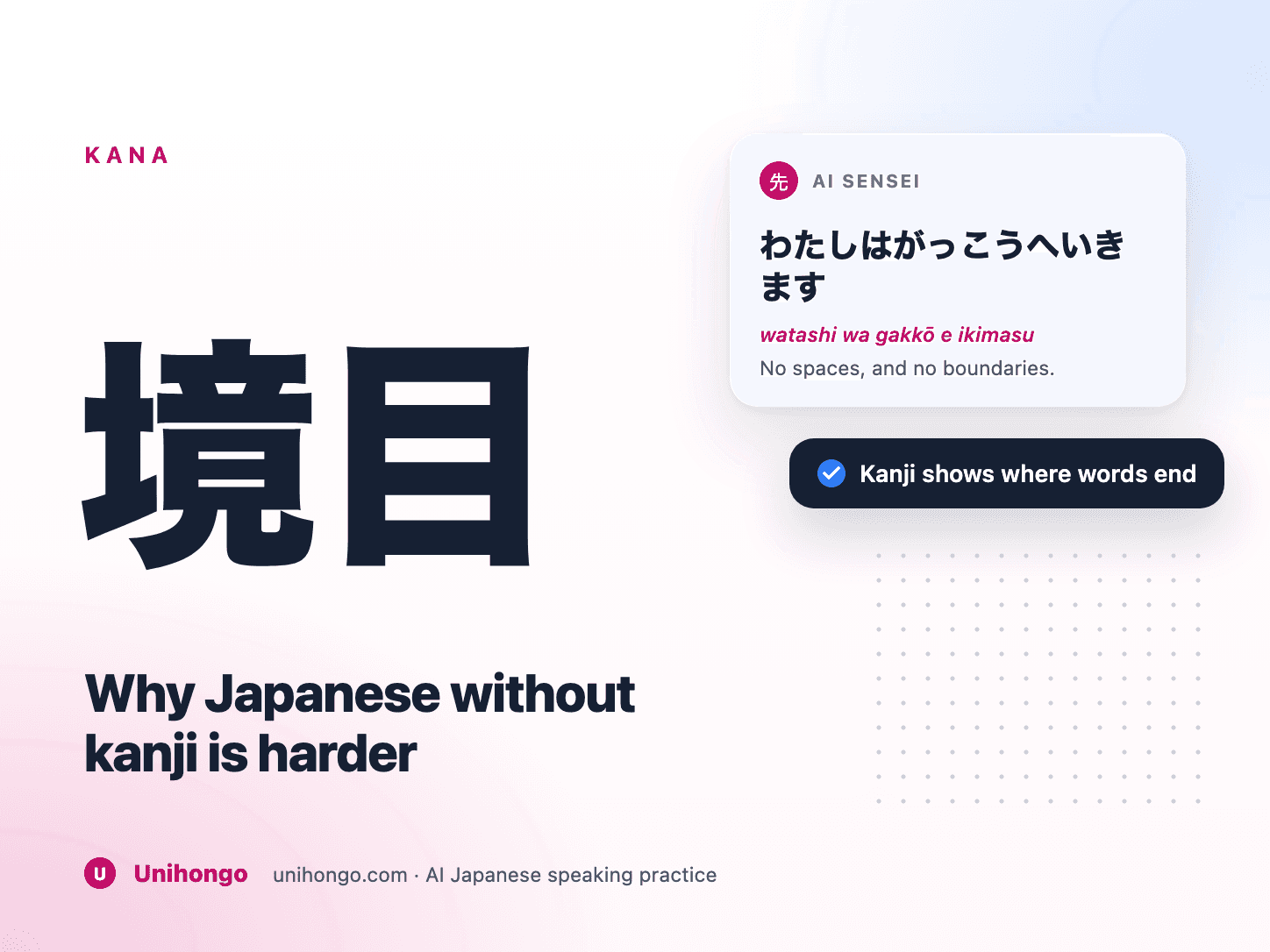
No spaces, and what fills the gap
Japanese does not put spaces between words. In most writing systems the space is what tells a reader where one word ends, and Japanese has to supply that information another way.
It does so through script alternation. Content words are typically written in kanji and the grammatical material around them in hiragana, so the switch from one script to the other marks the boundary. A reader uses that pattern constantly and unconsciously.
Remove the kanji and the pattern disappears, leaving a uniform run of characters with no visual structure at all.
| Japanese | Romaji | Meaning |
|---|---|---|
| わたしはがっこうへいきます | watashi wa gakkō e ikimasu | Kana only: no boundaries |
| 私は学校へ行きます | Watashi wa gakkō e ikimasu | Kanji marks each word |
| きょうはあめがふっています | kyō wa ame ga futte imasu | Kana only |
| 今日は雨が降っています | Kyō wa ame ga futte imasu | Boundaries visible at a glance |
| あたらしいくるまをかいました | atarashii kuruma o kaimashita | Kana only |
| 新しい車を買いました | Atarashii kuruma o kaimashita | Faster to read |
Segmentation is the work
Reading kana-only text requires an extra step: working out where the words are before you can identify them. Native speakers do this quickly because they know which words exist and can rule out impossible splits.
A learner cannot rule out as much, so the step is slower and sometimes ambiguous. This is why a passage you would understand instantly in mixed script can be genuinely difficult in kana alone.
- Find the particles first; they mark the edges of phrases.
- Look for verb endings, which mark the end of a clause.
- Read in phrases rather than trying to split every word.
- Say it aloud; hearing it often resolves a split that looking does not.
- Accept that some lines are ambiguous, and use context.
The homophone problem
Kanji does a second job that kana cannot: it distinguishes words that sound the same. Japanese has a great many homophones, and in speech context resolves them, but in writing kanji resolves them instantly.
In kana-only text those distinctions disappear, so the reader has to work them out from context, which is another source of slowness.
| Japanese | Romaji | Meaning |
|---|---|---|
| こうえん | kōen | Park, lecture, or support: all the same in kana |
| 公園 | kōen | Park |
| 講演 | kōen | Lecture |
| きかん | kikan | Period, organ, or organisation |
| 期間 | kikan | Period of time |
| 機関 | kikan | Organisation, engine |
In speech these are resolved by context and pitch. In kana-only writing you have context alone, which is often enough and sometimes is not.
The famously ambiguous line
The standard demonstration of this problem is a sign at an entrance, which without kanji can be split two ways with quite different results.
It is a joke among learners and it makes a real point: segmentation is not a formality, and the same run of kana can genuinely be two sentences.
| Japanese | Romaji | Meaning |
|---|---|---|
| ここではきものをぬいでください | koko de wa kimono o nuide kudasai | One reading: remove your kimono here |
| ここで履物を脱いでください | Koko de hakimono o nuide kudasai | The intended reading: remove your footwear |
| にわにはにわにわとりがいる | niwa ni wa niwa niwatori ga iru | A classic tongue twister in kana |
| 庭には二羽鶏がいる | Niwa ni wa niwa niwatori ga iru | Kanji makes it readable at once |
| うらにわにはにわにわとりがいる | uraniwa ni wa niwa niwatori ga iru | Even harder |
| 裏庭には二羽鶏がいる | Uraniwa ni wa niwa niwatori ga iru | Resolved by kanji |
Where you will meet it
Kana-only text is not rare. Children's books and early school material use it, some game text uses it, casual messages between friends often reduce kanji, and some older or decorative signage uses kana alone.
It also appears in learner material, which is where it causes the most trouble, because it is presented as the simpler option when for an adult learner it usually is not.
| Where | Why | Difficulty for a learner |
|---|---|---|
| Children's books | Readers lack kanji | High: no boundaries |
| Beginner textbooks | Presented as simpler | Higher than intended |
| Casual messages | Speed and informality | Medium |
| Game text | Space and audience | Medium |
| Old or decorative signs | Style | Medium |
| Furigana material | Readings supplied | Low: the best option |
The last row is the recommendation. Furigana gives you the boundaries from the kanji and the readings above them, which is the combination that actually helps a learner.
What to read instead
The practical conclusion is to stop treating kanji as the obstacle to reading and start treating it as the thing that makes reading possible. Even partial kanji knowledge speeds up a sentence, because the boundaries become visible whether or not you can read every character.
Choose mixed script with furigana wherever you can. Graded readers, learner news sites and children's material aimed at older children all use it, and it is a far better format than kana-only text at the same vocabulary level.
If you are still slow at kana itself, that is a separate problem with a separate fix: character recognition speed responds to drilling, and the kana games on Unihongo's alphabet page train exactly that.
Learn kanji for reading speed rather than despite it. Every kanji you know makes sentences faster to parse, not slower.