

Sky, rain, snow and wind
天, ten, is the sky or heaven, and its kun reading ame or ama is rare in daily life, so think of it as ten. 気, ki, is air, spirit or mood, the same ki as in 元気, genki. Together they make 天気, tenki, weather, and 天気予報, tenki yohō, the forecast. 気 also gives 気温, kion, air temperature, which is the number on the forecast, and 気圧, kiatsu, air pressure.
雨, ame, is rain, with on reading u in 雨天, uten, rainy weather, a word you see on event notices as 雨天中止, uten chūshi, cancelled if it rains, or 雨天決行, uten kekkō, goes ahead rain or shine. 雪, yuki, is snow, on reading setsu, as in 大雪, ōyuki, heavy snow, and 積雪, sekisetsu, snow accumulation. 風, kaze, is wind, on reading fū, and it appears in 強風, kyōfū, strong wind, and 台風, taifū, typhoon. The 雨 radical sits on top of 雪, 雲 and 曇, so any kanji with rain on the roof is about the sky.
| Japanese | Romaji | Meaning |
|---|---|---|
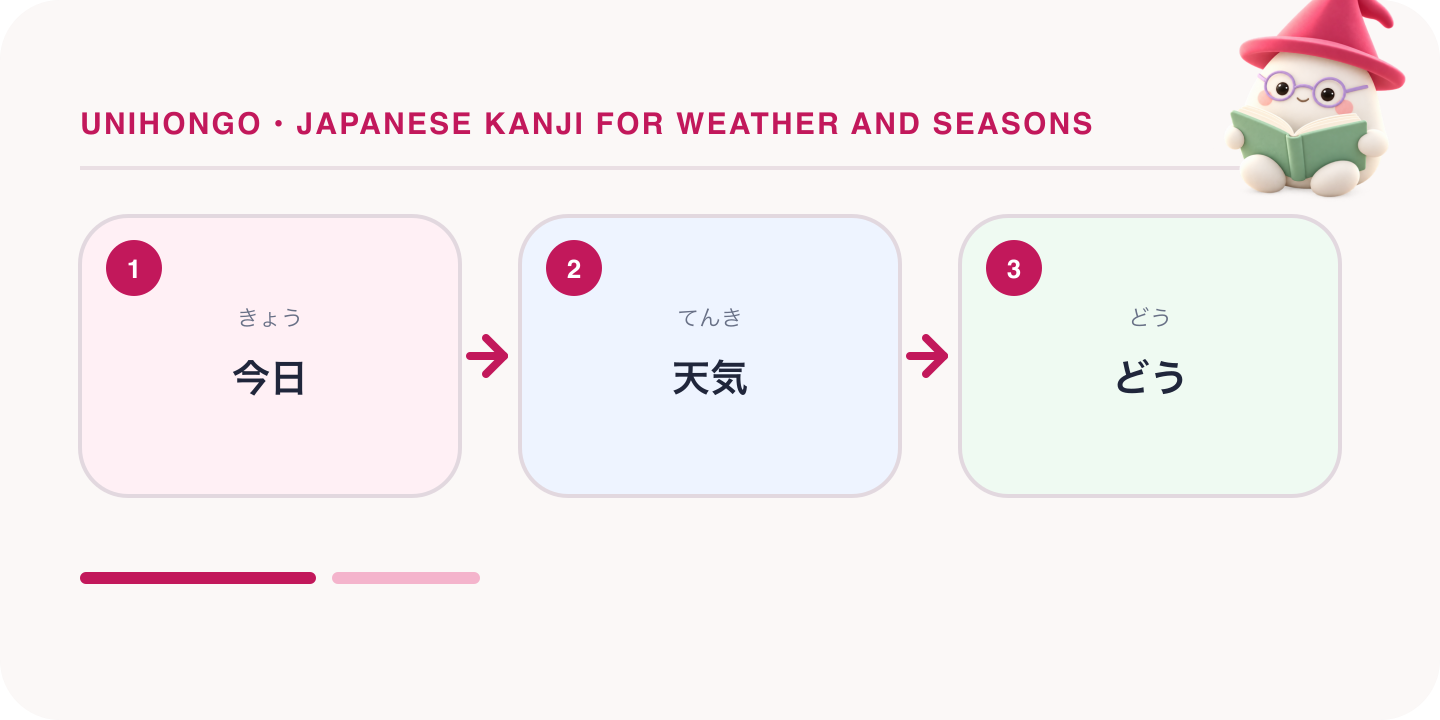
| 今日の天気はどうですか。 | Kyō no tenki wa dō desu ka. | What is the weather like today? |
| 午後から雨が降るそうです。 | Gogo kara ame ga furu sō desu. | I hear it will rain from the afternoon. |
| 雪が積もっています。 | Yuki ga tsumotte imasu. | The snow is piling up. |
| 風が強いので気をつけてください。 | Kaze ga tsuyoi node ki o tsukete kudasai. | The wind is strong, so please take care. |
| 雨天の場合は中止です。 | Uten no baai wa chūshi desu. | In case of rain it is cancelled. |
Sunny, cloudy and the forecast line
晴, hare, is clear or sunny, from the verb hareru, to clear up, and the on reading sei appears in 晴天, seiten, fine weather. 曇, kumori, is cloudy, from kumoru, and the on reading don is rare. 雲, kumo, is a cloud, the noun, and it is the lower part of 曇: a cloud with a sun 日 covering it. 快晴, kaisei, is a perfectly clear sky, the word you will see on the best days.
The forecast line strings these together. 晴のち曇, hare nochi kumori, is sunny then cloudy. 曇時々雨, kumori tokidoki ame, is cloudy with occasional rain. 曇一時雨, kumori ichiji ame, is cloudy with a brief spell of rain. 予報, yohō, is the forecast itself: 予 means beforehand and 報 means report, and you will also read 降水確率, kōsui kakuritsu, the chance of rain, given as a percentage. These fixed patterns mean a whole forecast uses fewer than ten kanji.
| Japanese | Romaji | Meaning |
|---|---|---|
| 明日は晴れのち曇りです。 | Ashita wa hare nochi kumori desu. | Tomorrow will be sunny then cloudy. |
| 今日は一日中曇りです。 | Kyō wa ichinichijū kumori desu. | It is cloudy all day today. |
| 降水確率は六十パーセントです。 | Kōsui kakuritsu wa rokujū pāsento desu. | The chance of rain is sixty percent. |
| 久しぶりに晴れましたね。 | Hisashiburi ni haremashita ne. | It has cleared up for the first time in a while. |
Sky and forecast kanji at a glance
The first table gathers the sky, precipitation and forecast kanji. The compound in the meaning column is the one you will most often read on a screen.
| Kanji | Reading | Meaning |
|---|---|---|
| 天 | on: ten; kun: ame, ama | Sky, heaven; 天気 tenki, weather |
| 気 | on: ki, ke | Air, spirit; 気温 kion, air temperature |
| 雨 | on: u; kun: ame | Rain; 雨天 uten, rainy weather |
| 雪 | on: setsu; kun: yuki | Snow; 大雪 ōyuki, heavy snow |
| 風 | on: fū; kun: kaze | Wind; 強風 kyōfū, strong wind |
| 晴 | on: sei; kun: ha(reru) | Clear, sunny; 快晴 kaisei, perfectly clear |
| 曇 | on: don; kun: kumo(ru) | Cloudy; 曇り kumori, cloudy |
| 雲 | on: un; kun: kumo | Cloud; 雨雲 amagumo, rain cloud |
| 予 | on: yo | Beforehand; 予報 yohō, forecast |
| 報 | on: hō | Report; 警報 keihō, warning |
| 台 | on: dai, tai | Stand, platform; 台風 taifū, typhoon |
Two readings deserve a note. 気 is read ke in a few words such as 湿気, shikke, humidity. 台 is dai in 台所, daidokoro, kitchen, and tai in 台風, so read it from the compound rather than guessing.
Hot, cold, warm and cool
The temperature kanji come in two pairs. 暑, atsui, is hot weather, on reading sho, in 猛暑, mōsho, extreme heat, and 残暑, zansho, lingering late-summer heat, a word you will read in September greetings. 寒, samui, is cold weather, on reading kan, in 寒波, kanpa, a cold wave. Both are about the air around you, not an object; a hot drink is 熱い and a cold drink is 冷たい, with different kanji.
The milder pair is 暖, atatakai, warm, with on reading dan in 暖房, danbō, heating, and 涼, suzushii, cool and pleasant, with on reading ryō in 涼風, ryōfū, a cool breeze. 温, on, is warmth as a measurement, read atatakai as well when it describes water or a meal: 温度, ondo, temperature, 気温, kion, air temperature, and 温泉, onsen, hot spring. 度, do, is a degree, so 三十度, sanjū-do, is thirty degrees, and 最高気温, saikō kion, is the day's high.
| Japanese | Romaji | Meaning |
|---|---|---|
| 今日は暑いですね。 | Kyō wa atsui desu ne. | It is hot today, isn't it? |
| 朝は寒かったです。 | Asa wa samukatta desu. | It was cold this morning. |
| だんだん暖かくなってきました。 | Dandan atatakaku natte kimashita. | It has gradually become warmer. |
| 最高気温は三十五度です。 | Saikō kion wa sanjūgo-do desu. | The high is thirty-five degrees. |
| 夜は涼しいです。 | Yoru wa suzushii desu. | It is cool at night. |
Seasons, typhoons and temperature kanji
春, haru, spring; 夏, natsu, summer; 秋, aki, autumn; 冬, fuyu, winter. The on readings shun, ka, shū and tō appear in 春夏秋冬, shunkashūtō, and in compounds such as 夏休み, natsuyasumi, summer holiday, which uses the kun reading, and 初夏, shoka, early summer, which uses the on reading. Season kanji appear on menus as 春野菜, haru yasai, spring vegetables, and in 秋祭り, akimatsuri, autumn festival.
| Japanese | Romaji | Meaning |
|---|---|---|
| 台風が近づいています。 | Taifū ga chikazuite imasu. | A typhoon is approaching. |
| 大雨警報が出ています。 | Ōame keihō ga dete imasu. | A heavy rain warning has been issued. |
| 秋は涼しくて過ごしやすいです。 | Aki wa suzushikute sugoshiyasui desu. | Autumn is cool and comfortable. |
| 冬は雪がたくさん降ります。 | Fuyu wa yuki ga takusan furimasu. | It snows a lot in winter. |
| Kanji | Reading | Meaning |
|---|---|---|
| 春 | on: shun; kun: haru | Spring; 春休み haruyasumi, spring holiday |
| 夏 | on: ka; kun: natsu | Summer; 真夏 manatsu, midsummer |
| 秋 | on: shū; kun: aki | Autumn; 秋祭り akimatsuri, autumn festival |
| 冬 | on: tō; kun: fuyu | Winter; 真冬 mafuyu, midwinter |
| 暑 | on: sho; kun: atsu(i) | Hot weather; 猛暑 mōsho, extreme heat |
| 寒 | on: kan; kun: samu(i) | Cold weather; 寒波 kanpa, cold wave |
| 暖 | on: dan; kun: atata(kai) | Warm; 暖房 danbō, heating |
| 涼 | on: ryō; kun: suzu(shii) | Cool; 涼風 ryōfū, cool breeze |
| 温 | on: on; kun: atata(kai) | Warmth; 温度 ondo, temperature |
| 度 | on: do; kun: tabi | Degree; 三十度 sanjū-do, thirty degrees |
Typhoon season runs through late summer and early autumn, and the forecast uses a fixed set of words: 台風接近, taifū sekkin, typhoon approaching; 上陸, jōriku, landfall; 暴風, bōfū, violent wind; 大雨警報, ōame keihō, heavy rain warning; and 注意報, chūihō, advisory, which is one step below a warning. Trains and schools decide on closures based on these, so knowing 警報 from 注意報 is practical, not academic.
Where you meet these kanji every day
Weather kanji are on your phone before you leave the house and on the street all day, so review happens on its own if you know where to look.
- Weather apps and TV: 晴, 曇, 雨, 雪 icons with 最高 and 最低 for the high and low, and 降水確率
- Station and school notices: 雨天中止, 雨天決行, 台風のため運休 for services stopped by a typhoon
- Seasonal greetings and cards: 残暑お見舞い in late summer, 寒中お見舞い in midwinter
- Menus and supermarkets: 春野菜, 夏野菜, 秋の味覚, 冬限定 for winter-only items
- Air conditioners and remote controls: 冷房 cooling, 暖房 heating, 温度 and 風量 for fan strength
- Onsen and baths: 温泉, 温度 on the sign, 冷水 for the cold plunge
An air conditioner remote is an underrated textbook: 冷房, 暖房, 除湿, 温度 and 風量 cover half of this post on one panel.
Look-alike kanji to watch
The rain-radical group is the first trap. 雲, cloud, and 曇, cloudy, share the bottom half, but 曇 has 日 between the rain and the cloud. On a forecast, 曇 is the one you will see, since forecasts describe conditions, not objects. 雨 and 両, both, look similar at small sizes on a screen, but 両 has no dots inside.
暑 and 者, person, share the bottom half, and 署, as in 警察署, police station, adds a net on top. Only 暑 has a sun 日 on top, so if the word is about heat, look for the sun. 寒 and 塞 share the roof and the stacked strokes, but 寒 ends in two ice dots at the bottom, which is a good memory hook for cold. 温 and 湿, damp, both have the water radical and a 日 on the right, but 温 has a 皿 dish underneath and 湿 has a cluster of strokes; 湿度, shitsudo, humidity, sits right next to 温度 on the forecast, so check the base. 天 and 夫, husband, differ by whether the top stroke pokes through, and 気 and 汽 differ by the water radical, though 汽 survives only in 汽車, a steam train.
| Japanese | Romaji | Meaning |
|---|---|---|
| 雲と曇りは違う字です。 | Kumo to kumori wa chigau ji desu. | Cloud and cloudy use different characters. |
| 温度と湿度を確認してください。 | Ondo to shitsudo o kakunin shite kudasai. | Please check the temperature and humidity. |
| 暑いの字には日があります。 | Atsui no ji ni wa hi ga arimasu. | The character for hot has a sun in it. |
A one-week study plan for weather kanji
Learn the sky kanji from your weather app, the temperature kanji from the numbers on the forecast and the season kanji from the calendar. Write each character once by hand, say both readings and read one real forecast every morning.
- Day 1: 天, 気, 雨, 雪, 風. Read the forecast icons and say each word aloud.
- Day 2: 晴, 曇, 雲, 予, 報. Read a full forecast line with のち and 時々.
- Day 3: 暑, 寒, 暖, 涼. Start a small-talk line with each one.
- Day 4: 温, 度 with the day's high and low. Read the air conditioner remote.
- Day 5: 春, 夏, 秋, 冬 and 台. Find a seasonal item on a menu or a notice.
- Day 6: Look-alike pairs. Write 雲 and 曇, 暑 and 者, 温 and 湿 side by side.
- Day 7: Review all 21 with Unihongo's free learning games, then read tomorrow's forecast aloud.
For the spoken side, the related post on Japanese weather small talk covers the phrases and replies in more depth, and the seasons post explains the customs around each season. This post gives you the reading that lets you follow the forecast they refer to.