
命 and 生: two kinds of life
Think of 命 as the life that can be saved or lost: the heartbeat, the breath, the life of a cat or a tree. Think of 生 as the process of living: being born, growing, studying, working, even the freshness of raw food. The two meet in 生命 (seimei), life in a biological or formal sense.
The cards below show 命 and three common words built on the idea of living.
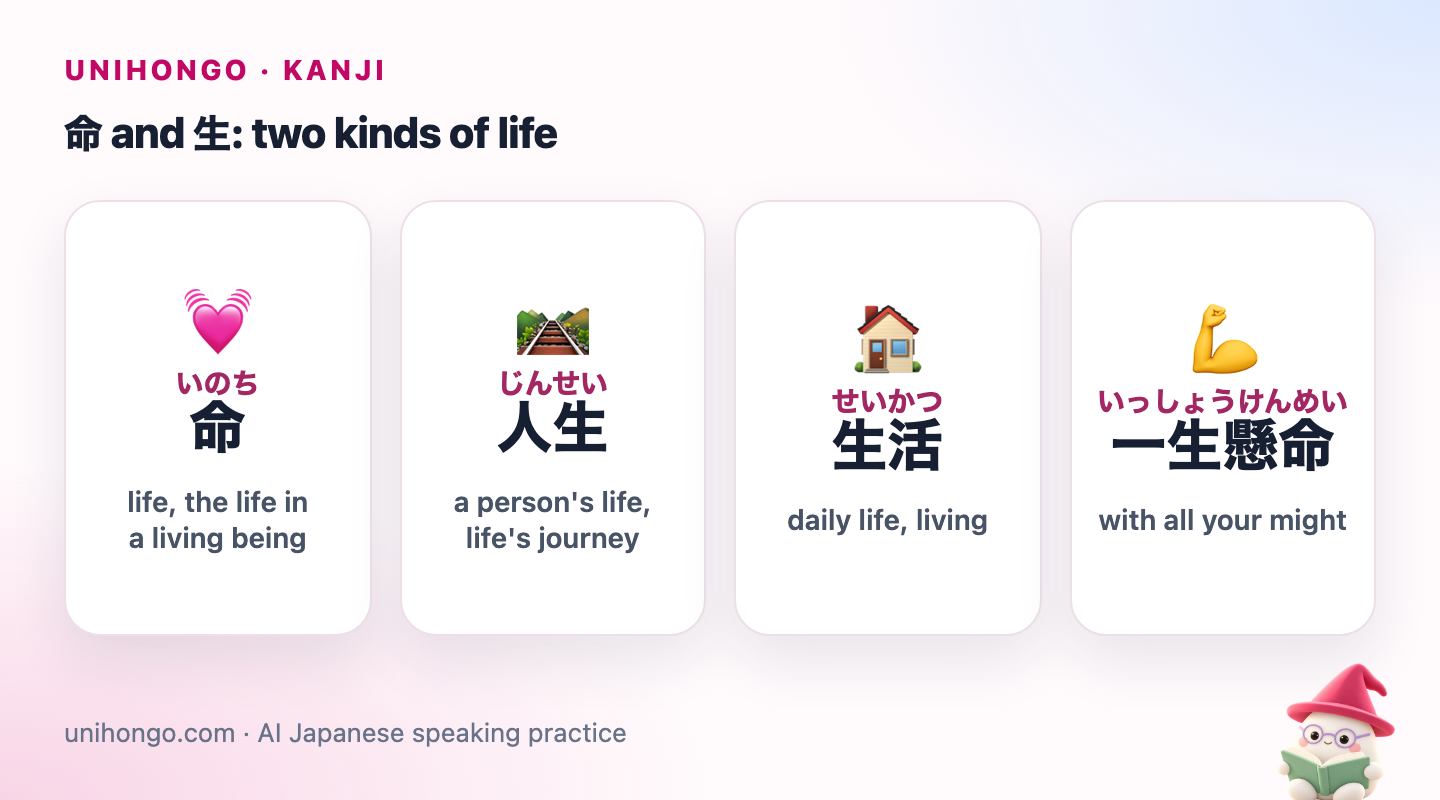
| Japanese | Romaji | Meaning |
|---|---|---|
| 命 | inochi | life, the life in a living being |
| 人生 | jinsei | a person's life, life's journey |
| 生活 | seikatsu | daily life, living |
| 一生懸命 | isshōkenmei | with all your might |
You cannot swap these freely. 命を大切に means value life, as on a safety poster; 人生を大切に means make the most of your life; 生活を大切に sounds like take care of your daily routine.
Readings, strokes and parts
命 is built from 口, mouth, and 令, an order or command. That is why it also appears in 命令 (meirei, an order) and 運命 (unmei, fate): life as something given or commanded from above. Remember the reading myō in 寿命 (jumyō, lifespan).
生 has a famously large number of readings, more than almost any other kanji in the official list. Some of the most common are sei in 人生, shō in 一生, i in 生きる, u in 生まれる and nama in 生ビール. Its shape is usually explained as a plant sprouting from the earth, which suits its meanings of growth and birth.
| Japanese | Romaji | Meaning |
|---|---|---|
| 生きる | ikiru | to live, to be alive |
| 生まれる | umareru | to be born |
| 生 | nama | raw, fresh, live |
| 一生 | isshō | your whole life, a lifetime |
| Item | 命 | 生 |
|---|---|---|
| Core meaning | Life, a life; also command, destiny | Living, birth, growth; raw |
| On'yomi (Chinese readings) | mei, myō | sei, shō |
| Kun'yomi (native readings) | inochi | i(kiru), u(mareru), nama, ha(eru) and more |
| Stroke count | 8 | 5 |
| Parts | 口 mouth + 令 order | Usually explained as a sprout growing from the ground |
Everyday words with 命
命 words are often serious, about safety, health and the value of life, but a few are light and everyday.
| Japanese | Romaji | Meaning |
|---|---|---|
| 生命 | seimei | life (biological, formal) |
| 寿命 | jumyō | lifespan; battery life |
| 命令 | meirei | an order, a command |
| 運命 | unmei | fate, destiny |
| 命がけ | inochigake | risking your life, desperate |
| 命拾い | inochibiroi | a narrow escape |
| 命の恩人 | inochi no onjin | the person who saved your life |
| 使命 | shimei | a mission, a calling |
寿命 is also used for objects: このスマホは電池の寿命が短い, this phone's battery has a short life. It is a natural way to talk about anything wearing out.
命の恩人 is often used playfully. If a coworker lends you an umbrella in a sudden storm, saying 命の恩人です, you saved my life, makes them laugh. 命がけ works the same way: it can describe real danger, but people also use it with a smile for a desperate effort, like running for the last train.
Everyday words with 生
生 is in hundreds of words. These are some of the most useful, including several you probably already know without noticing the kanji.
| Japanese | Romaji | Meaning |
|---|---|---|
| 生きがい | ikigai | a reason for living, what makes life worthwhile |
| 先生 | sensei | teacher, doctor |
| 学生 | gakusei | student |
| 誕生日 | tanjōbi | birthday |
| 生まれ | umare | birthplace, origin |
| 生ビール | nama bīru | draught beer |
| 一生に一度 | isshō ni ichido | once in a lifetime |
| 生き物 | ikimono | living things, creatures |
Notice 誕生日: here 生 is read jō, a sound change from shō. Small changes like this are common in compounds, and the only reliable way to learn them is word by word, with each word's reading attached.
生きがい (ikigai) has become well known outside Japan, often with a diagram attached. In Japanese it is simply an everyday word for what makes your life feel worthwhile, such as your grandchildren, your garden or your job: 孫が生きがいです.
Mini dialogue: life in a new country
Two acquaintances chat at a community event. One has recently moved to Japan, and the conversation naturally uses 生活 and 人生.

| Japanese | Romaji | Meaning |
|---|---|---|
| 日本の生活にはもう慣れましたか。 | Nihon no seikatsu ni wa mō naremashita ka. | Mrs Ito: Have you got used to life in Japan? |
| はい、だいぶ慣れました。 | Hai, daibu naremashita. | Sofía: Yes, I'm pretty used to it now. |
| どうして日本に来たんですか。 | Dōshite Nihon ni kita n desu ka. | Mrs Ito: Why did you come to Japan? |
| 人生一度きりなので、挑戦したくて。 | Jinsei ichido kiri na node, chōsen shitakute. | Sofía: You only live once, so I wanted to try. |
| すごいですね。一生懸命なんですね。 | Sugoi desu ne. Isshōkenmei na n desu ne. | Mrs Ito: That's wonderful. You're really giving it your all. |
Look-alike kanji, writing tips and common mistakes
命 contains 令, order, and the two are easy to confuse; so are 冷 (rei, cold) and 鈴 (rin, bell), which share the same part. 生 has a classic look-alike in 牛 (gyū, cow). 牛 has only two horizontal lines, with the vertical running through them and poking out at the top; 生 has three and sits on a long base line. On a menu, the difference is between raw and beef.
How to write 生: five strokes, starting with the short slanted stroke at the top left and ending with the long base line, which should be the longest stroke of all. Keep the vertical centred and stop it at the top horizontal.
| Japanese | Romaji | Meaning |
|---|---|---|
| 生 | sei | life, raw (base line at the bottom) |
| 牛 | gyū | cow, beef (look-alike) |
| 令 | rei | order (part of 命) |
- Saying 命 when you mean lifestyle. Daily life is 生活; 命 is life or death.
- Thinking 一所懸命 is a typo. It is the older form, read isshokenmei, and still appears in writing, though 一生懸命 is far more common today.
- Using 人生 for routine. 人生が忙しい sounds philosophical; say 毎日忙しい.
- Reading every 生 as sei. It depends on the word: 生ビール is nama, 生きる is i.
命 or 生 as a tattoo or design
命 is a powerful, real kanji, and Japanese readers will understand it as life, sometimes with a strong sense of life and death or the preciousness of life. It is a serious word; some people love that, and others find it heavy on its own.
生 alone is trickier. It means life and birth, but also raw, unprocessed and live, and in everyday Japan it is seen most often on menus, as in 生ビール and 生ハム (raw ham). A lone 生 can therefore make Japanese readers think of food or beer before philosophy. A word solves the problem: 生きる (to live), 人生 (life), or a phrase such as 一生懸命 (with all your might). In Chinese, 生 and 命 have similar core meanings, but compounds and connotations can differ.
Before inking, ask a native speaker to check the meaning, the characters and the design, and give the artist a clean, checked image.
| Japanese | Romaji | Meaning |
|---|---|---|
| 生きる | ikiru | to live |
| 生ハム | nama hamu | cured ham (what 生 suggests on menus) |
Build a 命 and 生 word map with Mocchi
- Ask Mocchi, Unihongo's study assistant: Make me a list of the ten most useful words with 生, grouped by reading. Mocchi groups sei, shō, i, u and nama words and keeps track of the readings you find hard.
- Type /read and ask for a short, easy text about life in Japan. Mocchi gives you a passage with 生活 and 人生 in context, then checks your understanding.
- Turn the words into flashcards with /create-flashcards and run them in Vocabulary Dash, the 3D word runner, using your own deck.