
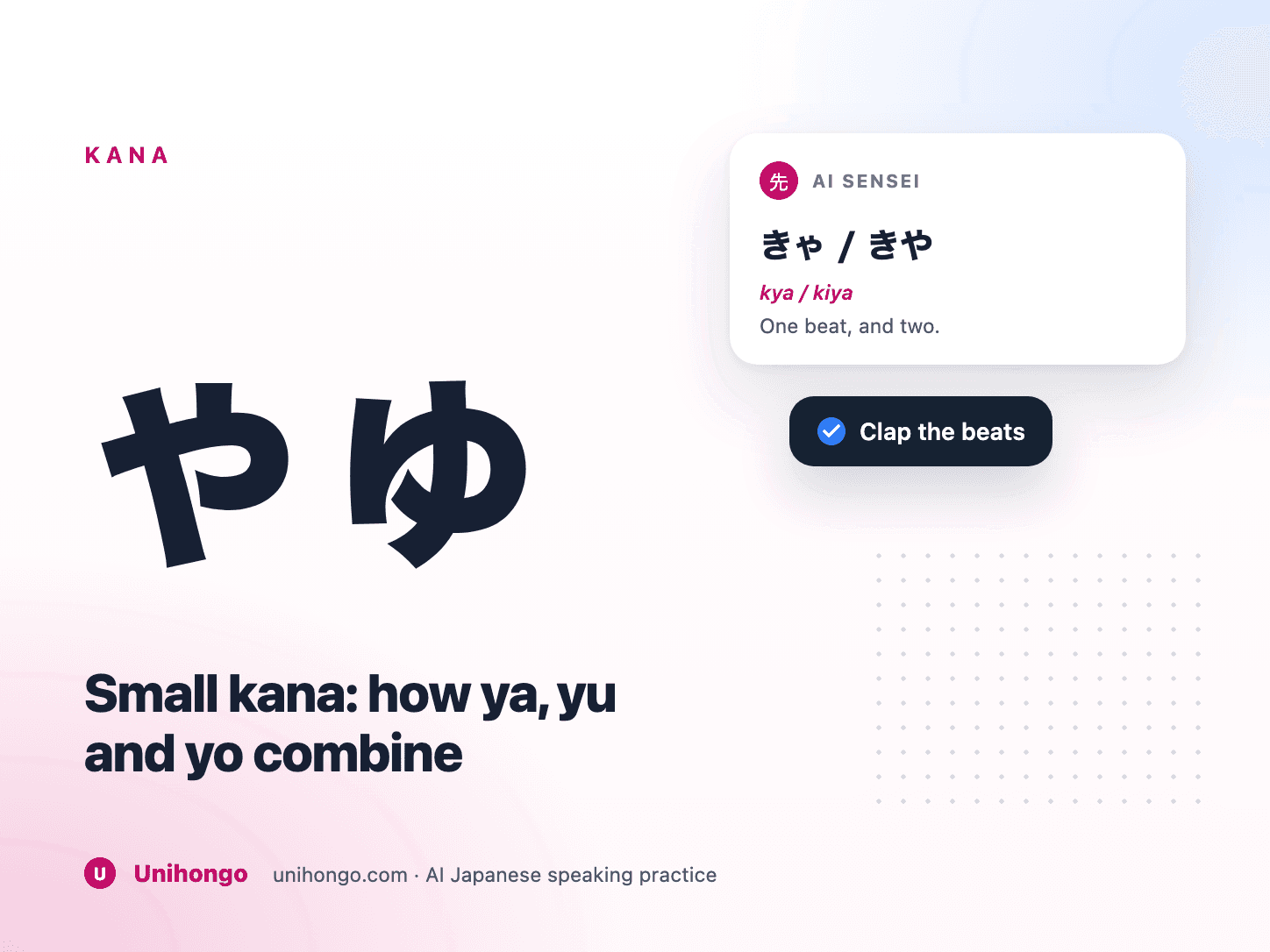
One beat, not two
The single most important fact about these combinations is the beat count. Two characters are written and one beat is spoken, and Japanese counts beats to distinguish words.
Learners routinely produce them as two beats, which lengthens the word and is immediately audible. It also makes some words genuinely ambiguous, because a full-size ya in the same position is a separate beat and a different word.
| Japanese | Romaji | Meaning |
|---|---|---|
| きゃ | kya | One beat |
| きや | kiya | Two beats, a different word |
| しゅ | shu | One beat |
| しゆ | shiyu | Two beats |
| びょう | byō | Two beats: the combination plus a long vowel |
| びよう | biyō | Three beats, a different word |
Which kana take them
Only the i-column kana combine with a small ya, yu or yo, which keeps the set small and regular. Once you know the column, you know the whole system.
The voiced forms combine too, following the same pattern.
| Base | With small ya | With small yu | With small yo |
|---|---|---|---|
| き | きゃ | きゅ | きょ |
| し | しゃ | しゅ | しょ |
| ち | ちゃ | ちゅ | ちょ |
| に | にゃ | にゅ | にょ |
| ひ | ひゃ | ひゅ | ひょ |
| み | みゃ | みゅ | みょ |
| り | りゃ | りゅ | りょ |
The voiced kana in the same column follow identically, so learning the pattern once covers the voiced forms as well.
Combinations with a long vowel
A combination can itself be lengthened, and this is where the beat counting gets confusing. The combination is one beat and the long vowel adds a second, making two.
Three characters are written and two beats are spoken, which is the arrangement learners find least intuitive.
| Japanese | Romaji | Meaning |
|---|---|---|
| きょう | kyō | Two beats: today |
| しょう | shō | Two beats |
| りょう | ryō | Two beats |
| じゅう | jū | Two beats: ten |
| ちょう | chō | Two beats |
| びょういん | byōin | Four beats: hospital |
The last word is four beats written with five characters. Counting characters instead of beats is what makes this feel harder than it is.
Where it changes the word
Because the beat count differs, a split combination often produces a real word rather than an odd-sounding one, which is why this error causes actual confusion.
These pairs are common enough to encounter in ordinary conversation.
| Japanese | Romaji | Meaning |
|---|---|---|
| びょういん / びよういん | byōin / biyōin | Hospital / beauty salon |
| じゅう / じゆう | jū / jiyū | Ten / freedom |
| しょう / しよう | shō / shiyō | Prize / usage |
| きょう / きよう | kyō / kiyō | Today / dexterous |
| りょう / りよう | ryō / riyō | Quantity / use |
| ちょう / ちよう | chō / chiyō | Butterfly / a thousand generations |
In katakana, for foreign sounds
Katakana uses the same mechanism and extends it, combining small kana with bases that hiragana does not, in order to write sounds that Japanese does not natively have.
These appear constantly in loanwords and in foreign names, so they are worth learning as soon as katakana is comfortable.
| Japanese | Romaji | Meaning |
|---|---|---|
| ティ | ti | Not a native Japanese sound |
| ディ | di | Used in loanwords |
| フォ | fo | As in fork |
| ウィ | wi | As in week |
| ジェ | je | As in jet |
| チェ | che | As in check |
Each of these is still one beat. The extended combinations follow the same counting rule as the native ones.
Counting rather than reading
The habit that fixes all of this is counting beats rather than characters. Say the word while clapping one beat per mora, and the combinations resolve themselves.
It is worth doing deliberately for a week with the pairs above, because the error is invisible from the inside: a split combination sounds correct to the person producing it.
That invisibility is what makes an external check useful. The pronunciation lab scores a line against a native model, so a combination produced as two beats shows up as a number rather than as a vague sense that something was off.
Once the beat counting is automatic, this stops being a topic. It is a short problem with a clear fix.