
Why kana is the ideal thing to learn through a game
A game needs three things from its subject: a limited set of items, an unambiguous answer, and a skill that improves with repetition. Vocabulary fails the first test, because there is always another word. Grammar fails the second, because the right form depends on context and register. Kana passes all three. There are 46 basic hiragana and 46 basic katakana, each maps to one sound, and the only thing that separates a beginner from a fluent reader is how quickly the sound arrives.
That is why a chart on the wall works so badly. A chart lets you look up a kana, which is exactly the habit you need to break. A game refuses to let you look anything up: the character appears, a decision is due, and the answer is right or wrong with no room for a vague feeling of familiarity. Ten minutes of that does more for reading speed than an hour of copying rows.
The reading-speed goal
The finish line for kana is not completing the chart. It is recognising a character without thinking, so that when you see か you hear ka in your head with no gap. Learners who stop at the chart stage read Japanese the way a child reads English, sounding out each letter, and then have no attention left for the meaning of the word. Speed is what frees that attention.
Set the goal in those terms: single kana first, without hesitation, in any order. Only then move to words, because a word made of three kana you read slowly is a word you will never remember. A game measures exactly this, since a slow reader misses the gate and a fast one does not, and the score is an honest record of whether the sound has become automatic.
How Kana Dash works
Kana Dash is a free 3D runner at unihongo.com/alphabet built for this single skill. Your runner moves forward along a track with several lanes. A kana appears, and ahead of you a row of gates shows possible readings. You read the character, switch lanes, and pass through the correct gate. Miss it and the round tells you immediately. There is no account to create; signing in only adds a streak and saved scores.
Because the track keeps moving, the game sets the pace instead of you. That is the feature that matters. Left to your own devices you would linger on つ and そ until the answer surfaced. The runner does not wait, so hesitation shows up as a missed gate rather than as a slow but eventually correct answer, and that is the honest measure of whether you know a kana.
- Start with hiragana only and one row at a time if you are new; add rows as your gate accuracy stays high.
- Read each kana aloud before you steer, even when you are alone on a train and have to whisper.
- Play the katakana mode as soon as hiragana feels boring, not after you feel ready.
- Use the mixed mode for a final round every session, because real Japanese never gives you one script at a time.
- Sign in if you want a streak, but do not let the streak decide whether today's round was good.
The pairs that slow everyone down
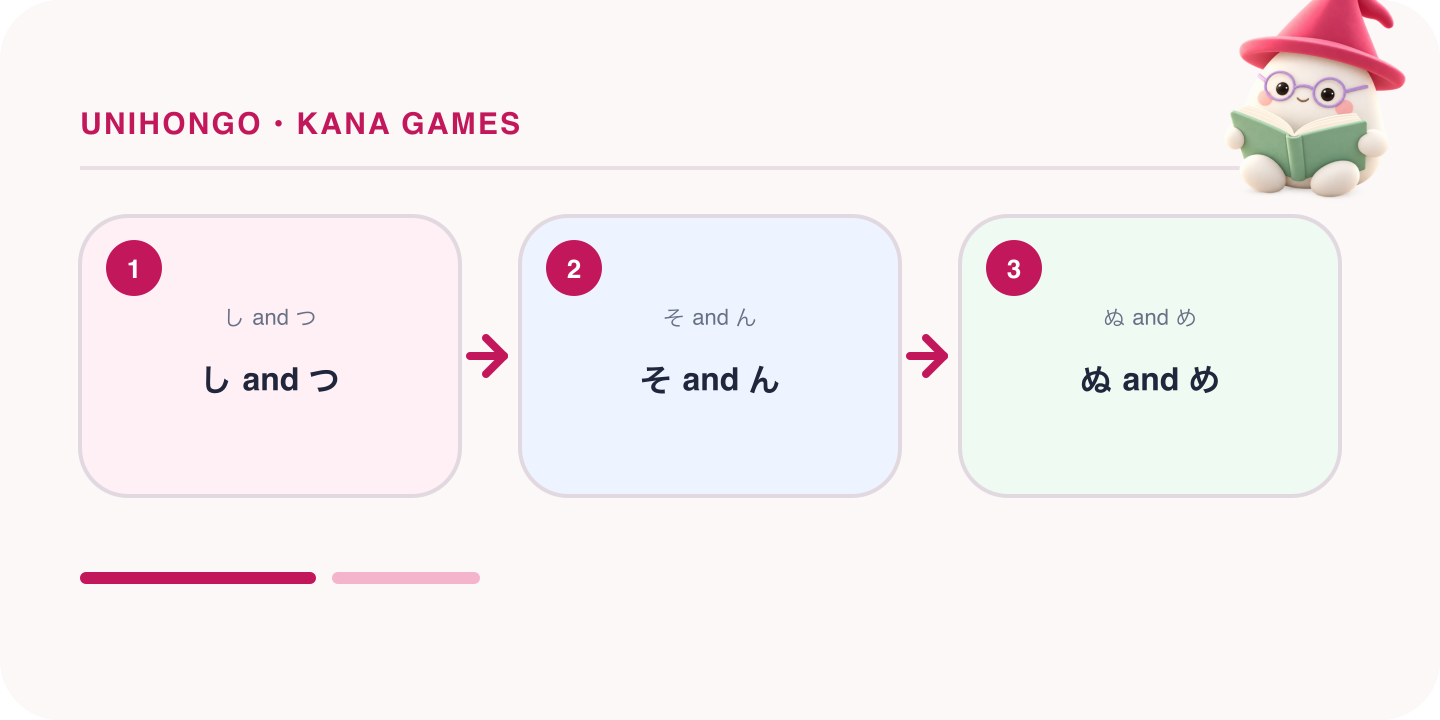
Most kana mistakes come from a few families of look-alike characters, and a runner exposes them fast because the same pairs keep costing you gates. These are the ones every learner trips on, with the visual clue that separates them. The fourteen-day plan in the learn-hiragana-katakana-fast guide covers memory methods for the whole set; here the aim is simply to make these pairs stop stealing time.
| Pair | Readings | The clue that separates them |
|---|---|---|
| し and つ | shi and tsu | し drops down and hooks right at the bottom; つ runs across the top and hooks down and back to the left |
| そ and ん | so and n | そ has a zigzag at the top before its curve; ん is one flowing stroke that ends in a tail on the right |
| れ, わ and ね | re, wa and ne | All start with a vertical stroke; れ flicks out to the right, わ closes into a rounded shape, ね closes with a small loop at the bottom |
| ぬ and め | nu and me | ぬ has a loop in its tail; め does not |
| は and ほ | ha and ho | ほ has an extra horizontal bar above its right-hand part |
| シ and ツ | shi and tsu | シ's short strokes lean sideways and its long stroke sweeps up from bottom left; ツ's short strokes stand upright and its long stroke sweeps down from top right |
| ソ and ン | so and n | Same logic with one short stroke: ン's long stroke sweeps up like シ, ソ's sweeps down like ツ |
| ク and タ | ku and ta | タ is ク with one extra stroke inside |
| つ and っ | tsu and a doubled consonant | The small っ is not read; it doubles the consonant that follows, as in きって kitte |
A useful rule for the katakana set: シ and ン are written with the long stroke going upward, like a smile, and their short strokes sit more horizontally; ツ and ソ are written with the long stroke coming down, and their short strokes stand more vertically. Once you see that シ pairs with ン and ツ with ソ, the four characters become two habits instead of four.
Mixing hiragana and katakana rounds
Learners usually treat katakana as a second chore to postpone, and then read menus and shop signs at half speed for a year. The fix is to start katakana rounds as soon as hiragana is merely comfortable, and to play mixed rounds from then on. The sound map is identical: カ is ka just as か is, so a mixed round is not twice the work but the same fifty sounds shown two ways.
Katakana also gives you the most immediately useful reading practice, because loanwords are everywhere in Japan and most of them you already know once you can sound them out. Read these aloud in full, paying attention to the long-vowel bar ー and to シャツ, which contains both members of the shi and tsu pair.
| Japanese | Romaji | Meaning |
|---|---|---|
| コーヒー | Kōhī | Coffee |
| テレビ | Terebi | Television |
| シャツ | Shatsu | Shirt |
| ソース | Sōsu | Sauce |
| ツナ | Tsuna | Tuna |
| タクシー | Takushī | Taxi |
| ホテル | Hoteru | Hotel |
| メニュー | Menyū | Menu |
| ケーキ | Kēki | Cake |
| アイスクリーム | Aisukurīmu | Ice cream |
From single kana to whole words
Once single characters are automatic, the game changes shape: a word is a short run of kana that has to arrive as one sound. This is the moment recognition turns into reading. Start with two- and three-kana words whose meaning you already know, so the only new demand is speed, and read each one as a unit rather than as a list of letters.
These hiragana-only words cover common sounds and include the small つ and the long vowels that trip new readers. Read the list top to bottom aloud, then bottom to top, then in a random order, and time yourself on the third pass; the whole list should take well under half a minute.
| Japanese | Romaji | Meaning |
|---|---|---|
| あめ | Ame | Rain |
| ねこ | Neko | Cat |
| いぬ | Inu | Dog |
| さかな | Sakana | Fish |
| おかね | Okane | Money |
| つくえ | Tsukue | Desk |
| しんぶん | Shinbun | Newspaper |
| きって | Kitte | Stamp |
| がっこう | Gakkō | School |
| おとうさん | Otōsan | Father |
| せんせい | Sensei | Teacher |
| でんわ | Denwa | Telephone |
The second group is built from the confusable pairs. If any of these makes you pause, go back to a single-kana round with that family for a minute, then return to the word.
Words made from the confusable pairs
| Japanese | Romaji | Meaning |
|---|---|---|
| しつれい | Shitsurei | Rudeness, as in excuse me |
| そんな | Sonna | That kind of |
| わたし | Watashi | I |
| ねる | Neru | To sleep |
| れんしゅう | Renshū | Practice |
| つづく | Tsuzuku | To continue |
| ほん | Hon | Book |
| はな | Hana | Flower |
| ぬの | Nuno | Cloth |
| めがね | Megane | Glasses |
Notice that れんしゅう contains れ and ん together, and しつれい puts し and つ side by side. Words like these are the best test of a pair, because the game asks for both members within a second of each other.
Say the kana aloud as you play
Silent recognition is only half a kana. Japanese writing is phonetic, so a character you can identify but have never said is stored in the wrong place, as a picture rather than a sound. Saying each kana aloud as you steer binds the shape to the sound, and it also trains your mouth on the sounds themselves: the tsu that English speakers soften, the doubled consonant that needs a real pause, and the long vowel that has to be held.
These kana-only sentences are the final step. Each one uses only characters from the basic sets, and each is something you can say to a teacher. Read them aloud at a steady pace, and note that the topic particle は is read wa here, one of the few places kana and sound do not match.
| Japanese | Romaji | Meaning |
|---|---|---|
| わたしはがくせいです。 | Watashi wa gakusei desu. | I am a student. |
| ねこがいます。 | Neko ga imasu. | There is a cat. |
| これはつくえです。 | Kore wa tsukue desu. | This is a desk. |
| コーヒーをのみます。 | Kōhī o nomimasu. | I drink coffee. |
| バスでいきます。 | Basu de ikimasu. | I go by bus. |
| しんぶんをよみます。 | Shinbun o yomimasu. | I read the newspaper. |
| きょうはあついです。 | Kyō wa atsui desu. | It is hot today. |
| がっこうはたのしいです。 | Gakkō wa tanoshii desu. | School is fun. |
| ホテルはえきのちかくです。 | Hoteru wa eki no chikaku desu. | The hotel is near the station. |
| メニューをください。 | Menyū o kudasai. | The menu, please. |
| きってをかいました。 | Kitte o kaimashita. | I bought stamps. |
| ゆっくりよみます。 | Yukkuri yomimasu. | I will read slowly. |
When the game stops helping
A kana game has a natural end. When you pass every gate in mixed mode without a miss and read the sentences above at speaking pace, further rounds are maintenance, not learning. At that point move the ten minutes to something with meaning: a vocabulary runner, a sentence game, or a spoken session where the teacher writes a word back to you in kana and you read it aloud on the spot. Kana was never the goal. It was the tool that lets every later lesson happen in Japanese.
- Play mixed hiragana and katakana rounds until a full round has no missed gates.
- Replace one kana round with a vocabulary game as soon as that happens.
- Ask your AI Sensei to reply in kana-only writing for a session and read every line aloud.
- Return to Kana Dash for two minutes if a pair such as シ and ツ starts to slip again.