
More than paint: 色 in four everyday words
色 means colour, and these four words show how widely Japanese uses it. The first is the kanji itself. The second turns colour into variety. The third turns it into a whole view, and the fourth into the colour of a face, which is how Japanese talks about whether someone looks well.
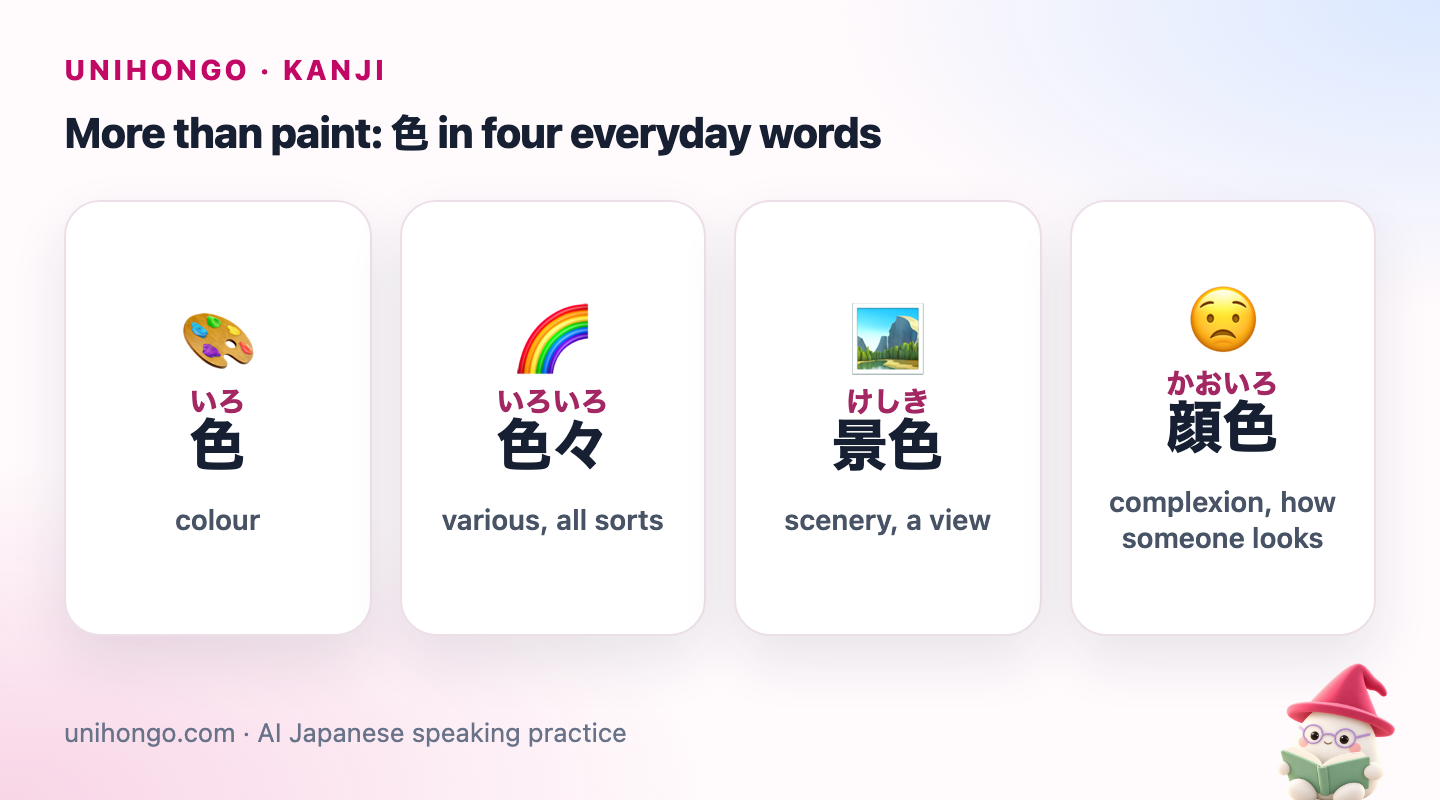
| Japanese | Romaji | Meaning |
|---|---|---|
| 色 | iro | colour |
| 色々 | iroiro | various, all sorts |
| 景色 | keshiki | scenery, a view |
| 顔色 | kaoiro | complexion, how someone looks |
Three readings and six strokes
色 has six strokes. The top is the same ク shape you see in 危 (dangerous) and 争 (conflict), and the bottom is a frame with a long hooked tail. Explanations of its origin vary, so it is best learned by shape: a little hat on top, a box with a tail below.
Most of the time, 色 is iro. In compounds borrowed from Chinese it is shoku, and in a few words, including the very common 景色, it is shiki. The counter for colours also uses shoku: nishoku, two colours; sanshoku, three colours.
| Reading type | Reading | When it is used | Example |
|---|---|---|---|
| kun'yomi | iro | alone and in native words | 色, iro; 顔色, kaoiro; 茶色, chairo |
| on'yomi | shoku | most compounds and counting | 特色, tokushoku; 二色, nishoku |
| on'yomi | shiki | a few common words | 景色, keshiki; 色彩, shikisai |
Fifteen 色 words for shopping, travel and daily life
These words go far beyond the colour chart. Several are handy in shops, a few describe people, and two are for art class or a children's drawing table.
| Japanese | Romaji | Meaning |
|---|---|---|
| 何色 | nani iro | what colour |
| 好きな色 | suki na iro | favourite colour |
| 色違い | irochigai | the same item in another colour |
| 黄色 | kiiro | yellow |
| 茶色 | chairo | brown |
| 水色 | mizuiro | light blue, sky blue |
| 銀色 | gin'iro | silver (colour) |
| 色鉛筆 | iroenpitsu | coloured pencils |
| 特色 | tokushoku | a special feature, character |
| 色彩 | shikisai | colouring, colour (formal) |
| 原色 | genshoku | primary colours; loud colours |
| 色白 | irojiro | fair-skinned |
| 景色がきれいですね。 | Keshiki ga kirei desu ne. | What a beautiful view. (polite) |
| いろいろありがとう。 | Iroiro arigatō. | Thanks for everything. (casual) |
| この色、似合うね。 | Kono iro, niau ne. | That colour suits you. (casual) |
Irochigai is the word to know when shopping: it means the same design in a different colour, so irochigai wa arimasu ka? is how you ask whether there are other colours. Mizuiro, water colour, is the pale blue of a summer sky, distinct from ao. Irojiro, fair-skinned, is often used as a compliment in Japan, but comments on skin colour can make people uncomfortable, so it is better to recognise this word than to use it about others.
Akai or akairo? When a colour needs 色
A short grammar point saves a lot of confusion. Japanese has only a handful of colour words that work as i-adjectives, which you can put directly before a noun. Two of them, yellow and brown, keep 色 inside the adjective. Every other colour is a noun, so it needs no between it and the thing it describes.
| Japanese | Romaji | Meaning |
|---|---|---|
| 赤い車 | akai kuruma | a red car |
| 黄色い傘 | kiiroi kasa | a yellow umbrella |
| 緑の帽子 | midori no bōshi | a green hat |
| Colour | Before a noun | Example |
|---|---|---|
| red, blue, white, black | akai, aoi, shiroi, kuroi | akai kuruma, a red car |
| yellow, brown | kiiroi, chairoi (with 色) | kiiroi kasa, a yellow umbrella |
| green, purple and others | noun + no | midori no bōshi, a green hat |
| loanword colours | katakana + no | pinku no shatsu, a pink shirt |
A common mistake is to say midorii, adding i to green as if it were an adjective. It is always midori no. Another is to say akairo no kuruma; it is not wrong, but akai kuruma is what most people say.
Dialogue: asking for another colour in a clothes shop
Here you are shopping with a friend. The shop assistant uses polite shop language, you answer politely, and you switch to casual speech with your friend. Notice irochigai, and how kaoiro comes back in a new way at the end.

| Japanese | Romaji | Meaning |
|---|---|---|
| すみません、これの色違いはありますか? | Sumimasen, kore no irochigai wa arimasu ka? | You: Excuse me, is this in other colours? |
| はい、紺と白がございます。 | Hai, kon to shiro ga gozaimasu. | Assistant: Yes, we have navy and white. |
| 紺を見せてもらえますか? | Kon o misete moraemasu ka? | You: Could I see the navy one? |
| こちらです。落ち着いた色で人気ですよ。 | Kochira desu. Ochitsuita iro de ninki desu yo. | Assistant: Here. It's a calm colour, very popular. |
| うーん、ちょっと地味かな。 | Ūn, chotto jimi ka na. | You: Hmm, a bit plain, maybe. |
| 白のほうが顔色が明るく見えるよ。 | Shiro no hō ga kaoiro ga akaruku mieru yo. | Friend: White makes your face look brighter. |
| じゃあ、白にします。 | Jā, shiro ni shimasu. | You: OK, I'll take the white one. |
Idioms: colour in faces, eyes and deals
Japanese uses 色 in several expressions about people's moods and reactions. They are common in conversation and worth recognising.
| Japanese | Romaji | Meaning |
|---|---|---|
| 十人十色 | jūnin toiro | everyone has their own taste |
| 顔色をうかがう | kaoiro o ukagau | to read someone's mood |
| 目の色を変える | me no iro o kaeru | to suddenly get very eager |
| 色を付ける | iro o tsukeru | to add a little extra |
| 色気 | iroke | allure, sex appeal |
Jūnin toiro, ten people, ten colours, is the Japanese way of saying everyone is different; notice the unusual reading toiro. Kaoiro o ukagau, checking someone's face colour, means watching a boss or partner to see what mood they are in, often with a hint of anxiety. Iro o tsukeru, adding colour, is what a friendly shopkeeper does when they throw in a little discount or an extra item: sukoshi iro o tsukete okimashita, I've added a little something.
Iroke shows the romantic side of 色. It can mean sex appeal, but also simply charm or flair, and in casual speech iroke ga nai can mean something is plain and businesslike. In older and literary Japanese, 色 itself can mean romance, which is why some 色 words sound flirtatious.
Colour tattoos and designs, and the Chinese trap
色 is a beautiful character to draw, and colour is a happy theme. But this is one kanji where the meaning on skin may surprise you.
- A lone 色 is plain colour to many Japanese readers, but some may sense a romantic or sensual hint, as in 色気 or 色っぽい (iroppoi, sexy).
- Chinese and Japanese really differ here. In Chinese, 色 appears in words for lust, such as 好色 (lecherous), so a Chinese reader may find a lone 色 suggestive.
- For colour and vividness, 彩 (irodori, colouring) is a popular and elegant choice, and it is also used in girls' names such as Aya.
- For variety and individuality, 十人十色 is a friendly, positive phrase that most Japanese readers will recognise.
- Ask a native speaker to check the characters and the brush style before getting inked.
Look-alikes and common mistakes
色 appears as a part inside 絶 (zetsu, to cut off, absolutely), next to the thread radical, as in 絶対 (zettai, definitely). Its top half matches 危 (dangerous) and 負 (to lose), so look at the bottom to tell them apart.
| Japanese | Romaji | Meaning |
|---|---|---|
| 絶対 | zettai | definitely, absolutely |
| 危ない | abunai | dangerous |
| 負ける | makeru | to lose |
- Reading 景色 as keiiro. It is keshiki.
- Saying midorii for green. It is midori no.
- Using kaoiro for skin colour. It means how healthy someone looks.
- Writing the last stroke without the hook. It should sweep right and flick up.
Collect 色 words in a photo flashcard deck
Colour words beg for pictures. Sign in and ask Mocchi to /create-flashcards for keshiki, kaoiro, irochigai, mizuiro and the colour words you keep mixing up. You pick a photo for each card, an autumn valley for keshiki or a sky for mizuiro, and Mocchi reviews them with you using spaced repetition with /review-flashcards, bringing the hard ones back sooner.
Once the deck is ready, play Flashcard Flip for a quick round on your phone. Mocchi keeps notes on which words slow you down, so your next quiz picks up where you left off.