
日 at a glance: sun, sunrise, Sunday
日 began as a picture of the sun: a circle with a dot or line in the middle, later squared off into a box. It means sun, and because a day is one turn of the sun, it also means day. The word hi can mean either, and context decides.
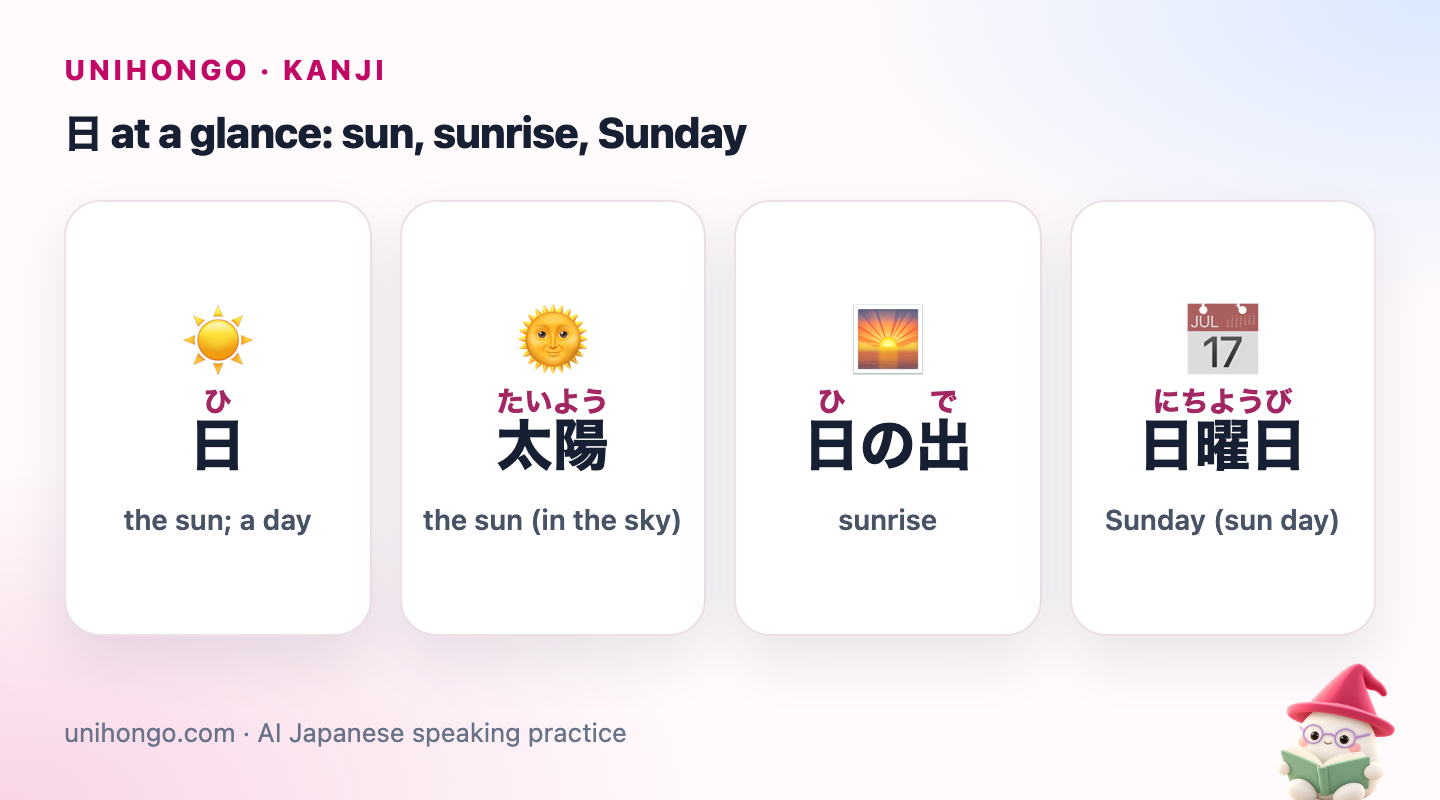
These four words show the sun side of 日 and its partner 太陽: the kanji itself, the sun as a star, sunrise, and Sunday.
| Japanese | Romaji | Meaning |
|---|---|---|
| 日 | hi | the sun; a day |
| 太陽 | taiyō | the sun (in the sky) |
| 日の出 | hinode | sunrise |
| 日曜日 | nichiyōbi | Sunday (sun day) |
日, 陽 or 太陽? Choosing the right sun
Japanese has three main ways to write the sun, and they do different jobs. 日 is the workhorse: everyday words about sunlight, days and dates. 太陽 is the sun as an object, in science, in songs and whenever you point at it in the sky. 陽 is the kanji of sunlight and brightness, used in a handful of words and many names. And ohisama, お日様, is the warm, childlike way to say the sun, common in picture books and when talking to children.
| Japanese | Romaji | Meaning |
|---|---|---|
| 陽気な人 | yōki na hito | a cheerful, sunny person |
| 陽だまり | hidamari | a warm, sunny spot |
| お日様 | ohisama | Mr Sun (warm, to children) |
| Form | Reading | Meaning and feeling | Example |
|---|---|---|---|
| 日 | hi, nichi, jitsu | sun and day; everyday and neutral | 日の出, hinode, sunrise |
| 太陽 | taiyō | the sun as a star; clear and standard | 太陽が昇る, taiyō ga noboru, the sun rises |
| 陽 | yō (hi, haru in names) | sunshine, the bright side, yang | 陽気, yōki, cheerful |
| お日様 | ohisama | Mr Sun; warm, childlike | お日様が出てきた, the sun has come out |
陽 has twelve strokes: the left part 阝, a form often associated with hills, and on the right 昜, which gives the sound yō and is commonly explained as the sun rising high. It is the yang of yin and yang, 陰陽 (in'yō), so it carries a sense of brightness and positive energy. Some words can be written with either kanji: hizashi, sunlight, is usually 日差し but sometimes 陽射し, and hidamari, a sunny spot, can be 日だまり or 陽だまり. The 陽 version looks a little more poetic.
Readings of 日, including the special date words
日 has four strokes and more readings than almost any other basic kanji. The main ones follow a pattern: hi in native words, nichi or jitsu in Chinese-style compounds, ka in counting days, and ni in 日本. On top of that, the time words today, tomorrow and yesterday, and the first twenty days of the month, use special readings you simply have to memorise.
| Japanese | Romaji | Meaning |
|---|---|---|
| 今日 | kyō | today |
| 明日 | ashita | tomorrow |
| 昨日 | kinō | yesterday |
| 一日 | tsuitachi | the first (of the month) |
| 二日 | futsuka | the second; two days |
| 二十日 | hatsuka | the twentieth; twenty days |
| Reading | When you use it | Examples |
|---|---|---|
| hi (bi) | native words, sun and day | 日の出, hinode; 夕日, yūhi; 誕生日, tanjōbi |
| nichi | many compounds | 毎日, mainichi; 日曜日, nichiyōbi; 日記, nikki |
| jitsu | some compounds | 休日, kyūjitsu; 平日, heijitsu; 祝日, shukujitsu |
| ka | counting days, dates | 三日, mikka; 十日, tōka |
| ni | Japan | 日本, Nihon |
Be careful with 一日: as a date, the first of the month, it is tsuitachi; as a length of time, one day, it is ichinichi. Kyō, today, has a long vowel: kiyō, with two short beats, is a different word meaning skilful.
How to write 日: start with the left vertical, then the top and right side as one stroke, then the middle line, and finally the bottom line, which closes the box. Make 日 a little narrower than a perfect square so it does not look like 曰, an old kanji meaning to say, which is wider and flatter.
Everyday sun words for summer and beyond
Japanese summers are hot and bright, and sun care is a big topic. You will see sunscreen in every pharmacy, parasols carried by people of all ages, and arm covers on cyclists. These words cover sunlight, the times of day it marks, and how people protect themselves from it.
| Japanese | Romaji | Meaning |
|---|---|---|
| 日差しが強いですね。 | Hizashi ga tsuyoi desu ne. | The sun is really strong today. |
| 日焼け止め、塗った? | Hiyakedome, nutta? | Did you put on sunscreen? (casual) |
| この部屋は日当たりがいいです。 | Kono heya wa hiatari ga ii desu. | This room gets lots of sun. |
Hiatari is a key word when you look for a flat: hiatari ga ii means the rooms get plenty of sun, a strong selling point in Japan, where many people dry laundry outside. 日光 means sunlight in general, and it is also the name of Nikkō, a famous mountain town of shrines and temples north of Tokyo.
Mini dialogue: the first sunrise of the year
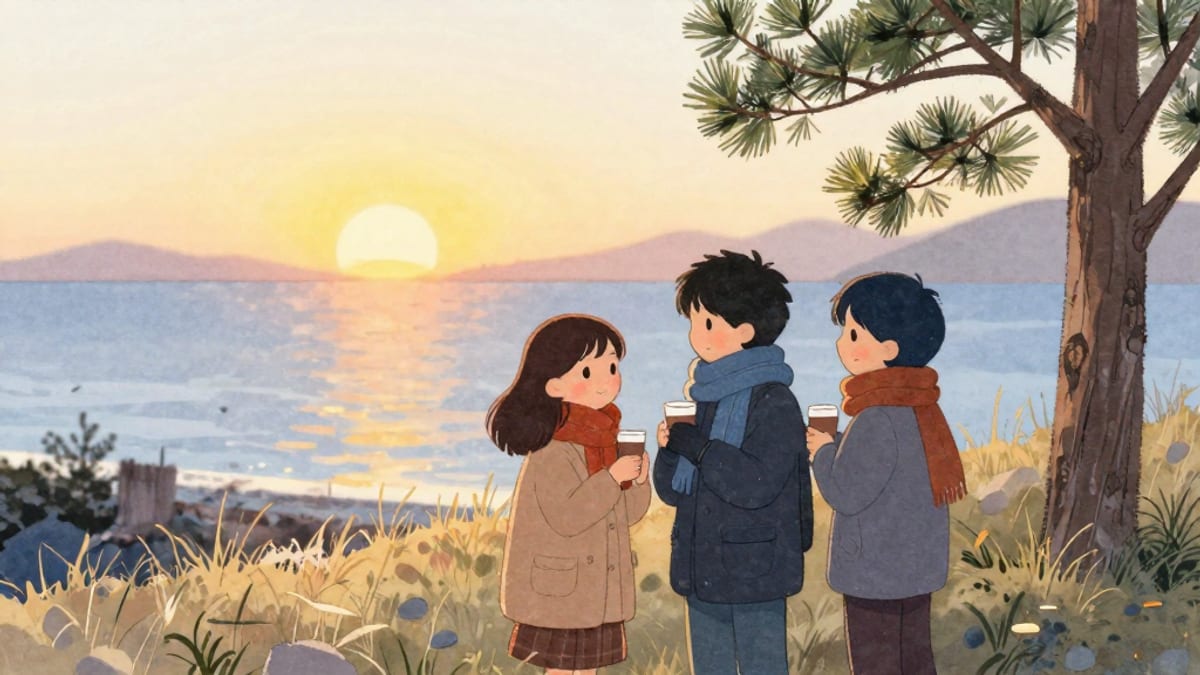
Hatsuhinode, the first sunrise of the year on the morning of 1 January, is a popular New Year custom. Some people climb a hill, go to a beach or a mountain top before dawn, and wait in the cold to see the sun rise and make a wish for the year. Others simply watch from a balcony. The name uses 日 twice: 初日の出, first sun's rising.
| Japanese | Romaji | Meaning |
|---|---|---|
| 寒いね。あと何分? | Samui ne. Ato nanpun? | You: It's cold. How many more minutes? |
| もうすぐだよ。ほら、空が明るくなってきた。 | Mō sugu da yo. Hora, sora ga akaruku natte kita. | Friend: Nearly. Look, the sky's getting lighter. |
| わあ、出てきた! | Wā, dete kita! | You: Wow, here it comes! |
| 初日の出、きれいだね。 | Hatsuhinode, kirei da ne. | Friend: The first sunrise is beautiful. |
| 今年もよろしくね。 | Kotoshi mo yoroshiku ne. | You: Here's to another year together. |
日本, Nippon and names with 陽 and 日
日本, Japan, combines sun and origin, and is usually explained as the land where the sun comes from, as seen from the Asian mainland. It is read Nihon in most everyday speech and Nippon in some formal names and in sports cheering; both are correct.
陽 and 日 are both popular in modern given names, chosen for warmth, brightness and a sunny character. In names, 陽 is often read haru or hi. The names below are examples; Haruto and Himari in particular have been popular in recent years. Each one can be written in many ways, and families choose kanji for meaning, sound and look.
| Japanese | Romaji | Meaning |
|---|---|---|
| 陽翔 | Haruto | sun soaring · boy |
| 陽葵 | Himari | sun and hollyhock · girl |
| 陽太 | Yōta | big sunshine · boy |
| 日向 | Hinata | a sunny place · unisex |
Sun tattoos, designs and look-alikes
When reading, 日 is easy to confuse with several box-shaped kanji. 目 (eye) has two lines inside and is taller. 白 (white) adds a short stroke on top. 旧 (old) adds a vertical line on the left. 曰 is wider and flatter.
| Japanese | Romaji | Meaning |
|---|---|---|
| 目 | me | an eye |
| 白 | shiro | white |
| 旧 | kyū | old, former |
- Avoid 日 alone. Japanese readers see day as much as sun, and it appears in countless ordinary words such as dates. In some Chinese slang, 日 used as a verb is also a crude word, which is another reason to choose something else.
- 太陽 (taiyō) is clear and positive. 陽 alone suggests sunshine and brightness and is often chosen for its look, but some readers may read it as part of a name.
- Chinese also uses 太陽 for the sun, in the simplified form 太阳 on the mainland, so use 陽 if you want the Japanese form.
- Ask a native speaker to check the final characters and style before you book the tattoo.
Common learner mistakes with 日
- Saying tsuitachi when you mean one whole day. One day is ichinichi; tsuitachi is the first of the month.
- Reading 二十日 as nijūnichi. The twentieth is hatsuka.
- Saying kiyō for today. It is kyō, one long syllable.
- Using hi for the sun in a science sentence. In formal or scientific Japanese, say taiyō.
- Reading 日本 as Hinomoto in modern speech. That is an old poetic reading; today it is Nihon or Nippon.
A sunny ten-minute routine with Mocchi
Start by asking Mocchi: Quiz me on the special readings of 日 in dates, from tsuitachi to tōka and hatsuka, mixing them up. Mocchi checks each answer, explains why mikka and yokka are irregular, and keeps a note of the dates you miss so they come back in your next /review.
Then spend five minutes in the pronunciation coach on long vowels. Listen to the model, slowed down if you like, record yourself and check your score for words like taiyō and kyō, where a short vowel changes the word.