
The big names: two capitals, a slope and a beach
Until 1868 Tokyo was Edo (江戸), usually explained as the door of the inlet. When the emperor moved east from Kyoto, the city became 東京: east plus capital. Kyoto itself is 京都, two kanji that both mean capital, and it had been the imperial capital for more than a thousand years.
Osaka is 大阪, large slope. Older documents write it 大坂, using the everyday kanji for slope, and the form with 阪 became standard in the Meiji era. You will often hear that the old kanji was dropped because its parts could be read as returning to the soil, but this is a popular explanation, not an established fact. Today 阪 survives almost only in names tied to Osaka, such as Hanshin (阪神), Osaka and Kobe.
Yokohama is 横浜, side plus beach. It was a small fishing village until its port opened in 1859, and the name is usually explained as a sandbar that stretched sideways across the bay.
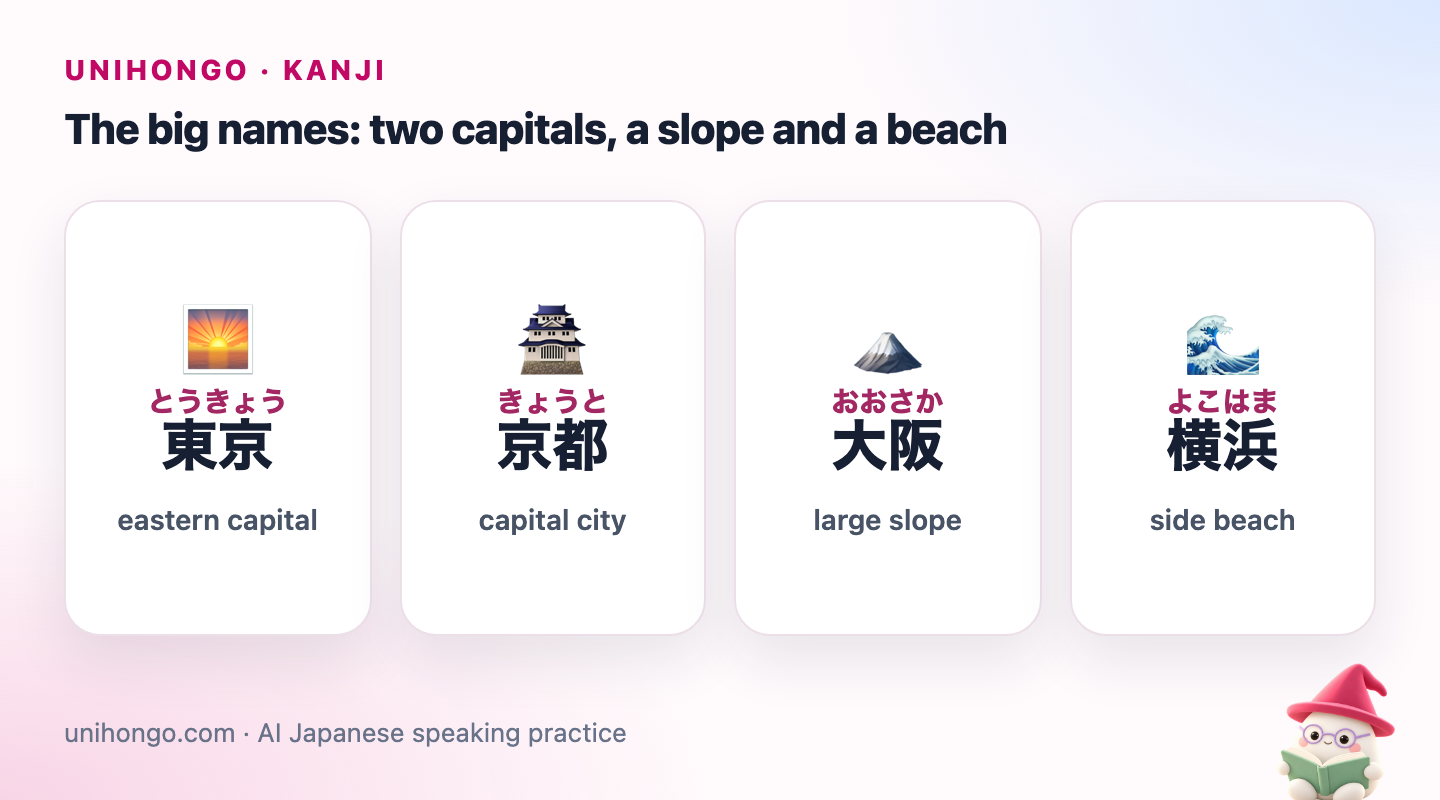
| Japanese | Romaji | Meaning |
|---|---|---|
| 東京 | Tōkyō | eastern capital |
| 京都 | Kyōto | capital city |
| 大阪 | Ōsaka | large slope |
| 横浜 | Yokohama | side beach |
| 江戸 | Edo | the old name of Tokyo |
| 大坂 | Ōsaka | the older spelling of Osaka |
More cities you can read like pictures
| Japanese | Romaji | Meaning |
|---|---|---|
| 北海道 | Hokkaidō | north sea road |
| 広島 | Hiroshima | wide island |
| 福岡 | Fukuoka | fortune hill |
| 神戸 | Kōbe | god's door |
| 千葉 | Chiba | thousand leaves |
| 長崎 | Nagasaki | long cape |
Hiroshima grew as a castle town on the delta of the Ōta River, and its name is usually linked to the broad sandbanks, the islands, of that delta. Fukuoka was named by its feudal lords, the Kuroda family, after a place called Fukuoka in their old home region in today's Okayama Prefecture. The merchant town next door kept its own name, Hakata, which is why the main station is still Hakata Station.
Kōbe looks like god plus door, but the origin is the word kanbe, the households that supported a shrine, here Ikuta Shrine. The kanji 戸 counts households as well as doors. Chiba and Nagasaki read simply as a thousand leaves and a long cape; how each name actually began is less clear than the kanji suggest.
When the kanji are only sound: Nara, Nagoya, Sapporo
Kanji chosen for their reading and not their meaning are called ateji (当て字). Nara (奈良) is the classic case. The two kanji tell you nothing, and the origin of the name is uncertain. One often-quoted theory links it to narasu, to make flat, but it is only a theory.
Nagoya (名古屋) reads as name, old, shop. These are ateji as well. Older spellings exist, and the origin is debated. Sapporo (札幌) is different again: like most place names in Hokkaido it comes from the Ainu language and was fitted with kanji later.
A practical rule: if the literal reading of a name gives you nonsense, suspect ateji and enjoy the sound instead.
| Japanese | Romaji | Meaning |
|---|---|---|
| 奈良 | Nara | kanji used for sound |
| 名古屋 | Nagoya | kanji used for sound |
| 札幌 | Sapporo | a name from the Ainu language |
| 当て字 | ateji | kanji borrowed for their sound |
A decoding kit: nine kanji found all over the map
| Japanese | Romaji | Meaning |
|---|---|---|
| 山 | yama | mountain |
| 川 | kawa | river |
| 田 | ta | rice field |
| 島 | shima | island |
| 崎 | saki | cape |
| 浜 | hama | beach |
| 野 | no | field, plain |
| 原 | hara | open plain |
| 橋 | hashi | bridge |
Inside a name the first sound often softens: kawa becomes gawa, shima becomes jima, saki becomes zaki, hashi becomes bashi, ta becomes da. So 崎 is saki in Nagasaki but zaki in Miyazaki.
The kit at work
Try covering the right-hand column and guessing. The meanings below are literal readings of the kanji, a way to remember the names, not a claim about how each place got its name.
| Japanese | Romaji | Meaning |
|---|---|---|
| 富山 | Toyama | rich mountain |
| 品川 | Shinagawa | goods river |
| 秋田 | Akita | autumn rice field |
| 福島 | Fukushima | fortune island |
| 宮崎 | Miyazaki | shrine cape |
| 長野 | Nagano | long field |
| 日本橋 | Nihonbashi | Japan bridge |
Direction and size words in names
Station names in big cities lean on a second small set: the four directions, and the word for new. A station called Shin plus a city name, such as Shin-Ōsaka, is usually the newer station built for the Shinkansen.
| Japanese | Romaji | Meaning |
|---|---|---|
| 東 | higashi | east |
| 西 | nishi | west |
| 南 | minami | south |
| 北 | kita | north |
| 新大阪 | Shin-Ōsaka | new Osaka |
| 新宿 | Shinjuku | new post town |
In two-kanji city names the same kanji usually take their Chinese-style readings: east is tō in Tōkyō and north is hoku in Hokkaidō.
Saying where you are from and where you are going
| Japanese | Romaji | Meaning |
|---|---|---|
| ご出身はどちらですか。 | Goshusshin wa dochira desu ka. | Where are you from? |
| カナダから来ました。 | Kanada kara kimashita. | I'm from Canada. |
| 大阪に住んでいます。 | Ōsaka ni sunde imasu. | I live in Osaka. |
| 明日、京都に行きます。 | Ashita, Kyōto ni ikimasu. | I'm going to Kyoto tomorrow. |
| 広島は初めてです。 | Hiroshima wa hajimete desu. | It's my first time in Hiroshima. |
| この漢字は何と読みますか。 | Kono kanji wa nan to yomimasu ka. | How do you read this kanji? |
| どういう意味ですか。 | Dō iu imi desu ka. | What does it mean? |
Goshusshin wa dochira desu ka is polite and safe with anyone. Friends ask doko shusshin? Asking a local what the name of their town means is an easy way to start a conversation, and many people enjoy working it out with you.