
美 at a glance
美 is a common kanji taught in the third year of elementary school. Its core meaning is beauty, but it stretches to mean fine, excellent and pleasing, so it appears in words about food, art, praise and rewards as well as looks.
The cards below show the kanji and three words that every learner meets early.
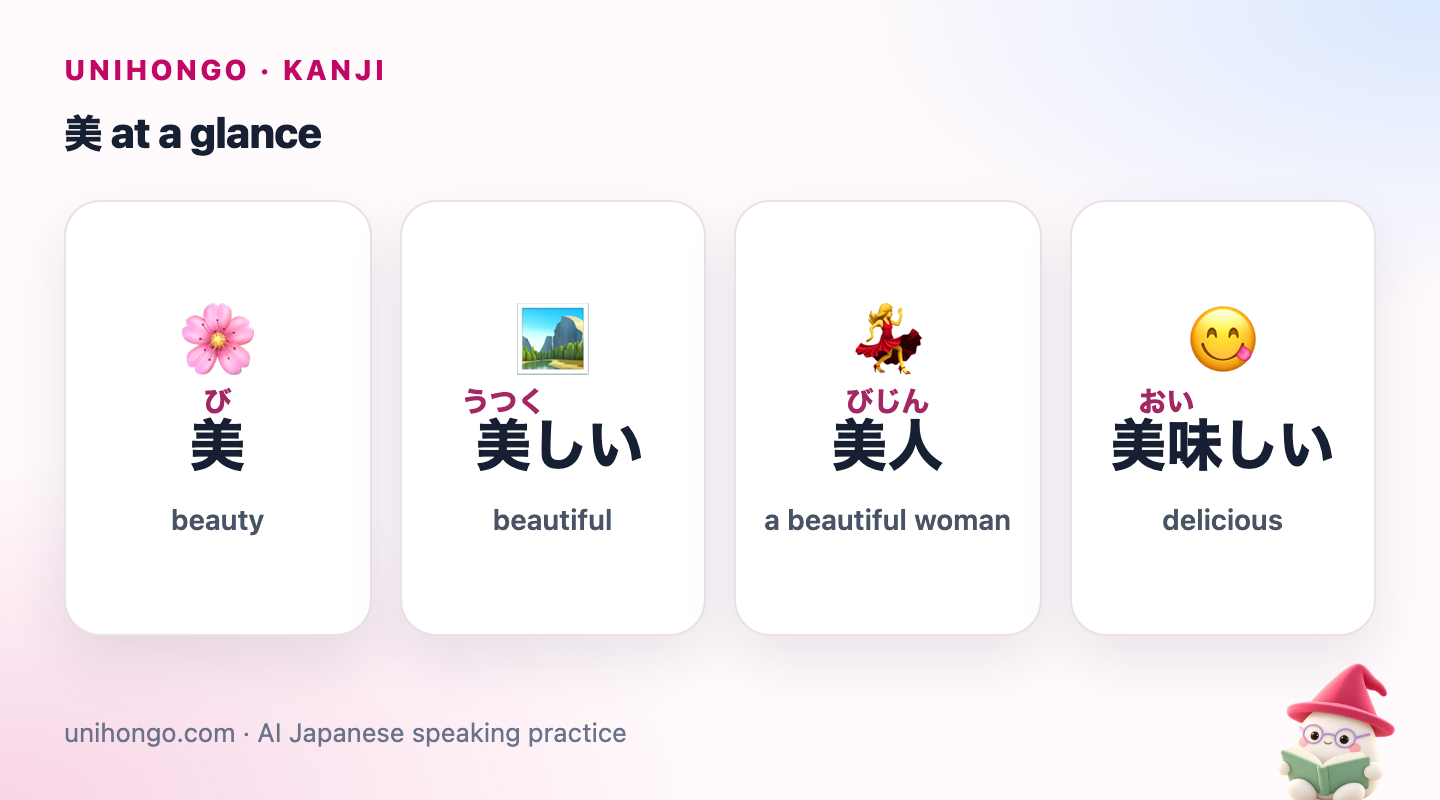
| Japanese | Romaji | Meaning |
|---|---|---|
| 美 | bi | beauty |
| 美しい | utsukushii | beautiful |
| 美人 | bijin | a beautiful woman |
| 美味しい | oishii | delicious |
Notice that the readings change: bi in 美 and 美人, utsukushi in 美しい, and in 美味しい the whole word is read oishii, with no separate reading for 美. That is the sign of ateji, kanji chosen for meaning.
Readings, strokes and the parts of 美
美 is made of a sheep shape on top, the same top as 羊 (hitsuji, sheep) without its tail, and 大 (big) underneath. A popular explanation is that a big, fine sheep was a picture of something excellent, perhaps as an offering. Other explanations exist, so treat this as a memory hook rather than a settled fact.
In the official list of everyday kanji, 美 has just two readings: bi and utsukushii. The reading mi is a name reading, and you will meet it constantly in given names.
| Japanese | Romaji | Meaning |
|---|---|---|
| 羊 | hitsuji | sheep (top of 美) |
| 大 | dai | big (bottom of 美) |
| Item | Detail | Example |
|---|---|---|
| On'yomi (Chinese reading) | bi | 美術 (bijutsu), 美容 (biyō) |
| Kun'yomi (native reading) | utsuku(shii) | 美しい (utsukushii) |
| Common reading in names | mi; also yoshi | 美咲 (Misaki), 美子 (Yoshiko or Miko) |
| Stroke count | 9 | Top 6 (羊 shape), bottom 3 (大) |
| Parts | ⺶ sheep shape + 大 big | Origin explained in different ways |
Everyday words with 美
These words come up in daily life, shopping and travel. Several are on shop fronts you walk past every day.
| Japanese | Romaji | Meaning |
|---|---|---|
| 美術館 | bijutsukan | art museum |
| 美容院 | biyōin | hair salon |
| 美容 | biyō | beauty care |
| 美肌 | bihada | beautiful skin |
| 美男美女 | binan bijo | good-looking men and women |
| 美意識 | biishiki | a sense of beauty, aesthetic sense |
| 美化 | bika | beautifying; glorifying the past |
| 優美 | yūbi | graceful, elegant |
| ご褒美 | gohōbi | a reward, a treat |
| 美味 | bimi | a delicacy, fine taste (written) |
| 美徳 | bitoku | a virtue |
ご褒美 is a favourite word in daily life: 自分へのご褒美, a treat for myself, is what people say when they buy a nice cake after a hard week. Here 美 means something good rather than something beautiful.
美化 has a double meaning. 町の美化 is keeping the town clean and pretty, as on a volunteer clean-up day, but 過去を美化する means looking at the past through rose-tinted glasses.
美しい, きれい and 美人: what people really say
美しい is a strong, slightly formal word. It is perfect for a mountain at dawn, a piece of music, a calligraphy work or a kind act, and it often sounds poetic. In everyday conversation, most people say きれい, which also means clean and tidy.
美人 is the standard word for a beautiful woman. It is a compliment, but comments on someone's looks can feel personal, especially at work, so many people avoid them. For men, イケメン (ikemen, a good-looking guy) is common and casual; 美男 (binan) sounds old-fashioned.
| Japanese | Romaji | Meaning |
|---|---|---|
| わあ、きれい! | Wā, kirei! | Wow, how beautiful! (everyday) |
| 本当に美しい景色ですね。 | Hontō ni utsukushii keshiki desu ne. | What a truly beautiful view. |
| 美しい日本語ですね。 | Utsukushii Nihongo desu ne. | Your Japanese is beautiful. |
| お姉さん、美人ですね。 | Onēsan, bijin desu ne. | Your sister is beautiful. |
| 部屋がきれいになった。 | Heya ga kirei ni natta. | The room is clean now. (casual) |
If a Japanese speaker compliments you, a modest reply is natural: そんなことないです (sonna koto nai desu, not at all) or just ありがとうございます with a smile. Both are fine; younger people increasingly just say thank you, while a strong denial can sound old-fashioned but is never rude.
A safe habit for learners is to praise things rather than people: the view, the food, the handwriting, the garden, the photo. 美しい and きれい both work for things, and nobody will misread your intention.
Mini dialogue: in a temple garden
Gardens are where 美しい feels most at home. Here two friends visit a quiet temple garden in autumn.
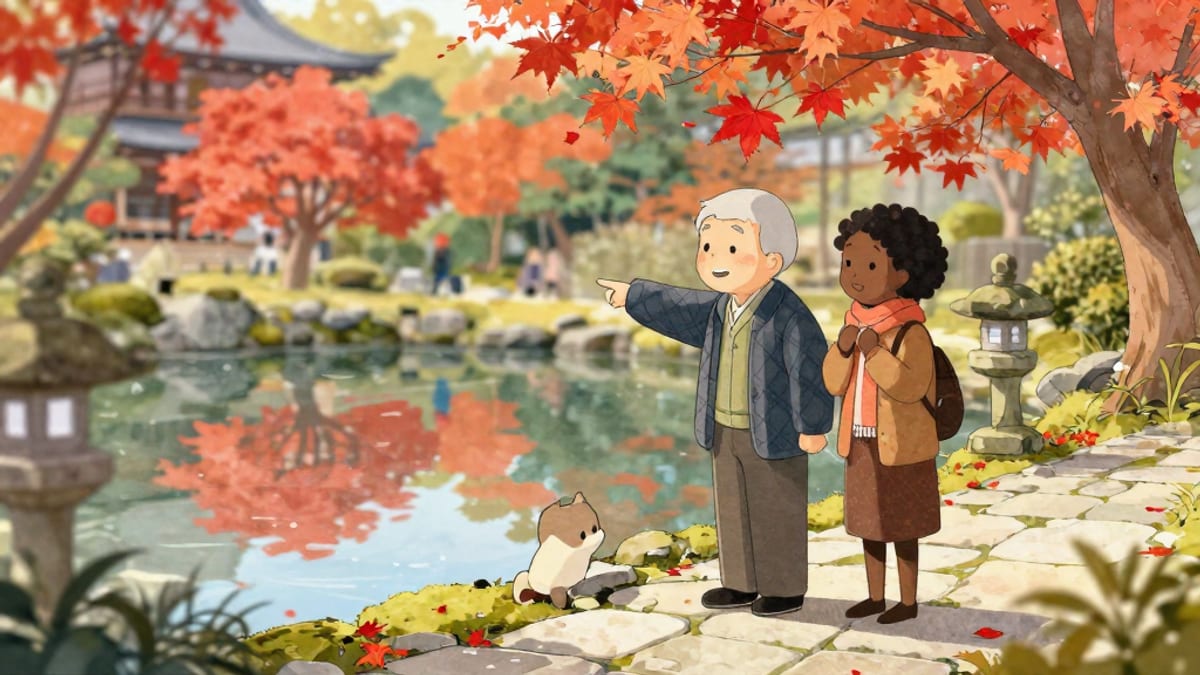
| Japanese | Romaji | Meaning |
|---|---|---|
| ここの庭、本当に美しいですね。 | Koko no niwa, hontō ni utsukushii desu ne. | Selam: This garden is truly beautiful. |
| 秋は特にきれいですよ。 | Aki wa toku ni kirei desu yo. | Mr Kato: It's especially lovely in autumn. |
| 紅葉が池に映っていますね。 | Kōyō ga ike ni utsutte imasu ne. | Selam: The autumn leaves are reflected in the pond. |
| 日本人の美意識ですね。 | Nihonjin no biishiki desu ne. | Mr Kato: That's the Japanese sense of beauty. |
| あとで抹茶と和菓子はどうですか。 | Ato de matcha to wagashi wa dō desu ka. | Selam: How about matcha and sweets afterwards? |
| いいですね。美味しいところを知っています。 | Ii desu ne. Oishii tokoro o shitte imasu. | Mr Kato: Good idea. I know a delicious place. |
美 in names, look-alikes and common mistakes
美 is one of the most common kanji in Japanese girls' names, usually read mi. Families often choose it for its meaning, its gentle sound and its balanced shape. It also appears in some older names read yoshi, and occasionally in boys' names, but these are less common. The same reading mi can be written with other kanji, such as 実 (fruit) or 海 (sea), so you cannot guess the kanji from the sound.
| Japanese | Romaji | Meaning |
|---|---|---|
| 美咲 | Misaki | beauty, blooming · girl |
| 由美 | Yumi | reason, beauty · girl |
| 美穂 | Miho | beauty, ear of grain · girl |
| 美月 | Mizuki | beauty, moon · girl |
- Calling a man 美人. It is used for women; for men, try かっこいい (kakkoii, cool, handsome).
- Saying 美しい about a tidy desk. That is きれい.
- Reading 美味しい as bimishii. It is oishii; the kanji are for meaning only.
- Assuming every mi in a name is 美. Always ask how someone writes their name: どういう字を書きますか.
Look-alikes: 美 shares its sheep-shaped top with 義 (gi, justice, duty) and 着 (chaku, to wear, to arrive). The difference is the bottom: 大 in 美, 我 in 義, and 目 in 着. 美 also looks like 業 (gyō, work) at small sizes.
How to write 美: start with the two little dots at the top, then the three horizontals and the vertical of the sheep shape, then 大 at the bottom, whose top horizontal is the longest stroke in the character. Nine strokes in all.
美 as a tattoo or design
美 is a real, positive kanji that Japanese readers understand at once. Its challenge is that it is so familiar from girls' names, beauty salons and cosmetics that a lone 美 can look like part of a name or a brand rather than a personal idea. That is a matter of taste, not a mistake.
A word can say more: 美しい (beautiful) as an adjective, 優美 (grace, elegance) or 美意識 (a sense of beauty). In Chinese, 美 is used in the same way and the character is identical, but it also forms part of the Chinese name for the United States, so some Chinese readers may make that link.
Before inking, ask a native speaker to check the characters, the meaning and the design, and give the artist a clean, checked image.
| Japanese | Romaji | Meaning |
|---|---|---|
| 優美 | yūbi | grace, elegance |
Learn the 美 words with Mocchi, then use them in a museum
Write three short sentences, one with 美しい, one with きれい and one with ご褒美, and send them to Mocchi, Unihongo's study assistant, with /correct. Mocchi corrects them, explains whether 美しい sounds too formal in each, and remembers your choices so a later /quiz checks the difference again.
Then open AI Sensei, choose Yamada-sensei and ask him to play a guide at a small local museum. Ask where the paintings are, say what you find beautiful, and read the session report afterwards for corrections and new vocabulary.