

The head and face
Body kanji are friendly: most are single characters read with a kun reading you already know, and many are simple pictures. 体, karada, is the body, and its on reading tai appears in 体温, taion, body temperature, and 体調, taichō, physical condition. 頭, atama, is the head; the on readings tō and zu give 頭痛, zutsū, headache. 目, me, is the eye, a picture of an eye turned on its side; the eye department, 眼科, ganka, uses a different eye kanji.
耳, mimi, the ear, is also a picture, and its on reading ji appears in 耳鼻科, jibika, the ear, nose and throat department. 鼻, hana, is the nose, on reading bi. 口, kuchi, the mouth, gives 口内炎, kōnaien, a mouth ulcer. 歯, ha, is a tooth, and its on reading shi gives 歯科, shika, dentistry, and 歯医者, haisha, the dentist, one of the few compounds where a body part keeps its kun reading.
| Japanese | Romaji | Meaning |
|---|---|---|
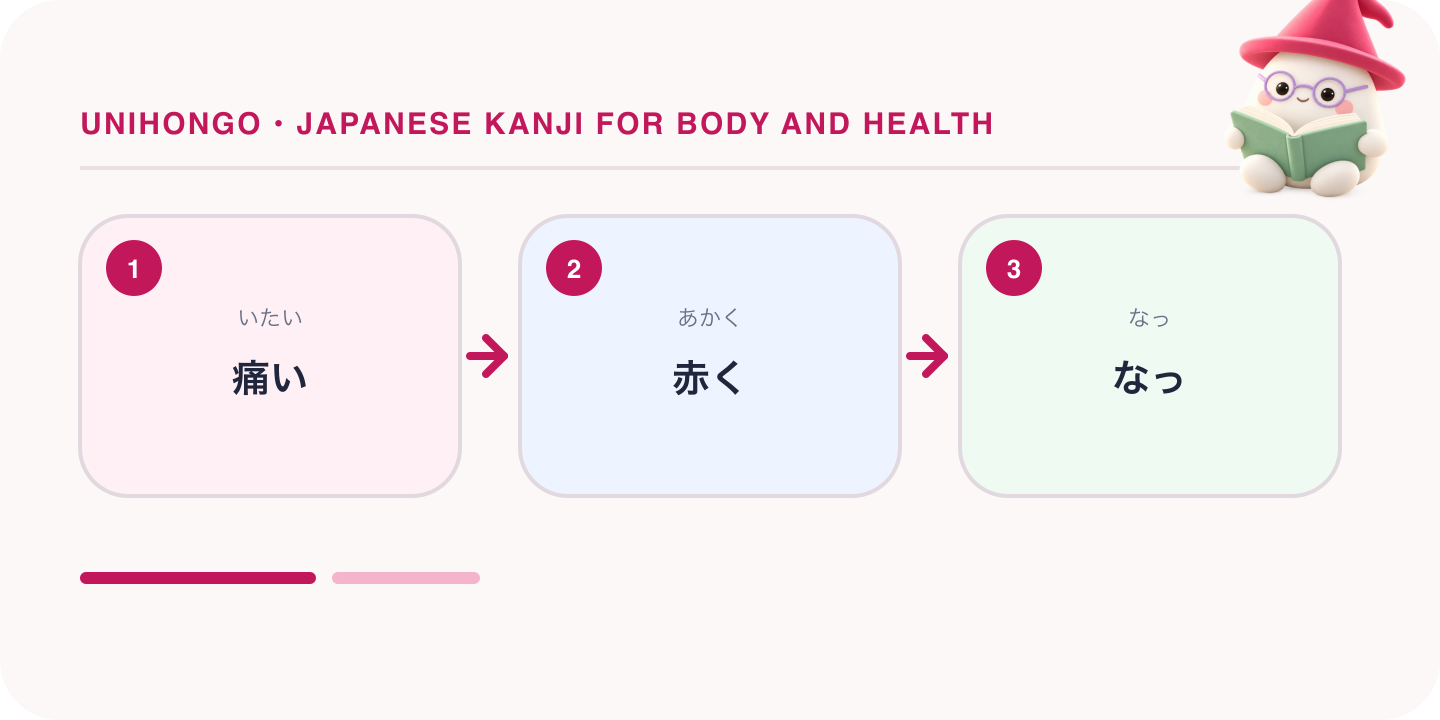
| 頭が痛いです。 | Atama ga itai desu. | My head hurts. |
| 目が赤くなっています。 | Me ga akaku natte imasu. | My eyes have gone red. |
| 耳鼻科は二階です。 | Jibika wa nikai desu. | The ear, nose and throat department is on the second floor. |
| 歯医者を予約したいです。 | Haisha o yoyaku shitai desu. | I would like to book a dentist. |
| 体調が悪いです。 | Taichō ga warui desu. | I am not feeling well. |
Hands, feet, belly and heart
手, te, is the hand, with on reading shu in 手術, shujutsu, surgery, a word you will see on hospital signs. 足, ashi, is the foot or leg, since Japanese does not separate the two as strictly as English; the on reading soku appears in 遠足, ensoku, an outing, while 足首, ashikubi, ankle, keeps the kun reading. 腹, hara, is the belly, on reading fuku, giving 腹痛, fukutsū, stomach ache. Onaka is the polite everyday word, but the kanji on a form will be 腹.
心, kokoro, is the heart in the sense of mind and feeling, on reading shin. The organ is 心臓, shinzō, and 心配, shinpai, is worry, while 安心, anshin, is relief. On a clinic form you may see 心療内科, shinryō naika, the department for stress-related illness. The heart shape is easy: three dots and a hook, like a heart drawn in one stroke.
| Japanese | Romaji | Meaning |
|---|---|---|
| 手を洗ってください。 | Te o aratte kudasai. | Please wash your hands. |
| 足首をひねりました。 | Ashikubi o hinerimashita. | I twisted my ankle. |
| お腹が痛いです。 | Onaka ga itai desu. | My stomach hurts. |
| 心配しないでください。 | Shinpai shinaide kudasai. | Please do not worry. |
Body kanji at a glance
Here are the ten body kanji with both readings. The compound in the meaning column is the one you are most likely to read on a clinic sign or form.
| Kanji | Reading | Meaning |
|---|---|---|
| 体 | on: tai; kun: karada | Body; 体温 taion, body temperature |
| 頭 | on: tō, zu; kun: atama | Head; 頭痛 zutsū, headache |
| 目 | on: moku; kun: me | Eye; 目薬 megusuri, eye drops |
| 耳 | on: ji; kun: mimi | Ear; 耳鼻科 jibika, ear and nose department |
| 鼻 | on: bi; kun: hana | Nose; 鼻水 hanamizu, runny nose |
| 口 | on: kō; kun: kuchi | Mouth; 口内炎 kōnaien, mouth ulcer |
| 歯 | on: shi; kun: ha | Tooth; 歯科 shika, dentistry |
| 手 | on: shu; kun: te | Hand; 手術 shujutsu, surgery |
| 足 | on: soku; kun: ashi | Foot, leg; 足首 ashikubi, ankle |
| 腹 | on: fuku; kun: hara | Belly; 腹痛 fukutsū, stomach ache |
| 心 | on: shin; kun: kokoro | Heart, mind; 心臓 shinzō, the heart |
目薬, megusuri, and 鼻水, hanamizu, keep the kun readings because they are native words made of two native parts. The on readings dominate in technical terms: 頭痛, 腹痛, 手術, 心臓.
Illness, fever, pain and blood
Four kanji describe what is wrong. 病, byō, is illness, and the kun reading yamai is literary; you will read it in 病気, byōki, sick, 病院, byōin, hospital, and 病名, byōmei, the name of a diagnosis. 熱, netsu, is heat or fever, and atsui is the kun reading for hot. Netsu ga arimasu, I have a fever, is the sentence you need most, and 解熱剤, genetsuzai, is a fever reducer on the pharmacy shelf. 痛, tsū or itai, is pain, and it attaches to any body part: 頭痛, 腹痛, 胃痛, 生理痛, seiritsū, period pain. 痛み止め, itamidome, is a painkiller.
血, chi or ketsu, is blood. 血圧, ketsuatsu, blood pressure, is on every check-up form, 血液検査, ketsueki kensa, is a blood test, and 出血, shukketsu, is bleeding. 病 and 痛 share the sickness radical 疒, the roof with a bed underneath, which also appears in 疲れ, tsukare, tiredness, and 症状, shōjō, symptoms, so any kanji with that roof is a signal that the word is about being unwell.
| Japanese | Romaji | Meaning |
|---|---|---|
| 熱があります。 | Netsu ga arimasu. | I have a fever. |
| 三日前から頭痛が続いています。 | Mikka mae kara zutsū ga tsuzuite imasu. | I have had a headache for three days. |
| 血圧を測ります。 | Ketsuatsu o hakarimasu. | I will take your blood pressure. |
| 痛み止めはありますか。 | Itamidome wa arimasu ka. | Do you have a painkiller? |
| 病気ではないと思います。 | Byōki de wa nai to omoimasu. | I do not think it is an illness. |
Clinic and pharmacy kanji
The last five kanji build the institutional words. 医, i, means medicine or doctor and never stands alone; 者, sha or mono, means person, so 医者, isha, is a doctor and 患者, kanja, is a patient. 院, in, is an institution, giving 病院, hospital, 医院, iin, a small practice, and 入院, nyūin, being admitted, with 退院, taiin, being discharged. 薬, kusuri or yaku, is medicine, and 診, shin, is a medical examination: 診察, shinsatsu, a consultation, 診察券, shinsatsuken, the patient card you show at reception, and 受診, jushin, seeing a doctor.
| Japanese | Romaji | Meaning |
|---|---|---|
| 診察券をお持ちですか。 | Shinsatsuken o o-mochi desu ka. | Do you have your patient card? |
| 内科で受診してください。 | Naika de jushin shite kudasai. | Please see the internal medicine department. |
| 処方箋を薬局に出します。 | Shohōsen o yakkyoku ni dashimasu. | I hand the prescription in at the pharmacy. |
| この薬は一日三回、食後に飲んでください。 | Kono kusuri wa ichinichi sankai, shokugo ni nonde kudasai. | Take this medicine three times a day after meals. |
| Kanji | Reading | Meaning |
|---|---|---|
| 病 | on: byō; kun: yamai | Illness; 病気 byōki, sick |
| 熱 | on: netsu; kun: atsu(i) | Heat, fever; 解熱剤 genetsuzai, fever reducer |
| 痛 | on: tsū; kun: ita(i) | Pain; 痛み止め itamidome, painkiller |
| 血 | on: ketsu; kun: chi | Blood; 血圧 ketsuatsu, blood pressure |
| 医 | on: i | Medicine, doctor; 医院 iin, small clinic |
| 者 | on: sha; kun: mono | Person; 患者 kanja, patient |
| 院 | on: in | Institution; 入院 nyūin, hospital admission |
| 薬 | on: yaku; kun: kusuri | Medicine; 薬局 yakkyoku, pharmacy |
| 診 | on: shin; kun: mi(ru) | Examine; 診察券 shinsatsuken, patient card |
The department names on a hospital directory all end in 科, ka: 内科, naika, internal medicine; 外科, geka, surgery; 眼科, ganka, eyes; 耳鼻科, jibika, ear and nose; 歯科, shika, teeth; 皮膚科, hifuka, skin; 小児科, shōnika, children; 産婦人科, sanfujinka, obstetrics and gynaecology. At the pharmacy you hand over a 処方箋, shohōsen, prescription, and the label will say 一日三回, ichinichi sankai, three times a day, and 食後, shokugo, after meals.
Where you meet these kanji every day
These characters do not only live in hospitals. You will see them on the street, in the drugstore and on your own phone.
- Hospital directories: 内科, 外科, 眼科, 耳鼻科, 歯科, 皮膚科, 小児科 and 受付 for reception
- The intake form: 症状, symptoms, 熱, 痛み, 血圧, and boxes for 頭, 腹 and 目
- Pharmacy and drugstore shelves: 薬, 目薬, 痛み止め, 解熱剤, 胃薬 for stomach medicine
- Medicine labels: 服用, 一日三回, 食後, 食前 before meals, and 用法 for directions
- Street signs: 病院 and 医院 with an arrow, and 歯科 above a dental clinic
- Health apps and thermometers: 体温, 体重 for weight, 心拍 for heart rate
- Everyday speech: 心配, 安心, 元気 and 病気 in almost any conversation
Reading a medicine label is a good weekly exercise: every box uses the same handful of kanji for dose and timing.
Look-alike kanji to watch
The most common confusion is 体 and 休. Both have the person radical on the left, but 体 has 本 on the right and 休, rest, has 木. A body has a root; a rest is a person leaning on a tree. 目 and 日 differ by one horizontal stroke: 目, eye, has two inside, 日, sun or day, has one, and 自, self, adds a small stroke on top. On a form, 目 appears in symptom boxes and 日 in the date, so the position gives a clue.
病 and 痛 share the sickness radical, so look inside: 病 holds 丙 and 痛 holds a shape like 甬. 薬 and 楽 differ only by the grass radical on top, and the difference matters, because 楽 means comfort or music, so 薬局 is a pharmacy but 楽器店 is a music shop. 医 and 区, ward or district, both have an open box on the right, but 医 holds an arrow 矢 and 区 holds a small cross. 者 and 著 are the same trap as 薬 and 楽: the grass radical turns person into author. 手 and 毛, hair, differ by which way the top stroke curls.
| Japanese | Romaji | Meaning |
|---|---|---|
| 体と休は似ています。 | Karada to yasumu wa nite imasu. | The kanji for body and rest look alike. |
| 薬局と楽器店は違います。 | Yakkyoku to gakkiten wa chigaimasu. | A pharmacy and a music shop are different. |
| 目と日を間違えないでください。 | Me to hi o machigaenaide kudasai. | Do not mix up eye and day. |
A one-week study plan for health kanji
Learn the body kanji by pointing at yourself and saying the word, then add the illness and clinic kanji by reading real labels. Write each character once by hand and say both readings aloud.
- Day 1: 体, 頭, 目, 耳. Point to each part and say the kun reading, then the compound.
- Day 2: 鼻, 口, 歯, 手, 足, 腹, 心. Same drill, and write a sentence with itai for three of them.
- Day 3: 病, 熱, 痛, 血. Read the symptom boxes on a clinic form or a health app.
- Day 4: 医, 者, 院, 薬, 診. Read a hospital directory and find every 科.
- Day 5: Medicine labels. Read a box for 一日三回, 食後 and 服用 and say the dose.
- Day 6: Look-alike pairs. Write 体 and 休, 薬 and 楽, 目 and 日 side by side.
- Day 7: Review all 20 with Unihongo's free learning games, then describe three symptoms aloud.
For the spoken side, the related post on Japanese at a clinic walks through the conversation with the receptionist and doctor. This post gives you the reading skill that makes it easier.