
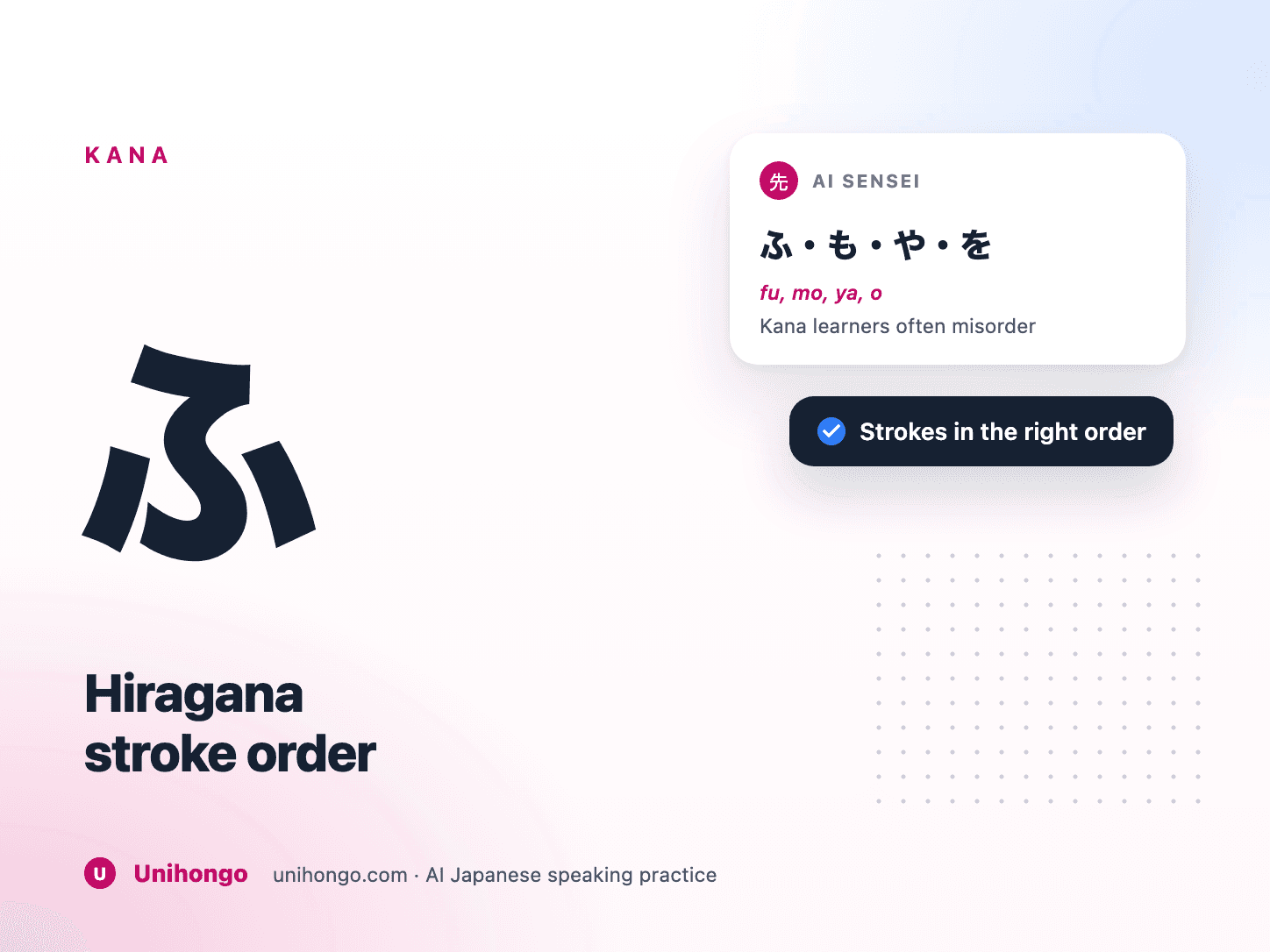
Why the order matters for kana
Hiragana are curved and flowing, and their shapes come from quick brush writing. The stroke order is part of that flow: each stroke ends where the next one naturally begins, which is what gives written kana their balance.
Writing out of order usually still produces a recognisable character, but the proportions drift, the kana look stiff, and connected writing becomes awkward. Handwriting input on phones is also sensitive to order and misreads kana written backwards more often.
The principles that cover most kana
Most hiragana follow a small set of principles. Learn these and you can predict the order of the majority of kana before looking them up.
- Top before bottom: the upper part of a kana is written first.
- Left before right: in kana with separate left and right parts, the left comes first.
- Horizontal before a crossing stroke: in kana such as た and な, the horizontal line comes before the stroke that cuts through it.
- Small marks last: dots and short final strokes, as in お, か and む, are usually written at the end.
- Loops belong to one stroke: a loop is not lifted and restarted but written in one continuous movement.
How a stroke ends
Japanese handwriting distinguishes three kinds of stroke ending: a stop, where the pen halts firmly; a flick, where the pen lifts away with a small hook; and a sweep, where the stroke thins out as it ends. Kana look written rather than traced when the endings are right.
You do not need calligraphy for this. Noticing where a hook or a sweep appears in a model and copying it is enough to change how your kana look.
| Japanese | Romaji | Meaning |
|---|---|---|
| い | i | The left stroke ends with a small upward flick |
| け | ke | The left vertical ends with a flick toward the next stroke |
| し | shi | One stroke that curves up at the end with a light sweep |
| つ | tsu | One stroke that sweeps down and away at the end |
| こ | ko | The top stroke ends with a small flick toward the bottom stroke |
The kana most often written in the wrong order
These are the kana where learners most commonly guess wrong, usually because the natural-looking order is not the traditional one. Each description follows the standard handwriting order.
| Japanese | Romaji | Meaning |
|---|---|---|
| お | o | 3 strokes: the horizontal, then the vertical with its loop, then the dot at the top right |
| か | ka | 3 strokes: the hooked stroke, then the slanting stroke through it, then the short mark on the right |
| ふ | fu | 4 strokes: the top curved mark, then the central hooked curve, then the left dot, then the right dot |
| も | mo | 3 strokes: the long curved hook first, then the upper and lower horizontal lines |
| や | ya | 3 strokes: the curved stroke on the right first, then the small dot, then the long line down to the left |
| を | o | 3 strokes: the short horizontal, then the angled stroke that drops and turns, then the large curve |
| せ | se | 3 strokes: the horizontal, then the short right vertical, then the left vertical that curves right |
| ほ | ho | 4 strokes: the left vertical, then the two horizontals, then the vertical with the loop |
Print fonts versus handwriting
A great deal of confusion comes from learning kana shapes from ordinary print fonts. Fonts are designed to look even at small sizes, so some join strokes that are separate when written by hand, and some separate strokes that are usually joined.
If a kana in a font looks different from your chart, trust a handwriting or textbook-style model for how to write it.
| Japanese | Romaji | Meaning |
|---|---|---|
| き | ki | Often shown joined in fonts; in handwriting the bottom curve is usually separate |
| さ | sa | Often shown joined in fonts; in handwriting the bottom curve is usually separate |
| り | ri | Often shown as one stroke in fonts; handwritten as two |
| そ | so | Shown with a break in some fonts; commonly handwritten in one continuous stroke |
| ら | ra | The first stroke is a short separate mark above the curve |
Checking your own writing
The fastest way to check stroke order without a teacher is to use a phone keyboard set to Japanese handwriting input. Write a kana slowly in the correct order; if it is recognised easily, your order and shape are probably fine. If it is recognised only after several tries, compare your strokes with a model.
Once the order is right, speed comes from writing short words rather than single kana, because real writing is about moving from one character to the next.
- Write slowly with a model beside you for the first few days.
- Say the stroke numbers aloud for kana you tend to misorder.
- Move to whole words once single kana feel automatic.
- Check a few kana each week with handwriting input.
- Keep a short list of your personal problem kana.
Reading speed and writing together
Writing kana correctly and reading them quickly reinforce each other. Handwriting fixes the shapes in memory, and fast recognition makes reading fluent enough that you stop decoding kana one at a time.
Unihongo's Kana Dash is built for the recognition side: short rounds against the clock with hiragana, katakana or both. Pair a few rounds with ten minutes of handwriting practice and the two skills grow together.