
Why the order still matters
Almost nobody writes long Japanese texts by hand any more, so learners reasonably ask why the order matters at all. The honest answer is that stroke order has stopped being about penmanship and become about search. Handwriting input compares the path your finger takes against a stored sequence, so a character drawn in a private order is often rejected even when the finished shape looks perfectly correct.
The second reason is reading rather than writing. Japanese handwriting joins and shortens strokes when people write quickly, and it abbreviates along the standard path. A colleague's note or a shop sign in semi-cursive style becomes far more readable once your eye knows which stroke came first.
- Handwriting recognition scores your stroke path, not just the final shape.
- Stroke-count lookup needs an exact count.
- Even proportions come from the order, not careful copying.
- Writing a character once in the right order is a strong memory hook.
The eight rules in one table
| Rule | Example character | What it prevents |
|---|---|---|
| Top to bottom | 三 san, three | Uneven spacing between stacked horizontals |
| Left to right | 川 kawa, river | Crowding the left side against the right |
| Horizontal before vertical | 十 jū, ten | A vertical that misses the centre of the cross |
| Outside before inside | 同 dō, same | An inside part too large for its frame |
| Close the enclosure last | 日 nichi, sun | A box that will not shut cleanly at the bottom |
| Centre before the wings | 小 shō, small | Wings that drift and leave the centre off balance |
| Left-falling before right-falling | 人 hito, person | A crossing point that lands too high or too low |
| Piercing strokes last | 中 naka, middle | A through-stroke that cannot be centred |
These eight cover most characters, and they interact rather than compete. One kanji usually applies three or four of them, working from the top left of the square towards the bottom right. Where two seem to conflict, the more local rule wins.
Top to bottom, then left to right
These two are the master rules, and the others refine them. The hand travels down the character and across it, so stacked horizontals are written from the top down and parallel verticals from the left across. In 三 the horizontals go top, middle, bottom; in 川 the verticals go left, centre, right. In a character with a left part and a right part, such as 語, finish the left element first.
| Japanese | Romaji | Meaning |
|---|---|---|
| 三 | San | Three: the horizontals run from the top down |
| 川 | Kawa | River: the verticals run from the left across |
| 言 | Gen | Speech: a dot, then horizontals downward, then the mouth |
| 語 | Go | Language: finish the whole left element before the right |
Horizontal before vertical
Where a horizontal and a vertical cross, the horizontal comes first. In 十 you draw the crossbar and then the upright, which lets you place the upright exactly through the middle of a line you can already see. This explains a common complaint: kanji that look lopsided even though every stroke is present. Draw the vertical first and you have nothing to aim at.
| Japanese | Romaji | Meaning |
|---|---|---|
| 十 | Jū | Ten: crossbar first, upright second |
| 木 | Ki | Tree: horizontal, trunk, then the two sweeps |
| 土 | Tsuchi | Earth: short horizontal, upright, long horizontal |
Outside first, and close the box last
When a character contains an enclosing frame, the frame comes before whatever sits inside it, with one qualification: the stroke sealing the bottom is saved until the very end. In 日 you write the left upright, then the top and right side as one turning stroke, then the middle horizontal, and only then the base. The instinct to finish the box first is strong and almost always wrong.
| Japanese | Romaji | Meaning |
|---|---|---|
| 日 | Nichi | Sun or day: the base line is the last stroke |
| 国 | Kuni | Country: frame, then the inside, then the base |
| 同 | Dō | Same: the outside shape comes before the inner parts |
| 内 | Uchi | Inside: the outer shape leads, the inner sweep follows |
Centre before the wings
In characters built around a central stroke, the centre is written first and the balancing strokes follow, left then right. 小 begins with the central hooked vertical, then takes the left dot and the right dot. 水 follows the same idea: the central hook anchors the character and the two side sweeps hang off it. Write a side stroke first and you are guessing where the middle should be, so the result reliably leans.
| Japanese | Romaji | Meaning |
|---|---|---|
| 小 | Shō | Small: centre hook, left dot, right dot |
| 水 | Mizu | Water: the central hook comes before the sweeps |
Falling strokes and piercing strokes
Where a left-falling sweep and a right-falling sweep meet, the left one comes first. 人 is the clearest case, and 文 and 父 both end with the same pair in the same order. This gives the crossing point somewhere fixed to land, which is why a correctly ordered 人 sits evenly.
The last rule is that a stroke passing through the whole character comes at the end. The long vertical of 中 follows the box it pierces, the closing hook of 事 follows everything above it, and the long horizontal of 女 crosses last. Saving it gives you a finished shape to centre it on.
| Japanese | Romaji | Meaning |
|---|---|---|
| 人 | Hito | Person: left sweep, then right sweep |
| 文 | Bun | Writing: the pair of sweeps closes the character |
| 中 | Naka | Middle: the piercing vertical comes last |
| 事 | Koto | Matter or thing: the hooked vertical closes it |
| 女 | Onna | Woman: the long crossing horizontal is last |
Exceptions worth knowing
The rules are general tendencies, not laws, and a handful of very common characters break them. Learn these as individual facts rather than trying to reason them out, because they appear constantly and getting them wrong quietly breaks handwriting lookup.
- 右 starts with the falling sweep; 左 starts with the horizontal.
- 上 puts the vertical before the horizontals, against the usual rule.
- The 辶 and 廴 wrapping elements come last, after the part they wrap.
- The 走 element in 起 comes first, so wrapping elements do not all behave alike.
- In 区 and 医 the sealing stroke at the bottom left comes last of all.
- 必 and 飛 have orders nobody guesses; look them up once and memorise them.
How to check an unfamiliar kanji
The reliable method is to watch a character animate before you write it, not after. A dictionary that plays the strokes shows the two things a printed font cannot: where each stroke begins, and how many strokes there really are. Note the stroke count and the radical at the same time, since those are the keys you will need to find the character again.
| Japanese | Romaji | Meaning |
|---|---|---|
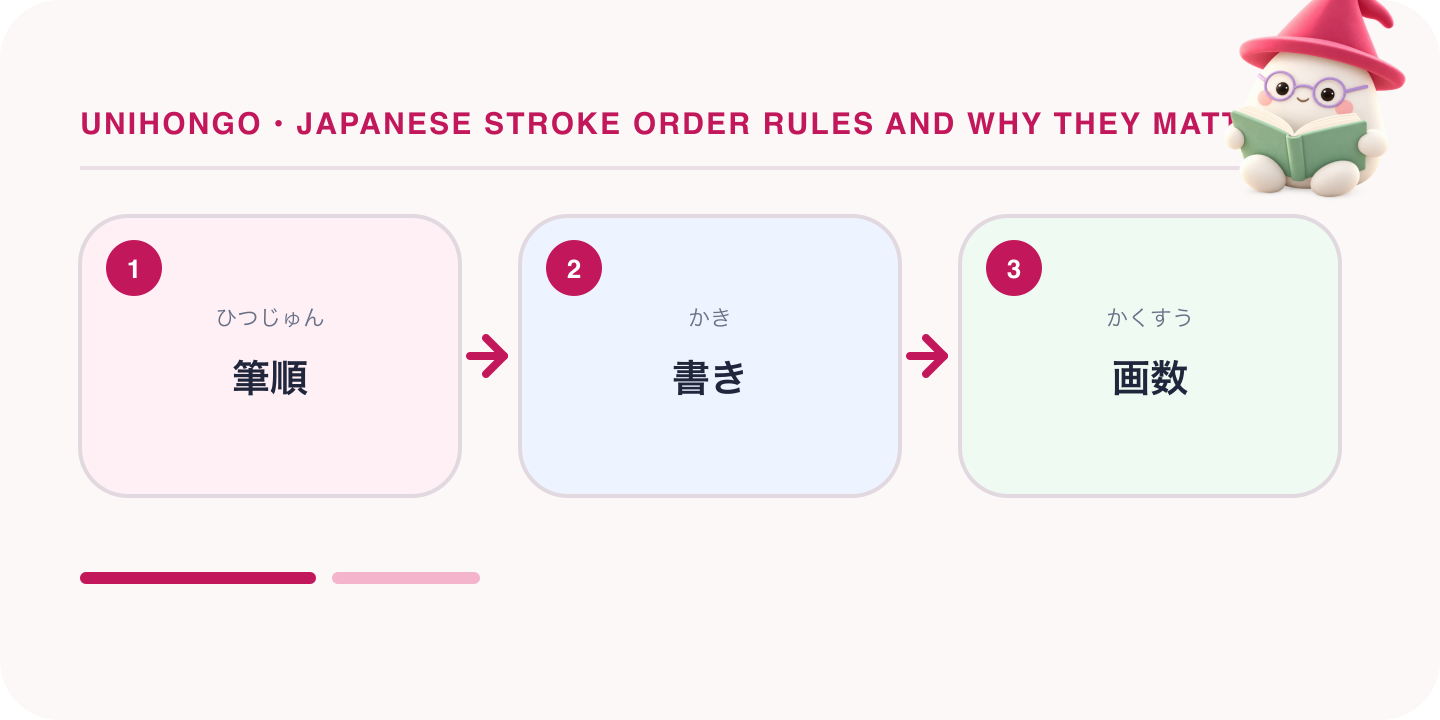
| 筆順 | Hitsujun | Stroke order (the formal term) |
| 書き順 | Kakijun | Stroke order (the everyday term) |
| 画数 | Kakusū | Stroke count |
| 一画 | Ikkaku | One stroke |
| 部首 | Bushu | Radical |
| 止め | Tome | A stop, ending the stroke firmly |
| 跳ね | Hane | A hook, flicking up at the end |
| 払い | Harai | A sweep, tapering away |
These eight words are enough to discuss writing with a teacher. One correction you will hear is tome ga tarimasen, meaning a stroke trails off where it should stop.
Ask about a character out loud
Handwriting questions come up more often than learners expect: filling in a form at a ward office, writing your address at a hotel, or asking what a scrawled note says. These lines cover both directions, asking about a character and being asked to write one, and the replies you hear are short and practical.
| Japanese | Romaji | Meaning |
|---|---|---|
| この漢字の書き順を教えてください。 | Kono kanji no kakijun o oshiete kudasai. | Please show me the stroke order for this kanji. |
| 最初の一画はどれですか? | Saisho no ikkaku wa dore desu ka? | Which one is the first stroke? |
| この字の画数はいくつですか? | Kono ji no kakusū wa ikutsu desu ka? | How many strokes does this character have? |
| 横画を先に書きます。 | Yokokaku o saki ni kakimasu. | You write the horizontal stroke first. |
| 縦画は最後に書きます。 | Tatekaku wa saigo ni kakimasu. | The vertical stroke is written last. |
| 上から下へ書いてください。 | Ue kara shita e kaite kudasai. | Please write from the top downwards. |
| 囲みは最後に閉じます。 | Kakomi wa saigo ni tojimasu. | You close the enclosure at the end. |
| 順番が違いますね。 | Junban ga chigaimasu ne. | The order is not quite right. |
| もう一度書いてみてください。 | Mō ichido kaite mite kudasai. | Please try writing it once more. |
| ここに名前を書いてください。 | Koko ni namae o kaite kudasai. | Please write your name here. |
| 漢字で書いてもいいですか? | Kanji de kaite mo ii desu ka? | Is it all right if I write it in kanji? |
| ひらがなでお願いします。 | Hiragana de onegai shimasu. | In hiragana, please. |
| この字が読めません。 | Kono ji ga yomemasen. | I cannot read this character. |
| 何と書いてありますか? | Nan to kaite arimasu ka? | What does it say there? |
| 手書きで検索できます。 | Tegaki de kensaku dekimasu. | You can search for it by handwriting. |
| 少し練習が必要です。 | Sukoshi renshū ga hitsuyō desu. | I need a little more practice. |
How much practice is worth doing
Handwriting practice has sharply diminishing returns, and the stopping point comes earlier than most study plans admit. The goal is not muscle memory for every character but a feel for the rules, so a kanji you have never written still comes out in a plausible order. For most learners that arrives around the first couple of hundred common characters.
- Write each new kanji three times with the animation open, then once from memory.
- Say the rule aloud as your hand moves, so the sequence is verbal too.
- Practise on squared paper until the proportions settle.
- Prioritise the characters in your name, address, job and hobbies.
- Review by writing sentences, not character lists, once the basics feel stable.