
The kanji for wisdom at a glance
The four cards below are the wisdom words you will use most. 知恵 is wisdom and know-how. 知識 is knowledge, its close cousin. 賢い is the adjective wise or clever, and 賢明 is the formal word for a wise choice.
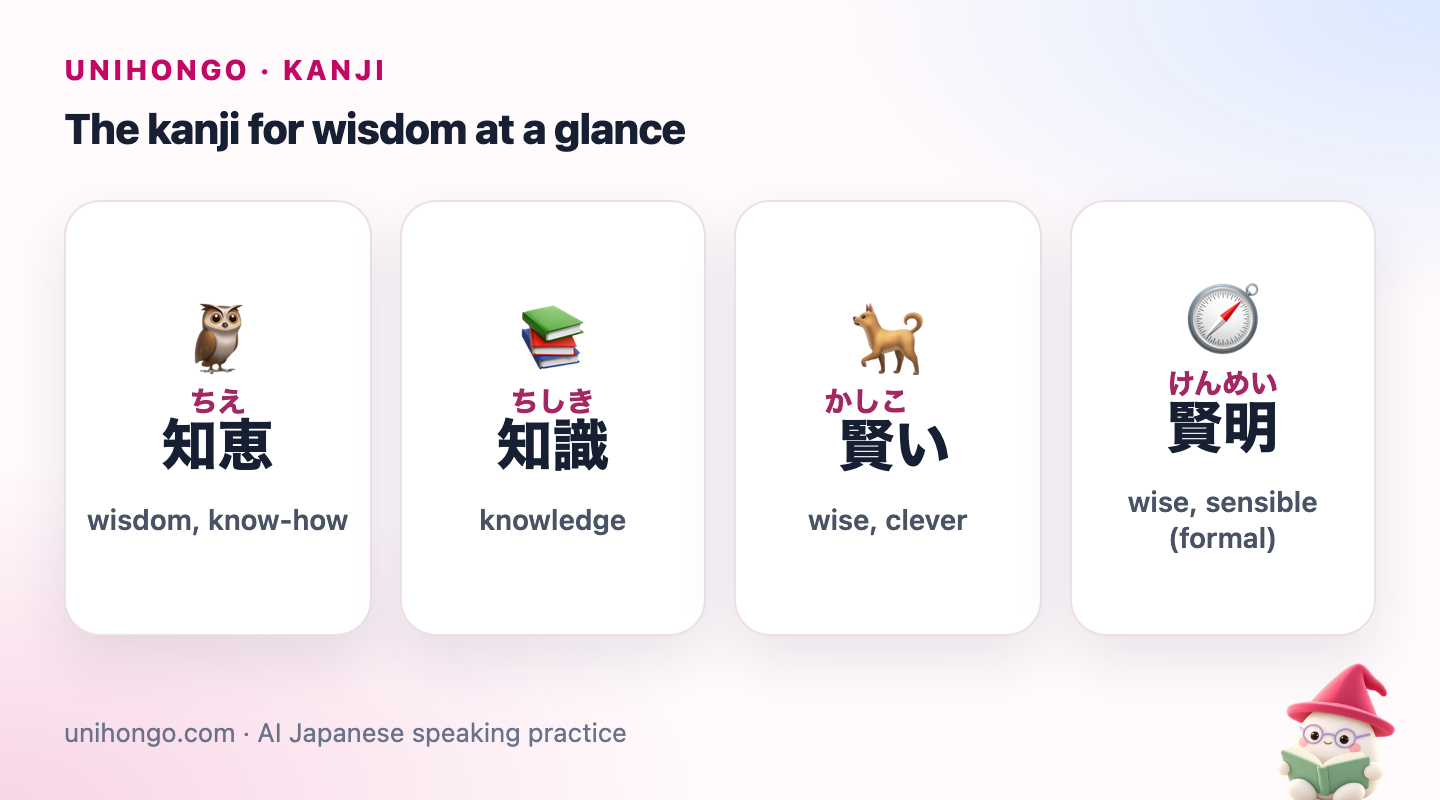
| Japanese | Romaji | Meaning |
|---|---|---|
| 知恵 | chie | wisdom, know-how |
| 知識 | chishiki | knowledge |
| 賢い | kashikoi | wise, clever |
| 賢明 | kenmei | wise, sensible (formal) |
Readings, strokes and parts
| Kanji | Strokes | On'yomi | Kun'yomi | Core meaning |
|---|---|---|---|---|
| 知 | 8 | chi | shiru, shiraseru | know, wisdom |
| 智 | 12 | chi | none in common use (name reading satoshi, tomo) | wisdom, intellect |
| 賢 | 16 | ken | kashikoi | wise, clever |
| 恵 | 10 | kei, e | megumu, megumi | blessing, favour |
知 has eight strokes: 矢 (ya, arrow) on the left and 口 (mouth) on the right. Some explain it as knowledge that flies as fast as an arrow from the mouth; it is a nice image, but treat it as a memory aid.
智 is 知 with 日 (sun, day) underneath, 12 strokes in all. It is not one of the 2,136 standard jōyō kanji used in everyday writing, but it is an official name kanji, which is why it is so common in personal names.
賢 has 16 strokes: 臣 and 又 on top, 貝 (shell, once used as money) below. In 知恵, the second kanji 恵 means blessing, as in the name Megumi, which gives 知恵 a warm feeling.
Everyday words with 知 and 賢
| Japanese | Romaji | Meaning |
|---|---|---|
| 知る | shiru | to know, to find out |
| お知らせ | oshirase | notice, announcement |
| 知り合い | shiriai | an acquaintance |
| 通知 | tsūchi | notification |
| 承知しました。 | Shōchi shimashita. | Understood, certainly. (business) |
| 知事 | chiji | prefectural governor |
| 生活の知恵 | seikatsu no chie | everyday know-how, a life hack |
| 知恵袋 | chiebukuro | a source of wisdom, a wise person |
| 知恵を絞る | chie o shiboru | to rack your brains |
| 知的 | chiteki | intellectual |
| 賢者 | kenja | a sage, a wise person |
| 英知 | eichi | great wisdom, intellect |
承知しました is one of the most useful business phrases in Japanese: it means understood, I will do it, and it is more polite than わかりました. 通知 is the notification on your phone. 生活の知恵 is a lovely everyday phrase for clever household tips, and おばあちゃんの知恵袋, grandma's bag of wisdom, is the classic way to describe them.
知る and わかる both translate as know, but they are not the same. 知る is to come to know a fact, so 知っています means I know it, while わかる is to understand. The negative is a classic trap: I don't know is 知りません, not 知っていません.
知恵, 知識, 賢い or 頭がいい: which wisdom is which
| Japanese | Romaji | Meaning |
|---|---|---|
| 知識はあるけど、知恵が足りない。 | Chishiki wa aru kedo, chie ga tarinai. | I have knowledge, but not enough wisdom. |
| みんなで知恵を出し合おう。 | Minna de chie o dashiaō. | Let's pool our ideas. (casual) |
| 賢い犬だね。 | Kashikoi inu da ne. | What a clever dog. (casual) |
| 彼は本当に頭がいい。 | Kare wa hontō ni atama ga ii. | He's really smart. |
| 賢明なご判断だと思います。 | Kenmei na go-handan da to omoimasu. | I think that's a wise decision. (polite) |
| Word | Meaning | Typical use | Register |
|---|---|---|---|
| 知恵 | Wisdom, practical know-how | Solving problems, life hacks, ideas | Everyday |
| 知識 | Knowledge, information | Studying, expertise, facts | Neutral |
| 賢い | Wise, clever, sensible | A good choice, a well-behaved child, a clever dog | Everyday |
| 頭がいい | Smart, intelligent | School results, quick thinking | Everyday, casual |
| 賢明 | Wise, prudent | A decision, a judgement | Formal |
When not to use them: 賢い said to an adult colleague can sound like praise for a child, so 頭がいいですね or さすがですね is safer. 賢明 belongs in formal talk; with friends, いい判断だね (good call) is natural. And 知恵 is never used for school knowledge; that is 知識 or 勉強.
A proverb, names and a look-alike
The most famous wisdom proverb is 三人寄れば文殊の知恵: when three ordinary people put their heads together, they have the wisdom of Monju, the Buddhist figure of wisdom. It is close to the English two heads are better than one.
Wisdom kanji are very popular in names. 智 is read tomo or satoshi, among other readings, and 賢 is read ken or masaru. As with all names, one name can be written many ways and one kanji can have many name readings.
| Japanese | Romaji | Meaning |
|---|---|---|
| 三人寄れば文殊の知恵 | sannin yoreba monju no chie | three heads are better than one |
| 智子 | Tomoko | wisdom · girl |
| 智 | Satoshi | wisdom · boy |
| 賢治 | Kenji | wise rule · boy |
The look-alike to watch is 賢 and 堅 (katai, firm, as in 堅実, steady). They share the same top, 臣 and 又; 賢 has 貝 below, 堅 has 土 (earth). And 知 and 智 are easy to mix up in names, so always check whether someone's name has 日 at the bottom.
Mini dialogue: three heads on a camping trip
Wisdom words come up when people solve a problem together. Here three friends are trying to pitch a tent as the wind picks up.

| Japanese | Romaji | Meaning |
|---|---|---|
| 風が強くて、テントが立たないね。 | Kaze ga tsuyokute, tento ga tatanai ne. | Friend: The wind is so strong, the tent won't stand up. |
| 石で端を押さえたらどう? | Ishi de hashi o osaetara dō? | You: How about holding the corners down with stones? |
| いい知恵だね! | Ii chie da ne! | Friend: Good idea! |
| 三人寄れば文殊の知恵だね。 | Sannin yoreba monju no chie da ne. | Other friend: Three heads really are better than one. |
Wisdom kanji as a tattoo or design
智 is the kanji people most often choose for wisdom in designs, and it is a good kanji, but in Japan it looks very much like a name: many Japanese readers will think of Satoshi or Tomo before they think of an abstract virtue. 知 alone looks like the verb to know, a little plain. 賢 alone reads as clever.
Japanese and Chinese also differ here. In Chinese, wisdom is commonly 智慧 and 智 is everyday; in Japanese, the everyday word is 知恵, and 智慧 has a Buddhist, literary flavour. So 知恵 is the natural Japanese choice, and 智慧 suits a design with a spiritual feeling. Decide which language you want, and ask a native speaker to check the characters before inking.
Sharpen your wisdom words with Mocchi
Type /kanji 智 in Mocchi to see its meaning, readings and common words, then ask: When do Japanese people say chie and when chishiki? Give me three examples of each. Mocchi explains, and if you mix up 賢い and 頭がいい later, it remembers and folds that pair into your next /quiz.
Then make a small deck with /create-flashcards, picking a photo per word, and stack them up in Kotoba Stack, building a tower word by word. It is a playful way to keep 知, 智 and 賢 apart.
Common mistakes and how to write 知
- Using 知恵 for school knowledge. That is 知識; 知恵 is practical wisdom.
- Calling an adult colleague 賢い. It can sound like praising a child; say 頭がいいですね or さすがですね.
- Writing 智 in everyday words. Outside names and literary uses, Japanese writes 知恵 and 知識 with 知.
- Confusing 賢 with 堅 (firm): check the bottom, 貝 or 土.