
One kanji, four jobs: gold, money, Friday and colour
If you learn 金 as gold only, you will be puzzled the first time you see it on a calendar or a receipt. It is better to learn it as one kanji with four everyday jobs from the start. These four words show them all, along with the two most important readings, kin and kane.
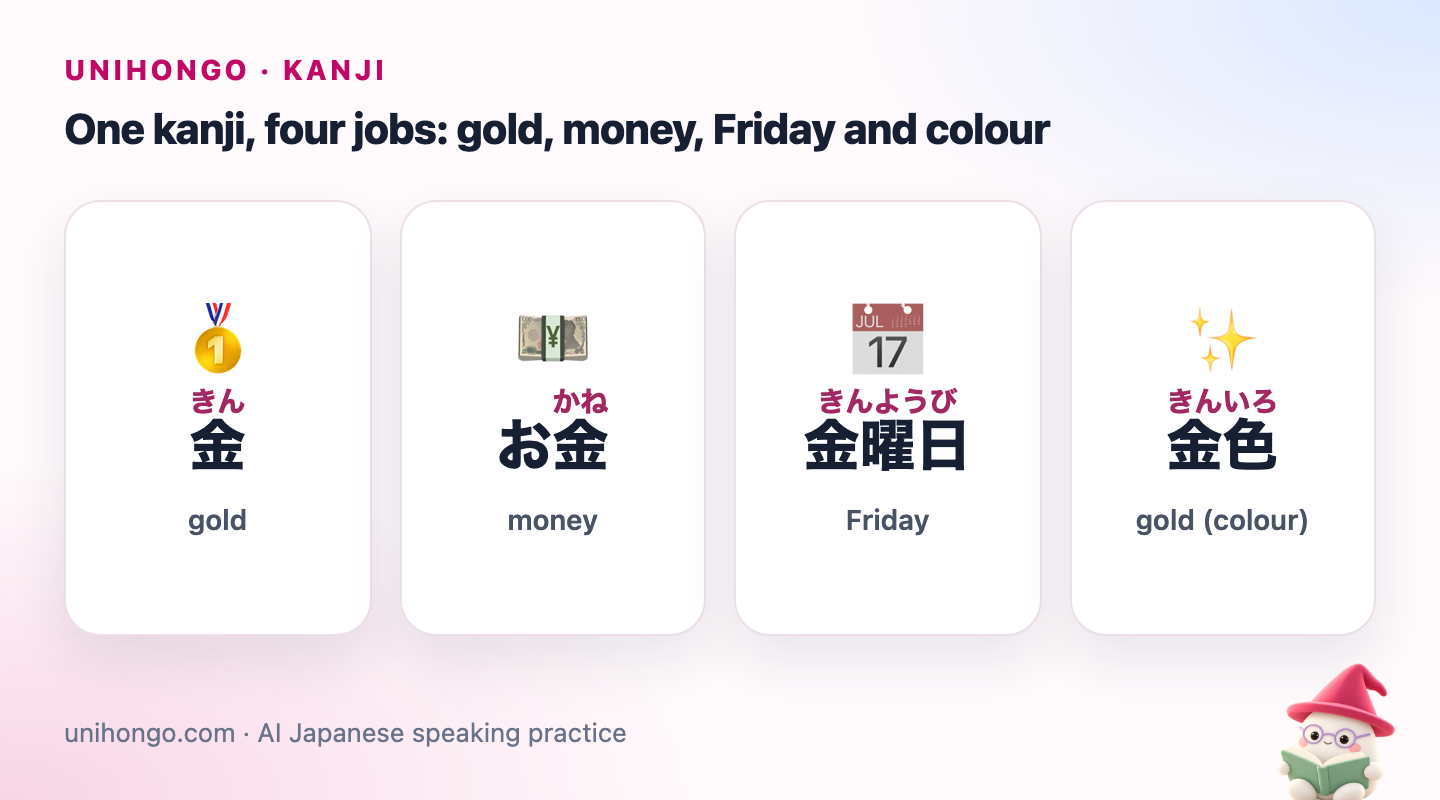
| Japanese | Romaji | Meaning |
|---|---|---|
| 金 | kin | gold |
| お金 | okane | money |
| 金曜日 | kin'yōbi | Friday |
| 金色 | kin'iro | gold (colour) |
Readings, strokes and the metal radical
金 has eight strokes. It starts with a roof-like pair of strokes, then 王-like horizontal lines with two small dots near the bottom, which are often described as nuggets of metal in the ground. That picture is a common memory aid rather than settled history, but it works well.
The readings are more varied than most beginner kanji. Kin is used for gold and in most compounds. Kane is the native word for money and metal, almost always with o in front when it means money. Kana appears in a few metal words, and kon in rare literary or Buddhist words.
| Japanese | Romaji | Meaning |
|---|---|---|
| 銀 | gin | silver |
| 鉄 | tetsu | iron |
| 鍵 | kagi | a key, a lock |
| 針 | hari | a needle |
| Reading type | Reading | When it is used | Example |
|---|---|---|---|
| on'yomi | kin | gold and most compounds | 金メダル, kin medaru; 料金, ryōkin, fee |
| on'yomi (rare) | kon | literary and Buddhist words | 金色, konjiki, golden (literary) |
| kun'yomi | kane | money and metal | お金, okane; 金持ち, kanemochi, rich |
| kun'yomi | kana | a few metal words | 金物, kanamono, hardware; 金づち, kanazuchi, hammer |
As a radical, 金 shrinks and moves to the left side, where it is called kanehen. It tells you a kanji has to do with metal, and the right side often hints at the sound or the specific meaning.
Fifteen money, metal and colour words
These words come up when you shop, pay bills, read prices and talk about colours. The money group is the most useful for daily life in Japan, where some small shops and restaurants still accept cash only.
| Japanese | Romaji | Meaning |
|---|---|---|
| 現金 | genkin | cash |
| 料金 | ryōkin | a fee, a charge |
| 税金 | zeikin | tax |
| 貯金 | chokin | savings |
| 借金 | shakkin | a debt |
| 金額 | kingaku | an amount of money |
| お金持ち | okanemochi | a rich person |
| 賞金 | shōkin | prize money |
| 金髪 | kinpatsu | blond hair |
| 金魚 | kingyo | a goldfish |
| 金属 | kinzoku | metal |
| 金箔 | kinpaku | gold leaf |
| 現金のみです。 | Genkin nomi desu. | Cash only. (shop notice style) |
| お金、足りる? | Okane, tariru? | Do you have enough money? (casual) |
| 貯金しなきゃ。 | Chokin shinakya. | I need to start saving. (casual) |
Kanazuchi, a hammer, has a fun second meaning: someone who cannot swim and sinks like a hammer. Watashi, kanazuchi nan da, I can't swim at all, is a friendly self-description. And kingyo, goldfish, are a summer festival classic, where children try to catch them with a fragile paper scoop.
Gold or money? Reading 金 in context
Because one kanji covers both ideas, Japanese relies on readings and context. The quickest rule: okane is always money, kin on its own is gold, and in compounds you need to know the word. Ryōkin is a fee, but kinpaku is gold leaf, even though both are read with kin.
| Japanese | Romaji | Meaning |
|---|---|---|
| 黄金 | ōgon | gold, golden (grand) |
| 金メダルを取った! | Kin medaru o totta! | They won a gold medal! |
| You see | Read | Means | Clue |
|---|---|---|---|
| お金 | okane | money | the polite o in front |
| 金 | kin | gold | standing alone, with metal or medal |
| 金曜 | kin'yō | Friday | on a calendar or timetable |
| 料金・現金 | ryōkin, genkin | fee, cash | on prices and receipts |
| 金色 | kin'iro | gold colour | describing how something looks |
One more is worth knowing: 黄金 (ōgon), golden, a slightly grand word for gold or a golden age. You will hear it in phrases like ōgon no aki, a glorious autumn, and in sports commentary. ゴールド (gōrudo) also exists as a loanword, mostly for colours of products and membership cards.
Gold-leaf ice cream in Kanazawa: a short dialogue
Kanazawa, whose name begins with 金, is famous for gold leaf, and visitors can try crafts that use it and even eat it. A soft-serve ice cream wrapped in a whole sheet of gold leaf has become a popular treat. Here two friends find one on a sightseeing walk; the speech is casual.

| Japanese | Romaji | Meaning |
|---|---|---|
| 見て、金箔のソフトクリーム! | Mite, kinpaku no sofuto kurīmu! | Friend: Look, gold-leaf soft serve! |
| 本物の金? | Honmono no kin? | You: Real gold? |
| そうだよ。金沢は金箔で有名なんだ。 | Sō da yo. Kanazawa wa kinpaku de yūmei nan da. | Friend: Yes. Kanazawa is famous for gold leaf. |
| 食べても大丈夫なの? | Tabete mo daijōbu na no? | You: Is it really OK to eat? |
| うん、味はしないけどね。 | Un, aji wa shinai kedo ne. | Friend: Yes, though it has no taste. |
| 金色でキラキラしてる! | Kin'iro de kirakira shiteru! | You: It's all golden and sparkly! |
| 写真撮ってから食べよう。 | Shashin totte kara tabeyō. | Friend: Let's take a photo, then eat. |
Sayings and phrases about gold and money
Several well-known sayings use 金, some imported from other languages and some home-grown. They show up in speeches, advice and everyday chat.
| Japanese | Romaji | Meaning |
|---|---|---|
| 時は金なり | toki wa kane nari | time is money |
| 沈黙は金 | chinmoku wa kin | silence is golden |
| 金の切れ目が縁の切れ目 | kane no kireme ga en no kireme | when money ends, so does friendship |
| 金字塔 | kinjitō | a monumental achievement |
| 花金 | hanakin | a fun Friday night (dated slang) |
Kane no kireme ga en no kireme warns that some relationships last only as long as the money does. Kinjitō, literally a tower shaped like the kanji 金, originally referred to a pyramid and now means a landmark achievement, often in sports or culture news. Hanakin, flower Friday, was popular slang for the start of the weekend and still raises a smile, although many younger people find it old-fashioned.
金 in tattoos, names and designs
Gold suggests value and shine, so it is tempting for tattoos, team names and logos. But 金 sends mixed messages to Japanese readers, so think it through first.
- A lone 金 is usually read as money. On skin it can look greedy or like a joke, and some people will think of Friday.
- 金 is a common family name in Korea, read Kim, and in China, read Jin. A reader from those countries may take it as a surname.
- For shining or precious, 黄金 (ōgon) or 金色 (kin'iro) say gold more clearly, and 輝き (kagayaki, radiance) avoids money altogether.
- In Japanese place and family names, 金 is common: Kanazawa, and surnames such as Kaneko and Kaneda, which use the reading kane.
- Ask a native speaker to check the characters and the style before getting inked, and make sure it is not the look-alike below.
Look-alikes and common mistakes
The kanji most often confused with 金 is 全 (zen, all, whole). Both have the same roof on top, but 全 has 王 underneath with no dots, while 金 has its two small dots and a longer body. 釜 (kama, a cooking pot) puts 金 under another shape and is seen on menus for rice cooked in an iron pot.
| Japanese | Romaji | Meaning |
|---|---|---|
| 全部 | zenbu | all, everything |
| 釜飯 | kamameshi | rice cooked in an iron pot |
- Saying kane for gold. Gold is kin; okane is money.
- Dropping the o in okane in polite speech. Kane alone sounds rough.
- Merging the n in kin'yōbi. Keep the n separate: kin-yō-bi.
- Reading 金持ち as kinmochi. It is kanemochi.
Sort kin, kane and kana in a Mocchi quiz
Readings are where 金 gets tricky, so make them the focus. Sign in and type /kanji 金 to see the meanings, readings and common words in one place. Then ask Mocchi for a quiz: Give me ten words with 金 and make me choose kin, kane or kana. Mocchi notes the readings you miss and folds them into your next /review, picking up where you left off.
When you want speed, turn the same words into flashcards with /create-flashcards and play Kotoba Tank with your own deck: you hear the word and fire at the right one, which trains your ear for kin'yōbi and genkin at natural pace.