
What the marks do
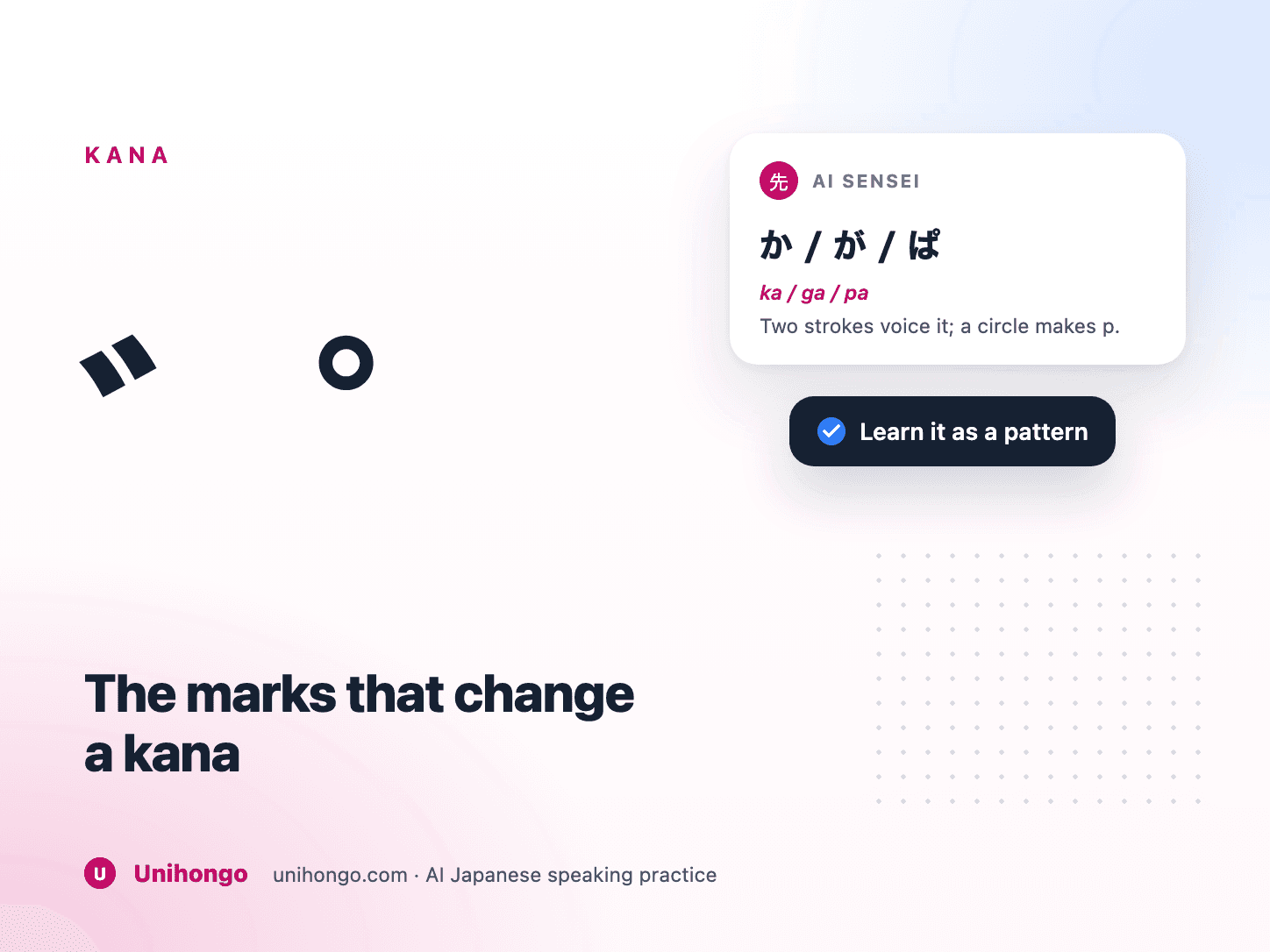
Japanese does not have separate characters for voiced and unvoiced consonants. Instead the same kana carries a small diacritic: two short strokes for voicing, and for one row only, a small circle.
Voicing is the difference between k and g, s and z, t and d, and h and b. It is produced by the vocal cords vibrating during the consonant, and in Japanese it distinguishes words, which is why the marks matter.
| Row | Plain | With two strokes | With a circle |
|---|---|---|---|
| k | か | が | — |
| s | さ | ざ | — |
| t | た | だ | — |
| h | は | ば | ぱ |
| Others | な, ま, や, ら, わ | — | — |
The h row is the only one taking both marks, which makes it the row to learn most carefully.
The h row, which does the most
The h row is unusual: with two strokes it becomes b, and with a circle it becomes p. That gives three versions of every character in the row, and they are all common.
Historically this row has moved around in the sound system, which is why the relationships look less obvious than in the other rows. For learning purposes the pattern simply has to be memorised, and it is short.
| Japanese | Romaji | Meaning |
|---|---|---|
| はな | hana | Flower |
| ばな | bana | Appears in compounds |
| ぱん | pan | Bread |
| へや | heya | Room |
| べや | beya | Appears in compounds |
| ぺん | pen | Pen |
Pairs that change meaning
Because voicing distinguishes words, missing a mark is a reading error rather than a small inaccuracy. These pairs are common enough that the confusion happens in real life.
They are also worth drilling aloud, since producing the voicing distinctly is what makes you understood.
| Japanese | Romaji | Meaning |
|---|---|---|
| かみ / がみ | kami / gami | Paper, and a compound form |
| こま / ごま | koma / goma | Spinning top / sesame |
| たい / だい | tai / dai | Sea bream / large |
| ひと / びと | hito / bito | Person, and a compound form |
| さる / ざる | saru / zaru | Monkey / a bamboo strainer |
| てん / でん | ten / den | Point / electricity in compounds |
Several of these pairs exist because a word takes a voiced form when it becomes the second half of a compound, which is a regular pattern worth noticing.
Voicing in compounds
Japanese frequently voices the first consonant of the second element in a compound word. This is why the same word appears with and without a mark depending on where it sits.
The pattern is not fully predictable, so it is learned word by word, but recognising that it is happening removes a lot of confusion when a familiar word suddenly looks different.
| Japanese | Romaji | Meaning |
|---|---|---|
| ひと + はな | hito + hana | The parts, unvoiced |
| はなび | hanabi | Fireworks: the second element voices |
| て + かみ | te + kami | The parts |
| てがみ | tegami | Letter: the second element voices |
| ほん + はこ | hon + hako | The parts |
| ほんばこ | honbako | Bookcase: the second element voices |
The two kana that overlap
Two of the voiced kana are pronounced identically to two others in modern standard Japanese, which is a spelling matter rather than a pronunciation one.
The rule for a learner is simple: use the spelling the word takes, and do not try to hear a difference that most speakers do not make.
- The voiced forms of the shi and chi characters sound the same in modern standard Japanese.
- The voiced forms of the su and tsu characters sound the same.
- Which spelling a word uses is fixed and is learned with the word.
- The rarer spellings appear mainly in compounds and in a few common words.
Learning it as a pattern
The whole system is a pattern rather than a list, which means it takes about an hour rather than a week. Four rows take the strokes, one row also takes the circle, and the rest take nothing.
The part that needs longer is production. Voicing is a contrast Japanese uses to distinguish words, and producing it clearly is what makes you understood; the pronunciation lab scores individual lines, so a voicing that is not landing shows up as a number rather than as a vague doubt.
For recognition speed, the kana games on Unihongo's alphabet page include the marked characters, which is worth doing because they are often taught late and drilled less than the plain kana.
Learn the marks with the plain kana rather than afterwards. Treating them as an advanced topic is what leaves them under-practised.