
The kanji for honour at a glance
The four cards below cover the main ways Japanese talks about honour. 名誉 is the word with 誉. 誇り is pride, the feeling inside. 光栄 is the honour of the moment, and 義 is the moral side, doing what is right.
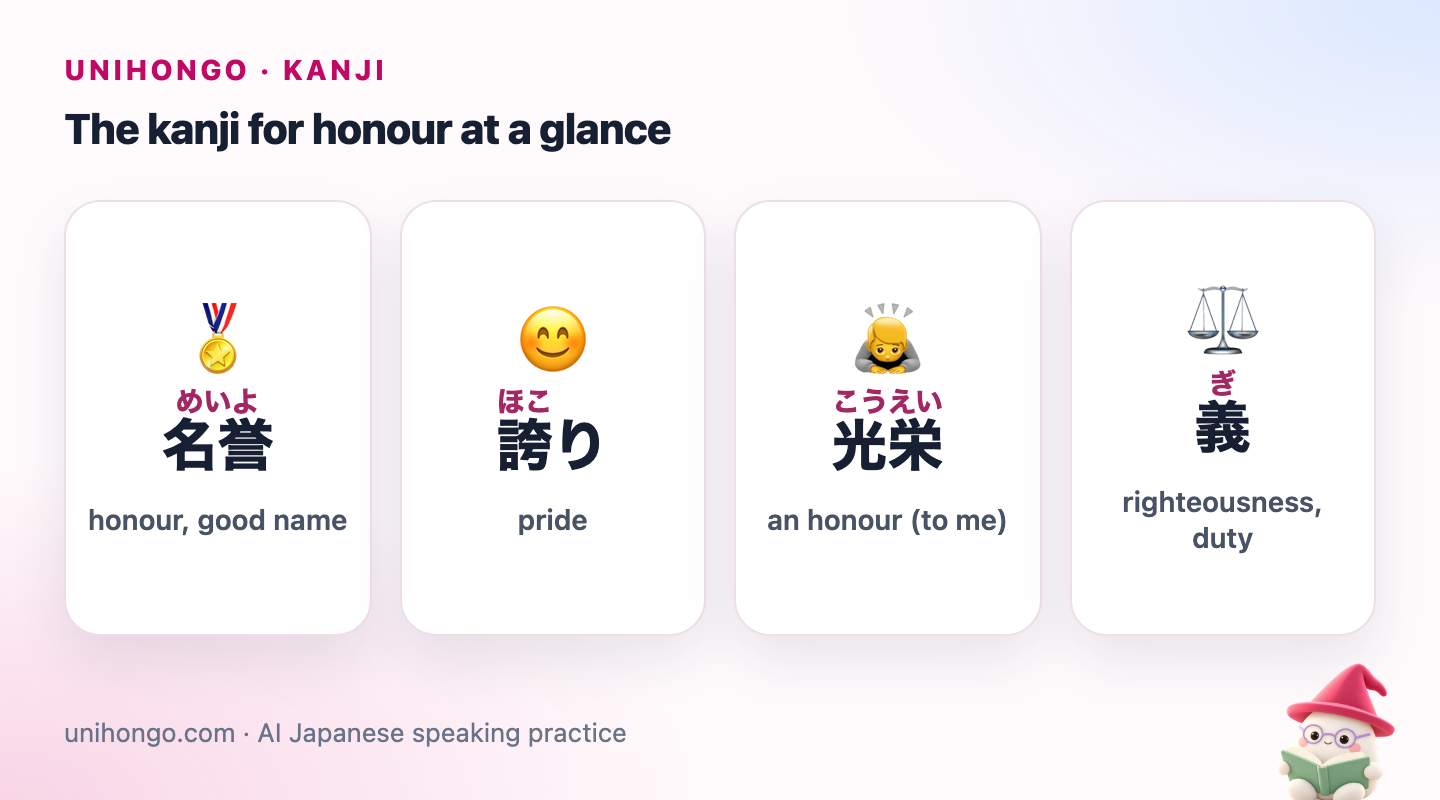
| Japanese | Romaji | Meaning |
|---|---|---|
| 名誉 | meiyo | honour, good name |
| 誇り | hokori | pride |
| 光栄 | kōei | an honour (to me) |
| 義 | gi | righteousness, duty |
Readings, strokes and parts
| Kanji | Strokes | On'yomi | Kun'yomi | Core meaning |
|---|---|---|---|---|
| 誉 | 13 | yo | homare, homeru | honour, praise, glory |
| 誇 | 13 | ko | hokoru | be proud, boast |
| 義 | 13 | gi | none in common use | righteousness, duty, in-law |
| 栄 | 9 | ei | sakaeru, haeru | glory, prosper, shine |
誉 has 13 strokes, with 言 (speech, words) at the bottom, which fits a kanji about praise. It is the simplified Japanese form of the older 譽, which you may still see in some names and old texts.
誇 also has 言, this time on the left. 義 is made of 羊 (sheep) on top and 我 (self) below. You will find stories about the parts online, but the shapes alone are enough to remember it: 羊 over 我.
名誉 combines 名 (name) and 誉 (honour), so it is literally an honoured name. That is why it pairs naturally with verbs of keeping and losing: 名誉を守る (to protect your honour) and 名誉を傷つける (to damage someone's reputation). The legal term for defamation, which you will meet in news stories, is built on the same word.
Everyday words with 誉, 誇 and 義
| Japanese | Romaji | Meaning |
|---|---|---|
| 名誉ある賞 | meiyo aru shō | an honourable award |
| 名誉教授 | meiyo kyōju | professor emeritus |
| 栄誉 | eiyo | glory, honour |
| 誉れ | homare | honour, glory (literary) |
| 誇りに思う | hokori ni omou | to be proud of |
| 誇らしい | hokorashii | proud, filled with pride |
| 誇る | hokoru | to take pride in, to boast of |
| 自慢 | jiman | showing off, being proud of |
| 正義 | seigi | justice |
| 義理 | giri | social obligation, duty |
| 義務 | gimu | duty, obligation |
| 面目 | menboku | face, honour |
名誉教授 shows the official side of 名誉: it also means honorary, as in an honorary title. 面目 is honour as face: 面目ない (menbokunai) means I'm ashamed, I've lost face, and it is a humble apology among adults. 義理 appears in 義理チョコ, the obligation chocolates some people give coworkers on Valentine's Day, though the custom is fading in many workplaces.
Honour vs pride: 名誉, 誇り, プライド and 自慢
| Japanese | Romaji | Meaning |
|---|---|---|
| この仕事に誇りを持っています。 | Kono shigoto ni hokori o motte imasu. | I take pride in this work. |
| 彼はプライドが高い。 | Kare wa puraido ga takai. | He's very proud; he hates asking for help. |
| これは母の自慢の料理です。 | Kore wa haha no jiman no ryōri desu. | This is my mother's pride-and-joy dish. |
| 名誉ある賞をいただきました。 | Meiyo aru shō o itadakimashita. | I received an honourable award. (humble) |
| Word | Meaning | Positive or negative | Example idea |
|---|---|---|---|
| 名誉 | Honour, reputation given by others | Positive, official | An award, a good name, honorary |
| 誇り | Pride in something good | Positive | Proud of your work, family, town |
| プライド | Self-respect, ego | Often slightly negative | Too proud to ask for help |
| 自慢 | Showing off, being proud of | Neutral to negative | Showing off a new car; a family's pride and joy |
When not to use them: do not say 私は誇りです for I am proud; say 誇りに思います or うれしいです. Avoid プライド when you mean a positive pride in your work, because it often sounds like ego. And 自慢 about yourself can sound like bragging, so Japanese speakers often soften it with humour, as in ちょっと自慢させて, let me brag a little.
Polite phrases for honour and praise
Most of the time, you need honour words to accept praise or thank someone graciously. Japanese politeness tends to pair pride with modesty, so the replies to praise matter as much as the praise itself.
| Japanese | Romaji | Meaning |
|---|---|---|
| お会いできて光栄です。 | Oai dekite kōei desu. | It's an honour to meet you. (formal) |
| 光栄です。ありがとうございます。 | Kōei desu. Arigatō gozaimasu. | I'm honoured. Thank you. |
| いえいえ、まだまだです。 | Ie ie, mada mada desu. | Oh no, I still have a long way to go. (modest reply) |
| 皆さんのおかげです。 | Minasan no okage desu. | It's all thanks to everyone. |
Notice the pattern: accept briefly, then hand the credit to others. Many Japanese speakers feel uncomfortable simply accepting a compliment about their skill, so they add まだまだです or 皆さんのおかげです. You do not have to copy this every time, and among friends a smile and うれしい! is fine, but in formal speech or at work the modest add-on sounds gracious rather than weak.
Mini dialogue: an award at work
Honour words appear at ceremonies, speeches and office celebrations. Here a coworker congratulates you after your team receives an award.

| Japanese | Romaji | Meaning |
|---|---|---|
| 受賞おめでとうございます! | Jushō omedetō gozaimasu! | Coworker: Congratulations on the award! |
| ありがとうございます。とても光栄です。 | Arigatō gozaimasu. Totemo kōei desu. | You: Thank you. I'm truly honoured. |
| チームの誇りですね。 | Chīmu no hokori desu ne. | Coworker: You're the pride of the team. |
| いえ、皆さんのおかげです。 | Ie, minasan no okage desu. | You: No, it's thanks to all of you. |
Honour kanji as a tattoo or design
Honour is one of the virtues often listed in samurai-themed designs, usually as 名誉, and sometimes 義 is chosen as the moral heart of the code. To Japanese eyes, 名誉 reads as honour or reputation, and because of words like 名誉教授 it can also feel official, like an honorary title. 誉 alone is rare outside names and literary words.
Think about what you mean. Pride in who you are is 誇り. Doing what is right is 義. Honour as a good name is 名誉. In Chinese, the everyday word for honour is 荣誉, written in Japan as 栄誉, so check which form a design uses. Ask a native speaker to check the characters before inking.
義 deserves a closer look, because it is the kanji many people choose for a code of honour. In modern Japanese it appears mostly inside words: 正義 (justice), 義務 (duty), 義理 (obligation), and even 義母 (mother-in-law), where it means related by law. On its own it reads as righteousness, a strong statement, and some readers may also think of 義理 and its sense of social duty.
Rehearse modest replies to praise with Mocchi and Sakura-sensei
Start in Mocchi with: Check these sentences about things I'm proud of, and tell me if hokori, jiman or puraido fits better. Type three of your own after /correct. Mocchi corrects them, explains the nuance and remembers if プライド keeps slipping in where 誇り belongs.
Then say the lines aloud. In AI Sensei, choose Sakura-sensei and ask her to play an interviewer who asks what you are proud of. Answering with 誇りに思います, then softening it with a modest phrase, is exactly the balance a Japanese interview rewards.
Common mistakes and how to write 誉
- Saying 私は誇りです for I'm proud. Say 誇りに思います or うれしいです.
- Using 名誉 for personal pride. 名誉 is honour given by others; pride inside is 誇り.
- Using 光栄 among close friends, where it sounds stiff.
- Confusing 誉 with 挙 (to raise, as in 選挙, election). They share the top; 誉 has 言 at the bottom, 挙 has 手.