
雷 at a glance: thunder, rumble, storm and flash
The kanji 雷 is the single word Japanese uses for thunder and lightning together, as in English thunderstorm. Around it sit a handful of words you will hear every summer: the verb phrase for thunder rumbling, the word for a thunderstorm on the forecast and the poetic word for a lightning flash.
Notice the verbs. Thunder 鳴る (rings or rumbles), lightning 落ちる (falls) when it strikes and 光る (shines) when it flashes. Those three verbs are all you need to describe nearly any storm.
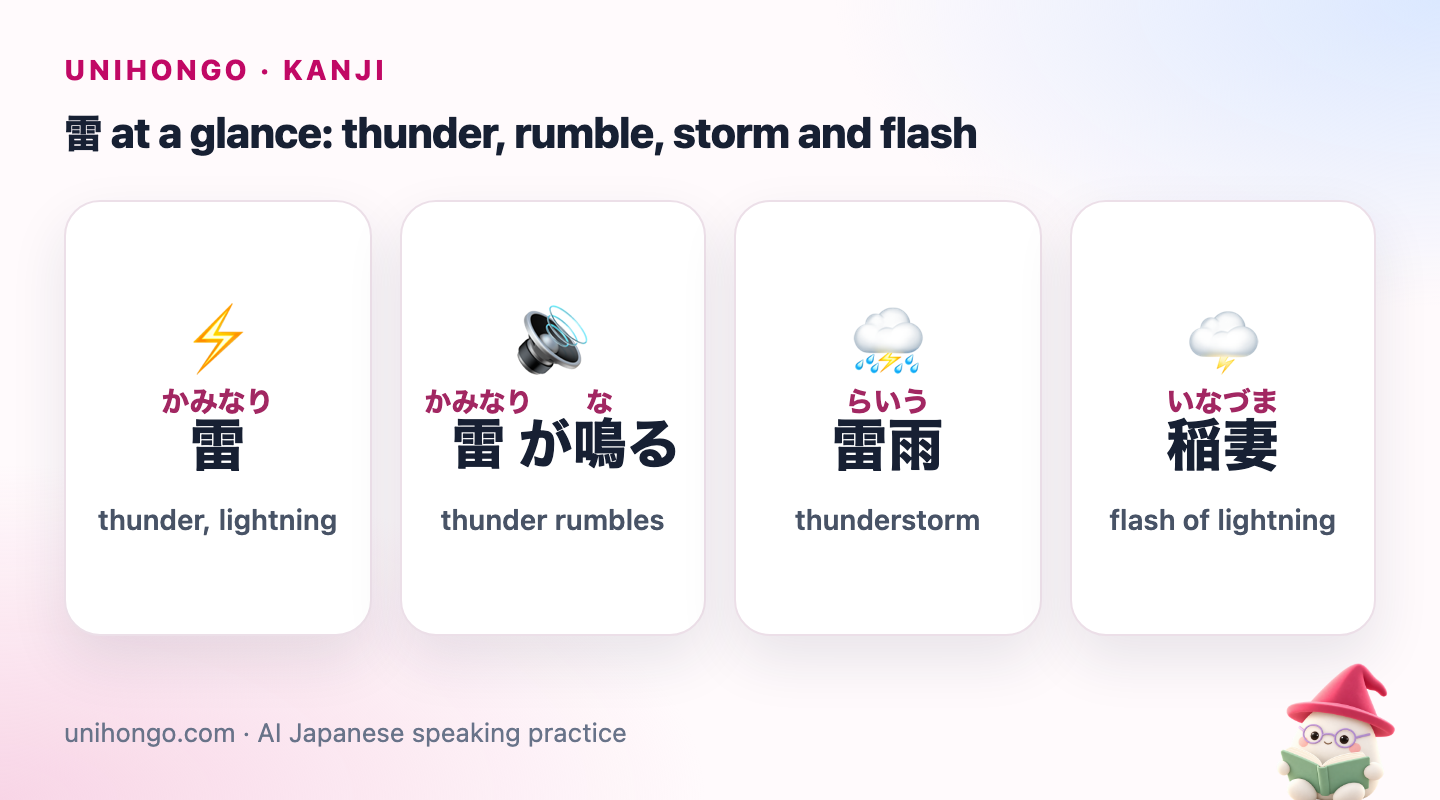
| Japanese | Romaji | Meaning |
|---|---|---|
| 雷 | kaminari | thunder, lightning |
| 雷が鳴る | kaminari ga naru | thunder rumbles |
| 雷雨 | raiu | thunderstorm |
| 稲妻 | inazuma | flash of lightning |
Readings, strokes and the parts of 雷
| Kanji | Strokes | On'yomi | Kun'yomi | Core meaning |
|---|---|---|---|---|
| 雷 | 13 | rai | kaminari, ikazuchi | thunder, lightning |
雷 has 13 strokes: eight for the rain radical 雨 on top and five for 田 below. The top is easy to explain: the rain radical sits on many weather kanji, such as 雪 (snow), 雲 (cloud), 電 (electricity, originally lightning) and 霧 (fog). The bottom looks like 田, rice field, but in older forms of the character it was a cluster of circles, usually explained as the rolling of thunder. For memory, rain plus field works perfectly well: a storm over the rice fields.
Kaminari is the everyday reading. Ikazuchi is an older, literary word for thunder that you will meet in poetry, place names and fiction rather than conversation. Rai is the reading inside compounds.
The word kaminari is generally explained as 神鳴り, the sounding of the gods. That fits Japanese folklore, where thunder has long been tied to a god called 雷様 (kaminari-sama) or 雷神 (raijin), often drawn with a ring of drums on his back.
Weather words with 雷 and the lightning family
These are the words on forecasts, phone alerts and in conversation. The reading rai appears in the more formal words; native words such as 稲妻 feel softer and more vivid.
| Japanese | Romaji | Meaning |
|---|---|---|
| 落雷 | rakurai | a lightning strike |
| 雷鳴 | raimei | a roll of thunder |
| 雷雲 | raiun | thundercloud |
| 雷注意報 | kaminari chūihō | thunderstorm advisory |
| 稲光 | inabikari | lightning flash, glow |
| 夕立 | yūdachi | sudden summer evening shower |
| 避雷針 | hiraishin | lightning rod |
| ゴロゴロ | goro goro | rumbling sound of thunder |
| ピカッ | pika | a sudden flash |
| 雷を伴った激しい雨 | kaminari o tomonatta hageshii ame | heavy rain with thunder (forecast) |
稲妻 and 稲光 both contain 稲, rice plant. The connection is traditionally explained by an old belief that lightning helped the rice ripen, since storms come in the growing season. Treat that as folklore, but it is a lovely way to remember the words.
雷注意報 is issued by the Japan Meteorological Agency when thunderstorms are expected, and the last phrase in the list is typical forecast language: you will hear it on the news on unstable summer afternoons.
Idioms, sayings and places with 雷
Thunder appears in some of the most colourful Japanese expressions. The most common one has nothing to do with weather: when someone's thunder falls on you, you are being scolded.
| Japanese | Romaji | Meaning |
|---|---|---|
| 父の雷が落ちた。 | Chichi no kaminari ga ochita. | My father blew up at me. |
| 地震雷火事親父 | jishin kaminari kaji oyaji | earthquake, thunder, fire, father |
| 地雷を踏む | jirai o fumu | to touch a sore subject |
| 付和雷同 | fuwa raidō | blindly following the crowd |
| 風神雷神 | fūjin raijin | the wind god and the thunder god |
| 雷門 | Kaminarimon | Thunder Gate, at Sensōji in Asakusa |
地震雷火事親父 is an old saying that lists the four most frightening things: earthquakes, thunder, fire and fathers. People quote it with a smile today, often to joke that fathers are no longer scary. 地雷 means a landmine, and 地雷を踏む, to step on a landmine, is used for accidentally raising a topic that upsets someone.
Many children in Japan hear that 雷様 will take their belly button if they leave their tummy uncovered during a storm, a folk tale that keeps them dressed and indoors. You may hear parents say おへそを隠して, hide your belly button, when thunder starts.
雷 is uncommon in given names. You will see it more in place names, temple gates, festival floats, sweets such as 雷おこし (kaminari okoshi, a crunchy puffed-rice snack sold in Asakusa) and fiction.
Mini dialogue: caught in a summer storm
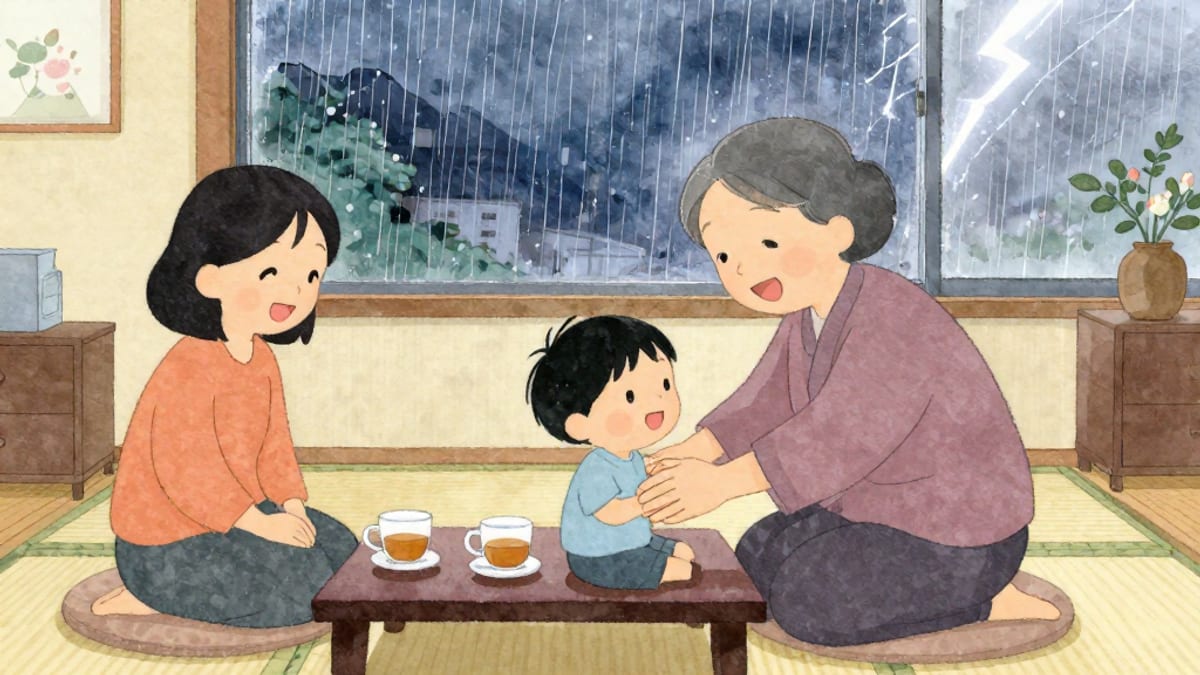
A sudden storm is one of the most natural small-talk moments in Japan. Here two friends are walking home when the sky turns dark. The speech is casual.
| Japanese | Romaji | Meaning |
|---|---|---|
| あ、今ゴロゴロって聞こえた? | A, ima goro goro tte kikoeta? | Friend: Did you just hear a rumble? |
| うん、雷だね。空も真っ暗。 | Un, kaminari da ne. Sora mo makkura. | You: Yeah, it's thunder. The sky's pitch-black too. |
| うわ、光った!近いかも。 | Uwa, hikatta! Chikai kamo. | Friend: Whoa, a flash! It might be close. |
| ちょっとあのお店で雨宿りしよう。 | Chotto ano omise de amayadori shiyō. | You: Let's shelter in that shop for a bit. |
| そうしよう。夕立ならすぐやむよね。 | Sō shiyō. Yūdachi nara sugu yamu yo ne. | Friend: Good idea. If it's a summer shower it'll stop soon. |
雨宿り (amayadori) means sheltering from the rain, and it is the word you need for this moment. In polite company, turn the suggestion into 少し雨宿りしませんか, shall we wait out the rain for a while?
雷 as a tattoo or design
雷 is a strong choice visually: it is compact, symmetrical and immediately readable. Unlike many kanji, it is written the same way in Japanese and in Chinese, so you avoid the problem of a design copied from a Chinese source in a different form. Japanese readers will simply see thunder, perhaps with a hint of the thunder god or of a short temper.
A single kanji can feel like one word lifted from a sentence, so some people choose a fuller expression. 風神雷神 suggests the famous pair of gods and balance between wind and thunder; 稲妻 (lightning) has a fast, elegant feel. Avoid 地雷 unless you mean it: as slang it can describe a person or topic to stay away from.
Before you ink or print anything, ask a native speaker to check the exact characters, the stroke shapes and the font. Many designs online have small stroke errors that a Japanese reader would notice at once.
| Japanese | Romaji | Meaning |
|---|---|---|
| 雷神 | raijin | the thunder god |
| 雷のように速い | kaminari no yō ni hayai | fast as lightning |
A storm-report routine with Mocchi
- Paste a real forecast sentence into Mocchi with /explain, for example 大気の状態が不安定で、雷を伴った激しい雨が降るおそれがあります. Mocchi splits it into pieces, names each particle and pattern and gives you the meaning.
- Ask /kanji 電 straight after /kanji 雷 so you see the two side by side. Mocchi remembers if you mixed them up and slips the pair into a later /quiz.
- Turn the storm words into a deck with /create-flashcards, picking a photo for each: a lightning rod for 避雷針, an evening shower for 夕立.
- Play that deck in Mocchi Flight, guiding Mocchi through the gate with the right word, until rakurai and raimei stop sounding alike.
Common mistakes and how to write 雷
- Writing 電 when you mean 雷. 電 (den) is electricity, as in 電気 and 電車; its bottom part is a field with a tail that curls up. 雷 has a plain, closed 田.
- Saying 雷が降る. Rain falls (降る), but lightning strikes with 落ちる and thunder sounds with 鳴る.
- Using 雷 to mean electricity or power. For a power cut, say 停電 (teiden); 雷 is only the weather.
- Reading 雷 as rai on its own. Alone it is kaminari; rai belongs to compounds.