
心 at a glance
心 is a basic kanji taught in the second year of elementary school, and its shape is one of the few that still looks a little like what it came from. Ancient forms of the character are usually explained as a drawing of the heart, and today it covers everything people associate with the heart: feeling, mind, intention, sincerity and the centre of things.
The four cards below show the kanji and the three distinctions learners need first.
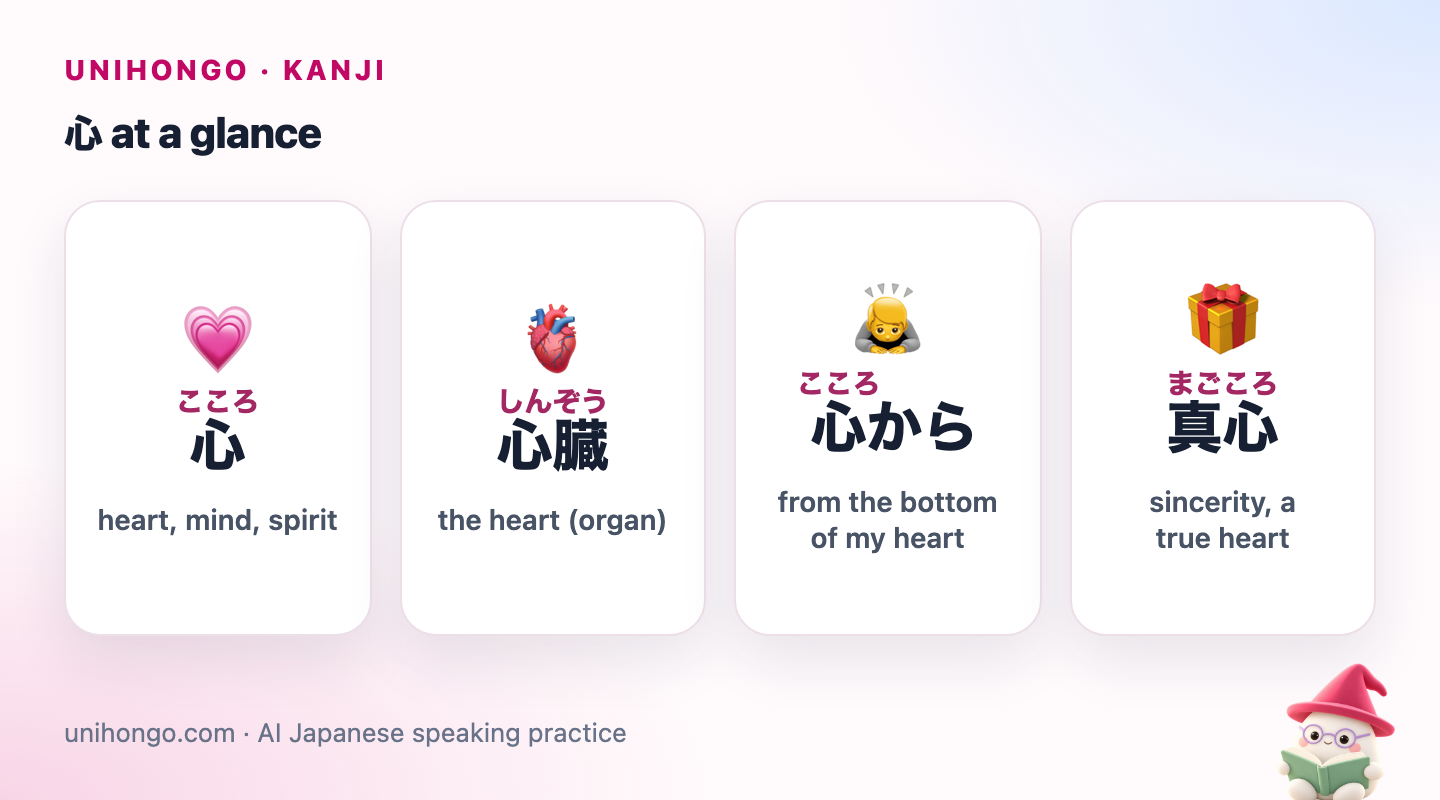
| Japanese | Romaji | Meaning |
|---|---|---|
| 心 | kokoro | heart, mind, spirit |
| 心臓 | shinzō | the heart (organ) |
| 心から | kokoro kara | from the bottom of my heart |
| 真心 | magokoro | sincerity, a true heart |
If you remember one thing, make it the difference between 心 and 心臓. In English, you can say my heart is beating fast and my heart is broken with the same word. In Japanese the first is about 心臓 and the second about 心. When your heart pounds with nerves before a speech, Japanese often uses yet another word, 胸 (mune, chest): 胸がドキドキする, my heart is pounding. So the physical feeling in your chest, the organ and the emotional heart can be three different words.
Readings, strokes and three shapes
心 has a native reading, kokoro, used when it stands alone and in a few native compounds, and a Chinese reading, shin, used in most two-kanji words.
| Item | Detail | Example |
|---|---|---|
| Kun'yomi (native reading) | kokoro | 心 (kokoro), 心強い (kokorozuyoi) |
| On'yomi (Chinese reading) | shin | 安心 (anshin), 中心 (chūshin) |
| Stroke count | 4 | Dot, hook, dot, dot |
| At the bottom of a kanji | 心 | 思 (think), 感 (feel), 意 (mind), 忘 (forget) |
| On the left of a kanji | 忄 (risshinben) | 情 (emotion), 性 (nature), 快 (pleasant) |
| Squeezed at the bottom | 㣺 (shitagokoro) | 慕 (yearn), 恭 (respectful) |
Spotting 心 or 忄 in an unknown kanji is a great reading strategy: it tells you the character probably has something to do with feeling or thinking. 怒 (anger), 悲 (sadness), 恋 (romantic love) and 愛 (love) all contain a heart. The rule is not perfect, since the meanings of some kanji have drifted over the centuries, but it is right often enough to help you guess when you meet a new character in a novel or on the news.
In a few words 心 has a special reading. 心地 is read kokochi, a feeling or comfort, as in 居心地がいい (igokochi ga ii, comfortable to be in), and 心太 is read tokoroten, a jelly noodle. You learn these one by one.
Everyday words with 心
These words are common in daily conversation, at work and in the news. Several of them are among the first adjectives and nouns learners need.
| Japanese | Romaji | Meaning |
|---|---|---|
| 心配しないで。 | Shinpai shinaide. | Don't worry. (casual) |
| それを聞いて安心しました。 | Sore o kiite anshin shimashita. | I'm relieved to hear that. (polite) |
Two of these share the reading kanshin: 関心 (interest, as in politics is not my interest) and 感心 (being impressed). In speech the context tells them apart; in writing the kanji do.
心配 and 安心 are a pair worth learning together. 心配しないで (don't worry) and 安心して (rest assured) both comfort someone, but the second sounds warmer and more positive.
Speaking from the heart: 心から, 真心 and 心をこめて
Japanese has several fixed expressions for sincerity. They appear in thank-you letters, speeches, shop slogans and heartfelt apologies, and using one at the right moment makes your Japanese sound mature.
| Japanese | Romaji | Meaning |
|---|---|---|
| 心から感謝しています。 | Kokoro kara kansha shite imasu. | I'm grateful from the bottom of my heart. |
| 心をこめて作りました。 | Kokoro o komete tsukurimashita. | I made it with all my heart. |
| 心のこもった手紙 | kokoro no komotta tegami | a heartfelt letter |
| 真心をこめて | magokoro o komete | with sincere care |
| 心が痛む | kokoro ga itamu | it hurts my heart, I feel for them |
| 心を開く | kokoro o hiraku | to open up to someone |
心をこめて, with heart, is common in Japanese service culture: a bento shop or a hotel may say its food or welcome is prepared 心をこめて. It sounds natural there, but in a casual chat with friends it can feel a little formal; 一生懸命作ったよ (I worked hard on it) is lighter.
Be careful with 心が痛む. It expresses sympathy for someone else's pain, as with sad news. It does not describe chest pain; for that, a doctor needs 胸が痛いです (mune ga itai desu). Similarly, 心を開く, to open your heart, is about trust: a shy student slowly opens up to a teacher. It is a nice phrase for describing friendships that grew over time.
Mini dialogue: thanking someone for a thoughtful gift
Imagine an elderly neighbour has knitted you a scarf. A simple thank-you is fine, but this is the moment for 心のこもった.

| Japanese | Romaji | Meaning |
|---|---|---|
| これ、よかったら使ってね。 | Kore, yokattara tsukatte ne. | Neighbour: Here, use this if you like. |
| えっ、手編みですか。 | E, teami desu ka. | Marco: Oh, is it hand-knitted? |
| 下手だけどね。 | Heta da kedo ne. | Neighbour: It's not very good, mind you. |
| 心のこもったプレゼント、本当にありがとうございます。 | Kokoro no komotta purezento, hontō ni arigatō gozaimasu. | Marco: Thank you so much for such a heartfelt gift. |
| 大切に使います。 | Taisetsu ni tsukaimasu. | Marco: I'll take good care of it. |
Look-alike kanji, writing tips and common mistakes
The most famous trap is 必 (hitsu, must, as in 必要, hitsuyō, necessary). It is 心 with an extra slanted stroke cutting through it. In handwriting, a careless 心 can look like 必, and vice versa.
How to write 心: the stroke order is left dot, then the long curved hook along the bottom, then the top dot, then the right dot. Japanese teachers stress balance: the three dots should not line up evenly, and the hook should be wide and shallow. Because the strokes do not touch, 心 is harder to write beautifully than it looks.
| Japanese | Romaji | Meaning |
|---|---|---|
| 心 | shin | heart (four strokes) |
| 必 | hitsu | must, necessarily (five strokes) |
- Saying 心が痛い at a clinic. A doctor needs 胸が痛い, my chest hurts.
- Writing 心臓 when you mean feelings. 心臓が冷たい is a medical oddity; a cold-hearted person is 心が冷たい.
- Reading 熱心 as netsushin. The t sound doubles: nesshin.
- Overusing 心をこめて in casual chat. Keep it for letters, speeches and gifts.
心 as a tattoo or design
心 is a real, positive and immediately readable kanji, and its meaning, heart and mind, is broad enough that it rarely sounds strange. Its challenge is visual: four separate strokes with lots of empty space between them. In a cheap font or a hand-copied design, the dots can drift and the character starts to look clumsy or even like 必. A version based on careful brush calligraphy or a well-designed font helps a lot.
As always, a word often says more than a single kanji. 真心 (sincerity), 初心 (shoshin, the beginner's mind, from the saying 初心忘るべからず, never forget your beginner's spirit) and 平常心 (heijōshin, calm, composure) are popular because they carry a clear idea. 心 is used the same way in Chinese and Japanese, but compounds can differ in nuance between the languages.
Before inking, ask a native speaker to check the characters, the reading and the design, and give the artist a clean, checked image.
| Japanese | Romaji | Meaning |
|---|---|---|
| 初心 | shoshin | the beginner's mind |
| 平常心 | heijōshin | composure, a calm mind |
A short Mocchi routine for 心 words
- Type /kanji 心 to Mocchi, Unihongo's study assistant, and ask which everyday words to learn first. Mocchi gives readings, meanings and examples.
- Ask Mocchi to quiz you on shin and kokoro words. It keeps track of the ones you miss, such as nesshin or igokochi, and brings them back in your next review.
- Write a thank-you message using 心から or 心のこもった and send it with /correct. Mocchi explains each correction and the politeness level.
- Open Sentence Builder in the games and rebuild lines like 心をこめて作りました from shuffled chunks, so the word order sticks.