
What bungo actually is
Bungo, written 文語, means the literary language, and it is contrasted with kōgo, 口語, the colloquial language. For a very long stretch of Japanese history, people spoke one way and wrote another. Writers kept a grammar that had been standardised by court literature, so a document written centuries after that grammar left ordinary speech still used its endings. That gap is why classical Japanese feels foreign to a modern reader even though almost every word inside it is recognisable.
The written and spoken styles were deliberately brought together during the modernisation of Japanese prose, and modern novels, newspapers and laws now use the colloquial style. Older statutes, pre-war official documents and formal writing kept the classical style much longer, which is why a reader still meets it. Nothing about bungo is archaic in the sense of unusable: Japanese speakers read it in school, quote it in speeches, and use its endings in advertising when they want a line to sound weighty.
Where you meet classical Japanese today
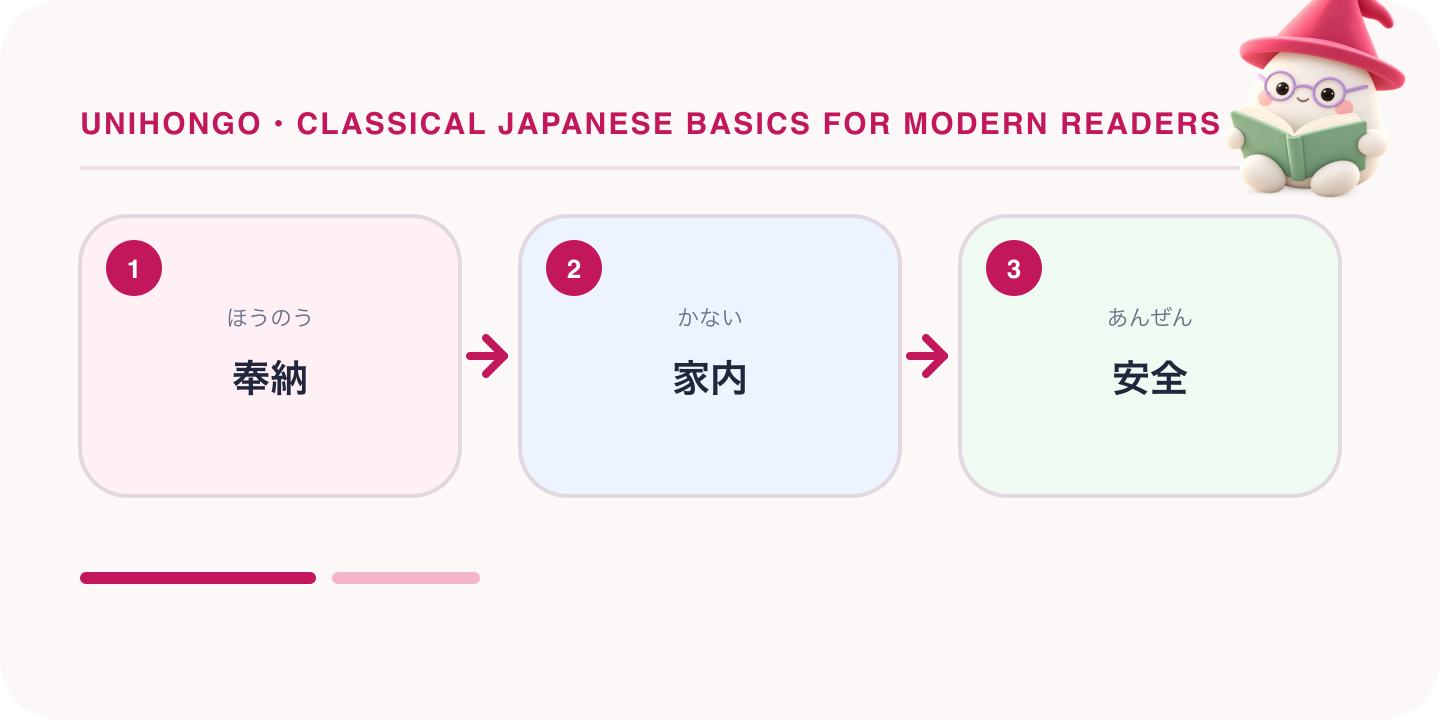
You are far more likely to meet four words of bungo than four pages of it. Temple and shrine boards, votive tablets, wooden pillars beside a gate, proverb calligraphy in a restaurant, the title of a traditional song, the motto on a school crest, an old station sign, and a chapter epigraph in a novel are all short texts written in the older style. Learning to read them is a matter of recognising a handful of endings, not of building a second grammar.
| Japanese | Romaji | Meaning |
|---|---|---|
| 奉納 | Hōnō | Dedicated as an offering, seen on votive items |
| 家内安全 | Kanai anzen | Safety for the household |
| 交通安全 | Kōtsū anzen | Road safety |
| 無病息災 | Mubyō sokusai | Good health and freedom from illness |
| 二礼二拍手一礼 | Nirei nihakushu ichirei | Two bows, two claps, one bow |
| 手水舎 | Chōzuya | The pavilion with the purification basin |
- Shrine and temple inscriptions, prayer plaques, and the wording printed on a charm.
- Proverbs and set phrases, which preserve classical negatives and adjective endings intact.
- Waka and haiku, including the poems printed on museum labels and on New Year cards.
- Titles and refrains of traditional and school songs, which keep old spellings.
- Modern novels quoting older text, and the epigraphs publishers print before chapter one.
- Japanese school textbooks, where classical Japanese is a required subject called kobun.
These are compound nouns rather than sentences, which is the usual shape of an inscription. Read them as blocks of two kanji plus two kanji, work out each block, then join them. A board that adds a verb at the end will almost always add one of the forms in the next table, so the grammar you need for signage is small and repeats constantly.
The forms that do most of the work
| Classical | Reading | Modern equivalent | What it does |
|---|---|---|---|
| なり | nari | だ、である | Is, the plain copula |
| たり | tari | だ、である | Is, mostly after Sino-Japanese nouns |
| あり | ari | ある、いる | Exists, there is |
| き | ki | 〜た | Past the speaker witnessed |
| けり | keri | 〜た、〜たそうだ | Past recalled or heard, often narrative |
| つ、ぬ | tsu, nu | 〜た、〜てしまった | Completion of an action |
| む | mu, read n | 〜う、〜だろう | Will, shall, probably |
| べし | beshi | 〜べきだ、〜はずだ | Should, must, is bound to |
| ず | zu | 〜ない | Not |
| まじ | maji | 〜てはいけない | Must not, surely will not |
| ごとし | gotoshi | 〜のようだ | Like, as if |
| なし | nashi | ない | There is none |
| いと | ito | とても | Very |
| いふ | iu | 言う | To say |
| をかし | okashi | 趣がある | Charming, delightful, interesting |
| あはれなり | aware nari | しみじみとする | Moving, touching |
Read the middle column as a translation key rather than a rule. Classical auxiliaries carry shades that modern Japanese splits across several expressions, so けり can be a plain past in one line and a note of discovery in the next. For recognition purposes, mapping each form onto one modern equivalent is enough to get the sense of a short passage on the first pass.
Nari and tari, the classical copula
Where modern Japanese ends a sentence with だ or である, classical Japanese ends it with なり. The form came from に plus あり, which is why it behaves like a verb and takes its own endings: the attributive is なる and the negative is ならず. Its partner たり attaches mostly to nouns of Chinese origin and gives the attributive たる. Both are alive in modern Japanese inside fixed expressions, which is the easiest way to remember them.
| Japanese | Romaji | Meaning |
|---|---|---|
| これは我が家なり。 | Kore wa waga ie nari. | This is my house. |
| 静かなり。 | Shizuka nari. | It is quiet. |
| 情けは人の為ならず。 | Nasake wa hito no tame narazu. | Kindness is never wasted on the other person alone. |
| 聖なる夜 | Sei naru yoru | A holy night, using the classical attributive naru |
| 堂々たる姿 | Dōdō taru sugata | A dignified figure, using the classical attributive taru |
| 幸いなるかな。 | Saiwai naru kana. | How fortunate it is. |
Ki and keri, two kinds of past
Classical Japanese does not use one past-tense ending. き marks a past the speaker experienced directly, and its attributive form is し, which is why you still see 過ぎにし日 for days gone by. けり narrates a past the speaker did not witness, or marks the moment of noticing something, and its attributive is ける. Story openings therefore tend to end in けり, because the narrator is reporting rather than remembering.
This distinction is worth knowing because it changes the flavour of a sentence rather than its timing. A line ending in けり often reads as once upon a time, or as a quiet realisation. A line ending in き reads as I saw this. Modern Japanese collapses both into 〜た, so a translation loses the difference that the original form is carrying.
| Japanese | Romaji | Meaning |
|---|---|---|
| 今は昔、竹取の翁といふものありけり。 | Ima wa mukashi, taketori no okina to iu mono arikeri. | Long ago there lived a man known as the old bamboo cutter. |
| 昔、男ありけり。 | Mukashi, otoko arikeri. | Long ago, there was a man. |
| 我が見し人 | Waga mishi hito | The person I saw, using shi, the attributive of ki |
| 過ぎにし日 | Suginishi hi | Days that have gone by |
The opening of Taketori Monogatari is the line most Japanese readers can recite, and it packs three classical features into eleven syllables: the topic marker は read wa, the verb いふ read iu, and the narrative past けり. If you can decode that one sentence you can decode most story openings written in the same register.
Zu and beshi, the two you already half know
The classical negative is ず, and its attributive form is ぬ. That single fact explains a whole shelf of modern expressions: 知らぬ, 言わぬ, 見ざる, 開かずの踏切. The obligation auxiliary べし survives even more openly, since modern Japanese still says するべきだ and 〜べからず on warning signs. Once you can see these two forms, proverbs stop looking like a special vocabulary and start looking like ordinary sentences with older endings.
| Japanese | Romaji | Meaning |
|---|---|---|
| 初心忘るべからず。 | Shoshin wasuru bekarazu. | Never forget the mind you began with. |
| 注意すべし。 | Chūi subeshi. | One should take care. |
| 知らぬが仏。 | Shiranu ga hotoke. | What you do not know cannot trouble you. |
| 言わぬが花。 | Iwanu ga hana. | Some things are better left unsaid. |
| 井の中の蛙大海を知らず。 | I no naka no kawazu taikai o shirazu. | A frog in a well knows nothing of the open sea. |
| 見ざる聞かざる言わざる | Mizaru kikazaru iwazaru | See not, hear not, speak not. |
| 光陰矢の如し。 | Kōin ya no gotoshi. | Time passes as swiftly as an arrow. |
| 過ぎたるは猶及ばざるが如し。 | Sugitaru wa nao oyobazaru ga gotoshi. | Too much is as bad as too little. |
The attributive form and why clauses end in -ki or -ru
Modern Japanese uses the same verb form to end a sentence and to modify a noun, so 行く can finish a sentence or introduce 行く道. Classical Japanese kept them apart. The conclusive form ends a sentence and the attributive form, the rentaikei, ends a clause that modifies a noun. Adjectives show it most clearly: 美し ends a sentence while 美しき modifies a noun. なり becomes なる, べし becomes べき, ず becomes ぬ, し becomes き.
This matters for reading because the attributive form is the signal that a noun is coming. When you see 静かなる, expect a noun immediately after it. When a passage seems to end in なる or き and no noun follows, look earlier in the sentence for one of the particles in the next section, because a particle can force the ending too.
| Japanese | Romaji | Meaning |
|---|---|---|
| 美しき花 | Utsukushiki hana | Beautiful flowers |
| 名もなき人 | Na mo naki hito | A person with no name |
| 静かなる海 | Shizuka naru umi | A quiet sea |
| 行くべき道 | Iku beki michi | The road one ought to take |
| 亡き友 | Naki tomo | A friend who has died |
Kakari-musubi, when a particle changes the ending
Classical Japanese has a rule with no modern equivalent. If one of five particles appears in the middle of a sentence, the sentence must end in a specific form instead of the ordinary conclusive one. ぞ, なむ, や and か force the attributive ending. こそ forces the realis form, the izenkei, which for なり is なれ and for けり is けれ. The Japanese name for the pattern, kakari-musubi, simply means the binding particle and the ending that answers it.
| Japanese | Romaji | Meaning |
|---|---|---|
| 好きこそ物の上手なれ。 | Suki koso mono no jōzu nare. | You become skilled at what you love. |
| 花ぞ美しき。 | Hana zo utsukushiki. | It is the flowers that are beautiful. |
| 名をば、さぬきのみやつことなむいひける。 | Na o ba, Sanuki no Miyatsuko to namu iikeru. | His name was Sanuki no Miyatsuko. |
| 月やあらぬ | Tsuki ya aranu | Is this not the same moon? |
| Particle | Force | Ending it requires | Example |
|---|---|---|---|
| ぞ zo | Strong emphasis | Attributive | 花ぞ美しき |
| なむ namu | Softer emphasis | Attributive | となむいひける |
| や ya | Question or rhetorical doubt | Attributive | 月やあらぬ |
| か ka | Question | Attributive | いづれか良き |
| こそ koso | Strongest emphasis, often contrastive | Realis | 上手なれ |
The practical use of this rule is diagnostic. If a sentence ends in an unexpected form, scan backwards for one of the five particles and the ending stops being a puzzle. It also explains the modern proverb 好きこそ物の上手なれ, which learners often mishear as なり: the ending is なれ precisely because こそ appears earlier in the line.
Historical kana spelling
Old text spells words the way they were pronounced long before the modern reader met them, and the spelling was only standardised on modern pronunciation after the war. The rules for reading it aloud are regular. Inside or at the end of a word, は, ひ, ふ, へ and ほ are read wa, i, u, e and o. The kana ゐ and ゑ are read i and e, and を is read o. Vowel sequences contract: au becomes ō, iu becomes yū, and eu becomes yō.
| Old spelling | Read as | Modern spelling | Meaning |
|---|---|---|---|
| かは | kawa | かわ 川 | River |
| こひ | koi | こい 恋 | Love |
| うへ | ue | うえ 上 | Above |
| いふ | iu | いう 言う | To say |
| けふ | kyō | きょう 今日 | Today |
| てふ | chō | ちょう 蝶 | Butterfly |
| やうやう | yōyō | ようよう | Gradually |
| ゐる | iru | いる 居る | To be, to sit |
| こゑ | koe | こえ 声 | Voice |
| をとこ | otoko | おとこ 男 | Man |
| 〜む | n | 〜う | Shall, will, the volitional ending |
| ぢ、づ | ji, zu | じ、ず | The same sounds as ji and zu |
Note that the rule applies inside words, not at the start. 花 is still hana and 人 is still hito. The exception you already use every day is the topic particle は, which is a word-initial は kept in the old spelling because it was originally attached to the phrase before it. へ as a direction particle is the same kind of survival.
Famous openings, read slowly
| Japanese | Romaji | Meaning |
|---|---|---|
| 春はあけぼの。 | Haru wa akebono. | In spring, the dawn. |
| 祇園精舎の鐘の声、諸行無常の響きあり。 | Gion shōja no kane no koe, shogyō mujō no hibiki ari. | The bell of the Gion temple sounds the passing of all things. |
| ゆく河の流れは絶えずして、 | Yuku kawa no nagare wa taezu shite, | The flow of the river never ceases, |
| もとの水にあらず。 | Moto no mizu ni arazu. | and yet the water is never the same water. |
| つれづれなるままに | Tsurezure naru mama ni | With nothing in particular to do |
These are the opening lines of Makura no Sōshi, Heike Monogatari, Hōjōki and Tsurezuregusa, and Japanese readers know them the way English readers know a handful of first sentences. Each one is a small grammar lesson. あり is the classical existence verb, あらず is the same verb negated, なる is the attributive of なり, and 絶えずして is the negative ず joined to the next clause.
Read them aloud rather than parsing them silently. The rhythm is part of why they are remembered, and reading with the old spellings pronounced correctly trains your ear for the endings faster than translation does.
A reading routine that builds recognition
- Keep a one-page card with なり, けり, き, ず, べし, む and ごとし and their modern equivalents; look at it before every attempt.
- Photograph inscriptions and signs on trips, then decode them in blocks of two kanji before reaching for a dictionary.
- When a sentence ends oddly, check for ぞ, なむ, や, か or こそ earlier in the line before assuming you misread the verb.
- Read old spellings aloud with modern pronunciation rules so けふ leaves your mouth as kyō, not as kefu.
- Rewrite each classical line you decode as one plain modern sentence, then say the modern version from memory.
- Do not try to compose bungo. Recognition is the useful skill; production belongs to specialists.