

Yen, money and paying
円, en, is the yen and also a circle, so 円 has a kun reading marui, round, that you will meet in 円い, a round shape. Prices in shops are written with the number followed by 円, and the number itself may be Arabic numerals or kanji: 1,500円 and 千五百円 are the same sen gohyaku-en. 金, kane, is money and gold, on reading kin, and with the polite o- it becomes o-kane, the everyday word for money. 金曜日, kin'yōbi, Friday, is gold day, and 料金, ryōkin, is a fee or charge, the word on car parks and utility bills.
払, harau, is to pay, on reading futsu, and it lives in 支払い, shiharai, payment, which you will read above the card reader as お支払い方法, o-shiharai hōhō, payment method. 料, ryō, is a fee and never stands alone; 料金 is a charge, 送料, sōryō, is postage and 手数料, tesūryō, is a handling fee, the small extra on a ticket or a bank transfer. 無, mu, means nothing, and with 料 it gives 無料, muryō, free, while 有料, yūryō, is the paid version.
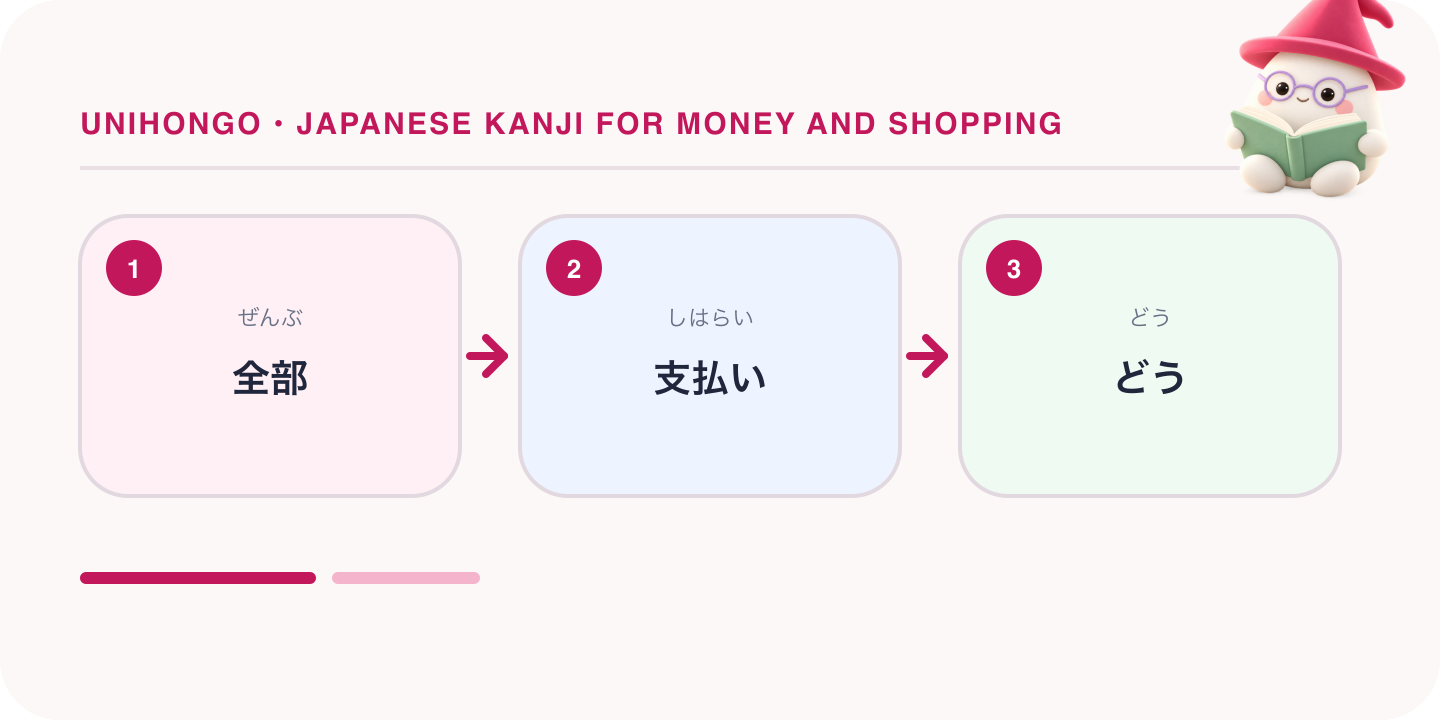
| Japanese | Romaji | Meaning |
|---|---|---|
| 全部で千五百円です。 | Zenbu de sen gohyaku-en desu. | That is one thousand five hundred yen in total. |
| お支払いはどうなさいますか。 | O-shiharai wa dō nasaimasu ka. | How would you like to pay? |
| カードで払います。 | Kādo de haraimasu. | I will pay by card. |
| 送料は無料ですか。 | Sōryō wa muryō desu ka. | Is postage free? |
| 駐車場は有料です。 | Chūshajō wa yūryō desu. | The car park is paid. |
Cheap, expensive and the kanji for price
安, yasui, is cheap, and its on reading an means peace, as in 安心, anshin, relief, and 安全, anzen, safety, so the kanji covers both a bargain and a calm mind. 高, takai, is expensive or tall, on reading kō in 高級, kōkyū, high class, and 最高, saikō, the best. A shop that calls itself 激安, gekiyasu, is promising extreme cheapness, and 高い is what you mutter when it is not.
値, ne, is price in compounds such as 値段, nedan, price, 値上げ, neage, a price rise, and 値下げ, nesage, a price cut. 段, dan, is a step or grade, so a nedan is the level at which something sits. 価格, kakaku, is the formal word for price on official labels, but 値段 is what people say. 額, gaku, is an amount, on the tag as 金額, kingaku, sum, and 半額, hangaku, half price. 半, han, is half, and 半分, hanbun, is the everyday word for a half.
| Japanese | Romaji | Meaning |
|---|---|---|
| これは安いですね。 | Kore wa yasui desu ne. | This is cheap, isn't it? |
| ちょっと高いです。 | Chotto takai desu. | It is a bit expensive. |
| 値段を教えてください。 | Nedan o oshiete kudasai. | Please tell me the price. |
| 来月から値上げだそうです。 | Raigetsu kara neage da sō desu. | I hear prices go up from next month. |
| お弁当が半額になっています。 | O-bentō ga hangaku ni natte imasu. | The bento boxes have gone half price. |
Money and price kanji at a glance
The first table collects the kanji for money, paying and price. The word in the meaning column is the one you will most often read on a tag or a sign.
| Kanji | Reading | Meaning |
|---|---|---|
| 円 | on: en; kun: maru(i) | Yen, circle; 千円 sen-en, one thousand yen |
| 金 | on: kin, kon; kun: kane | Money, gold; 料金 ryōkin, fee |
| 払 | on: futsu; kun: hara(u) | Pay; 支払い shiharai, payment |
| 料 | on: ryō | Fee, material; 送料 sōryō, postage |
| 無 | on: mu, bu; kun: na(i) | Nothing; 無料 muryō, free of charge |
| 安 | on: an; kun: yasu(i) | Cheap, peaceful; 激安 gekiyasu, extremely cheap |
| 高 | on: kō; kun: taka(i) | Expensive, high; 高級 kōkyū, high class |
| 値 | on: chi; kun: ne, atai | Price, value; 値段 nedan, price |
| 段 | on: dan | Step, grade; 値段 nedan, price |
| 半 | on: han; kun: naka(ba) | Half; 半額 hangaku, half price |
| 額 | on: gaku; kun: hitai | Amount, frame; 金額 kingaku, sum of money |
Almost every word here uses on readings, the vocabulary of commerce and paperwork. The exceptions are 安い, 高い and 払う, which keep their kun readings and are the words you actually say in a shop.
The three tax kanji
税, zei, is tax, and it never stands alone in everyday shop signs; 消費税, shōhizei, is consumption tax, the sales tax added to most purchases. Two kanji then tell you whether the tax is already in the number. 込, komu, means included and is one of the few kanji created in Japan with no on reading; 税込, zeikomi, is tax included, and you will also see it in 込み, komi, on menus and holiday prices. 抜, nuku, means to pull out, on reading batsu; 税抜, zeinuki, is tax excluded, and 抜き also appears on menus as わさび抜き, wasabi nuki, without wasabi.
Tax rates and rounding rules change over time and differ for take-away and eat-in food, so do not rely on a fixed figure; the tag's 税込 number is the one that counts. Most tags show the 税込 figure prominently, but some print the 税抜 figure larger with the 税込 total in small type beneath it, which is the trap to watch for.
| Japanese | Romaji | Meaning |
|---|---|---|
| この値段は税込ですか。 | Kono nedan wa zeikomi desu ka. | Is this price tax included? |
| 税抜で千円です。 | Zeinuki de sen-en desu. | It is one thousand yen before tax. |
| 消費税は別です。 | Shōhizei wa betsu desu. | Consumption tax is separate. |
| 店内でお召し上がりですか。 | Tennai de o-meshiagari desu ka. | Will you be eating in? |
Discounts, shops and goods
割, wari, is a tenth, and its on reading katsu appears in 分割, bunkatsu, instalments. 引, hiku, is to pull, on reading in, and 割引, waribiki, a discount, is literally pulling off tenths. 売, uru, is to sell, on reading bai, and 買, kau, is to buy, also bai, so 売買, baibai, is buying and selling. 店, mise, is a shop, on reading ten in 店員, ten'in, shop staff, and 店内, tennai, inside the shop. 品, shina, is goods, on reading hin in 商品, shōhin, merchandise, and 品切れ, shinagire, sold out.
| Japanese | Romaji | Meaning |
|---|---|---|
| 二割引になります。 | Niwaribiki ni narimasu. | That comes to twenty percent off. |
| この商品は売り切れです。 | Kono shōhin wa urikire desu. | This product is sold out. |
| 食品売り場は地下一階です。 | Shokuhin uriba wa chika ikkai desu. | The food floor is on basement level one. |
| 店員さんに聞いてみます。 | Ten'in-san ni kiite mimasu. | I will ask a member of staff. |
| Kanji | Reading | Meaning |
|---|---|---|
| 税 | on: zei | Tax; 消費税 shōhizei, consumption tax |
| 込 | kun: ko(mu), ko(meru) | Included; 税込 zeikomi, tax included |
| 抜 | on: batsu; kun: nu(ku) | Pull out, excluded; 税抜 zeinuki, tax excluded |
| 割 | on: katsu; kun: wa(ru), wari | Divide, tenth; 三割引 sanwaribiki, thirty percent off |
| 引 | on: in; kun: hi(ku) | Pull; 割引 waribiki, discount |
| 売 | on: bai; kun: u(ru) | Sell; 売り場 uriba, sales floor |
| 買 | on: bai; kun: ka(u) | Buy; 買い物 kaimono, shopping |
| 店 | on: ten; kun: mise | Shop; 店員 ten'in, shop staff |
| 品 | on: hin; kun: shina | Goods; 品切れ shinagire, sold out |
On the shelf you will read 特売, tokubai, special sale; 売り切れ, urikire, sold out; 新商品, shinshōhin, new product; 限定, gentei, limited; and 本日限り, honjitsu kagiri, today only. 割引 stickers show the tenths, 半額 shows half, and 値引き, nebiki, is a general price reduction. In a department store the floor guide uses 売り場, uriba, for each department, so 紳士服売り場, shinshifuku uriba, is menswear.
Where you meet these kanji every day
Shopping kanji cover every surface of a shop and most of your receipt, so one walk through a supermarket is a full review.
- Price tags: 円, 税込, 税抜, 本体価格 for the base price, and 特売 on the yellow ones
- Discount stickers: 三割引, 半額, 値引き and 見切り品 for reduced goods
- Shop signs and posters: 激安, 無料, 有料, 新商品, 限定, 本日限り
- The till: お支払い方法, 現金 cash, カード, ポイント, and 袋 for the bag question
- Receipts: 合計 total, 小計 subtotal, 消費税, お預かり amount tendered, お釣り change
- Vending machines and station kiosks: 料金, 販売中 on sale, 売切 sold out
- Department store floor guides: 売り場 after each department name
Keep one receipt and read it line by line: 合計, 小計, 消費税 and お釣り appear on every receipt in the country.
Look-alike kanji to watch
買 and 貝 are the classic pair: 貝, kai, is a shell, the ancient currency, and 買 puts a net on top, so buying is catching shells in a net. 売 is unrelated in shape despite being the opposite in meaning, and its own look-alike is 読, to read, which shares the right-hand side; 売り場 and 読書 will not appear in the same place, so context helps.
円 and 内, inside, differ at the top: 円 is a box with a vertical stroke, 内 has a person shape hanging from the top. 金 and 全, whole, differ by the two dots at the bottom of 金; 全品, zenpin, all items, is a common discount word, so 全品三割引 is all items thirty percent off, not gold. 安 and 女 differ by the roof. 高 and 京, capital, share a tall silhouette, but 高 has a box on top. 込 and 入 are both about going in, but only 込 has the road radical. 税 and 説, explain, share the right half, so read the left radical: grain for tax, speech for explaining.
| Japanese | Romaji | Meaning |
|---|---|---|
| 買うの字には網があります。 | Kau no ji ni wa ami ga arimasu. | The character for buy has a net on it. |
| 全品と金品は違います。 | Zenpin to kinpin wa chigaimasu. | All items and valuables are different words. |
| 税込と税抜を確認してください。 | Zeikomi to zeinuki o kakunin shite kudasai. | Please check whether it is tax included or excluded. |
A one-week study plan for shopping kanji
Learn these kanji from real tags. Write each character once by hand, say the reading and photograph one shelf strip or poster that uses it.
- Day 1: 円, 金, 払, 料, 無. Read five prices aloud including one above ten thousand yen.
- Day 2: 安, 高, 値, 段, 半, 額. Compare two tags and say which is cheaper and by how much.
- Day 3: 税, 込, 抜. Find a tag with both prices and say the tax-included total.
- Day 4: 割, 引. Read every discount sticker in a supermarket and work out the price.
- Day 5: 売, 買, 店, 品. Read a floor guide and find the sold-out and new product signs.
- Day 6: Look-alike pairs. Write 買 and 貝, 金 and 全, 税 and 説 side by side.
- Day 7: Review all 20 with Unihongo's free learning games, then read a receipt line by line.
For the spoken side, the related post on Japanese at the convenience store covers the questions the cashier asks. This post gives you the reading that tells you what you owe before anyone says it.