
What an AI Japanese teacher actually is
An AI Japanese teacher is a program that can hold a conversation with you in Japanese, understand what you say by voice or text, and give you feedback on it. The word teacher is doing a lot of work in that sentence. The tool does not plan a curriculum or remember your history unless it has been built to, but it reliably offers a partner that is always available, never tired, and willing to repeat the same exchange as often as you need.
The category is broad. At one end sits a general chatbot that you have asked to speak Japanese with you. At the other is a dedicated speaking tutor that listens to your voice, replies aloud, scores your pronunciation, adapts its difficulty, and writes a report after each session. Both are called AI teachers, but they teach differently, so it helps to understand the parts underneath before choosing.
How an AI Japanese teacher works behind the scenes
Most AI teachers are built from a handful of components working in sequence. You do not need to understand the engineering, but knowing roughly what each part does makes it much easier to tell whether a marketing claim describes a real feature or a rebranded chatbot, and to work out whether a strange correction came from the model itself or from a sentence it simply misheard.
- Speech recognition turns your voice into Japanese text; everything downstream depends on it hearing you correctly.
- A conversation model reads that text and generates a natural reply across several turns.
- A correction layer compares what you said with a more natural version and explains the difference.
- Pronunciation scoring measures sounds, pitch, and rhythm against expected patterns and flags the ones that drift.
- Level adaptation adjusts vocabulary, speed, and sentence length to how well you are coping.
- A session record keeps transcripts, corrections, and new vocabulary for later review.
Text-to-speech closes the loop by reading the reply aloud, ideally at a speed you can adjust. When every part works, the experience feels like talking to a patient tutor. When one component is weak, the whole lesson suffers: poor recognition produces corrections for sentences you never said, and a model with no level control drowns a beginner in keigo.
What an AI Japanese teacher teaches well
The strongest benefit is retrieval. Reading about a grammar point and producing it in a live conversation are different skills, and most learners have far more of the first than the second. An AI teacher makes you retrieve words and structures under mild time pressure, dozens of times a week, without the embarrassment of stumbling in front of a person. That volume of output is hard to get any other way.
It is also good at listening you can control: ask it to slow down, repeat, or simplify, and it does so without irritation. Corrections arrive while the sentence is still fresh, which is when they are easiest to absorb. Vocabulary appears in context, so if you learn yoyaku it is because the roleplay involved booking a table. Honest pronunciation feedback catches habits a textbook cannot hear, such as shortened long vowels.
What an AI teacher cannot do for you
An AI teacher has no cultural judgement of its own. It can tell you that a sentence is grammatical and even polite, but not whether your particular manager would find it presumptuous, or whether a joke lands in Osaka the way it does in Tokyo. Rare grammar, dialect, and very formal registers are areas where models sometimes sound confident and are simply wrong. Treat every surprising correction as something to confirm, not a verdict.
It also provides no accountability. A human teacher notices when you skip a week and asks why; an app just waits. Some learners find that freedom helpful, others drift. If you need external pressure, pair the AI with a class, a study partner, or a fixed calendar slot. The tool supplies practice on demand, but the habit has to come from you.
Phrases to say to an AI Japanese teacher
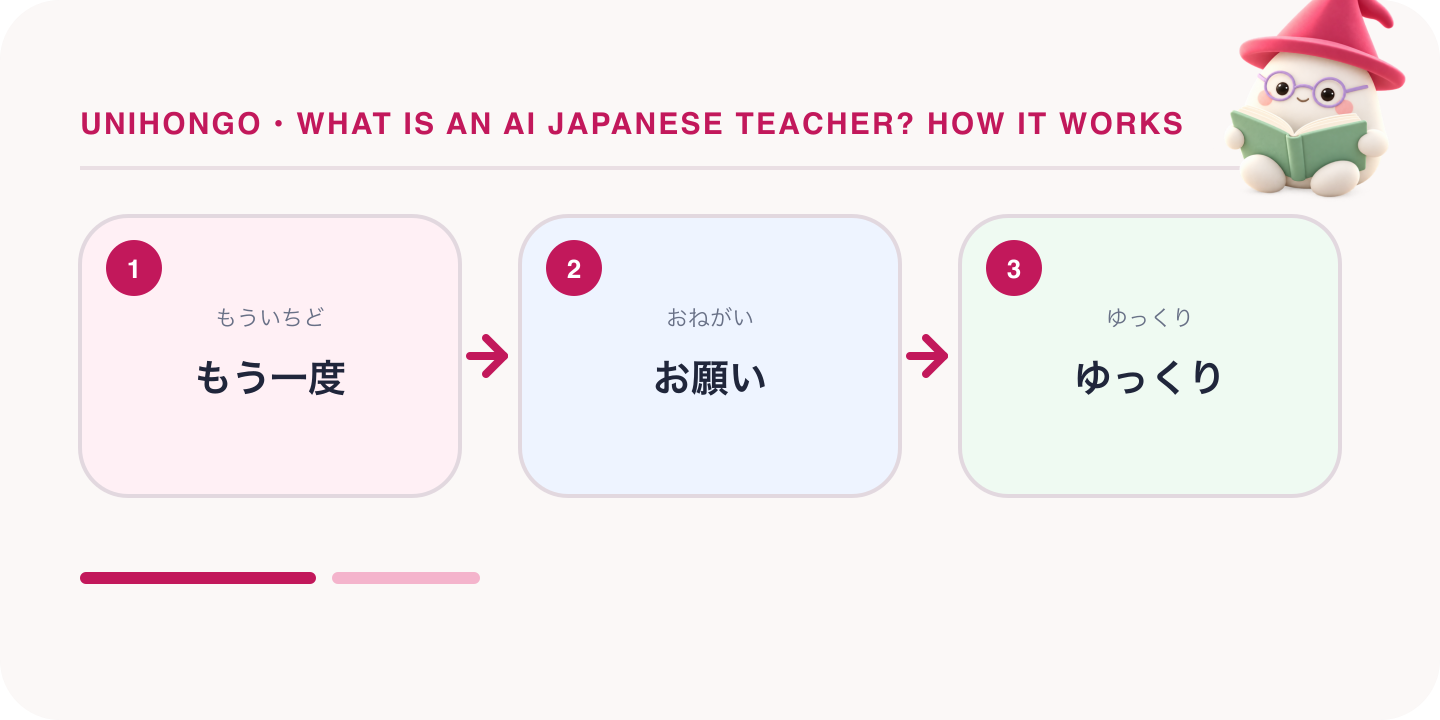
An underrated skill is steering the teacher in Japanese rather than switching to English whenever you are lost. These phrases keep the conversation in the target language, give you a way to recover when you do not understand, and model the kind of request you would make to a human tutor or a patient shop assistant. Say them aloud rather than typing them: the request itself is speaking practice, and the reply is listening practice. Naoshite kudasai is especially useful when you suspect something was off but the conversation moved on.
| Japanese | Romaji | Meaning |
|---|---|---|
| もう一度お願いします。 | Mō ichido onegaishimasu. | Once more, please. |
| ゆっくり話してください。 | Yukkuri hanashite kudasai. | Please speak slowly. |
| 簡単な日本語でお願いします。 | Kantan na Nihongo de onegaishimasu. | In simple Japanese, please. |
| それはどういう意味ですか。 | Sore wa dō iu imi desu ka. | What does that mean? |
| これは日本語で何と言いますか。 | Kore wa Nihongo de nan to iimasu ka. | How do you say this in Japanese? |
| 直してください。 | Naoshite kudasai. | Please correct me. |
| 続けましょう。 | Tsuzukemashō. | Let's continue. |
| もっと難しくしてください。 | Motto muzukashiku shite kudasai. | Please make it harder. |
What a first lesson usually looks like
A typical first session starts with a placement of some kind: a few questions about your level and goals, or a short conversation the teacher uses to gauge you. Answer honestly, in Japanese if you can. Then you choose a situation, for example a cafe order, and the teacher opens with a line such as irasshaimase, go-chuumon wa o-kimari desu ka. You reply aloud and the exchange continues for several turns.
Expect to be corrected, but not on everything. A well-designed teacher lets small slips pass while the conversation is moving and gathers them for the end, which is how a good human tutor behaves too. After about ten minutes you should see a transcript, the corrections, and a few new words. Read them while the conversation is fresh, and say the improved versions aloud before closing the app.
How to judge the quality of an AI Japanese teacher
- Recognition: does the transcript match what you said, including particles and long vowels?
- Corrections: does it explain why a sentence was wrong, or simply hand you a better one?
- Adaptation: when you ask for simpler Japanese, does it genuinely simplify?
- Speed: can you slow the spoken reply without it sounding unnatural?
- Memory: does it recall what you practised last time, or start from zero?
- Honesty: does it ever say a sentence was fine, or does it invent corrections to seem useful?
The last point matters more than it looks. A teacher that corrects everything teaches you nothing about which errors matter, and one that praises everything is a chat partner with a nicer interface. Run the same short conversation in two or three tools and compare the feedback; the differences are usually obvious within a quarter of an hour.
Who an AI Japanese teacher suits
It suits learners who already have some input from a class, a textbook, or a course app, and who need far more output than their schedule allows. It suits people who are nervous about speaking to strangers and want a private place to be clumsy first, and anyone preparing for a trip, a job interview, or a move to Japan, where the pressure is spoken and the deadline is real. It suits less well anyone who wants a complete curriculum handed to them.
For most learners the practical answer is both: a human teacher or class for direction and judgement, and an AI teacher such as Unihongo's AI Sensei for the daily roleplay missions, pronunciation coaching, and session reports that turn instruction into a habit. Neither replaces the other; together they cover far more of the week.