
What an AI flashcard maker does well
The hard part of flashcards was never reviewing; it was making the cards. Looking up each reading, choosing a meaning and writing an example sentence takes several minutes per word, so most learners make too few cards, or download someone else's deck full of words they will never use. An AI flashcard maker changes the economics. You can turn today's words into cards straight away, while the memory of where you met them is still fresh.
That speed is the real benefit: cards from your own life, made the same day. The trade-off is that you are now the editor rather than the author, and an editor has to read what they publish.
| Japanese | Romaji | Meaning |
|---|---|---|
| カードを作って! | Kādo o tsukutte! | Make me some cards! (casual) |
| 単語カード | tango kādo | word cards, flashcards |
| 例文 | reibun | example sentence |
The four parts of a good Japanese card
Japanese cards need more than a word and a translation, because the written form and the reading are separate things to learn. A strong card has four parts.
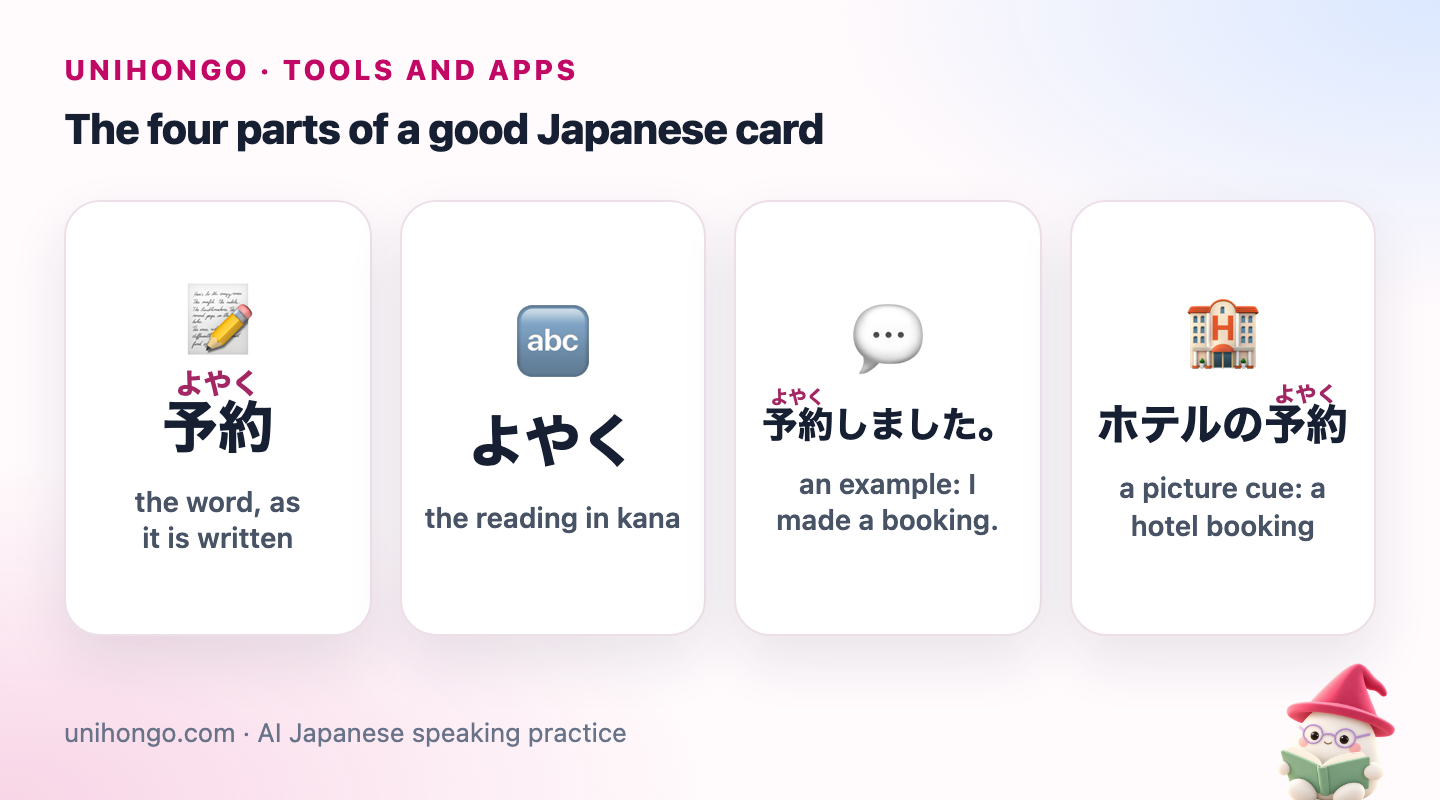
| Japanese | Romaji | Meaning |
|---|---|---|
| 予約 | yoyaku | the word, as it is written |
| よやく | yoyaku | the reading in kana |
| 予約しました。 | Yoyaku shimashita. | an example: I made a booking. |
| ホテルの予約 | hoteru no yoyaku | a picture cue: a hotel booking |
Keep the meaning to one sense per card. If a word has two common meanings, such as kakeru (to hang, to call on the phone, to sit, and more), make separate cards with separate examples. A card that lists five meanings tests whether you remember the list, not whether you understand the word.
The example should be short, at your level and something you might actually say. Yoyaku shimashita is a sentence you will use; a long newspaper-style example is not.
How to ask for cards that fit you
AI tools work much better with context. The same word can produce a beginner card or an advanced one depending on what you ask. These are the details worth including in your request.
- Your level: say beginner, around N4 or intermediate, so the examples use grammar you know.
- Where the words came from: a menu, a message from your landlord, a chat at work. The examples will match the situation.
- The register you need: polite desu and masu for most learners, casual if the words came from friends.
- One meaning per card, and the meaning that was used in your source.
- Readings in kana, not only romaji, so you practise reading as you review.
- A short note when a word is often used with a particle or verb, such as ni noru for getting on a train.
A good request sounds like this: make cards for these six words from a notice about garbage day, at beginner level, polite examples, one meaning each, with kana readings. That one sentence prevents most bad cards.
Check the AI's work: the errors to look for
AI tools make predictable kinds of mistakes with Japanese. Knowing them makes checking fast: you are not rereading every card, only looking at the risky spots.
| Japanese | Romaji | Meaning |
|---|---|---|
| 一日 | ichinichi | one day, a whole day |
| 一日 | tsuitachi | the first day of the month |
| 今日 | kyō | today |
| 大人 | otona | adult |
| 上手 | jōzu | skilful, good at |
| 三本 | sanbon | three (long, thin things) |
| What to check | Why it goes wrong | Quick fix |
|---|---|---|
| Readings of compounds | Some words change reading with meaning or context | Check in a dictionary when in doubt |
| Register of examples | Examples may be too casual or too formal for you | Ask for polite examples, or casual ones for friends |
| Naturalness | A sentence can be grammatical but not what people say | Ask whether a native speaker would say it |
| Meaning chosen | The tool may pick a different sense from your source | Paste the original sentence with the word |
| Counters and numbers | Counters change readings, such as ippon and sanbon | Check numbers with counters separately |
The two cards for 一日 show why readings matter. The kanji are the same, but ichinichi means one day or all day and tsuitachi means the first of the month. If a card shows only one reading without saying which meaning goes with it, fix it. Words like 今日, 大人 and 上手 have special readings that you cannot work out from the individual kanji, so they are worth a second look too.
Checking takes less time than it sounds. Read the card, read the example aloud, and ask one question: would I say this? If the answer is yes and the reading matches what you heard or read, keep it. If you are unsure, ask the tool to explain the card, or look the word up once in a dictionary. Two minutes of checking saves weeks of reviewing a mistake.
When a photo helps, and when it does not
A picture links a Japanese word directly to the thing it names, skipping the English translation. That is powerful for concrete words. Choose the picture yourself if you can: a photo that looks like the umbrella you actually own or the bike at your local station is easier to remember than a generic one.
Abstract words are different. A picture for enryo (holding back out of consideration) or natsukashii (nostalgic, bringing back fond memories) is usually vague, and you end up remembering the picture rather than the word. For these, a short example sentence from a real situation does the job better.
| Japanese | Romaji | Meaning |
|---|---|---|
| 傘 | kasa | umbrella: a photo works well |
| 自転車 | jitensha | bicycle: a photo works well |
| 遠慮 | enryo | holding back politely: use an example |
| 懐かしい | natsukashii | nostalgic: use an example |
| 遠慮しないでください。 | Enryo shinaide kudasai. | Please don't hold back. (help yourself) |
From a real morning to a small deck
The best decks come from real moments. Imagine a Saturday morning at a farmers' market in Japan. You chat with a stallholder, buy a vegetable you have never seen, and come home with five new words. That is the perfect batch: small, concrete, and tied to a memory.
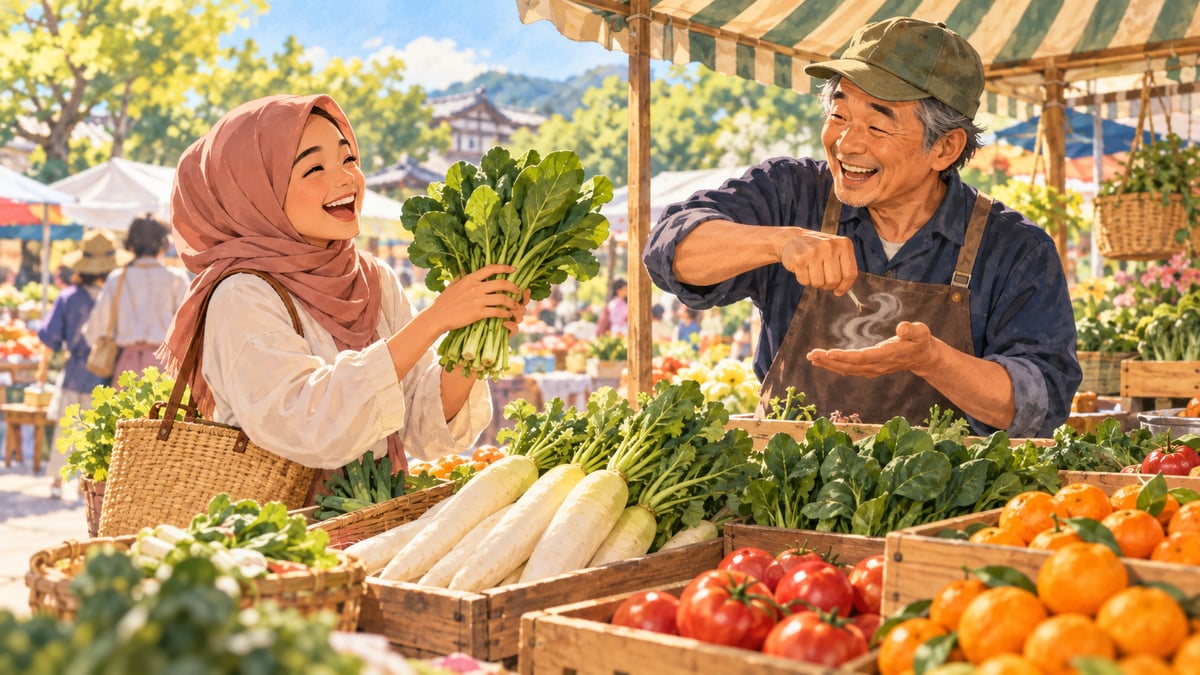
| Japanese | Romaji | Meaning |
|---|---|---|
| これは何ですか。 | Kore wa nan desu ka. | You: What is this? |
| 春菊です。鍋に入れるとおいしいですよ。 | Shungiku desu. Nabe ni ireru to oishii desu yo. | Farmer: It's shungiku. It's delicious in a hot pot. |
| じゃあ、一つください。 | Jā, hitotsu kudasai. | You: Then I'll take one, please. |
| 今が旬ですからね。おまけしておきます。 | Ima ga shun desu kara ne. Omake shite okimasu. | Farmer: It's in season now. I'll throw in a little extra. |
| ありがとうございます! | Arigatō gozaimasu! | You: Thank you! |
From this one exchange you get shungiku (crown daisy greens), nabe (hot pot), shun (in season) and omake (a little extra for free). Give the AI the dialogue itself, ask for cards for those four words with examples from the market, and pick your own photo of the greens you bought. You will remember the farmer every time the card comes up.
Common mistakes with AI flashcards
- Reviewing cards you never read. Check each new card once before it enters your deck.
- Making hundreds of cards at once. Small daily batches keep reviews under control.
- Accepting the first meaning. Make sure the card uses the meaning from your source.
- Romaji-only readings. Use kana so that reviewing also trains reading.
- Silent reviews. Saying the example aloud is what moves a word from recognition to speech.
Make and review your deck with Mocchi
Paste the market dialogue, or any text from your day, into Mocchi, type /create-flashcards and ask: "Cards for shungiku, nabe, shun and omake, beginner level, polite examples." Mocchi makes the cards for your Flash Card list and lets you pick a photo for each one. Ask it to explain any reading or example that looks odd before you keep the card.
Then use /review-flashcards: Mocchi reviews the deck with you using spaced repetition and brings back the cards you find hard sooner, while remembering which words keep slipping. For a change of pace, play Vocabulary Dash or Kotoba Stack with your own flashcards.