
Identify the object and the most useful distinguishing detail
Tell Mocchi the fictional object and the person you will speak with. Begin with the type of item, then choose a feature that helps identify it. Blue umbrella is more useful than something I had yesterday because it narrows the possibilities.
Use /vocab for a small describing-word set if needed. Attempt a short sentence yourself before requesting a model, so the feedback can address the words you can already retrieve.
| Japanese | Romaji | Meaning |
|---|---|---|
| 傘を忘れました。 | Kasa o wasuremashita. | I left my umbrella behind. |
| 青い傘です。 | Aoi kasa desu. | It is a blue umbrella. |
Connect the description with a word you can recall
Check the reading and meaning of 傘 in the sentence you need. Add one useful feature, such as size, only when it helps distinguish the item. A small set lets you practise the complete description instead of managing several new words at once.
Save a suitable card if the item or adjective fits your goals. During review, produce a description from a picture or a simple cue before looking at the answer. Recognition of the word alone does not show whether you can use it in the report.
Keep known information separate from a guess
You may remember the color clearly but be uncertain about where the umbrella was left. State that difference. Ask Mocchi to compare a definite location statement with an expression of uncertainty, then choose the one that matches your fictional situation.
Use a short quiz to check a changed account. The point is not to sound maximally confident; it is to communicate the information accurately enough for the other person to understand what is known and what remains uncertain.
| Japanese | Romaji | Meaning |
|---|---|---|
| 電車の中だと思います。 | Densha no naka da to omoimasu. | I think it was inside the train. |
Answer follow-up questions in AI Sensei practice
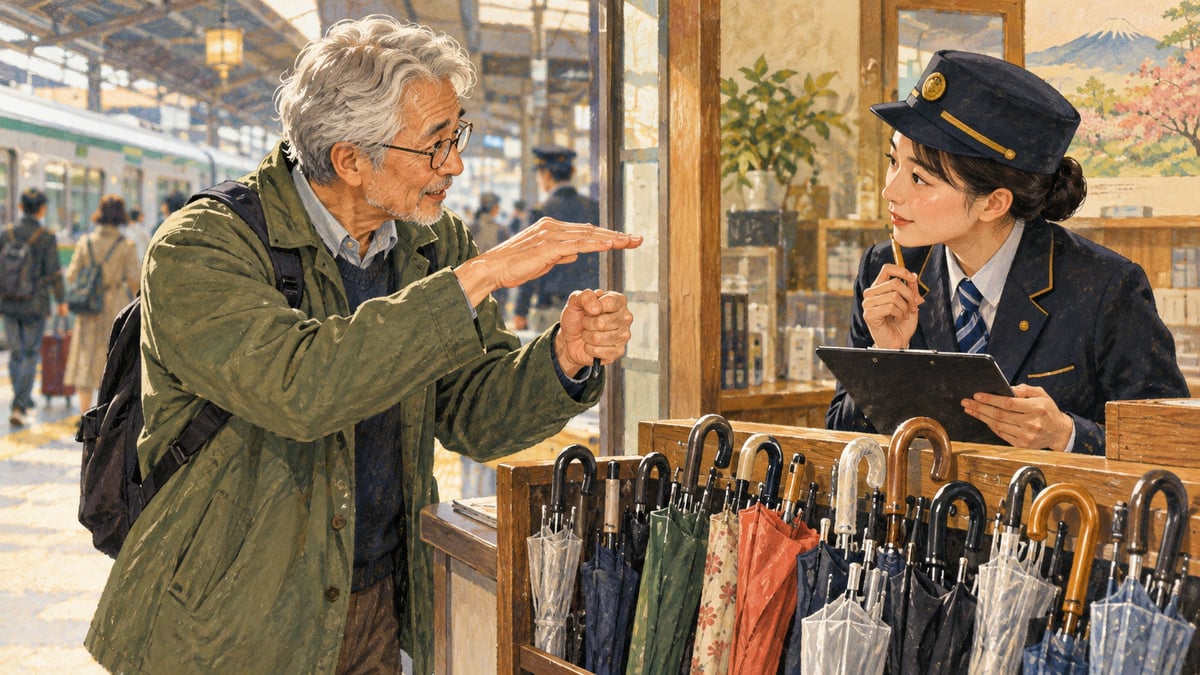
Prepare a lost-property situation with /kaiwa, then describe the umbrella in AI Sensei. Listen when the other speaker asks about a feature or time. Answer that question rather than repeating your entire prepared description.
If the question is unclear, ask for repetition. A complete exchange includes the other person’s attempt to identify the item, not only your opening report. Keep the model closed so you can notice which detail is difficult to retrieve.
| Japanese | Romaji | Meaning |
|---|---|---|
| どんな傘ですか。 | Donna kasa desu ka. | What kind of umbrella is it? |
| 大きい青い傘です。 | Ōkii aoi kasa desu. | It is a large blue umbrella. |
Check whether the proposed item actually matches
Ask Mocchi for two short fictional descriptions and decide which one fits your report. Explain the clue you used. If neither description matches, say what is different rather than choosing the closest option automatically.
Bring that distinction into another voice exchange. This connects reading and reasoning with a spoken confirmation. You may discover that the object vocabulary is easy but describing a mismatch needs a new sentence.
Review one difficulty and transfer the skill
Choose the detail that caused the most uncertainty and ask Mocchi for focused practice. A word may need a card, a sentence may need an explanation and a misunderstood question may need another listening-and-response attempt.
Later, describe a different fictional object, such as a bag or hat. The transferable skill is selecting useful details, expressing uncertainty and responding to questions. Unihongo’s study tools and AI Sensei can support those stages around the same practical goal.